

Inference-Based Cognitive Behavioral Therapy versus Cognitive Behavioral Therapy for Obsessive-Compulsive Disorder: A Multisite Randomized Controlled Non-Inferiority Trial
Open accessThe DOI matches its Crossref record; 32 of the 32 references it cites were found in a registry or an index.
Abstract
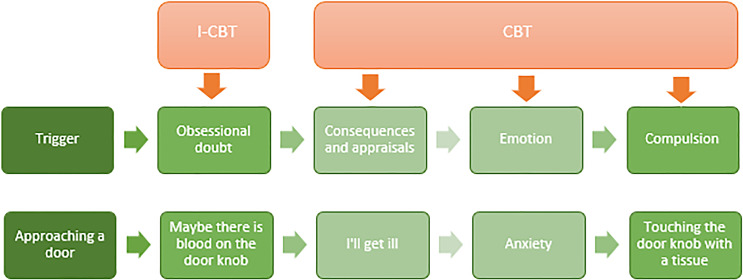
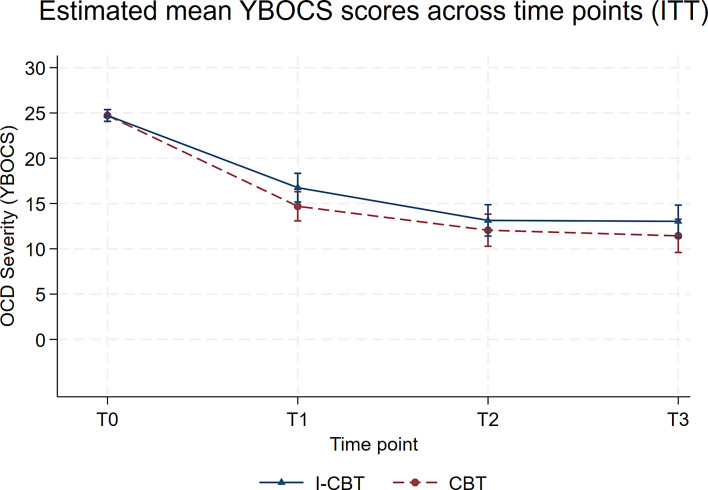
Introduction: Although cognitive behavioral therapy (CBT) effectively treats obsessive-compulsive disorder (OCD), many patients refuse CBT or drop out prematurely, partly because of anxiety regarding exposure and response prevention (ERP) exercises. Inference-based cognitive behavioral therapy (I-CBT) focuses on correcting distorted inferential thinking patterns, enhancing reality-based reasoning, and addressing obsessional doubt by targeting underlying dysfunctional reasoning, without incorporating an ERP component. We hypothesized that I-CBT would be non-inferior to CBT. Additionally, we hypothesized that I-CBT would be more tolerable than CBT. Methods: 197 participants were randomly assigned to 20 sessions CBT or I-CBT and assessed at baseline, posttreatment, and 6 and 12 months’ follow-up. The primary outcome was OCD symptom severity measured using the Yale-Brown Obsessive-Compulsive Scale (Y-BOCS; non-inferiority margin: 2 points). The secondary outcome, treatment tolerability, was assessed using the Treatment Acceptability/Adherence Scale (TAAS). A linear mixed-effects model was used to assess the non-inferiority of the primary outcome and superiority of secondary outcomes. Results: Statistically significant within-group improvements in the primary and secondary outcomes were observed in both treatments. No statistically significant between-group differences in Y-BOCS were found at any assessment point, but the confidence intervals exceeded the non-inferiority threshold, making the results inconclusive. The estimated mean posttreatment TAAS score was significantly higher in the I-CBT group than in the CBT group. Conclusion: While both CBT and I-CBT are effective for OCD, whether I-CBT is non-inferior to CBT in terms of OCD symptom severity remains inconclusive. Nevertheless, I-CBT offers better tolerability and warrants consideration as an alternative treatment for OCD.
Overview
The claims and statistics of this paper haven’t been checked yet.
Free: it reads the open-access text and checks the first 5 claims that cite a source we can check. Create a free account to check every claim.
Integrity signals
Registry
Cites
Statistics
Figures


Verification
Claims the paper makes
The claims and statistics of this paper haven’t been checked yet.
Free: it reads the open-access text and checks the first 5 claims that cite a source we can check. Create a free account to check every claim.
Self-check
Percentages, sums and reported differences re-computed from the paper’s own numbers.
The self-check needs the paper’s full text.
Citations
Cites
An inventory for measuring depression
BECK, A. T. (1961) · Archives of General Psychiatry · doi:10.1001/archpsyc.1961.01710120031004 · Cited by 38,032 · cited 1×
“The Beck Depression Inventory was used to assess the severity of depressive symptoms [29], and the Beck Anxiety Inventory was used to assess the severity of anxiety symptoms [30] (range: 0 – 63, with higher scores indicating greater severity).”
EuroQol: a new facility for the measurement of health-related quality of life
(1990) · Health Policy · doi:10.1016/0168-8510(90)90421-9 · Cited by 15,736
An inventory for measuring clinical anxiety: Psychometric properties.
Beck, A. T., Epstein, N., Brown, G., & Steer, R. A. (1988) · Journal of Consulting and Clinical Psychology · doi:10.1037/0022-006x.56.6.893 · Cited by 14,407 · cited 1×
“The Beck Depression Inventory was used to assess the severity of depressive symptoms [29], and the Beck Anxiety Inventory was used to assess the severity of anxiety symptoms [30] (range: 0 – 63, with higher scores indicating greater severity).”
The Yale-Brown Obsessive Compulsive Scale: II. Validity
Goodman, W. K. (1989) · Archives of General Psychiatry · doi:10.1001/archpsyc.1989.01810110054008 · Cited by 2,799
Piaggio, G., Elbourne, D. R., Pocock, S. J., Evans, S. J. W., Altman, D. G., & CONSORT Group, F. T. (2012) · JAMA · doi:10.1001/jama.2012.87802 · Cited by 2,428
Psychometric properties of the credibility/expectancy questionnaire
Devilly, G. J., & Borkovec, T. D. (2000) · Journal of Behavior Therapy and Experimental Psychiatry · doi:10.1016/s0005-7916(00)00012-4 · Cited by 2,295 · cited 1×
“The Credibility/Expectancy Questionnaire (CEQ) was used to assess treatment credibility (range 3 – 27) and expectancy (range 3 – 27) for improvement, with higher scores indicating greater credibility and expectancy [31].”
Olatunji, B. O., Davis, M. L., Powers, M. B., & Smits, J. A. J. (2013) · Journal of Psychiatric Research · doi:10.1016/j.jpsychires.2012.08.020 · Cited by 659
Öst, L.-G., Havnen, A., Hansen, B., & Kvale, G. (2015) · Clinical Psychology Review · doi:10.1016/j.cpr.2015.06.003 · Cited by 655 · cited 2×
“However, only 43 – 52% of patients achieve remission after treatment [8].”
InfluentialThrough the looking glass: understanding non-inferiority
Schumi, J., & Wittes, J. T. (2011) · Trials · doi:10.1186/1745-6215-12-106 · Cited by 445 · cited 1×
“If the upper limit of the two-sided 95% CI of the mean difference between treatments is less than the prespeci fi ed positive non-inferiority margin, non-inferiority is established with the associated alpha level [32].”
Psychological treatment of obsessive–compulsive disorder: A meta-analysis
Rosa-Alcázar, A. I., Sánchez-Meca, J., Gómez-Conesa, A., & Marín-Martínez, F. (2008) · Clinical Psychology Review · doi:10.1016/j.cpr.2008.07.001 · Cited by 444
Impact of obsessive-compulsive disorder on quality of life
Eisen, J. L., Mancebo, M. A., Pinto, A., Coles, M. E., Pagano, M. E., Stout, R., & Rasmussen, S. A. (2006) · Comprehensive Psychiatry · doi:10.1016/j.comppsych.2005.11.006 · Cited by 435
Mataix‐Cols, D., de la Cruz, L. F., Nordsletten, A. E., Lenhard, F., Isomura, K., & Simpson, H. B. (2016) · World Psychiatry · doi:10.1002/wps.20299 · Cited by 386
Including all individuals is not enough: Lessons for intention-to-treat analysis
White, I. R., Carpenter, J., & Horton, N. J. (2012) · Clinical Trials · doi:10.1177/1740774512450098 · Cited by 305 · cited 1×
“LMM analysis is able to address missing data resulting from dropout under the assumption that the missing data mechanism is missing at random [34].”
Neziroglu, F., McKay, D., Yaryura-Tobias, J. A., Stevens, K. P., & Todaro, J. (1999) · Behaviour Research and Therapy · doi:10.1016/s0005-7967(98)00191-0 · Cited by 169
Psychological treatments versus treatment as usual for obsessive compulsive disorder (OCD)
Gava, I., Barbui, C., Aguglia, E., Carlino, D., Churchill, R., De Vanna, M., & McGuire, H. (2007) · Cochrane Database of Systematic Reviews · doi:10.1002/14651858.cd005333.pub2 · Cited by 151 · cited 1×
“However, since treatment as usual (including usual care/ management, waiting list and no treatment) is largely ineffective for patients with OCD [39], this suggests that the improvements observed in both treatment groups during this study are unlikely to be due to the natural progression of OCD.”
Evaluation of an inference-based approach to treating obsessive–compulsive disorder
O'Connor, K. P., Aardema, F., Bouthillier, D., Fournier, S., Guay, S., Robillard, S., Pélissier, M. C., Landry, P., Todorov, C., Tremblay, M., et al. (2005) · Cognitive Behaviour Therapy · doi:10.1080/16506070510041211 · Cited by 109 · cited 7×
“A small RCT of 54 patients with OCD suggested similar outcomes for CBT and I-CBT [13].”
InfluentialThe treatment acceptability/adherence scale: Moving beyond the assessment of treatment effectiveness
Milosevic, I., Levy, H. C., Alcolado, G. M., & Radomsky, A. S. (2015) · Cognitive Behaviour Therapy · doi:10.1080/16506073.2015.1053407 · Cited by 107 · cited 1×
“The Treatment Acceptability/Adherence Scale (TAAS) was used to assess treatment tolerability [26].”
Patient Utilization of Cognitive-Behavioral Therapy for OCD
Mancebo, M. C., Eisen, J. L., Sibrava, N. J., Dyck, I. R., & Rasmussen, S. A. (2011) · Behavior Therapy · doi:10.1016/j.beth.2010.10.002 · Cited by 107 · cited 1×
“Mancebo et al. [12] reported that among those who discontinued CBT for OCD, fear and anxiety regarding CBT were reasons to refuse or terminate in more than 25% of cases.”
Obsessive-compulsive disorder; chronic versus non-chronic symptoms
Visser, H. A. D., van Oppen, P., van Megen, H. J. G. M., Eikelenboom, M., & van Balkom, A. J. L. M. (2013) · Journal of Affective Disorders · doi:10.1016/j.jad.2013.09.004 · Cited by 103
Self-citationLeeuwerik, T., Cavanagh, K., & Strauss, C. (2019) · Journal of Anxiety Disorders · doi:10.1016/j.janxdis.2019.102135 · Cited by 90 · cited 1×
“Although a de fi nitive relationship has not been established [10], this may contribute to drop-out and refusal rates, which occur in approximately 15% of cases [11].”
Çíçek, E., Çiçek, İ. E., Kayhan, F., Uğuz, F., & Kaya, N. (2013) · General Hospital Psychiatry · doi:10.1016/j.genhosppsych.2013.01.004 · Cited by 87
Falkenström, F., Markowitz, Jonker, H., Philips, B., & Holmqvist, R. (2013) · The Journal of Clinical Psychiatry · doi:10.4088/jcp.12r07848 · Cited by 78
Four-year course of quality of life and obsessive–compulsive disorder
Remmerswaal, K. C. P., Batelaan, N. M., Hoogendoorn, A. W., van der Wee, N. J. A., van Oppen, P., & van Balkom, A. J. L. M. (2020) · Social Psychiatry and Psychiatric Epidemiology · doi:10.1007/s00127-019-01779-7 · Cited by 62
Self-citationVisser, H. A., van Megen, H., van Oppen, P., Eikelenboom, M., Hoogendorn, A. W., Kaarsemaker, M., & van Balkom, A. J. (2015) · Psychotherapy and Psychosomatics · doi:10.1159/000382131 · Cited by 55 · cited 5×
“The latter is in line with previous studies [13, 16, 17]; nonetheless to gain a better understanding, we explored reasons for treatment dropout in both conditions.”
InfluentialSelf-citationInferential Confusion and Obsessive Beliefs in Obsessive‐Compulsive Disorder
Aardema, F., O'Connor, K. P., & Emmelkamp, P. M. G. (2006) · Cognitive Behaviour Therapy · doi:10.1080/16506070600621922 · Cited by 49 · cited 1×
“This obsessional doubt arises from “ inferential confusion ” [14, 15], a dysfunctional reasoning process that entails excessive reliance on imagination and possibilities rather than actual evidence or sensory input [13].”
An Inference-Based Approach to Treating Obsessive-Compulsive Disorders
O'Connor, K., Koszegi, N., Aardema, F., van Niekerk, J. V., & Taillon, A. (2009) · Cognitive and Behavioral Practice · doi:10.1016/j.cbpra.2009.05.001 · Cited by 43 · cited 1×
“In I-CBT, people learn to observe the invalid reasoning process of OCD, gaining insight into how their reasoning leads to doubting the actual state of affairs [19].”
Aardema, F., Bouchard, S., Koszycki, D., Lavoie, M. E., Audet, J., & O’Connor, K. P. (2022) · Psychotherapy and Psychosomatics · doi:10.1159/000524425 · Cited by 37
van Oppen, P., van Balkom, A. J. L. M., Smit, J. H., Schuurmans, J., van Dyck, R., & Emmelkamp, P. M. G. (2010) · The Journal of Clinical Psychiatry · doi:10.4088/jcp.08m04990blu · Cited by 36
Quality of life and relationship satisfaction of patients with Obsessive Compulsive Disorder
Remmerswaal, K. C. P., Batelaan, N. M., Smit, J. H., van Oppen, P., & van Balkom, A. J. L. M. (2016) · Journal of Obsessive-Compulsive and Related Disorders · doi:10.1016/j.jocrd.2016.08.005 · Cited by 32
Aardema, F., Connor, K. P. O., Delorme, M.-E., & Audet, J. (2017) · Clinical Psychology and Psychotherapy · doi:10.1002/cpp.2024 · Cited by 28
Baraby, L.-P., Wong, S., Radomsky, A. S., & Aardema, F. (2021) · Journal of Obsessive-Compulsive and Related Disorders · doi:10.1016/j.jocrd.2020.100593 · Cited by 21 · cited 1×
“This obsessional doubt arises from “ inferential confusion ” [14, 15], a dysfunctional reasoning process that entails excessive reliance on imagination and possibilities rather than actual evidence or sensory input [13].”
Spencer, S. D., Stiede, J. T., Wiese, A. D., Guzick, A. G., Cervin, M., McKay, D., & Storch, E. A. (2023) · Journal of Obsessive-Compulsive and Related Disorders · doi:10.1016/j.jocrd.2023.100805 · Cited by 18 · cited 1×
“Although a de fi nitive relationship has not been established [10], this may contribute to drop-out and refusal rates, which occur in approximately 15% of cases [11].”
Research works printed but not linked: 2
- 10.1037//0022-006x.56.6.893 · doi:10.1037//0022-006x.56.6.893 · Paper page
- 10.1002/cpp.2024 · DOI
Cited by
Management of obsessive-compulsive disorder in adults
Abramowitz, J. S., Abramovitch, A., McKay, D., & Draffin, A. (2026) · BMJ · doi:10.1136/bmj-2024-083443 · Cited by 11
“Another RCT with 197 patients compared I-CBT and ERP based CBT. 64 Both treatments produced large reductions in Y-BOCS scores at post-treatment (10.02 for ERP and 7.97 for I-CBT), with an effect size moderately favoring ERP (Cohen’s d=0.44, 95% CI −0.02 to 0.91).”
InfluentialVriend, C., Fitzsimmons, S., Aarts, I., Broekhuizen, A., van der Werf, Y. D., Douw, L., Visser, H. A. D., Thomaes, K., & van den Heuvel, O. A. (2025) · NeuroImage Clinical · doi:10.1016/j.nicl.2025.103870 · Cited by 3
Self-citationSwisher, V. S., & Newman, M. G. (2025) · Journal of Affective Disorders · doi:10.1016/j.jad.2025.120530 · Cited by 10
O’Keeffe, S. (2026) · Trials · doi:10.1186/s13063-026-09698-0
“Most commonly, studies reported locating outcome assessors and clinicians at different locations [35, 40, 42, 52, 62, 67, 69] and asked clinicians to refrain from discussing details of individual treatments with outcome assessors [35, 52, 62, 72].”
Sonneveldt, I. J., Wolf, N., van Balkom, A. J. L. M., van Enckevort, L., van Genugten, C., Kampman, M., van Oppen, P., van Straten, A., Toffolo, M. B. J., & Visser, H. A. D. (2025) · Journal of Obsessive-Compulsive and Related Disorders · doi:10.1016/j.jocrd.2025.100936 · Cited by 1
Self-citation
Metadata
- Authors
- Wolf, N., van Oppen, P., Hoogendoorn, A. W., van den Heuvel, O. A., van Megen, H. J. G. M., Broekhuizen, A., Kampman, M., Cath, D. C., Schruers, K. R. J., van Es, S. M., Opdam, T., van Balkom, A. J. L. M., & Visser, H. A. D.
- Affiliations
- GGz centraal (NL)
- Amsterdam Public Health (NL)
- Radboud University Nijmegen (NL)
- University Medical Center Groningen (NL)
- Maastricht University (NL)
- Lentis (NL)
- Amsterdam UMC Location University of Amsterdam (NL)
- Corresponding author
- Wolf, Nadja
- ORCID
- Venue
- Psychotherapy and Psychosomatics
- Publisher
- S. Karger AG
- Published
- 2024-10-18
- Volume
- 93
- Issue
- 6
- Pages
- 397-411
- ISSN
- 0033-3190 (ISSN-L)
- 1423-0348
- PMC
- PMC11614422
- OpenAlex
- W4403520297
- Cited by
- 15
- References
- 31
- Citations by year
- 2026: 9 · 2025: 6
- FWCI
- 7.49
- Type
- journal article
- Language
- en
- Open access
- hybrid
- doi.org
- Licence
- cc-by
- creativecommons.org/licenses/by/4.0/ (vor)
- creativecommons.org/licenses/by/4.0/ (tdm)
- Locations
- Psychotherapy and Psychosomatics (publishedVersion, cc-by)
- PubMed Central (publishedVersion, cc-by)
- PubMed (publishedVersion)
- Pure Amsterdam UMC (publishedVersion, cc-by)
- University of Groningen research database (University of Groningen / Centre for Information Technology) (acceptedVersion, other-oa)
- Radboud Repository (Radboud University) (submittedVersion)
- Research Publications (Maastricht University) (submittedVersion, cc-by)
- Funders
- ZonMw (636310004)
- Topics
- Social Sciences › Psychology › Clinical Psychology › Obsessive-Compulsive Spectrum Disorders
- Social Sciences › Psychology › Experimental and Cognitive Psychology › Anxiety, Depression, Psychometrics, Treatment, Cognitive Processes
- Social Sciences › Psychology › Applied Psychology › Digital Mental Health Interventions
- Keywords
- cognitive behavioral therapy, obsessive-compulsive disorder, exposure and response prevention, treatment tolerability, treatment acceptability, non-inferiority
- MeSH terms
- Adult, Female, Humans, Male, Middle Aged, Obsessive-Compulsive Disorder, Psychiatric Status Rating Scales, Severity of Illness Index, Cognitive Behavioral Therapy, Treatment Outcome
About these checks
Registry, retraction, Cites and statistics results are computed, not judged, with one exception: a printed reference that no index lists is read once by a model before it counts as a citation error. Claims are extracted by a model and kept only when their quote appears verbatim in the text; each cited source is then checked, with a model’s help, for whether it says what the claim relies on. Those verdicts can be wrong — read the claim’s quote and the cited source before relying on one.
Statistics and arithmetic are recomputed, not judged.
Confidence bands are shown only for fields calibrated on our annotated test set. None is calibrated yet, so no band is shown.
What counts as a claim ›How we measure confidence ›How we check this ›
Are you an author, or do you see a problem with this page? Request a review
Data sources
Bibliographic data: Semantic Scholar, OpenAlex, Crossref.
Contains information from the Semantic Scholar Academic Graph Datasets, made available under the ODC Attribution License (ODC-BY 1.0).
Semantic Scholar’s data is described in: Kinney, R., et al. (2023). The Semantic Scholar Open Data Platform. arXiv:2301.10140.
