

The DOI matches its Crossref record; 45 of the 45 references it cites were found in a registry or an index.
Long-term outcomes of catheter ablation of atrial fibrillation: a systematic review and meta-analysis
Open accessAbstract
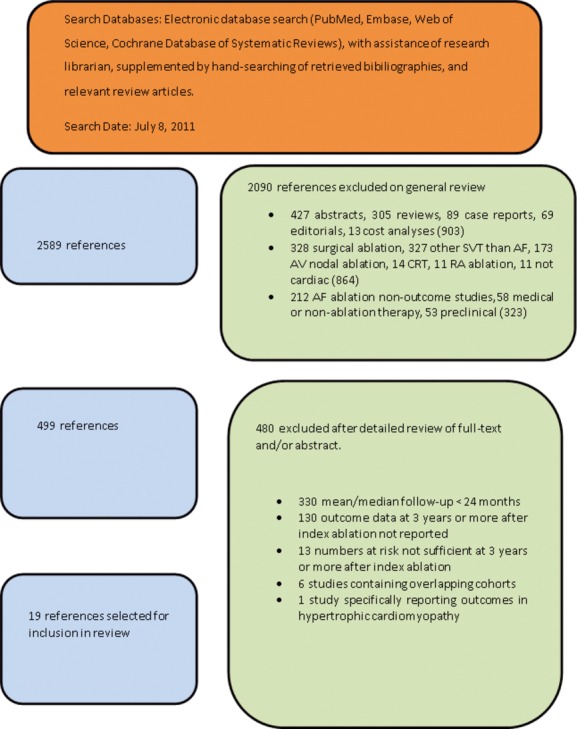
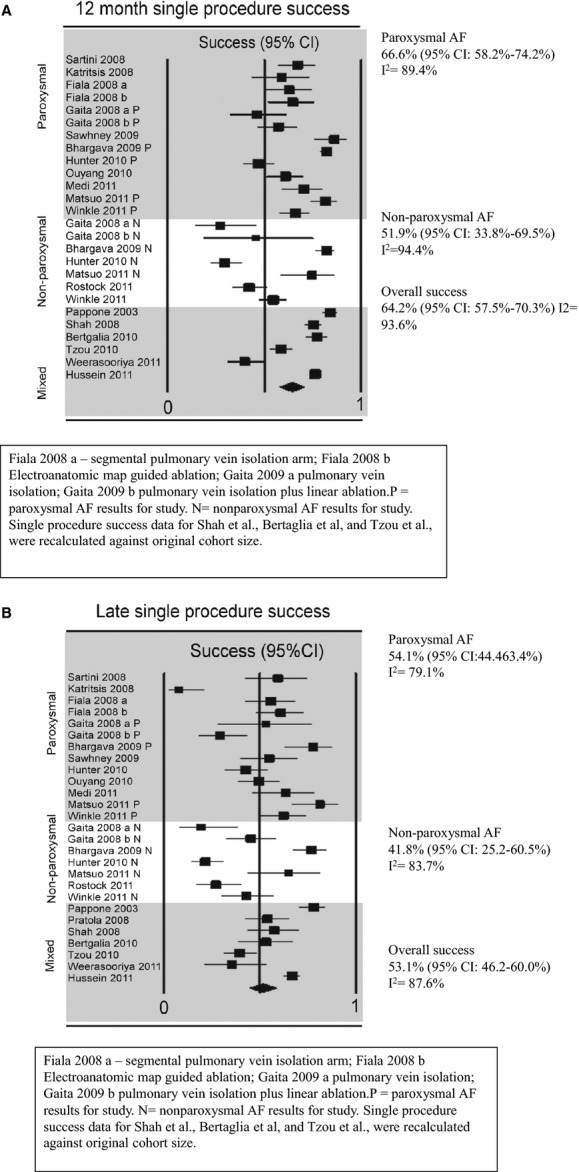
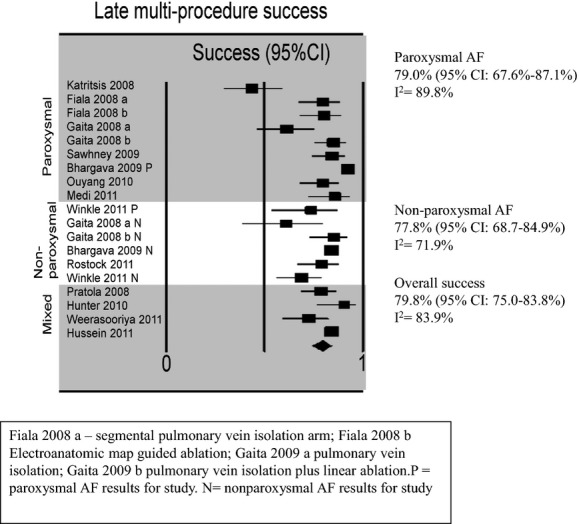
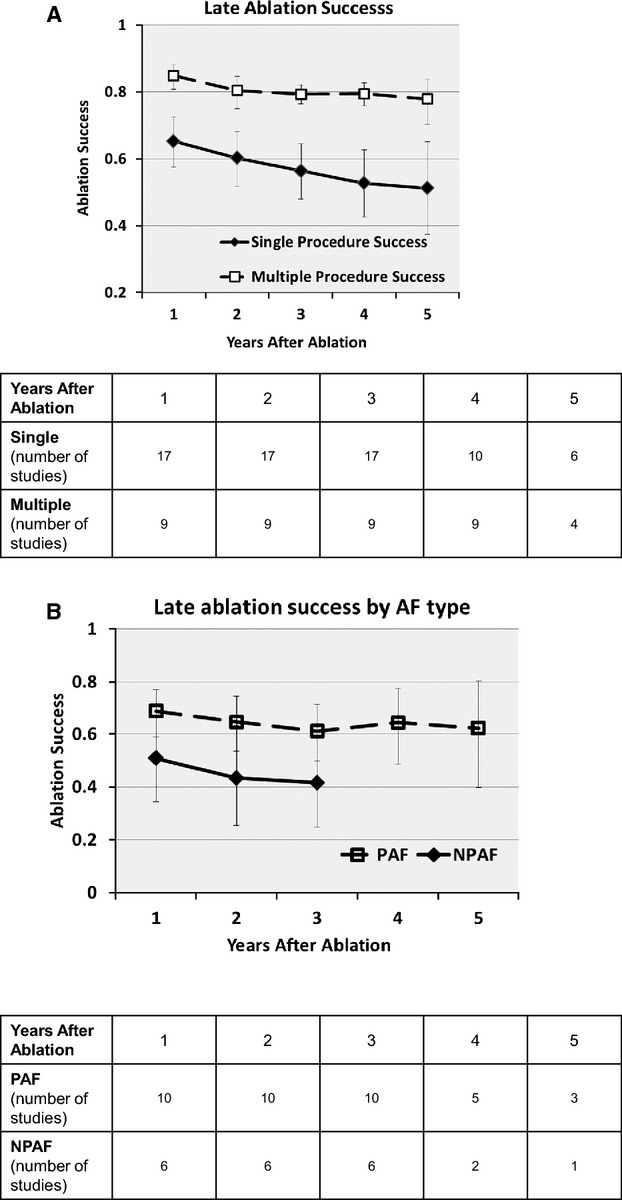
BACKGROUND: In the past decade, catheter ablation has become an established therapy for symptomatic atrial fibrillation (AF). Until very recently, few data have been available to guide the clinical community on the outcomes of AF ablation at ≥3 years of follow-up. We aimed to systematically review the medical literature to evaluate the long-term outcomes of AF ablation. METHODS AND RESULTS: A structured electronic database search (PubMed, Embase, Web of Science, Cochrane) of the scientific literature was performed for studies describing outcomes at ≥3 years after AF ablation, with a mean follow-up of ≥24 months after the index procedure. The following data were extracted: (1) single-procedure success, (2) multiple-procedure success, and (3) requirement for repeat procedures. Data were extracted from 19 studies, including 6167 patients undergoing AF ablation. Single-procedure freedom from atrial arrhythmia at long-term follow-up was 53.1% (95% CI 46.2% to 60.0%) overall, 54.1% (95% CI 44.4% to 63.4%) in paroxysmal AF, and 41.8% (95% CI 25.2% to 60.5%) in nonparoxysmal AF. Substantial heterogeneity (I(2)>50%) was noted for single-procedure outcomes. With multiple procedures, the long-term success rate was 79.8% (95% CI 75.0% to 83.8%) overall, with significant heterogeneity (I(2)>50%).The average number of procedures per patient was 1.51 (95% CI 1.36 to 1.67). CONCLUSIONS: Catheter ablation is an effective and durable long-term therapeutic strategy for some AF patients. Although significant heterogeneity is seen with single procedures, long-term freedom from atrial arrhythmia can be achieved in some patients, but multiple procedures may be required.
Overview
The claims and statistics of this paper haven’t been checked yet.
Run the check — free, no account needed. It reads the open-access text and checks the sources it cites.
Integrity signals
Registry
Cites
Statistics
Figures
Verification
Claims the paper makes
The claims and statistics of this paper haven’t been checked yet.
Run the check — free, no account needed. It reads the open-access text and checks the sources it cites.
Claims other papers make about this one
Each is checked against this paper’s own text: does it say what the citing paper says it does?
In the citing paper
“Sinus rhythm without severely symptomatic recurrences of AF is found in up to 70% of patients with paroxysmal AF, and around 50% in persistent AF. 713,728,735,1042”
From 2016 ESC Guidelines for the management of atrial fibrillation developed in collaboration with EACTS (2016) · cites this paper as [728]
In the citing paper
“Very late recurrence of AF after years of sinus rhythm is not uncommon and may reflect disease progression, with important implications for continuation of AF therapies.728”
From 2016 ESC Guidelines for the management of atrial fibrillation developed in collaboration with EACTS (2016) · cites this paper as [728]
In the citing paper
“Most patients require more than one procedure to achieve symptom control.713,726,728”
From 2016 ESC Guidelines for the management of atrial fibrillation developed in collaboration with EACTS (2016) · cites this paper as [728]
In the citing paper
“Very late recurrence of AF after years of sinus rhythm is not uncommon and may reflect disease progression, with important implications for continuation of AF therapies.728”
From 2016 ESC Guidelines for the management of atrial fibrillation developed in collaboration with EACTS (2016) · cites this paper as [728]
Self-check
Percentages, sums and reported differences re-computed from the paper’s own numbers.
The self-check needs the paper’s full text.
Citations
Cites
Meta-analysis in clinical trials
DerSimonian, R., & Laird, N. (1986) · Controlled Clinical Trials · doi:10.1016/0197-2456(86)90046-2 · Cited by 39,552 · cited 1×
“A pooled estimate of survival at 12months and the latest follow-upwas calculated, using random-effects models based on logit transformed proportions.(7) The time point of latest follow-up in a study was defined as the last time point reporting a minimum of 30 subjects at risk.”
MethodQuantifying heterogeneity in a meta‐analysis
Higgins, J. P. T., & Thompson, S. G. (2002) · Statistics in Medicine · doi:10.1002/sim.1186 · Cited by 36,763 · cited 1×
“Heterogeneity was assessed with the I(2) statistic, with 50% defined as the threshold for significant heterogeneity.(8) Subgroup analysis and random-effects metaregression were performed to explore possible reasons for heterogeneity of study outcomes.”
MethodDermyshi, E., Wang, Y., Yan, C., Hong, W., Qiu, G., Gong, X., & Zhang, T. (2017) · Neonatology · doi:10.1159/000454668 · Cited by 24,586
Meta-analysis of Observational Studies in Epidemiology<SUBTITLE>A Proposal for Reporting</SUBTITLE>
Stroup, D. F. (2000) · JAMA · doi:10.1001/jama.283.15.2008 · Cited by 20,623
Spontaneous initiation of atrial fibrillation by ectopic beats originating in the pulmonary veins.
Haïssaguerre, M., Jaïs, P., Shah, D. C., Takahashi, A., Hocini, M., Quiniou, G., Garrigue, S., Mouroux, A. L., Métayer, P. L., & Clémenty, J. (1998) · New England Journal of Medicine · doi:10.1056/nejm199809033391003 · Cited by 8,040 · cited 6×
“C atheter ablation of atrial fibrillation (AF) has become an established therapeutic modality for the treatment of patients with symptomatic AF.(1) To date, studies reporting outcomes of AF ablation have predominantly limited follow-up to 1 to 2 years after the index ablation procedure.”
BackgroundInfluentialGuidelines for the management of atrial fibrillation
Authors/Task Force Members, Camm, A. J., Kirchhof, P. F., Lip, G. Y. H., Schotten, U., Savelieva, I., Ernst, S., Gelder, I. C. V., Al‐Attar, N., Hindricks, G., et al. (2010) · European Heart Journal · doi:10.1093/eurheartj/ehq278 · Cited by 5,954
Cappato, R., Calkins, H., Chen, S.-A., Davies, W., Iesaka, Y., Kalman, J., Kim, Y.-H., Klein, G., Natale, A., Packer, D., et al. (2010) · Circulation Arrhythmia and Electrophysiology · doi:10.1161/circep.109.859116 · Cited by 2,852
Calkins, H., Kuck, K. H., Cappato, R., Brugada, J., Camm, A. J., Chen, S.-A., Crijns, H. J. G., Damiano, R. J., Davies, D. W., DiMarco, J., et al. (2012) · Europace · doi:10.1093/europace/eus027 · Cited by 2,722
Guidelines for the management of atrial fibrillation
Authors/Task Force Members, Camm, A. J., Kirchhof, P. F., Lip, G. Y. H., Schotten, U., Savelieva, I., Ernst, S., Gelder, I. C. V., Al‐Attar, N., Hindricks, G., et al. (2010) · EP Europace · doi:10.1093/europace/euq350 · Cited by 1,764
Calkins, H. G., Kück, K., Cappato, R., Brugada, J., Camm, A. J., Chen, S., Crijns, H. J. G. M., Damiano, R. J., Davies, D. W., Dimarco, J., et al. (2012) · Journal of Interventional Cardiac Electrophysiology · doi:10.1007/s10840-012-9672-7 · Cited by 1,685
Research works printed but not linked: 1
- Sartini RJ, Scanavacca MI, Sosa E, Moreira LF, Lara S, Hardy C, Darrieux F, Hachul D. Radiofrequency ablation of paroxysmal atrial fibrillation: factors determining long‐term clinical efficacy. Arq Bras Cardiol. 2008;90:112–118.
Cited by
Sorted by citations
Hindricks, G., Potpara, T., Dagres, N., Arbelo, E., Bax, J. J., Blomström‐Lundqvist, C., Boriani, G., Castella, M., Dan, G.-A., Dilaveris, P., et al. (2020) · European Heart Journal · doi:10.1093/eurheartj/ehaa612 · Cited by 10,550
2016 ESC Guidelines for the management of atrial fibrillation developed in collaboration with EACTS
Kirchhof, P. F., Benussi, S., Kotecha, D., Ahlsson, A., Atar, D., Casadei, B., Castellà, M., Diener, H., Heidbüchel, H., Hendriks, J., et al. (2016) · EP Europace · doi:10.1093/europace/euw295 · Cited by 6,438
2016 ESC Guidelines for the management of atrial fibrillation developed in collaboration with EACTS
Kirchhof, P., Benussi, S., Kotecha, D., Ahlsson, A., Atar, D., Casadei, B., Castella, M., Diener, H.-C., Heidbuchel, H., Hendriks, J., et al. (2016) · European Heart Journal · doi:10.1093/eurheartj/ehw210 · Cited by 6,418
“Most patients require more than one procedure to achieve symptom control.(713,726,728) In general, better rhythm outcome and lower procedure-related complications can be expected in younger patients with a short history of AF and frequent, short AF episodes in the absence of significant structural heart disease.”
InfluentialJoglar, J. A., Chung, M. K., Armbruster, A. L., Benjamin, E. J., Chyou, J. Y., Cronin, E. M., Deswal, A. M., Eckhardt, L. L., Goldberger, Z. D., Gopinathannair, R., et al. (2023) · Circulation · doi:10.1161/cir.0000000000001193 · Cited by 3,145
Calkins, H. G., Hindricks, G., Cappato, R., Kim, Y., Saad, E., Aguinaga, L., Akar, J. G., Badhwar, V., Brugada, J., Camm, A. J., et al. (2017) · Heart Rhythm · doi:10.1016/j.hrthm.2017.05.012 · Cited by 2,794
Metadata
- Authors
- Ganesan, A. N., Shipp, N. J., Brooks, A. G., Kuklik, P., Lau, D. H., Lim, H. S., Sullivan, T., Roberts‐Thomson, K. C., & Sanders, P.
- Affiliations
- Royal Adelaide Hospital (AU)
- Centre for Heart Rhythm Disorders (CHRD), University of Adelaide and Royal Adelaide Hospital, Adelaide, Australia
- Corresponding author
- Sanders, Prashanthan
- Venue
- Journal of the American Heart Association
- Published
- 2013-03-12
- Volume
- 2
- Issue
- 2
- Pages
- e004549-e004549
- ISSN
- 2047-9980 (ISSN-L)
- PMC
- PMC3647286
- OpenAlex
- W2165779304
- Cited by
- 800
- References
- 45
- Citations by year
- 2026: 43 · 2025: 36 · 2024: 62 · 2023: 61 · 2022: 63 · 2021: 65 · 2020: 76 · 2019: 77 · 2018: 74 · 2017: 75 · 2016: 60 · 2015: 53 · 2014: 43 · 2013: 11
- FWCI
- 9.52
- Type
- journal article
- Language
- en
- Open access
- gold
- doi.org
- Locations
- Journal of the American Heart Association (publishedVersion)
- Europe PMC (PubMed Central) (publishedVersion, cc-by)
- PubMed Central (publishedVersion, cc-by)
- PubMed (publishedVersion)
- Adelaide Research & Scholarship (AR&S) (University of Adelaide) (submittedVersion, other-oa)
- Minerva Access (University of Melbourne) (submittedVersion, cc-by)
- Topics
- Health Sciences › Medicine › Cardiology and Cardiovascular Medicine › Atrial Fibrillation Management and Outcomes
- Health Sciences › Medicine › Cardiology and Cardiovascular Medicine › Cardiac Arrhythmias and Treatments
- Health Sciences › Medicine › Cardiology and Cardiovascular Medicine › Cardiac pacing and defibrillation studies
- Keywords
- atrial fibrillation, catheter ablation, long-term outcomes, procedural success, repeat procedures, atrial arrhythmia recurrence, paroxysmal atrial fibrillation, non-paroxysmal atrial fibrillation
- MeSH terms
- Anti-Arrhythmia Agents, Atrial Fibrillation, Humans, Longitudinal Studies, Recurrence, Treatment Outcome, Catheter Ablation
About these checks
Registry, retraction, Cites and statistics results are computed, not judged, with one exception: a printed reference that no index lists is read once by a model before it counts as a citation error. Claims are extracted by a model and kept only when their quote appears verbatim in the text; each cited source is then checked, with a model’s help, for whether it says what the claim relies on. Those verdicts can be wrong — read the claim’s quote and the cited source before relying on one.
Statistics and arithmetic are recomputed, not judged.
Confidence bands are shown only for fields calibrated on our annotated test set. None is calibrated yet, so no band is shown.
What counts as a claim ›How we measure confidence ›How we check this ›
Are you an author, or do you see a problem with this page? Request a review
