

The DOI matches its Crossref record; 35 of the 35 references it cites were found in a registry or an index.
mActive: A Randomized Clinical Trial of an Automated mHealth Intervention for Physical Activity Promotion
Open accessAbstract
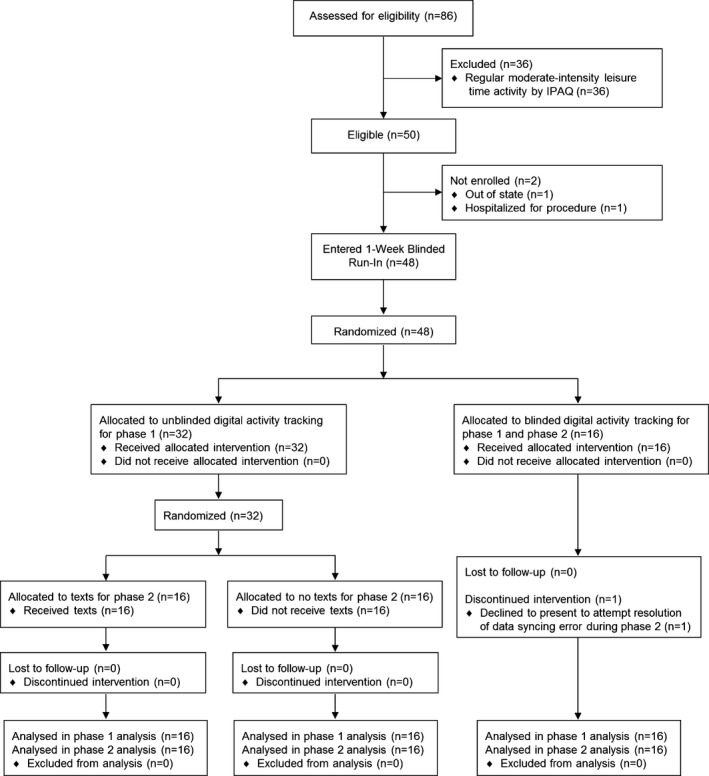
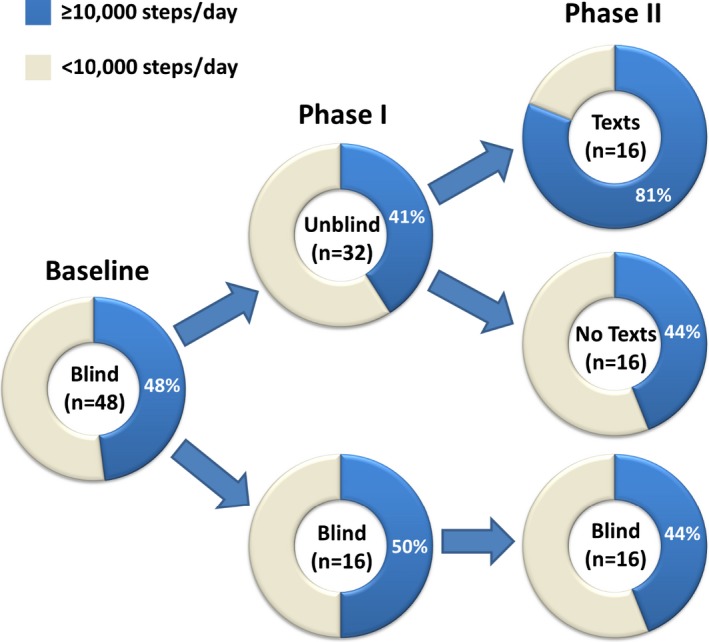
Background: We hypothesized that a fully automated mobile health ( mH ealth) intervention with tracking and texting components would increase physical activity. Methods and Results: mA ctive enrolled smartphone users aged 18 to 69 years at an ambulatory cardiology center in Baltimore, Maryland. We used sequential randomization to evaluate the intervention's 2 core components. After establishing baseline activity during a blinded run‐in (week 1), in phase I (weeks 2 to 3), we randomized 2:1 to unblinded versus blinded tracking. Unblinding allowed continuous access to activity data through a smartphone interface. In phase II (weeks 4 to 5), we randomized unblinded participants 1:1 to smart texts versus no texts. Smart texts provided smartphone‐delivered coaching 3 times/day aimed at individual encouragement and fostering feedback loops by a fully automated, physician‐written, theory‐based algorithm using real‐time activity data and 16 personal factors with a 10 000 steps/day goal. Forty‐eight outpatients (46% women, 21% nonwhite) enrolled with a mean± SD age of 58±8 years, body mass index of 31±6 kg/m 2 , and baseline activity of 9670±4350 steps/day. Daily activity data capture was 97.4%. The phase I change in activity was nonsignificantly higher in unblinded participants versus blinded controls by 1024 daily steps (95% confidence interval [ CI ], −580 to 2628; P =0.21). In phase II , participants receiving texts increased their daily steps over those not receiving texts by 2534 (95% CI , 1318 to 3750; P <0.001) and over blinded controls by 3376 (95% CI , 1951 to 4801; P <0.001). Conclusions: An automated tracking‐texting intervention increased physical activity with, but not without, the texting component. These results support new mH ealth tracking technologies as facilitators in need of behavior change drivers. Clinical Trial Registration: URL : http://ClinicalTrials.gov/ . Unique identifier: NCT01917812 .
Overview
The claims and statistics of this paper haven’t been checked yet.
Run the check — free, no account needed. It reads the open-access text and checks the sources it cites.
Integrity signals
Registry
Cites
Statistics
Figures
Verification
Claims the paper makes
The claims and statistics of this paper haven’t been checked yet.
Run the check — free, no account needed. It reads the open-access text and checks the sources it cites.
Claims other papers make about this one
Each is checked against this paper’s own text: does it say what the citing paper says it does?
The source backs part of the claim, not all of it — or backs it for a different population, condition or comparison.
In the citing paper
“In addition, 4 studies included either an unstructured follow-up phase [34,42] or additional intervention phase utilizing a nonblinded activity tracker for all participants [41,50].”
From Consumer-based wearable activity trackers increase physical activity participation: systematic review and meta-analysis (2019) · cites this paper as [41]
Experimental — accuracy not yet measuredThe cited source says what the claim attributes to it.
In the citing paper
“Furthermore, 17 studies specified that the participant must have regular access to the internet, a computer, tablet, and/or smartphone [21,30,33,35-37,39,41-47,51-53]”
From Consumer-based wearable activity trackers increase physical activity participation: systematic review and meta-analysis (2019) · cites this paper as [41]
The cited source says what the claim attributes to it.
In the citing paper
“Moreover, 17 studies reported activity tracker adherence data [21,22,30,32,34,35, 37,38,40,41,43-45,50-52,54], with 13 of these studies [21,22,30,34,35,40,41,43,44,50-52,54] reporting activity tracker wear on at least 50% of the study intervention days.”
From Consumer-based wearable activity trackers increase physical activity participation: systematic review and meta-analysis (2019) · cites this paper as [41]
In the citing paper
“PA interventions, including texting, gamification and social or financial incentives, can promote PA”
From Smart wearable devices in cardiovascular care: Where we are and how to move forward (2021) · cites this paper as [40]
In the citing paper
“The text messaging group increased their daily steps by 2,534 compared with the no-texting unblinded group and by 3,376 steps compared with blinded controls40.”
From Smart wearable devices in cardiovascular care: Where we are and how to move forward (2021) · cites this paper as [40]
In the citing paper
“Martin et al. [30] in the US found that an automated text message system increased physical activity to prevent cardiovascular diseases in phase 1 (weeks 2 to 3) and phase 2 (weeks 4 to 5), all P < 0.001.”
From Effective behavioral intervention strategies using mobile health applications for chronic disease management: a systematic review (2018) · cites this paper as [30]
In the citing paper
“Considering the method of randomization, 5 trials did not present details of randomization [25, 27, 29, 30, 33].”
From Effective behavioral intervention strategies using mobile health applications for chronic disease management: a systematic review (2018) · cites this paper as [30]
Self-check
Percentages, sums and reported differences re-computed from the paper’s own numbers.
The self-check needs the paper’s full text.
Citations
Cites
International physical activity questionnaire: 12-country reliability and validity
CRAIG, C. L., MARSHALL, A. L., SJ??STR??M, M., BAUMAN, A. E., BOOTH, M. L., AINSWORTH, B. E., PRATT, M., EKELUND, U., YNGVE, A., SALLIS, J. F., et al. (2003) · Medicine & Science in Sports & Exercise · doi:10.1249/01.mss.0000078924.61453.fb · Cited by 21,619
‘Small Changes' to Diet and Physical Activity Behaviors for Weight Management
Hills, A. P., Byrne, N. M., Lindstrom, R. C., & Hill, J. O. (2013) · Obesity Facts · doi:10.1159/000345030 · Cited by 9,526
Lloyd-Jones, D. M., Hong, Y., Labarthe, D., Mozaffarian, D., Appel, L. J., Van Horn, L., Greenlund, K., Daniels, S., Nichol, G., Tomaselli, G. F., et al. (2010) · Circulation · doi:10.1161/circulationaha.109.192703 · Cited by 4,750
Kodama, S. (2009) · JAMA · doi:10.1001/jama.2009.681 · Cited by 3,035
Eckel, R. H., Jakicic, J. M., Ard, J. D., de Jesus, J. M., Miller, N. H., Hubbard, V. S., Lee, I.-M., Lichtenstein, A. H., Loria, C. M., Millen, B. E., et al. (2014) · Circulation · doi:10.1161/01.cir.0000437740.48606.d1 · Cited by 2,261
Using Pedometers to Increase Physical Activity and Improve Health: A Systematic Review
Bravata, D. M., Smith-Spangler, C., Sundaram, V., Gienger, A. L., Lin, N., Lewis, R., Stave, C. D., Olkin, I., & Sirard, J. R. (2007) · JAMA · doi:10.1001/jama.298.19.2296 · Cited by 2,064
Eysenbach, G., & CONSORT-EHEALTH Group (2011) · Journal of Medical Internet Research · doi:10.2196/jmir.1923 · Cited by 1,863
Strath, S. J., Kaminsky, L. A., Ainsworth, B. E., Ekelund, U., Freedson, P. S., Gary, R. A., Richardson, C. R., Smith, D. T., & Swartz, A. M. (2013) · Circulation · doi:10.1161/01.cir.0000435708.67487.da · Cited by 1,029
Artinian, N. T., Fletcher, G. F., Mozaffarian, D., Kris-Etherton, P., Van Horn, L., Lichtenstein, A. H., Kumanyika, S., Kraus, W. E., Fleg, J. L., Redeker, N. S., et al. (2010) · Circulation · doi:10.1161/cir.0b013e3181e8edf1 · Cited by 919
Wearable Devices as Facilitators, Not Drivers, of Health Behavior Change
Patel, M. S., Asch, D. A., & Volpp, K. G. (2015) · JAMA · doi:10.1001/jama.2014.14781 · Cited by 808
Cited by
Sorted by citations
Smart wearable devices in cardiovascular care: Where we are and how to move forward
Bayoumy, K., Gaber, M., Elshafeey, A., Mhaimeed, O., Dineen, E. H., Marvel, F. A., Martin, S. S., Muse, E. D., Turakhia, M. P., Tarakji, K. G., et al. (2021) · Nature Reviews Cardiology · doi:10.1038/s41569-021-00522-7 · Cited by 829
Self-citationBrickwood, K.-J., Watson, G., O'Brien, J., & Williams, A. D. (2019) · JMIR mHealth and uHealth · doi:10.2196/11819 · Cited by 689
Sullivan, A. N., & Lachman, M. E. (2017) · Frontiers in Public Health · doi:10.3389/fpubh.2016.00289 · Cited by 458
Laranjo, L., Ding, D., Heleno, B., Kocaballi, B., Quiroz, J. C., Tong, H. L., Chahwan, B., Neves, A. L., Gabarron, E., Dao, K. P., et al. (2021) · British Journal of Sports Medicine · doi:10.1136/bjsports-2020-102892 · Cited by 400
Lee, J.-A., Choi, M., Lee, S. A., & Jiang, N. (2018) · BMC Medical Informatics and Decision Making · doi:10.1186/s12911-018-0591-0 · Cited by 303
Metadata
- Authors
- Martin, S. S., Feldman, D. I., Blumenthal, R. S., Jones, S. R., Post, W. S., McKibben, R. A., Michos, E. D., Ndumele, C. E., Ratchford, E. V., Coresh, J., & Blaha, M. J.
- Affiliations
- Johns Hopkins University (US)
- Corresponding author
- Martin, Seth S.
- ORCID
- Venue
- Journal of the American Heart Association
- Published
- 2015-10-29
- Volume
- 4
- Issue
- 11
- ISSN
- 2047-9980 (ISSN-L)
- PMC
- PMC4845232
- OpenAlex
- W2178720062
- Cited by
- 267
- References
- 35
- Citations by year
- 2026: 10 · 2025: 14 · 2024: 20 · 2023: 29 · 2022: 25 · 2021: 33 · 2020: 37 · 2019: 26 · 2018: 37 · 2017: 22 · 2016: 10 · 2015: 1
- FWCI
- 42.56
- Type
- journal article
- Language
- en
- Open access
- gold
- doi.org
- Licence
- cc-by-nc
- Locations
- Journal of the American Heart Association (publishedVersion, cc-by-nc)
- PubMed Central (publishedVersion, cc-by-nc)
- PubMed (publishedVersion)
- Funders
- National Institutes of Health (UL1TR001079)
- National Heart, Lung, and Blood Institute (T32 HL 07024, T32HL007024)
- National Center for Advancing Translational Sciences
- Topics
- Health Sciences › Health Professions › General Health Professions › Mobile Health and mHealth Applications
- Health Sciences › Medicine › Public Health, Environmental and Occupational Health › Physical Activity and Health
- Social Sciences › Psychology › Applied Psychology › Digital Mental Health Interventions
- Keywords
- mobile health, physical activity promotion, automated text messaging, step count goals, behavior change, sedentary adults, real-time feedback
- MeSH terms
- Adolescent, Adult, Aged, Algorithms, Automation, Cardiovascular Diseases, Counseling, Female, Health Promotion, Health Status, Humans, Health Knowledge, Attitudes, Practice, Male, Middle Aged, Motivation, Motor Activity, Pilot Projects, Risk Factors, Time Factors, Baltimore, Health Behavior, Exercise, Telemedicine, Risk Reduction Behavior, Cell Phone, Young Adult, Actigraphy, Text Messaging, Mobile Applications
About these checks
Registry, retraction, Cites and statistics results are computed, not judged, with one exception: a printed reference that no index lists is read once by a model before it counts as a citation error. Claims are extracted by a model and kept only when their quote appears verbatim in the text; each cited source is then checked, with a model’s help, for whether it says what the claim relies on. Those verdicts can be wrong — read the claim’s quote and the cited source before relying on one.
Statistics and arithmetic are recomputed, not judged.
Confidence bands are shown only for fields calibrated on our annotated test set. None is calibrated yet, so no band is shown.
What counts as a claim ›How we measure confidence ›How we check this ›
Are you an author, or do you see a problem with this page? Request a review
