

Widening Access to Applied Machine Learning With TinyML
Open accessThe DOI matches its Crossref record; 76 of the 78 references it cites were found in a registry or an index.
Abstract
Broadening access to both computational and educational resources is critical to diffusing machine learning (ML) innovation. However, today, most ML resources and experts are siloed in a few countries and organizations. In this article, we describe our pedagogical approach to increasing access to applied ML through a massive open online course (MOOC) on Tiny Machine Learning (TinyML). We suggest that TinyML, applied ML on resource-constrained embedded devices, is an attractive means to widen access because TinyML leverages low-cost and globally accessible hardware and encourages the development of complete, self-contained applications, from data collection to deployment. To this end, a collaboration between academia and industry produced a four part MOOC that provides application-oriented instruction on how to develop solutions using TinyML. The series is openly available on the edX MOOC platform, has no prerequisites beyond basic programming, and is designed for global learners from a variety of backgrounds. It introduces real-world applications, ML algorithms, data-set engineering, and the ethical considerations of these technologies through hands-on programming and deployment of TinyML applications in both the cloud and on their own microcontrollers. To facilitate continued learning, community building, and collaboration beyond the courses, we launched a standalone website, a forum, a chat, and an optional course-project competition. We also open-sourced the course materials, hoping they will inspire the next generation of ML practitioners and educators and further broaden access to cutting-edge ML technologies.
Overview
The claims and statistics of this paper haven’t been checked yet.
Free: it reads the open-access text and checks the first 5 claims that cite a source we can check. Create a free account to check every claim.
Integrity signals
Registry
Cites
Statistics
Figures
Verification
Claims the paper makes
The claims and statistics of this paper haven’t been checked yet.
Free: it reads the open-access text and checks the first 5 claims that cite a source we can check. Create a free account to check every claim.
Claims other papers make about this one
Each is checked against this paper’s own text: does it say what the citing paper says it does?
The check wasn’t confident either way, so it gives no verdict — never disputed.
In the citing paper
“NPU is substantially quicker than traditional processors such as CPU or GPU [43] in performing matrix multiplications, which are the essential operations of neural networks.”
From A Comprehensive Survey on TinyML (2023) · cites this paper as [43]
Experimental — accuracy not yet measured
Self-check
Percentages, sums and reported differences re-computed from the paper’s own numbers.
The self-check needs the paper’s full text.
Citations
Cites
ImageNet: A large-scale hierarchical image database
Deng, J., Dong, W., Socher, R., Li, L.-J., Li, K., & Fei-Fei, L. (2009) · 2009 IEEE Conference on Computer Vision and Pattern Recognition · doi:10.1109/cvpr.2009.5206848 · Cited by 65,333
MobileNets: Efficient Convolutional Neural Networks for Mobile Vision Applications
Howard, A. G., Zhu, M., Chen, B., Kalenichenko, D., Wang, W., Weyand, T., Andreetto, M., & Adam, H. (2017) · arXiv · doi:10.48550/arxiv.1704.04861 · Cited by 19,015
Chandola, V., Banerjee, A., & Kumar, V. (2009) · ACM Computing Surveys · doi:10.1145/1541880.1541882 · Cited by 11,687
Learning Transferable Architectures for Scalable Image Recognition
Zoph, B., Vasudevan, V., Shlens, J., & Le, Q. V. (2018) · 2018 IEEE/CVF Conference on Computer Vision and Pattern Recognition · doi:10.1109/cvpr.2018.00907 · Cited by 7,831
How transferable are features in deep neural networks?
Yosinski, J., Clune, J., Bengio, Y., & Lipson, H. (2014) · arXiv · doi:10.48550/arxiv.1411.1792 · Cited by 6,061
Federated Learning: Strategies for Improving Communication Efficiency
Konečný, J., McMahan, H. B., Yu, F. X., Richtárik, P., Suresh, A. T., & Bacon, D. (2016) · arXiv · doi:10.48550/arxiv.1610.05492 · Cited by 3,766
(2018) · Cited by 3,510
A Survey of Data Mining and Machine Learning Methods for Cyber Security Intrusion Detection
Buczak, A. L., & Guven, E. (2016) · IEEE Communications Surveys & Tutorials · doi:10.1109/comst.2015.2494502 · Cited by 3,332 · cited 2×
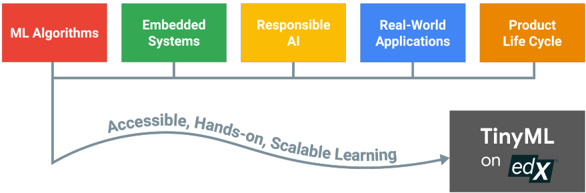
“…accessible and scalable, we focused on the emerging TinyML domain and released the course as a MOOC on edX. autonomous vehicles [3, 4], robotics [5], health care [6], transportation [7, 8], security [9], and education [10, 11], with new application use cases continuously emerging every few days.”
BackgroundMethodModel Cards for Model Reporting
Mitchell, M., Wu, S., Zaldivar, A., Barnes, P., Vasserman, L., Hutchinson, B., Spitzer, E., Raji, I. D., & Gebru, T. (2019) · Proceedings of the Conference on Fairness, Accountability, and Transparency · doi:10.1145/3287560.3287596 · Cited by 2,681
The Cambridge handbook of multimedia learning
(2006) · Choice Reviews Online · doi:10.5860/choice.43-5643 · Cited by 2,313
Research works printed but not linked: 9
- Bruner, J. S. (2009). The process of education. Harvard University Press.
- Chuvpilo, G. (2020). Who's ahead in AI research AT NeurIPS 2020? https://chuvpilo.medium. com/whos-ahead-in-ai-research-at-neurips-2020-bf2a40a54325
- Doyu, H., Morabito, R., & Höller, J. (2020). Bringing machine learning to the deepest IoT edge with TinyML as-a-service. IEEE IoT Newsl.
- Fosdick, A. (2021). Introduction to Embedded Systems Software and Development Environments. https://www.coursera.org/learn/introduction-embedded-systems Frame.io. (2021). Video review and collaboration software. Frame.io. https://www.frame.io/
- Grosz, B. J., Grant, D. G., Vredenburgh, K., Behrends, J., Hu, L., Simmons, A., & Waldo, J. (2019). Embedded ethiCS: Integrating ethics across CS curriculum [https: //cacm.acm. org/magazines/2019/8/238345-embedded-ethics/fulltext]. Communications of the ACM, 62 (8), 54-61.
- Jamieson, P. (2011). Arduino for teaching embedded systems. are computer scientists and engineer- ing educators missing the boat? Proceedings of the international conference on frontiers in education: computer science and computer engineering (FECS), 1.
- Maedche, A., Legner, C., Benlian, A., Berger, B., Gimpel, H., Hess, T., Hinz, O., Morana, S., & Söll- ner, M. (2019). AI-based digital assistants. Business & Information Systems Engineering, 61 (4), 535-544.
- Tiwari, V. (2010). MFCC and its applications in speaker recognition. International journal on emerging technologies, 1 (1).
- Zhang, G., Yan, C., Ji, X., Zhang, T., Zhang, T., & Xu, W. (2017). Dolphinattack: Inaudible voice commands. In Proceedings of the 2017 ACM SIGSAC Conference on Computer and Communications Security, 103-117.
Cited by
A Comprehensive Survey on TinyML
Abadade, Y., Temouden, A., Bamoumen, H., Benamar, N., Chtouki, Y., & Hafid, A. S. (2023) · IEEE Access · doi:10.1109/access.2023.3294111 · Cited by 366
Intelligence at the Extreme Edge: A Survey on Reformable TinyML
Rajapakse, V., Karunanayake, I., & Ahmed, N. (2023) · ACM Computing Surveys · doi:10.1145/3583683 · Cited by 127
A Review on the emerging technology of TinyML
Tsoukas, V., Gkogkidis, A., Boumpa, E., & Kakarountas, A. P. (2024) · ACM Computing Surveys · doi:10.1145/3661820 · Cited by 154
TinyML: A Systematic Review and Synthesis of Existing Research
Han, H., & Siebert, J. (2022) · International Conference on Artificial Intelligence in Information and Communication (ICAIIC) · doi:10.1109/icaiic54071.2022.9722636 · Cited by 155
Giordano, M., Baumann, N., Crabolu, M., Fischer, R., Bellusci, G., & Magno, M. (2022) · IEEE Transactions on Instrumentation and Measurement · doi:10.1109/tim.2022.3165816 · Cited by 72
Hayajneh, A. M., Aldalahmeh, S. A., Alasali, F., Al-Obiedollah, H. M., Zaidi, S. A., & McLernon, D. (2023) · IET Smart Cities · doi:10.1049/smc2.12072 · Cited by 83
TinyML-Sensor for Shelf Life Estimation of Fresh Date Fruits
Srinivasagan, R., Mohammed, M., & Alzahrani, A. (2023) · Sensors · doi:10.3390/s23167081 · Cited by 73
Mohammed, M., Srinivasagan, R., Alzahrani, A., & Alqahtani, N. K. (2023) · Sustainability · doi:10.3390/su151712871 · Cited by 57
Prakash, S., Stewart, M. P., Banbury, C., Mazumder, M., Warden, P., Plancher, B., & Reddi, V. J. (2023) · Communications of the ACM · doi:10.1145/3608473 · Cited by 67
Self-citationLOPdM: A Low-Power On-Device Predictive Maintenance System Based on Self-Powered Sensing and TinyML
Chen, Z., Gao, Y., & Liang, J. (2023) · IEEE Transactions on Instrumentation and Measurement · doi:10.1109/tim.2023.3308251 · Cited by 55
Advancing TinyML in IoT: A Holistic System-Level Perspective for Resource-Constrained AI
Ortiz, L. A. P., Soliz, I. F. M., & Balarezo, V. K. G. (2025) · Future Internet · doi:10.3390/fi17060257 · Cited by 43
Srinivasagan, R., Sayed, M. S. E., Al‐Rasheed, M., & Alzahrani, A. S. (2025) · PLoS ONE · doi:10.1371/journal.pone.0316920 · Cited by 33
Warden, P., Stewart, M. P., Plancher, B., Katti, S., & Reddi, V. J. (2023) · Communications of the ACM · doi:10.1145/3586991 · Cited by 36
Self-citationThe Case for tinyML in Healthcare: CNNs for Real-Time On-Edge Blood Pressure Estimation
Sun, B., Bayes, S., Abotaleb, A. M., & Hassan, M. (2023) · ACM Symposium on Applied Computing · doi:10.1145/3555776.3577747 · Cited by 38
Software engineering approaches for TinyML based IoT embedded vision: a systematic literature review
Lakshman, S. B., & Eisty, N. U. (2022) · doi:10.1145/3528227.3528569 · Cited by 25
A Self-Powered Sensing System with Embedded TinyML for Anomaly Detection
Chen, Z., Gao, Y., & Liang, J. (2023) · IEEE International Conference on Industrial Electronics for Sustainable Energy Systems (IESES) · doi:10.1109/ieses53571.2023.10253705 · Cited by 20
Hutiri, W. T., Ding, A. Y., Kawsar, F., & Mathur, A. (2023) · ACM Transactions on Software Engineering and Methodology · doi:10.1145/3591867 · Cited by 25
TinyML for UWB-radar based presence detection
Pavan, M., Caltabiano, A., & Roveri, M. (2022) · International Joint Conference on Neural Networks (IJCNN) · doi:10.1109/ijcnn55064.2022.9892925 · Cited by 17
Materiality and risk in the age of pervasive AI sensors
Sloane, M., Moss, E., Kennedy, S., Stewart, M. P., Warden, P., Plancher, B., & Reddi, V. J. (2025) · Nature Machine Intelligence · doi:10.1038/s42256-025-01017-7 · Cited by 19
Self-citationOnline Processing of Vehicular Data on the Edge Through an Unsupervised TinyML Regression Technique
de Andrade, P. H. M., da Silva, I. M. D., Diniz, M., Flores, T. K. S., Costa, D. G., & Soares, E. A. (2024) · ACM Transactions on Embedded Computing Systems · doi:10.1145/3591356 · Cited by 16
Singh, R., Nickhil, C., Upendar, K., Deka, S. C., & Nisha, R. (2024) · Journal of Food Measurement & Characterization · doi:10.1007/s11694-024-02999-5 · Cited by 12
Application of Tiny-ML methods for face recognition in social robotics using OhBot robots
Probierz, E., Bartosiak, N., Wojnar, M., Skowroński, K., Gałuszka, A., Grzejszczak, T., & Kedziora, O. (2022) · International Conference on Methods and Models in Automation and Robotics · doi:10.1109/mmar55195.2022.9874278 · Cited by 9
A Self-Powered Predictive Maintenance System Based on Piezoelectric Energy Harvesting and TinyML
Chen, Z., Gao, Y., & Liang, J. (2023) · International Symposium on Low Power Electronics and Design (ISLPED) · doi:10.1109/islped58423.2023.10244321 · Cited by 9
Qu, X., Key, M. L., Luo, E., & Qiu, C. (2024) · Lecture notes in computer science · doi:10.1007/978-3-031-76827-9_8 · Cited by 7
Zhang, X. (2024) · Journal of Electrical Systems · doi:10.52783/jes.3129 · Cited by 8
TinyMLedu: The Tiny Machine Learning Open Education Initiative
Plancher, B., & Reddi, V. J. (2022) · ACM Technical Symposium on Computer Science Education (SIGCSE) · doi:10.1145/3478432.3499093 · Cited by 7
Self-citationTinyWolf — Efficient on-device TinyML training for IoT using enhanced Grey Wolf Optimization
Adhikary, S., Dutta, S., & Dwivedi, A. D. (2024) · Internet of Things · doi:10.1016/j.iot.2024.101365 · Cited by 8
Embedded AI and Computation Offloading for 6G Green Communication
Chollet, N., Bouchemal, N., & Ramdane-Chérif, A. (2023) · International Conference on 6G Networking (6GNet) · doi:10.1109/6gnet58894.2023.10317778 · Cited by 11
Tiny ML-based Non-Invasive Approach of Cardiac Monitoring
Vivekanand, C. V., Purushothaman, R., Inbamalar, T. M., Kushbu, S. C., & Selvam, M. (2024) · International Conference on Contemporary Computing and Informatics (IC3I) · doi:10.1109/ic3i61595.2024.10828932 · Cited by 6
Pujari, T. D., Goel, A., & Kejriwal, D. K. (2022) · International Journal Science and Technology · doi:10.56127/ijst.v1i3.1963 · Cited by 6
Empowering voice assistants with TinyML for user-centric innovations and real-world applications
Chittepu, S., Martha, S., & Banik, D. (2025) · Scientific Reports · doi:10.1038/s41598-025-96588-1 · Cited by 6
Survey on implementation of TinyML for real-time sign language recognition using smart gloves
Santosh Kumar, B., Rachna, P., Hiremath, R. B., Ramadurgam, V. S., & Shaw, D. K. (2022) · International Conference on Emerging Research in Electronics, Computer Science and Technology (ICERECT) · doi:10.1109/icerect56837.2022.10060135 · Cited by 4
Development of Speech Command Control Based TinyML System for Post-Stroke Dysarthria Therapy Device
Riyanta, B., Irianta, H. A., & Kamiel, B. P. (2023) · Journal of Robotics and Control (JRC) · doi:10.18196/jrc.v4i4.15918 · Cited by 5
Chen, Z., Gao, Y., & Liang, J. (2023) · International Conference on Artificial Intelligence of Things and Systems (AIoTSys) · doi:10.1109/aiotsys58602.2023.00042 · Cited by 6
KEYWORD SPOTTING SYSTEM WITH NANO 33 BLE SENSE USING EMBEDDED MACHINE LEARNING APPROACH
ABBAS, N. A. B., & Ahmad, M. R. (2023) · Jurnal Teknologi · doi:10.11113/jurnalteknologi.v85.18744 · Cited by 6
Towards Efficient Multi-view Representation Learning
Liu, K., Guo, Z., Gao, L., Khan, N., & Guan, L. (2023) · IEEE International Symposium on Multimedia (ISM) · doi:10.1109/ism59092.2023.00042 · Cited by 4
Wiese, L. J., Will, H., & Magana, A. J. (2024) · Computer Applications in Engineering Education · doi:10.1002/cae.22734 · Cited by 4
Tiny ML-Based Non-Invasive Approach of Cardiac Monitoring
Purushothaman, R., Praveena, N. G., & Sivachandar, K. (2024) · International Conference on Science Technology Engineering and Mathematics (ICONSTEM) · doi:10.1109/iconstem60960.2024.10568737 · Cited by 3
Insect biodiversity in agriculture using IoT: opportunities and needs for further research
Zapico, J. L., Ahlgren, F., & Zennaro, M. (2021) · IEEE Globecom Workshops (GC Wkshps) · doi:10.1109/gcwkshps52748.2021.9682153 · Cited by 5
Test the Capability of Arduino TinyML for Machine Learning
Caravella, V., Yassine, S., & Kadry, S. (2024) · EAI/Springer Innovations in Communication and Computing · doi:10.1007/978-3-031-64495-5_12 · Cited by 2
Clothing Type and Color Classification Using TinyML
Lamchoudi, S., Miftah, R., & Mourhir, A. (2024) · International Conference on Intelligent Systems and Computer Vision (ISCV) · doi:10.1109/iscv60512.2024.10620147 · Cited by 2
Hey, T. (2023) · OECD eBooks · doi:10.1787/7b7b1bce-en · Cited by 5
TinyML based Deep Learning Model for Activity Detection
Kayarvizhy, N., Gera, B. M., Sharma, B., & Dakshinamurthy, S. (2023) · International Journal on Recent and Innovation Trends in Computing and Communication · doi:10.17762/ijritcc.v11i11s.8081 · Cited by 4
Lessons from shortcomings in machine learning for medical imaging
Varoquaux, G. P., & Cheplygina, V. (2023) · OECD eBooks · doi:10.1787/b885eecd-en · Cited by 4
Tiny machine learning model for obstacle detection with multi-zone time of flight sensors
ARSLAN, S. E. (2023) · Recent Advances in Science and Engineering · doi:10.14744/rase.2023.0002 · Cited by 1
HUMAN DETECTION IN SEARCH AND RESCUE OPERATIONS USING EMBEDDED ARTIFICIAL INTELLIGENCE
Ahmad, M. R., & Al-azzani, A. A. H. (2024) · Jurnal Teknologi · doi:10.11113/jurnalteknologi.v86.19497 · Cited by 1
Tiny Machine Learning for IoT-Enabled Embedded Systems: A Review
Mrabet, A. E., Tber, A., Elmousaid, R., Hlou, L., & gouri, R. E. (2025) · Communications in computer and information science · doi:10.1007/978-3-031-93448-3_6 · Cited by 1
Every second counts for search and rescue: A systematic review of TinyML drone
Junchang, L., JosephNg, P. S., Yuen, P. K., & Wan, W. S. (2026) · Edelweiss Applied Science and Technology · doi:10.55214/2576-8484.v10i1.11904 · Cited by 1
Theory Is Cool But So Are Microcontrollers: Computer Science Student Reactions to Arduino TinyML
Spantidi, O. (2026) · ACM Technical Symposium on Computer Science Education (SIGCSE) · doi:10.1145/3770762.3772499 · Cited by 1
Vummaneni, N. S., Mittal, A., Kumar, I., Bharadwaj, S., & Varshney, H. (2026) · IEEE SoutheastCon · doi:10.1109/southeastcon63549.2026.11476185 · Cited by 2
The end of Moore’s Law? Innovation in computer systems continues at a high pace
Kressel, H. (2023) · OECD eBooks · doi:10.1787/63e48242-en · Cited by 3
Management of TinyML-Enabled Internet of Things Devices
Szydło, T., & Nagy, M. (2024) · IEEE Micro · doi:10.1109/mm.2024.3382488 · Cited by 2
An English MOOC Answering System Based on Intelligent Algorithms
Zhang, Q. (2024) · Lecture notes on data engineering and communications technologies · doi:10.1007/978-981-97-1983-9_20 · Cited by 1
Langroudi, H. F., Karia, V., Pandit, T., Mashaido, B., & Kudithipudi, D. (2022) · Lecture notes in computer science · doi:10.1007/978-3-031-09779-9_4 · Cited by 1
Real-Time Arabic Digit Spotting with TinyML-Optimized CNNs on Edge Devices
Adla, Y. A., Saghir, M. A. R., & Awad, M. (2023) · IFIP advances in information and communication technology · doi:10.1007/978-3-031-34111-3_44
Is there a slowdown in research productivity? Evidence from China and Germany
OECD (2023) · OECD eBooks · doi:10.1787/6dc66969-en
Tourassi, G. D., Shankar, M. A., & Wang, F. (2023) · OECD eBooks · doi:10.1787/0e1b4c2f-en
Eroom’s Law and the decline in the productivity of biopharmaceutical R&D
Scannell, J. W. (2023) · OECD eBooks · doi:10.1787/6f256d17-en · Cited by 5
Szalay, K. Z. (2023) · OECD eBooks · doi:10.1787/6717b361-en
Quantifying the “cognitive extent” of science and how it has changed over time and across countries
Milojević, S. (2023) · OECD eBooks · doi:10.1787/1f717652-en
Interpretability: Should – and can – we understand the reasoning of machine-learning systems?
Cartwright, H. (2023) · OECD eBooks · doi:10.1787/2d0478b9-en
OECD (2023) · OECD eBooks · doi:10.1787/f1262928-en
Implementing TinyML-based Speech Recognition using Arduino
Koo, G.-S., & Seo, Y. G. (2023) · Journal of Digital Contents Society · doi:10.9728/dcs.2023.24.6.1285
Kishore, M., Saritha, K., M.V.N.Chandrika, Sai, B., & -, Y. P. R. (2024) · International Journal For Multidisciplinary Research · doi:10.36948/ijfmr.2024.v06i02.17525
Image Classifier Using Resource-Constrained Device and Tiny Machine Learning
Vinod, K. S., & Ruby, E. D. K. (2024) · Lecture notes in electrical engineering · doi:10.1007/978-981-97-7616-0_12
Sustainable Distributed ML Paradigms for Green Edge Intelligence: Analysis and Framework
Kumar, A., Chaudhary, S., & Ramnarayan (2025) · International Conference on Electronics and Sustainable Communication Systems (ICESC) · doi:10.1109/icesc65114.2025.11212593
Sampaio, A. P., Farias, P. C. M. A., & Bittencourt, R. A. (2025) · IEEE Frontiers in Education Conference (FIE) · doi:10.1109/fie63693.2025.11328314
Li, S., Xu, C., & Wang, H. (2025) · IEEE International Conference on Parallel and Distributed Systems (ICPADS) · doi:10.1109/icpads67057.2025.11322967
AirSense: AI-Powered Air Mouse Using TinyML
Pasandul, H. W. T. P., & Sudantha, B. H. (2025) · International Conference on Information Technology Research (ICITR) · doi:10.1109/icitr69413.2025.11353524
Castro-Vargas, C., & Cabana-Cáceres, M. R. (2026) · ESPACIOS · doi:10.48082/espacios-a26v47n01i14
Seamless Over-the-Air Updates for Edge AI-Powered Air Mouse
Pasandul, H. W. T. P., & Sudantha, B. H. (2026) · International Conference on Image Processing and Robotics (ICIPRoB) · doi:10.1109/iciprob69625.2026.11497826
TinyML: The NextGen AI Technology for Standalone Devices
Kataria, S., Prajapati, P. P., Gajjar, S., & Rathod, A. (2026) · Atlantis Highlights in Intelligent Systems/Atlantis highlights in intelligent systems · doi:10.2991/978-94-6239-707-1_15
Ali, H., Zahid, Z., Ansere, J. A., & Kamal, M. (2026) · International Conference on IT and Industrial Technologies (ICIT) · doi:10.1109/icit68548.2026.11577706
AI_Card en el borde: para la enseñanza-aprendizaje de redes neuronales e inteligencia artificial
Garnica, F. C., & Ospino, K. D. M. (2026) · Revista Educación en Ingeniería · doi:10.26507/rei.v21n42.1444
Ramírez‐Salgado, A., Antonenko, P., Eutsler, L., & Bhunia, S. (2026) · ASEE Annual Conference & Exposition · doi:10.18260/1-2--60261
A Micro-Credential Pathway to Safer and More Reliable Engineering for Industry 4.0
Abdullah, N. F., Abu-Samah, A., Heidary, S., Zulkifli, I. H., Ibrahim, R., Subhi, N., Nordin, R., Behjati, M., & Zennaro, M. (2025) · Research in Engineering Education Symposium (REES) · doi:10.52202/086293-0037
Metadata
- Authors
- Janapa Reddi, V., Plancher, B., Kennedy, S., Moroney, L., Warden, P., Suzuki, L., Agarwal, A., Banbury, C., Banzi, M., Bennett, M., Brown, B., Chitlangia, S., Ghosal, R., Grafman, S., Jaeger, R., Krishnan, S., Lam, M., Leiker, D., Mann, C., Mazumder, M., Pajak, D., Ramaprasad, D., Smith, J. E., Stewart, M., & Tingley, D.
- Affiliations
- Edge Computing Lab, John A. Paulson School of Engineering and Applied Sciences, Harvard University, Cambridge, Massachusetts, United States of America
- Harvard University (US)
- Google (United States) (US)
- Arduino, Boston, Massachusetts, United States of America
- Creative Class LLC, Westminster, Colorado, United States of America
- ORCID
- Venue
- Harvard Data Science Review
- Publisher
- MIT Press
- Published
- 2022-01-27
- Volume
- 4
- Issue
- 1
- ISSN
- 2644-2353 (ISSN-L)
- 2688-8513
- OpenAlex
- W3168641996
- Cited by
- 62
- References
- 78
- Citations by year
- 2026: 6 · 2025: 8 · 2024: 11 · 2023: 30 · 2022: 6
- FWCI
- 10.63
- Type
- journal article
- Language
- en
- Open access
- diamond
- doi.org
- Licence
- cc-by
- Locations
- Harvard Data Science Review (publishedVersion, cc-by)
- arXiv (Cornell University) (submittedVersion)
- DSpace@MIT (Massachusetts Institute of Technology) (submittedVersion, cc-by)
- DOAJ (DOAJ: Directory of Open Access Journals) (submittedVersion, cc-by-sa)
- PhilPapers (PhilPapers Foundation) (submittedVersion)
- arXiv (Cornell University)
- Funders
- Abdus Salam International Centre for Theoretical Physics
- Topics
- Physical Sciences › Computer Science › Computer Science Applications › Online Learning and Analytics
- Physical Sciences › Computer Science › Computer Science Applications › Teaching and Learning Programming
- Physical Sciences › Mathematics › Statistics and Probability › Statistics Education and Methodologies
- Keywords
- TinyML, massive open online courses, embedded devices, microcontroller, resource-constrained devices, applied machine learning, open educational resources, academia-industry collaboration, machine learning ethics, data engineering, community building
About these checks
Registry, retraction, Cites and statistics results are computed, not judged, with one exception: a printed reference that no index lists is read once by a model before it counts as a citation error. Claims are extracted by a model and kept only when their quote appears verbatim in the text; each cited source is then checked, with a model’s help, for whether it says what the claim relies on. Those verdicts can be wrong — read the claim’s quote and the cited source before relying on one.
Statistics and arithmetic are recomputed, not judged.
Confidence bands are shown only for fields calibrated on our annotated test set. None is calibrated yet, so no band is shown.
What counts as a claim ›How we measure confidence ›How we check this ›
Are you an author, or do you see a problem with this page? Request a review
Data sources
Bibliographic data: Semantic Scholar, OpenAlex, Crossref.
Contains information from the Semantic Scholar Academic Graph Datasets, made available under the ODC Attribution License (ODC-BY 1.0).
Semantic Scholar’s data is described in: Kinney, R., et al. (2023). The Semantic Scholar Open Data Platform. arXiv:2301.10140.
