

The DOI matches its Crossref record.
Crossref: The sustainable source of community-owned scholarly metadata
Abstract
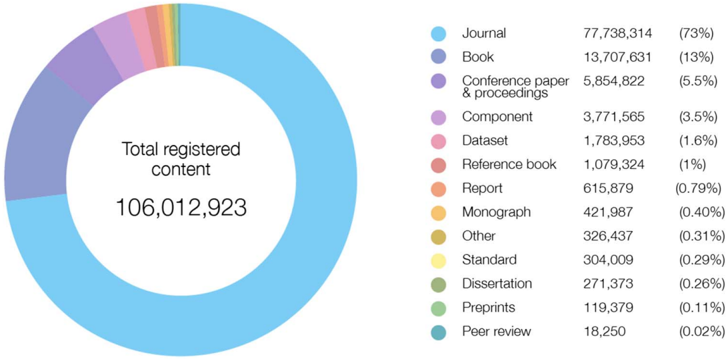
This paper describes the scholarly metadata collected and made available by Crossref, as well as its importance in the scholarly research ecosystem. Containing over 106 million records and expanding at an average rate of 11% a year, Crossref’s metadata has become one of the major sources of scholarly data for publishers, authors, librarians, funders, and researchers. The metadata set consists of 13 content types, including not only traditional types, such as journals and conference papers, but also data sets, reports, preprints, peer reviews, and grants. The metadata is not limited to basic publication metadata, but can also include abstracts and links to full text, funding and license information, citation links, and the information about corrections, updates, retractions, etc. This scale and breadth make Crossref a valuable source for research in scientometrics, including measuring the growth and impact of science and understanding new trends in scholarly communications. The metadata is available through a number of APIs, including REST API and OAI-PMH. In this paper, we describe the kind of metadata that Crossref provides and how it is collected and curated. We also look at Crossref’s role in the research ecosystem and trends in metadata curation over the years, including the evolution of its citation data provision. We summarize the research used in Crossref’s metadata and describe plans that will improve metadata quality and retrieval in the future.
Overview
The claims and statistics of this paper haven’t been checked yet.
Run the check — free, no account needed. It reads the open-access text and checks the sources it cites.
Integrity signals
Registry
Cites
Statistics
Figures
Verification
Claims the paper makes
The claims and statistics of this paper haven’t been checked yet.
Run the check — free, no account needed. It reads the open-access text and checks the sources it cites.
Claims other papers make about this one
Each is checked against this paper’s own text: does it say what the citing paper says it does?
In the citing paper
“All DOIs were validated using the CrossRef REST API (Hendricks et al., 2020) with proper academic headers and normalization protocols to ensure compliance and standardization.”
From Geographic Variation in LLM DOI Fabrication: Cross-Country Analysis of Citation Accuracy Across Four Large Language Models (2025) · cites this paper as Hendricks et al., 2020
Self-check
Percentages, sums and reported differences re-computed from the paper’s own numbers.
The self-check needs the paper’s full text.
Citations
Cites
No references could be resolved yet.
Research works printed but not linked: 15
- Akbaritabar A., 2019, SocArXiv
- Cho H., 2018, Social Network Analysis and Mining, 8, 211
- Dion M. L., 2018, Political Analysis, 26, 312, 10.1017/pan.2018.12 · DOI
- Esarey J., 2018, Political Analysis, 26, 331, 10.1017/pan.2018.24 · DOI
- Herrmannova D., 2019, CoRR
- Hicks D. J., 2019, Scientific Communication and Education
- Khoo S. Y-S., 2019, LIBER Quarterly, 29, 1, 10.18352/lq.10280 · DOI
- Klein M., 2016, Proceedings of the 16th ACM/IEEE-CS on Joint Conference on Digital Libraries—JCDL ’16, 153, 10.1145/2910896.2910909 · DOI
- Martín-Martín A., 2018, Journal of Informetrics, 12, 819, 10.1016/j.joi.2018.06.012 · DOI
- Matthias L., 2019, Publications, 7, 23, 10.3390/publications7020023 · DOI
- Ortega J. L., 2018, FEMS Microbiology Letters, 365, 10.1093/femsle/fny049 · DOI
- Ortega J. L., 2018, Scientometrics, 116, 2123, 10.1007/s11192-018-2838-z · DOI
- Peroni S., 2019, CoRR
- Schenkel R., 2018, BIR 2018 Workshop on Bibliometric-enhanced Information Retrieval
- Zahedi Z., 2018, PLoS One, 13, e0197326, 10.1371/journal.pone.0197326 · DOI
Cited by
Martín-Martín, A., Thelwall, M., Orduna-Malea, E., & Delgado López-Cózar, E. (2021) · Scientometrics · doi:10.1007/s11192-020-03690-4 · Cited by 1,018
Visser, M., van Eck, N. J., & Waltman, L. (2021) · Quantitative Science Studies · doi:10.1162/qss_a_00112 · Cited by 865
Cabanac, G., Labbé, C., & Magazinov, A. (2021) · arXiv · doi:10.48550/arxiv.2107.06751 · Cited by 224
“…- v 70 2019 - v 69 2019 - v 68 2019 - v 67 2019 - v 66 2019 - v 65 2019 - v 64 2018 - v 63 2018 - v 62 2018 - v 61 2018 - v 60 2018 - v 59 2018 - v 58 2018 - v 57 2018 - v 56 Microprocessors and Microsystems publishes articles with DOIs minted by Crossref (Hendricks, Tkaczyk, Lin, & Feeney, 2020).”
Sneaked references: Fabricated reference metadata distort citation counts
Besançon, L., Cabanac, G., Labbé, C., & Magazinov, A. (2024) · Journal of the Association for Information Science and Technology · doi:10.1002/asi.24896 · Cited by 31
“One of the main agencies is Crossref, which enables registration of DOIs for a fee and hosts the publishers' metadata which is then made publicly available (Hendricks et al., 2020).”
Kim, E., Kipchumba, F., & Min, S. (2025) · Publications · doi:10.3390/publications13040049 · Cited by 7
Metadata
- Authors
- Hendricks, G., Tkaczyk, D., Lin, J., & Feeney, P.
- Affiliations
- Crossref
- Venue
- Quantitative Science Studies
- Publisher
- MIT Press
- Published
- 2020-02
- Volume
- 1
- Issue
- 1
- Pages
- 414-427
- ISSN
- 2641-3337
- Cited by
- 175
- References
- 0
- Language
- en
About these checks
Registry, retraction, Cites and statistics results are computed, not judged, with one exception: a printed reference that no index lists is read once by a model before it counts as a citation error. Claims are extracted by a model and kept only when their quote appears verbatim in the text; each cited source is then checked, with a model’s help, for whether it says what the claim relies on. Those verdicts can be wrong — read the claim’s quote and the cited source before relying on one.
Statistics and arithmetic are recomputed, not judged.
Confidence bands are shown only for fields calibrated on our annotated test set. None is calibrated yet, so no band is shown.
What counts as a claim ›How we measure confidence ›How we check this ›
Are you an author, or do you see a problem with this page? Request a review
How to cite
Cite CoChat for the checks on this page, and the paper for its own findings.
- This page
- CoChat. (2026). Citation check: Crossref: The sustainable source of community-owned scholarly metadata. https://app.cochat.ai/papers/10.1162/qss_a_00022
- The paper
- Hendricks, G., Tkaczyk, D., Lin, J., & Feeney, P. (2020). Crossref: The sustainable source of community-owned scholarly metadata. Quantitative Science Studies. https://doi.org/10.1162/qss_a_00022
Data sources
Bibliographic data: Semantic Scholar, OpenAlex, Crossref.
Contains information from the Semantic Scholar Academic Graph Datasets, made available under the ODC Attribution License (ODC-BY 1.0).
Semantic Scholar’s data is described in: Kinney, R., et al. (2023). The Semantic Scholar Open Data Platform. arXiv:2301.10140.
