

The DOI matches its Crossref record, with a small difference in title or year; 52 of the 60 references it cites were found in a registry or an index.
“I’m just an Imam, not Superman”: Imams in Switzerland: Between Stakeholder Objects and Self-Interpretation
Open accessAbstract
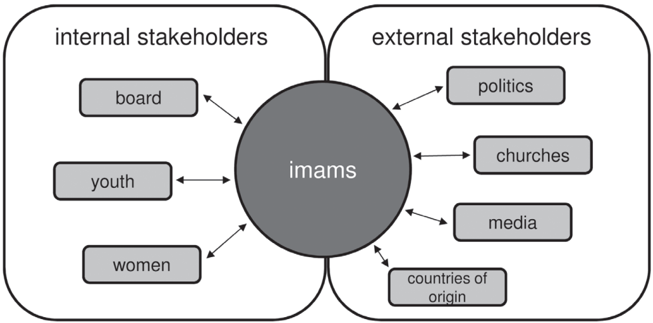
Current debates on Islam in Europe often focus on imams as religious leaders and key figures in integration politics. Muslim associations undergoing processes of transformation and generational change have equally high expectations of imams. This article uses stakeholder theory to analyse the current situation of imams and draws on empirical material from Switzerland to illustrate both multi-faceted stakeholder claims and imams’ self-reflections on role conflicts they experience. It indicates that imams and Muslim associations tend to develop different coping strategies leading either to an enlarged profile for imams or to a differentiation of functions and professions in the social and religious fields.
Overview
The claims and statistics of this paper haven’t been checked yet.
Run the check — free, no account needed. It reads the open-access text and checks the sources it cites.
Integrity signals
Registry
Cites
Statistics
Figures
Verification
Claims the paper makes
The claims and statistics of this paper haven’t been checked yet.
Run the check — free, no account needed. It reads the open-access text and checks the sources it cites.
Claims other papers make about this one
Each is checked against this paper’s own text: does it say what the citing paper says it does?
The cited source says what the claim attributes to it.
In the citing paper
“As Schmid and others have argued, imams are not super-men, and there follows from the growing and very diverse expectations of Muslim religious professionals a differentiation of tasks as people specialise.”
From An American Example of Islamic Chaplaincy Education for the European Context (2021) · cites this paper as Schmid 2020a
Self-check
Percentages, sums and reported differences re-computed from the paper’s own numbers.
The self-check needs the paper’s full text.
Citations
Cites
DiMaggio, P. J., & Powell, W. W. (1983) · American Sociological Review · doi:10.2307/2095101 · Cited by 38,435
DiMaggio, P., & Powell, W. W. (2004) · Advances in strategic management · doi:10.1016/s0742-3322(00)17011-1 · Cited by 25,952
(2010) · Cited by 24,023
Exit, Voice and Loyalty: Responses to Decline in Firms, Organizations, and States.
Tullock, G., & Hirschman, A. O. H. (1970) · The Journal of Finance · doi:10.2307/2325604 · Cited by 11,199
Qualitative Content Analysis in Practice
Schreier, M. (2012) · doi:10.4135/9781529682571 · Cited by 5,801
Mitchell, R. K., Agle, B. R., & Wood, D. J. (1997) · The Academy of Management Review · doi:10.2307/259247 · Cited by 5,039
Stakeholder Theory: The State of the Art
Parmar, B. L., Freeman, R. E., Harrison, J. S., Wicks, A. C., Purnell, L., & de Colle, S. (2010) · Academy of Management Annals · doi:10.5465/19416520.2010.495581 · Cited by 2,755
Strategies for assessing and managing organizational stakeholders
Savage, G. T., Nix, T. W., Whitehead, C. J., & Blair, J. D. (1991) · Academy of Management Perspectives · doi:10.5465/ame.1991.4274682 · Cited by 1,170
Stakeholder Theory: The State of the Art
Jones, T. M., Wicks, A. C., & Freeman, R. E. (2017) · doi:10.1002/9781405164771.ch0 · Cited by 1,114
Nonprofit Organizations: Theory, Management, Policy
Anheier, H. K. (2005) · Cited by 591
Research works printed but not linked: 19
- Hashas, " European Imam", p. 93; Solenne Jouanneau, "The Reinvented Role of Imams in French Society", in Imams in Western Europe: Developments, Transformations, and Institutional Challenges, ed. M. Hashas, N. Valdemar Vinding, K. Hajji and J. Jaap de Ruiter (Amsterdam: Amsterdam University Press), pp. 143-164, esp. 148-149;
- Dominik Müller, "'Aber Hocam …': Imame und die Aushandlung islamischer Autorität im Alltag von Schweizer Moscheen", Zeitschrift für Ethnologie 142 (2017): 67-92, p. 82.
- Petra Bleisch, Gelebte und erzählte Scharia in der Schweiz: Empirische Studien zur Aneignung religiöser Normen durch zum Islam konvertierte Frauen (Zürich: Schulthess, 2016), pp. 115-117.
- See Hussein Hamdan and Hansjörg Schmid, Junge Muslime als Partner (Weinheim: Beltz Verlagsgruppe, 2014), pp. 29-30, 42-43.
- Martin Baumann, Jürgen Endres, Silvia Martens and Andreas Tunger-Zanetti, "'Hallo, es geht um meine Religion!' Muslimische Jugendliche in der Schweiz auf der Suche nach ihrer Identität" (Luzern 2017), pp. 2, 18-19, https://www.unilu.ch/fileadmin/fakultaeten/ 88 Riyaset of the Islamic Community in Bosnia and Hercegovina (ed.), Constitution of the Islamic Community in Bosnia and Hercegovina 1997 (Sarajevo: 2008), Art. 1.
- Brigitte Reiser, "Mehr Partizipation wagen: Weshalb Nonprofits ein Stakeholder- Management brauchen, das auf Empowerment setzt", in Stakeholder-Management in Nonprofit-Organisationen. Theoretische Grundlagen, empirische Ergebnisse und prak- tische Ausgestaltungen. 9. Internationales NPO-Forschungscolloquium 2010 Georg-August- Universität Göttingen 18. und 19. März 2010. Eine Dokumentation, ed. Ludwig Theuvsen, Reinbert Schauer and Markus Gmür (Linz: Trauner, 2010), pp. 295-310, esp. 302-303. 110 See e.g. concerning the French context Frank Peter, "Leading the Community of the Middle Way: A Study of the Muslim Field in France", The Muslim World 96/4 (2006): 707-736, p. 712. Schmid Journal of Muslims in Europe 9 (2020) 64-95 Bibliographical Reference
- Bruce, B. (2019). Governing Islam Abroad. Turkish and Moroccan Muslims in Western Europe. Cham: Palgrave Macmillan.
- Bucher, R. (2014). 'Opfern und geopfert werden, ist des Priesters Los auf Erden.' Aktuelle Verflüssigungsprozesse des katholischen Amts-Priestertums. Pastoraltheologische Informationen 34 (2), pp. 115-129.
- Cesari, J. (2016). Securitization and Secularization: The Two Pillars of State Regulation of European Islam. In: J. Haynes, ed., Routledge Handbook of Religion and Politics, New York: Routledge pp. 231-247.
- Hirschman, A. (1970). Exit, Voice and Loyalty: Responses to Decline in Firms, Organizations and States. Cambridge: Harvard University Press.
- Schmid Journal of Muslims in Europe 9 (2020) 64-95
- Müller, D. (2017). 'Aber Hocam …' -Imame und die Aushandlung islamischer Autorität im Alltag von Schweizer Moscheen. Zeitschrift für Ethnologie 142, pp. 67-92.
- Peter, F. (2018). Training of Imams and the Fight against Radicalization. IEMed Med- iterranean Yearbook, pp. 342-345.
- Rosa, H. (2004). Four Levels of Self-Interpretation. A Paradigm for Interpretive Social Philosophy and Political Criticism. Philosophy & Social Criticisms 30 (5-6), pp. 691-720.
- Schneuwly Purdie, M., and Tunger-Zanetti, A. (2018). Switzerland. In: O. Scharbrodt et al. eds., Yearbook of Muslims in Europe, vol. 9, Leiden: Brill pp. 659-678.
- Sèze, R. (2015). Leaders musulmans et fabrication d'un 'islam civil' . Confluences Méditerranée 95 (4), pp. 43-58.
- Sözeri, S., Kosar Altinyelken, H., and Volman, M. (2018). Training Imams in the Netherlands: The Failure of a Post-Secular Endeavour. British Journal of Religious Education 41 (4), pp. 435-445.
- Vereinigung der Islamischen Organisationen in Zürich (2017). Tag der offenen Mo- scheen. http://vioz.ch/medien-ueber-vioz/3902/, accessed 5 August 2018. Imams in Switzerland Journal of Muslims in Europe 9 (2020) 64-95
- Vinding, N.V. (2018). Churchification of Islam in Europe. In: N.V. Vinding, E. Racius, J. Thielmann, eds., Exploring the Multitude of Muslims in Europe. Essays in Honour of Jørgen S. Nielsen, Leiden: Brill, pp. 50-66.
Cited by
Hough, C. V., Halpin, E., Mahmood, T., & Giles, J. (2021) · Religions · doi:10.3390/rel12090771 · Cited by 11
Within and Beyond the Community: Tensions in Muslim Service Provision in Switzerland
Trucco, N., Schmid, H., & Sheikhzadegan, A. (2023) · Religions · doi:10.3390/rel15010015 · Cited by 8
Self-citationInterreligious Dialogues in Switzerland: A Multiple-Case Study Focusing on Socio-Political Contexts
Schmid, H. (2020) · Interdisciplinary Journal for Religion and Transformation in Contemporary Society · doi:10.30965/23642807-00602004 · Cited by 8
Self-citationBad guy or good guy? The framing of an imam
Hänggli, R., & Trucco, N. (2022) · Studies in Communication Sciences · doi:10.24434/j.scoms.2022.03.2928 · Cited by 7
An American Example of Islamic Chaplaincy Education for the European Context
Vinding, N. V. (2021) · Religions · doi:10.3390/rel12110969 · Cited by 5
“Islamic chaplaincy is not new (Gilliat-Ray et al. 2013; Kowalski and Becker 2015) but is being professionalised and gaining wide attention (Schmid 2020b).”
BackgroundMethodInfluential
Metadata
- Authors
- Schmid, H.
- Affiliations
- University of Fribourg (CH)
- Corresponding author
- Schmid, Hansjörg
- ORCID
- Schmid, Hansjörg
- Venue
- Journal of Muslims in Europe
- Publisher
- Walter de Gruyter GmbH
- Published
- 2020-01-02
- Volume
- 9
- Issue
- 1
- Pages
- 64-95
- ISSN
- 2211-792X (ISSN-L)
- 2211-7954
- OpenAlex
- W2997518152
- Cited by
- 29
- References
- 60
- Citations by year
- 2026: 4 · 2025: 1 · 2024: 15 · 2023: 3 · 2022: 1 · 2021: 3 · 2020: 2
- FWCI
- 3.00
- Type
- journal article
- Language
- en
- Open access
- hybrid
- doi.org
- Locations
- Journal of Muslims in Europe (publishedVersion, cc-by)
- Topics
- Social Sciences › Sociology and Political Science › Religion and Society Interactions
- Social Sciences › Arts and Humanities › Religious studies › Theology and Canon Law Studies
- Social Sciences › Political Science and International Relations › Multiculturalism, Politics, Migration, Gender
- Keywords
- imams, Muslim associations, stakeholder theory, role conflict, integration politics, Islam in Europe, generational change, coping strategies, religious leadership, Switzerland
About these checks
Registry, retraction, Cites and statistics results are computed, not judged, with one exception: a printed reference that no index lists is read once by a model before it counts as a citation error. Claims are extracted by a model and kept only when their quote appears verbatim in the text; each cited source is then checked, with a model’s help, for whether it says what the claim relies on. Those verdicts can be wrong — read the claim’s quote and the cited source before relying on one.
Statistics and arithmetic are recomputed, not judged.
Confidence bands are shown only for fields calibrated on our annotated test set. None is calibrated yet, so no band is shown.
What counts as a claim ›How we measure confidence ›How we check this ›
Are you an author, or do you see a problem with this page? Request a review
