

Terms of Friendship: Bylaws for Associations of Buddhist Laywomen in Medieval China
Open accessThe DOI matches its Crossref record; 2 of the 2 references it cites were found in a registry or an index; none of the 21 sources its claims cite is checked for support yet.
Abstract
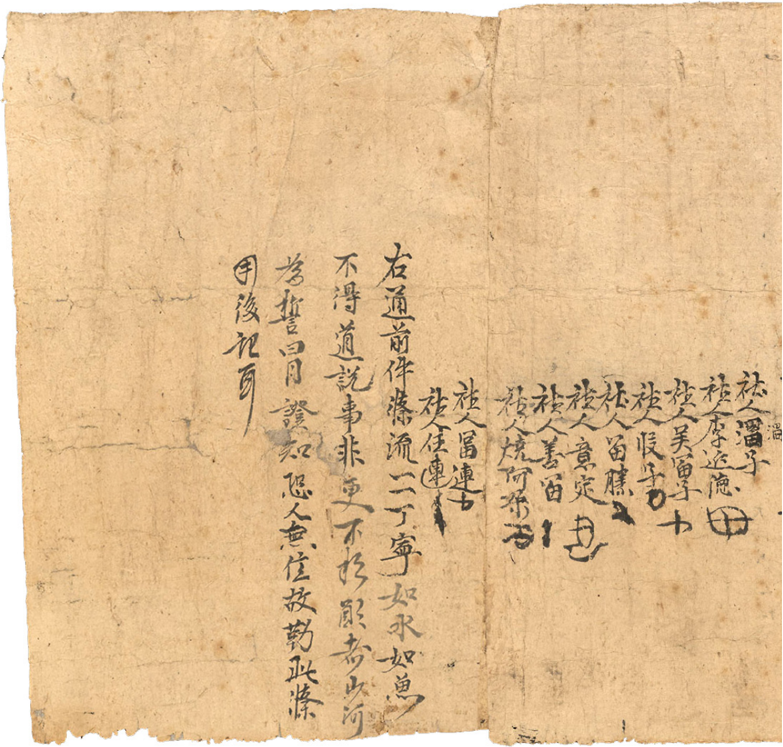
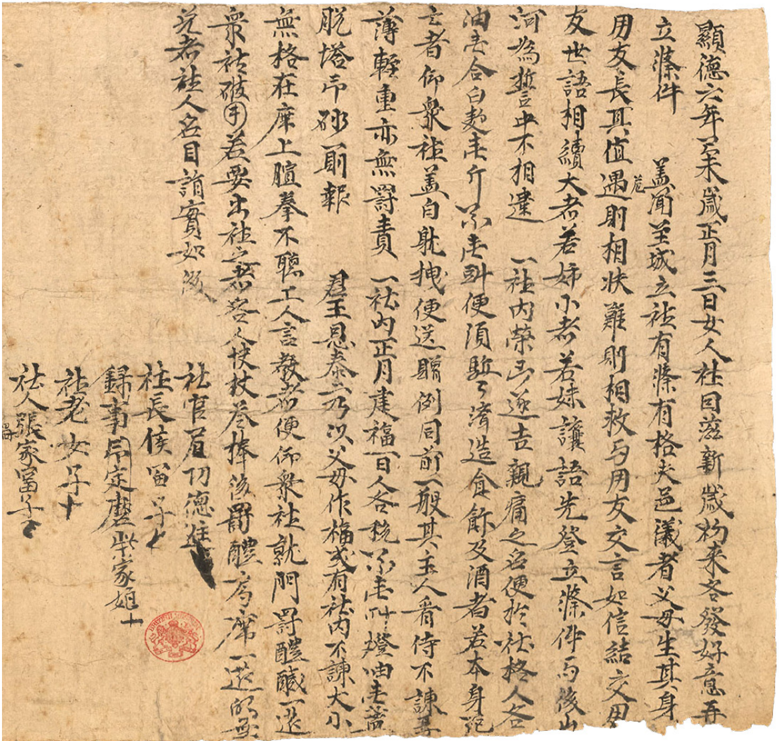
What do we owe our friends? How are close relationships outside the family formed, and by what principles? Where are the bonds of friendship situated among other social ties like neighborhood, profession, nation, or religious community? What are the historiographical challenges to understanding values, conventions, and intimacies in the past? Such questions are a natural starting point for an essay inspired by my amazing friend, Albert Hoffstädt. He is one subject—the sub-text, really—of this piece. The other, ostensive subject is a signed, handwritten Chinese document containing articles of incorporation for a congregation of Buddhist women in the tenth century. Contemplating the one helps me appreciate the other. The manuscript (British Library shelfmark Or. 8210/Stein 527, hereafter S 527; see Figure 13.1) is one of the more than sixty thousand documents that, after serving a useful purpose, were holed up in a shrine room in the Mogao Caves in the northwestern town of Dunhuang (Gansu province) in the early eleventh century. The manuscript is nearly unique in combining in one polished document a constitution for a women’s lay Buddhist association with the names and actual signatures of the members. Like other bylaws, the charter celebrates general principles. It references the philosophical underpinnings of the group and explains its main purpose, which was to provide mutual aid during funerals and annual religious festivals. The document stipulates the women’s duties, stating how much vegetable oil, grain, prepared food and liquor, and what religious objects they were required to contribute. The rules for the society also define penalties for disrupting the peace: those who contravene the regulations must provide a banquet for all, and those desiring to leave the community must not only fête the group but also submit to corporal punishment. In its original setting the document did more than simply talk about the incorporation of a new social group. Through its performative or juridical features, it also brought a new community into being. The list of members’ names near the end of the document asserts a hierarchy. It is ranked from most important (senior nun and organizer, officer, secretary, and elder) to least important
Overview
CoChat Summary
TL;DR
Teiser edits and translates a 959 Dunhuang manuscript (S 527), the bylaws of a Buddhist laywomen’s association, showing how a written charter with individualized signatures created and governed a voluntary female sodality. The document reveals mutual-aid obligations for funerals and festivals, internal hierarchy, and penalties for dissent or exit.
Key findings
- S 527, dated 959 (sixth year of Xiande, first month, third day; February 13, 959), is a formal set of women’s association bylaws listing 15 members; 14 appended personal signatures, probably made with a fingernail dipped in ink, in varying designs. It is nearly unique in combining a constitution with members’ names and actual signatures.
- The bylaws define mutual aid: on sickness or death, each member provides one vat of oil, one catty of white flour, and one peck of millet, and helps prepare food and wine; for New Year merit-making, each is taxed one peck of millet, a small cup of lamp oil, castings of stūpas, and stamped images.
- The membership list encodes hierarchies: a nun, Gongde Jin, is listed first as Association Officer; officers precede members; and an oldest non-office laywoman, Nüzi, heads the other laywomen. Naming practices vary, with some women listed by surname, some by husband’s surname, and some only by personal name.
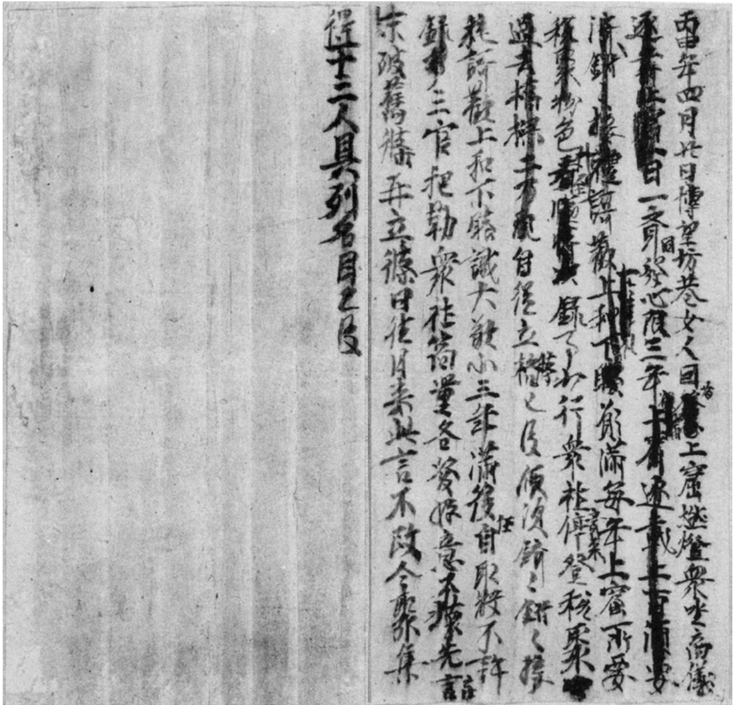
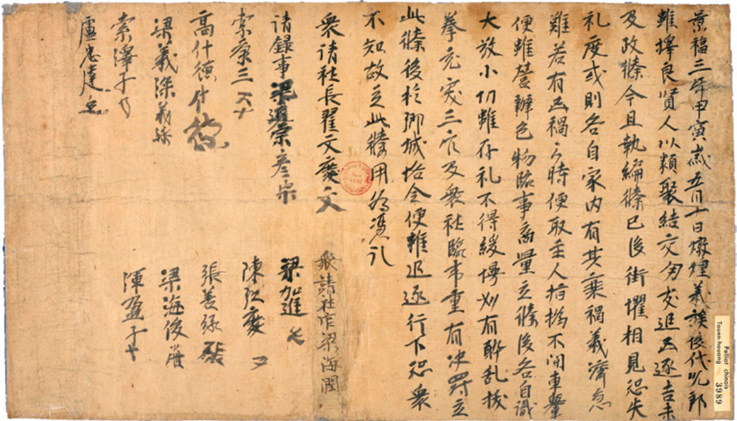
- Penalties include providing a banquet for the whole association for disrupting protocol or ignoring superiors; leaving the association brings three whacks of the stick and a banquet with ale, with “absolutely no exceptions.” Four women’s bylaws survive (658, 936 draft, 959, 968), among 422 Dunhuang and Turfan manuscripts related to lay societies.
Methods
- The edition, translation, and commentary of the 959 Bylaws are based on the author’s inspection of the original at the British Library in March 2019 and comparison with several scholarly editions; editorial choices also draw on the similar Undated Draft Bylaws.
- The study uses close reading of the text’s performative and juridical features, attention to material and paleographic features, and comparison with other Dunhuang and Turfan association documents, including the 894 Bylaws, 936 Draft Bylaws, 968 Bylaws, and Undated Draft Bylaws.
- It contextualizes the manuscript within scholarship on lay Buddhist societies and Dunhuang studies, using the corpus of 422 manuscripts related to lay societies.
Limitations
- The paper states that historical assessment is difficult because the uneven distribution and chance survival of Dunhuang and Turfan documents do not permit fine-grained differentiation; the affective depths of medieval Chinese associations remain largely unfathomable, and it may be impossible to ferret out distinct valences related to gender.
- The paper states that a complete study of paleography and alternate character forms is beyond its scope.
- Evident from the text: the argument is a single-manuscript case study, and interpreting the fingernail marks as signatures expressing assent is interpretive, though supported by comparison with other signed association documents.
Model-written summary. Check it against the paper before relying on it.
Integrity signals
Registry
Cites
Statistics
Figures
Verification
Claims the paper makes
0 Valid · 8 Not valid · 20 Not checked · 97 Own results and interpretations
A result the paper reports from its own data — it cites no other source for it, so there is none to check. The quote shows it is in the paper.
In the paper
“The document stipulates the women's duties, stating how much vegetable oil, grain, prepared food and liquor, and what religious objects they were required to contribute.”
plainSingle case- Asserted: passes — The authors put it forward as true.
- Checkable: passes — It can be checked against evidence.
- Load-bearing: unclear — It is unclear whether the paper’s conclusions depend on it.
- Based: passes — The paper gives a reason why it holds.
A result the paper reports from its own data — it cites no other source for it, so there is none to check. The quote shows it is in the paper.
In the paper
“The rules for the society also define penalties for disrupting the peace: those who contravene the regulations must provide a banquet for all”
plainstates a cause- Asserted: passes — The authors put it forward as true.
- Checkable: passes — It can be checked against evidence.
- Load-bearing: unclear — It is unclear whether the paper’s conclusions depend on it.
- Based: passes — The paper gives a reason why it holds.
A result the paper reports from its own data — it cites no other source for it, so there is none to check. The quote shows it is in the paper.
In the paper
“Beneath fourteen of the fifteen names, each woman has written her own personal sign indicating assent to the charter.”
plain- Asserted: passes — The authors put it forward as true.
- Checkable: passes — It can be checked against evidence.
- Load-bearing: passes — The paper’s conclusions depend on it.
- Based: passes — The paper gives a reason why it holds.
A result the paper states — it cites no source for it, so there is none to check. The quote shows it is in the paper.
In the paper
“Four bylaws for women's congregations survive among medieval manuscripts.”
plainn = 4- Asserted: passes — The authors put it forward as true.
- Checkable: passes — It can be checked against evidence.
- Load-bearing: passes — The paper’s conclusions depend on it.
- Based: passes — The paper gives a reason why it holds.
In the paper
“The essential data comprise 422 manuscripts from Dunhuang and Turfan, mostly produced in the ninth and tenth centuries, that contain documents related to the workings of lay societies.4”
What the sources say
- Not matchedcites [4]
The reference list we hold has no entry [4].
plain- Asserted: passes — The authors put it forward as true.
- Checkable: passes — It can be checked against evidence.
- Load-bearing: passes — The paper’s conclusions depend on it.
- Based: passes — The paper gives a reason why it holds.
- Not matched
21 more claims
Create a free account to see all 125 claims and every source verdict.
- It may state two separate claims as one. 44
- Probably not a substantial claim. 88
- The quote only partly states this claim. 3
Self-check
Percentages, sums and reported differences re-computed from the paper’s own numbers.
Each contradiction between two passages listed here was confirmed by an independent check.
Rated minor: it would not touch a result — a value no result rests on, a p-value that stays on the same side of the significance level, or a conflict that is clerical, resolved elsewhere in the paper, or outside its own findings.
In the paper
§ Conclusion
“The Undated Draft Bylaws, S 6357v, 6: 社有嚴條,官有政格。”
§ Text, Translation, Commentary of the 959 Bylaws
“Undated Draft Bylaws, S 6537v, 6; critical edition in Ning and Hao, Dunhuang sheyi wenshu jijiao, 55-58.”
Rated minor: it would not touch a result — a value no result rests on, a p-value that stays on the same side of the significance level, or a conflict that is clerical, resolved elsewhere in the paper, or outside its own findings.
In the paper
§ Conclusion
“Like some modern constitutions, the 957 Bylaws include a section concerning revision.”
§ Background
“The third of the bylaws is studied in this article.It is dated 959”
Citations
Cites
Friendship in the Classical World
Konstan, D. (1997) · Cambridge University Press eBooks · doi:10.1017/cbo9780511612152 · Cited by 937
A Student's Dictionary of Classical and Medieval Chinese
Kroll, P. W., Baxter, W., Boltz, W. G., et al. (2017) · doi:10.1163/9789004488991
Research works printed but not linked: 2
- Lin Yutang, Chinese-English Dictionary of Modern Chinese Usage/Dangdai Hanyu cidian 當代漢語辭典 (Online Version) (Hong Kong: Chinese Univ. Press, 1999), last accessed Jan uary 20, 2020, s.v. ni 膩. 30 Undated Draft Bylaws (S 6537v, 6) decree thirty strokes for not responding to others' rep- rimands and failing to observe social ranking.
- Deng Xiaonan 鄧小南, "Liu zhi ba shiji de Tulufan funü: tebie shi tamen zai jiating yiwai de huodong" 六至八世紀的吐魯番婦女:特別是她們在家庭以外的活動, Dun- huang Tulufan yanjiu 敦煌吐魯番研究 4 (1999): 232.
Cited by
Galambos, I. (2020) · De Gruyter eBooks · doi:10.1515/9783110726572-006
Chen, H. (2021) · Hualin International Journal of Buddhist Studies · doi:10.15239/hijbs.04.01.01
Metadata
- Authors
- Teiser, S. F.
- Corresponding author
- Teiser, Stephen F.
- Venue
- "At the Shores of the Sky"
- Publisher
- BRILL
- Published
- 2020-08-25
- Pages
- 154-172
- OpenAlex
- W4235872240
- Semantic Scholar
- 177622070b00571b3c5981ab9237ea57274d97de
- Cited by
- 1
- References
- 1
- Citations by year
- 2020: 1
- FWCI
- 5.58
- Type
- book chapter
- Language
- en
- Open access
- hybrid
- doi.org
- Licence
- Locations
- BRILL eBooks (publishedVersion, cc-by-nc)
- Topics
- Social Sciences › Arts and Humanities › Religious studies › Indian and Buddhist Studies
- Social Sciences › Arts and Humanities › History › Chinese history and philosophy
- Social Sciences › Arts and Humanities › History › Medieval Literature and History
- Keywords
- Buddhist associations, bylaws, friendship, women's religious communities, medieval China, Buddhist monasticism
About these checks
Registry, retraction, Cites and statistics results are computed, not judged, with one exception: a printed reference that no index lists is read once by a model before it counts as a citation error. Claims are extracted by a model and kept only when their quote appears verbatim in the text; each cited source is then checked, with a model’s help, for whether it says what the claim relies on. Those verdicts can be wrong — read the claim’s quote and the cited source before relying on one.
A language model drew the claims from the paper on 2026-10-04, under version 3 of the claim definition (model deepseek-v4.1-flash, prompt extract-v3).
A second model labelled each claim on 2026-10-04 (model jev-1.13-20260917, definition revision gold-guideline-v0.2).
Statistics and arithmetic are recomputed, not judged.
Confidence bands are shown only for fields calibrated on our annotated test set. None is calibrated yet, so no band is shown.
What counts as a claim ›How we measure confidence ›How we check this ›
Are you an author, or do you see a problem with this page? Request a review
Data sources
Bibliographic data: Semantic Scholar, OpenAlex, Crossref.
Contains information from the Semantic Scholar Academic Graph Datasets, made available under the ODC Attribution License (ODC-BY 1.0).
Semantic Scholar’s data is described in: Kinney, R., et al. (2023). The Semantic Scholar Open Data Platform. arXiv:2301.10140.
