

Dental RECUR Randomized Trial to Prevent Caries Recurrence in Children
Open accessThe DOI matches its Crossref record; 16 of the 16 references it cites were found in a registry or an index.
Abstract
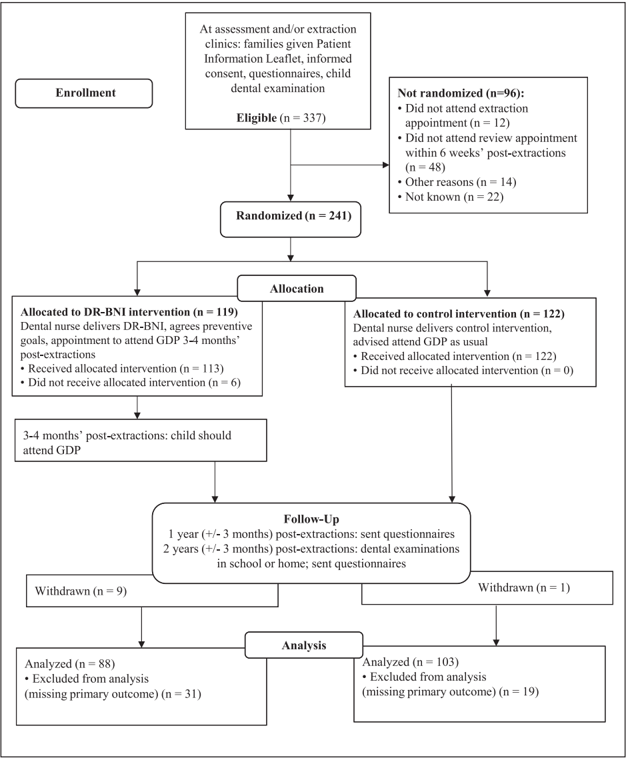
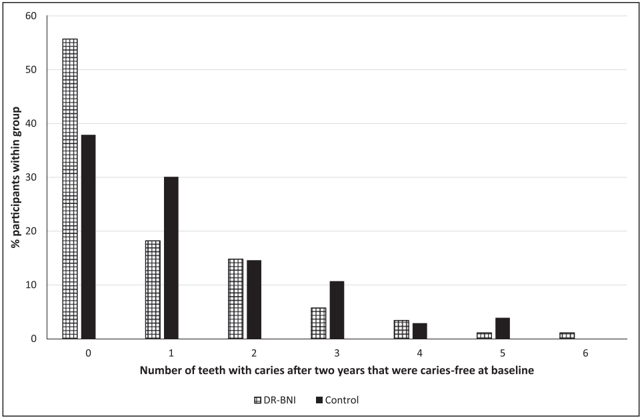
The purpose of this study was to determine the efficacy of a dental nurse–delivered intervention—the Dental RECUR Brief Negotiated Interview for Oral Health (DR-BNI)—in reducing the recurrence of dental caries in children who have a primary tooth extracted. It was based on a 2-arm multicenter randomized controlled trial with blinded outcome assessment. Participants were 5- to 7-y-old children ( n = 241) scheduled to have primary teeth extracted in 12 UK centers. Test intervention parents ( n = 119) received DR-BNI led by trained dental nurses. DR-BNI is a 30-min structured conversation informed by motivational interviewing with a forward focus to prevent future caries. Preventive goals are agreed, and a review appointment is made with child’s general dental practitioner, who is advised to treat the child as being at high caries risk. The control intervention ( n = 122) was a parent-nurse conversation about child’s future tooth eruption, with advice given to visit a general dental practitioner as usual. At baseline, the DR-BNI group’s mean dmft was 6.8, and the control group’s was 6.3. A median of 5 teeth were extracted, mainly under general anesthesia. Final dental assessments were conducted by a single examiner visiting 189 schools 2 y after intervention; 193 (80%) of 241 children were examined. In the control group, 62% developed new caries in teeth that were caries-free or unerupted at baseline, as compared with 44% in the test group, a significant reduction ( P = 0.021). The odds of new caries experience occurring were reduced by 51% in the DR-BNI group as compared with control. There was a 29% decrease in the relative risk of new caries experience in the DR-BNI group as compared with control. This single low-cost, low-intensity intervention was successful in significantly reducing the risk of recurrence of dental caries in children. This trial has implications for changing pediatric dental practice internationally. Training in and implementation of a motivational interviewing–informed brief intervention provides opportunities for dental nurses to facilitate behavior change improving the oral health of children at high caries risk (ISRCTN 24958829).
Overview
The claims and statistics of this paper haven’t been checked yet.
Free: it reads the open-access text and checks the first 5 claims that cite a source we can check. Create a free account to check every claim.
Integrity signals
Registry
Cites
Statistics
Figures
Verification
Claims the paper makes
The claims and statistics of this paper haven’t been checked yet.
Free: it reads the open-access text and checks the first 5 claims that cite a source we can check. Create a free account to check every claim.
Claims other papers make about this one
Each is checked against this paper’s own text: does it say what the citing paper says it does?
The cited source says what the claim attributes to it.
In the citing paper
“Where follow-up was conducted in a school setting for the RECUR study retention was reported as 80%; these were children with high caries risk having been referred for extractions [42].”
Self-check
Percentages, sums and reported differences re-computed from the paper’s own numbers.
The self-check needs the paper’s full text.
Citations
Cites
Scottish Intercollegiate Guidelines Network
Twaddle, S., & Qureshi, S. (2005) · Evidence-based Healthcare and Public Health · doi:10.1016/j.ehbc.2005.09.008 · Cited by 4,084
Multiple health behavior change research: An introduction and overview
Prochaska, J. J., Spring, B., & Nigg, C. R. (2008) · Preventive Medicine · doi:10.1016/j.ypmed.2008.02.001 · Cited by 604
Motivational interviewing in health care settings Opportunities and limitations
Emmons, K. (2001) · American Journal of Preventive Medicine · doi:10.1016/s0749-3797(00)00254-3 · Cited by 578
Delivering better oral health: an evidence-based toolkit for prevention
Munday, P. (2008) · Vital · doi:10.1038/vital731 · Cited by 456
Caries in Five-year-old Children and Associations with Family-related Factors
Mattila, M.-L., Rautava, P., Sillanpää, M., & Paunio, P. (2000) · Journal of Dental Research · doi:10.1177/00220345000790031501 · Cited by 288
Eight Stages in Learning Motivational Interviewing
Miller, W. R., & Moyers, T. B. (2006) · Journal of Teaching in the Addictions · doi:10.1300/j188v05n01_02 · Cited by 281
Adair, P., Pine, C. M., Burnside, G., Nicoll, A. D., Gillett, A., Anwar, S., Broukal, Z., Chestnutt, I. G., Declerck, D., Feng, P., et al. (2004) · PubMed · Cited by 245
Self-citationMotivating mothers to prevent caries
Weinstein, P., Harrison, R., & Benton, T. (2006) · The Journal of the American Dental Association · doi:10.14219/jada.archive.2006.0291 · Cited by 233
Motivating parents to prevent caries in their young children
WEINSTEIN, P., HARRISON, R., & BENTON, T. (2004) · The Journal of the American Dental Association · doi:10.14219/jada.archive.2004.0299 · Cited by 213
Papies, E. K. (2016) · Health Psychology Review · doi:10.1080/17437199.2016.1183506 · Cited by 186
Curnow, M. M. T., Pine, C. M., Burnside, G., Nicholson, J. A., Chesters, R. K., & Huntington, E. (2002) · Caries Research · doi:10.1159/000063925 · Cited by 143
Self-citationExtraction of first permanent molar teeth: results from three dental hospitals
Albadri, S., Zaitoun, H., McDonnell, S., & Davidson, L. E. (2007) · BDJ · doi:10.1038/bdj.2007.679 · Cited by 95
Self-citationEffect of smoking on subgingival microflora of patients with periodontitis in Japan
Kubota, M., Tanno-Nakanishi, M., Yamada, S., Okuda, K., & Ishihara, K. (2011) · BMC Oral Health · doi:10.1186/1472-6831-11-1 · Cited by 81
Amin, M. S., & Harrison, R. L. (2007) · PubMed · Cited by 41
Huntington, C., Newton, T., Donaldson, N. K., Liossi, C., Reynolds, P. A., Alharatani, R., & Hosey, M. T. (2017) · BMC Oral Health · doi:10.1186/s12903-017-0411-4 · Cited by 18
Self-citationPine, C. M., Adair, P., Burnside, G., Robinson, L., Edwards, R. T., Albadri, S., Curnow, M. M. T., Ghahreman, M., Henderson, M., Malies, C., et al. (2015) · Trials · doi:10.1186/s13063-015-1010-9 · Cited by 7
Self-citation
Research works printed but not linked: 5
- Coolidge T, Skaret E, Heima M, Johnson EK, Hillstead MB, Farjo N. 2011. Thinking about going to the dentist: a contemplation ladder to assess dentally-avoidant individuals' readiness to go to a dentist. BMC Oral Health. 11(4):1-12.
- Freudenthal JJ, Bowen DM. 2010. Motivational interviewing to decrease parental risk-related behaviors for early childhood caries. J Dent Hyg. 84(1):29-34.
- Pitts NB, Evans DJ, Pine CM. 1997. British Association for the Study of Community Dentistry (BASCD) diagnostic criteria for caries prevalence surveys-1996/97. Community Dent Health. 14 Suppl 1:6-9.
- Public Health England. 2018. National Dental Epidemiology Programme for England: oral health survey of five-year-old children. A report on the inequalities found in prevalence and severity of dental decay. London (UK): Public Health England. PHE 2018081.
- World Health Organization. 2008. Closing the gap in a generation: health equity through action on the social determinants of health. Final report of the Commission on Social Determinants of Health. Geneva (Switzerland): World Health Organization.
Cited by
Nonrestorative Management of Dental Caries
Yu, O. Y., Lam, W. Y. H., Wong, A. W.-Y., Duangthip, D., & Chu, C.-H. (2021) · Dentistry Journal · doi:10.3390/dj9100121 · Cited by 86
The current regenerative medicine approaches of craniofacial diseases: A narrative review
Tahmasebi, E., Mohammadi, M., Alam, M. M. R., Abbasi, K., Bajestani, S. G., Khanmohammad, R., Haseli, M., Yazdanıan, M., Barzegar, P. E. F., & Tebyanian, H. (2023) · Frontiers in Cell and Developmental Biology · doi:10.3389/fcell.2023.1112378 · Cited by 47
Aiuto, R., Dioguardi, M., Caruso, S., Lipani, E., Re, D., Gatto, R., & Garcovich, D. (2022) · Children · doi:10.3390/children9081215 · Cited by 42
Bhatti, A., Vinall‐Collier, K. A., Duara, R., Owen, J., Gray‐Burrows, K. A., & Day, P. F. (2021) · BMC Oral Health · doi:10.1186/s12903-021-01560-w · Cited by 27
Aggarwal, V. R., Wu, J., Fox, F., Howdon, D., Guthrie, E., & Mighell, A. J. (2021) · Journal of Oral Rehabilitation · doi:10.1111/joor.13229 · Cited by 19
Metadata
- Authors
- Pine, C. M., Adair, P. M., Burnside, G., Brennan, L., Sutton, L., Edwards, R. T., Ezeofor, V., Albadri, S., Curnow, M. M., Deery, C., Hosey, M. T., Willis-Lake, J., Lynn, J., Parry, J., & Wong, F. S. L.
- Affiliations
- Queen Mary University of London (GB)
- Queen's University Belfast (GB)
- University of Liverpool (GB)
- Health Education North West (GB)
- Bangor University (GB)
- NHS Tayside (GB)
- University of Sheffield (GB)
- King's College London (GB)
- Kent Community Health NHS Foundation Trust (GB)
- Belfast Health and Social Care Trust (GB)
- University College Cork (IE)
- Corresponding author
- Pine, C.M.
- ORCID
- Venue
- Journal of Dental Research
- Publisher
- SAGE Publications
- Published
- 2020-01-16
- Volume
- 99
- Issue
- 2
- Pages
- 168-174
- ISSN
- 0022-0345 (ISSN-L)
- 1544-0591
- OpenAlex
- W3000297948
- Semantic Scholar
- af8b0bff1022708da7a9a64604c869d9baaea7eb
- Cited by
- 48
- References
- 16
- Citations by year
- 2026: 2 · 2025: 6 · 2024: 6 · 2023: 3 · 2022: 8 · 2021: 15 · 2020: 7
- FWCI
- 8.43
- Type
- journal article
- Language
- en
- Open access
- hybrid
- doi.org
- Licence
- cc-by
- journals.sagepub.com/page/policies/text-and-data-mining-license (tdm)
- Locations
- Journal of Dental Research (publishedVersion, cc-by)
- PubMed (publishedVersion)
- White Rose Research Online (University of Leeds, The University of Sheffield, University of York) (acceptedVersion)
- Research Portal (Queen's University Belfast) (submittedVersion, cc-by)
- Arrow@dit (Dublin Institute of Technology) (submittedVersion, cc-by)
- Cork Open Research Archive (University College Cork, Ireland) (submittedVersion, cc-by)
- Research Portal (King's College London) (submittedVersion, other-oa)
- Queen Mary Research Online (Queen Mary University of London) (submittedVersion, cc-by)
- Funders
- National Institute for Health Research (PB-PG-0610-22310)
- Topics
- Health Sciences › Dentistry › General Dentistry › Dental Health and Care Utilization
- Health Sciences › Dentistry › Periodontics › Oral microbiology and periodontitis research
- Health Sciences › Dentistry › Oral Surgery › Dental Anxiety and Anesthesia Techniques
- Keywords
- primary tooth extraction, dental assistants, motivational interviewing, dental caries prevention, high caries risk children, DMFT index, behavior change
- MeSH terms
- Child, Child, Preschool, Dental Assistants, Dental Caries, Dentists, Humans, Parents, Recurrence, Tooth Extraction, Professional Role, Motivational Interviewing
About these checks
Registry, retraction, Cites and statistics results are computed, not judged, with one exception: a printed reference that no index lists is read once by a model before it counts as a citation error. Claims are extracted by a model and kept only when their quote appears verbatim in the text; each cited source is then checked, with a model’s help, for whether it says what the claim relies on. Those verdicts can be wrong — read the claim’s quote and the cited source before relying on one.
Statistics and arithmetic are recomputed, not judged.
Confidence bands are shown only for fields calibrated on our annotated test set. None is calibrated yet, so no band is shown.
What counts as a claim ›How we measure confidence ›How we check this ›
Are you an author, or do you see a problem with this page? Request a review
Data sources
Bibliographic data: Semantic Scholar, OpenAlex, Crossref.
Contains information from the Semantic Scholar Academic Graph Datasets, made available under the ODC Attribution License (ODC-BY 1.0).
Semantic Scholar’s data is described in: Kinney, R., et al. (2023). The Semantic Scholar Open Data Platform. arXiv:2301.10140.
