

The DOI matches its Crossref record; 75 of the 78 references it cites were found in a registry or an index, and 3 are not checked yet.
Estimation of Human Drug Clearance Using Multiexponential Techniques
Abstract
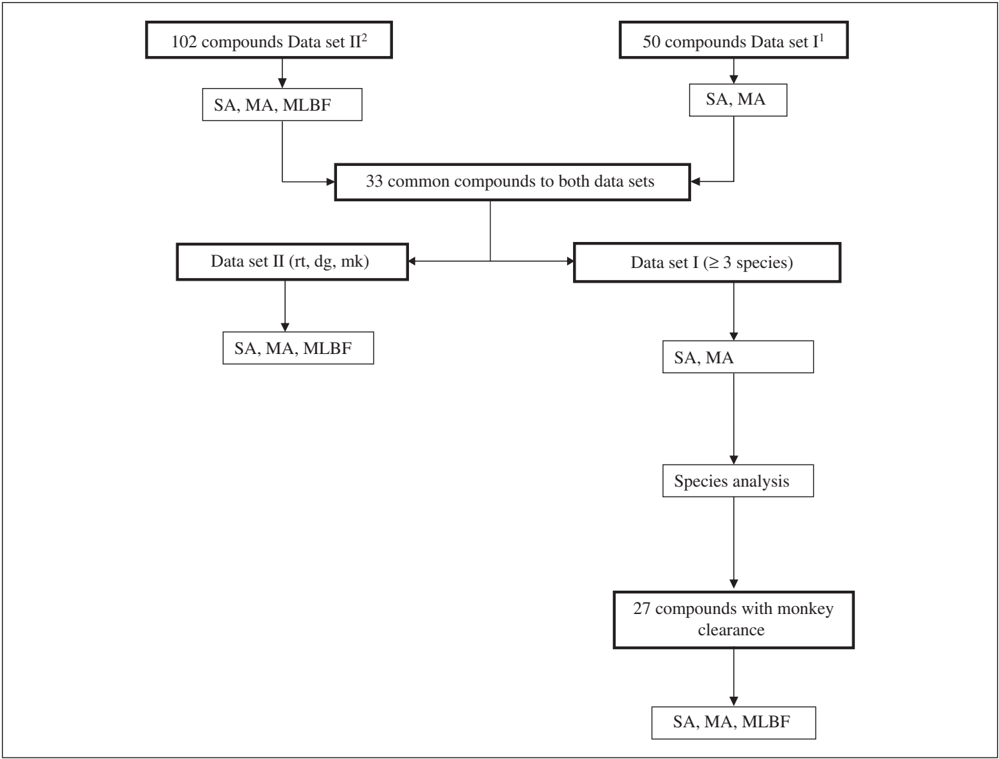
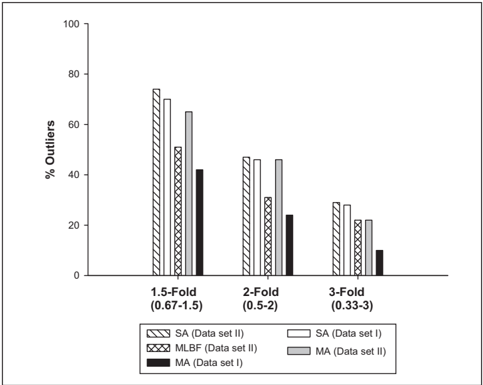
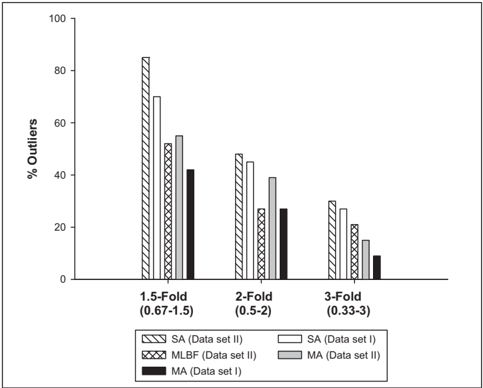
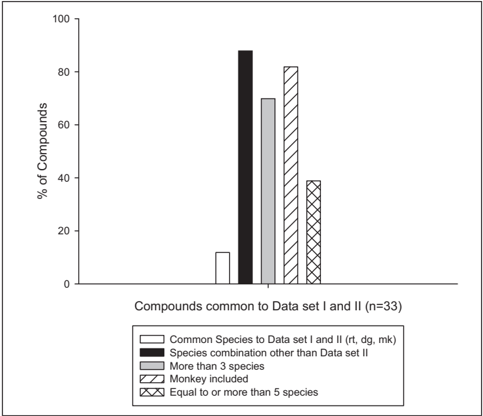
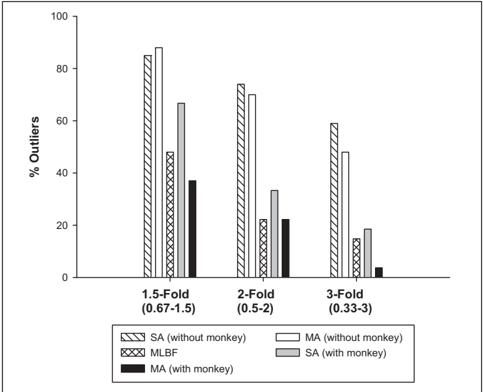
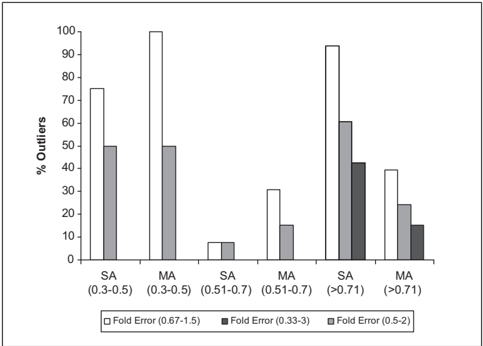
A multiexponential allometry (MA) method was developed to predict human drug clearance from preclinical data. Separate data sets containing clearances from human and preclinical species were chosen for the study. Human clearance was estimated using the MA technique according to the equation: CL = aBWb + cBWd, where CL is clearance in milliliters/minute, and a, b, c, and d are constants derived from preclinical pharmacokinetic data. Simple allometry (SA) gave the poorest prediction using any data set, and the percentage outliers remained larger than MA or monkey liver blood flow within 1.5-, 2-, and 3-fold error. Analysis of compounds common to both data sets suggested that MA could accurately predict human clearances within approximately 10% of 3-fold error. The analysis also showed that monkey is an important species for scaling, and MA is a better predictor of human clearance when the slope of SA is >0.7.
Overview
The claims and statistics of this paper haven’t been checked yet.
Run the check — free, no account needed. It reads the open-access text and checks the sources it cites.
Integrity signals
Registry
Cites
Statistics
Figures
Verification
Claims the paper makes
The claims and statistics of this paper haven’t been checked yet.
Run the check — free, no account needed. It reads the open-access text and checks the sources it cites.
Claims other papers make about this one
Each is checked against this paper’s own text: does it say what the citing paper says it does?
The cited source says what the claim attributes to it.
In the citing paper
“When the exponent of simple AS was greater than 0.7, MA showed better prediction of human CL than the simple AS method.”
From Interpretation of Non-Clinical Data for Prediction of Human Pharmacokinetic Parameters: In Vitro-In Vivo Extrapolation and Allometric Scaling (2019) · cites this paper as [92]
The cited source says what the claim attributes to it.
In the citing paper
“Their results indicate that monkey is an important species for scaling.”
From Interpretation of Non-Clinical Data for Prediction of Human Pharmacokinetic Parameters: In Vitro-In Vivo Extrapolation and Allometric Scaling (2019) · cites this paper as [92]
The cited source says what the claim attributes to it.
In the citing paper
“The MA method can successfully predict human clearance.”
From Interpretation of Non-Clinical Data for Prediction of Human Pharmacokinetic Parameters: In Vitro-In Vivo Extrapolation and Allometric Scaling (2019) · cites this paper as [92]
Self-check
Percentages, sums and reported differences re-computed from the paper’s own numbers.
The self-check needs the paper’s full text.
Citations
Cites
Physiological Parameters in Laboratory Animals and Humans
Davies, B., & Morris, T. (1993) · Pharmaceutical Research · doi:10.1023/a:1018943613122 · Cited by 2,957
The Prediction of Human Pharmacokinetic Parameters from Preclinical and in Vitro Metabolism Data
Obach, R. S., Baxter, J. G., Liston, T. E., Silber, B. M., Jones, B. C., Macintyre, F., Rance, D. J., & Wastall, P. (1997) · The Journal of Pharmacology and Experimental Therapeutics · doi:10.1016/s0022-3565(24)36999-x · Cited by 987
The prediction of human pharmacokinetic parameters from preclinical and in vitro metabolism data
Sun, K. (2005) · Chinese New Drugs Journal · Cited by 762
Quantitative Relations in the Physiological Constitutions of Mammals
Adolph, E. F. (1949) · Science · doi:10.1126/science.109.2841.579 · Cited by 497
Pharmacokinetics and metabolism of sildenafil in mouse, rat, rabbit, dog and man
Walker, D. K. (1999) · Xenobiotica · doi:10.1080/004982599238687 · Cited by 404
Dedrick, R. L. (1973) · Journal of Pharmacokinetics and Biopharmaceutics · doi:10.1007/bf01059667 · Cited by 397
Boxenbaum, H. (1980) · Journal of Pharmacokinetics and Biopharmaceutics · doi:10.1007/bf01065191 · Cited by 347
Interspecies Scaling: Predicting Clearance of Drugs in Humans. Three Different Approaches
Mahmood, I., & Balian, J. D. (1996) · Xenobiotica · doi:10.3109/00498259609052491 · Cited by 257
Evans, G. H., Nies, A. S., & Shand, D. G. (1973) · Journal of Pharmacology and Experimental Therapeutics · doi:10.1016/s0022-3565(25)29572-6 · Cited by 215
Ward, K. W., & Smith, B. R. (2004) · Drug Metabolism and Disposition · doi:10.1124/dmd.32.6.603 · Cited by 212
Research works printed but not linked: 1
- Mahmood I, 2005, Interspecies Pharmacokinetic Scaling
Cited by
Effects of Hypothermia on Pharmacokinetics and Pharmacodynamics
van den Broek, M. P. H., Groenendaal, F., Egberts, T. C. G., & Rademaker, C. M. A. (2010) · Clinical Pharmacokinetics · doi:10.2165/11319360-000000000-00000 · Cited by 209
Ring, B. J., Chien, J. Y., Adkison, K. K., Jones, H. M., Rowland, M., Jones, R. D., Yates, J. W. T., Ku, M. S., Gibson, C. R., He, H., et al. (2011) · Journal of Pharmaceutical Sciences · doi:10.1002/jps.22552 · Cited by 206
Applications of Human Pharmacokinetic Prediction in First-in-Human Dose Estimation
Zou, P., Yu, Y., Zheng, N., Yang, Y., Paholak, H. J., Yu, L. X., & Sun, D. (2012) · The AAPS Journal · doi:10.1208/s12248-012-9332-y · Cited by 138
Lombardo, F., Waters, N. J., Argikar, U. A., Dennehy, M. K., Zhan, J., Gunduz, M., Harriman, S. P., Berellini, G., Liric Rajlic, I., & Obach, R. S. (2013) · The Journal of Clinical Pharmacology · doi:10.1177/0091270012440282 · Cited by 106
Huh, Y., Smith, D. E., & Rose Feng, M. (2011) · Xenobiotica · doi:10.3109/00498254.2011.598582 · Cited by 98
Metadata
- Authors
- Goteti, K., Brassil, P. J., Good, S. S., & Garner, C. E.
- Affiliations
- AstraZeneca (United States) (US)
- Corresponding author
- Goteti, Kosalaram
- Venue
- The Journal of Clinical Pharmacology
- Publisher
- Wiley
- Published
- 2008-10
- Volume
- 48
- Issue
- 10
- Pages
- 1226-1236
- ISSN
- 0021-9754 (ISSN-L)
- 0091-2700
- 1552-4604
- OpenAlex
- W2126304490
- Cited by
- 28
- References
- 74
- Citations by year
- 2026: 1 · 2025: 2 · 2024: 2 · 2020: 1 · 2019: 1 · 2018: 1 · 2016: 1 · 2014: 1 · 2013: 2 · 2012: 5
- FWCI
- 2.97
- Type
- journal article
- Language
- en
- Open access
- closed
- Locations
- The Journal of Clinical Pharmacology (publishedVersion)
- PubMed (publishedVersion)
- Topics
- Health Sciences › Medicine › Pediatrics, Perinatology and Child Health › Pharmaceutical studies and practices
- Life Sciences › Pharmacology, Toxicology and Pharmaceutics › Pharmacology › Pharmacogenetics and Drug Metabolism
- Health Sciences › Veterinary › Small Animals › Animal testing and alternatives
- Keywords
- allometric scaling, clearance prediction, interspecies extrapolation
- MeSH terms
- Animals, Haplorhini, Body Weight, Data Interpretation, Statistical, Drug Evaluation, Preclinical, Pharmaceutical Preparations, Humans, Liver Circulation, Models, Biological, Pharmacokinetics, Species Specificity
About these checks
Registry, retraction, Cites and statistics results are computed, not judged, with one exception: a printed reference that no index lists is read once by a model before it counts as a citation error. Claims are extracted by a model and kept only when their quote appears verbatim in the text; each cited source is then checked, with a model’s help, for whether it says what the claim relies on. Those verdicts can be wrong — read the claim’s quote and the cited source before relying on one.
Statistics and arithmetic are recomputed, not judged.
Confidence bands are shown only for fields calibrated on our annotated test set. None is calibrated yet, so no band is shown.
What counts as a claim ›How we measure confidence ›How we check this ›
Are you an author, or do you see a problem with this page? Request a review
How to cite
Cite CoChat for the checks on this page, and the paper for its own findings.
- This page
- CoChat. (2026). Citation check: Estimation of Human Drug Clearance Using Multiexponential Techniques. https://app.cochat.ai/papers/10.1177/0091270008320369
- The paper
- Goteti, K., Brassil, P. J., Good, S. S., & Garner, C. E. (2008). Estimation of Human Drug Clearance Using Multiexponential Techniques. The Journal of Clinical Pharmacology. https://doi.org/10.1177/0091270008320369
Data sources
Bibliographic data: Semantic Scholar, OpenAlex, Crossref.
Contains information from the Semantic Scholar Academic Graph Datasets, made available under the ODC Attribution License (ODC-BY 1.0).
Semantic Scholar’s data is described in: Kinney, R., et al. (2023). The Semantic Scholar Open Data Platform. arXiv:2301.10140.
