

The DOI matches its Crossref record; 25 of the 25 references it cites were found in a registry or an index.
Balanced scorecard-based performance evaluation of Chinese county hospitals in underdeveloped areas
Open accessAbstract
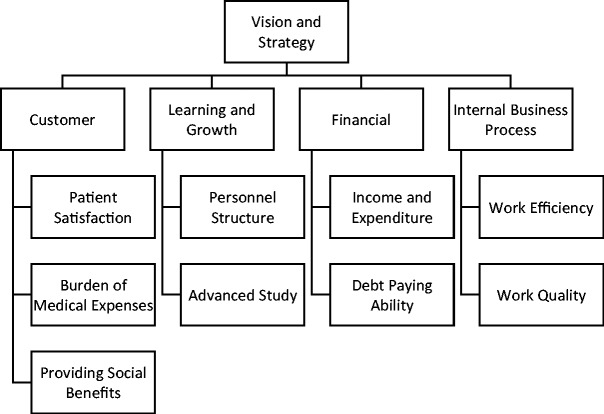
Objective: Since the Guangxi government implemented public county hospital reform in 2009, there have been no studies of county hospitals in this underdeveloped area of China. This study aimed to establish an evaluation indicator system for Guangxi county hospitals and to generate recommendations for hospital development and policymaking. Methods: A performance evaluation indicator system was developed based on balanced scorecard theory. Opinions were elicited from 25 experts from administrative units, universities and hospitals and the Delphi method was used to modify the performance indicators. The indicator system and the Topsis method were used to evaluate the performance of five county hospitals randomly selected from the same batch of 2015 Guangxi reform pilots. Results: There were 4 first-level indicators, 9 second-level indicators and 36 third-level indicators in the final performance evaluation indicator system that showed good consistency, validity and reliability. The performance rank of the hospitals was B > E > A > C > D. Conclusions: The performance evaluation indicator system established using the balanced scorecard is practical and scientific. Analysis of the results based on this indicator system identified several factors affecting hospital performance, such as resource utilisation efficiency, medical service price, personnel structure and doctor–patient relationships.
Overview
The claims and statistics of this paper haven’t been checked yet.
Run the check — free, no account needed. It reads the open-access text and checks the sources it cites.
Integrity signals
Registry
Cites
Statistics
Figures
Verification
Claims the paper makes
The claims and statistics of this paper haven’t been checked yet.
Run the check — free, no account needed. It reads the open-access text and checks the sources it cites.
Claims other papers make about this one
Each is checked against this paper’s own text: does it say what the citing paper says it does?
The cited source doesn’t support the claim as written.
In the citing paper
“However, even if healthcare organizations need to fulfil government constraints about budget, expenditures, costs, etc. [50,68,84], the financial perspective is not at the top of BSC perspectives.”
From The Evolution of Balanced Scorecard in Healthcare: A Systematic Review of Its Design, Implementation, Use, and Review (2022) · cites this paper as [84]
Checked by a reasoning model — may be wrong.
Experimental — accuracy not yet measured
Self-check
Percentages, sums and reported differences re-computed from the paper’s own numbers.
The self-check needs the paper’s full text.
Citations
Cites
(1992) · PubMed · Cited by 7,979
Creating project plans to focus product development.
Wheelwright, S. C., & Clark, K. B. (1992) · PubMed · Cited by 775
Wang, T.-K., Zhang, Q., Chong, H., & Wang, X. (2017) · Sustainability · doi:10.3390/su9020289 · Cited by 204
Self-citationVoelker, K., Rakich, J. S., & French, G. (2001) · Hospital Topics · doi:10.1080/00185860109597908 · Cited by 147
An analysis of performance evaluation for motor-imagery based BCI
Thomas, E. M., Dyson, M., & Clerc, M. (2013) · Journal of Neural Engineering · doi:10.1088/1741-2560/10/3/031001 · Cited by 116
Falle, S., Rauter, R., Engert, S., & Baumgartner, R. J. (2016) · Sustainability · doi:10.3390/su8060545 · Cited by 112
Developing a national performance indicator framework for the Dutch health system
ten Asbroek, A. H. A. (2004) · International Journal for Quality in Health Care · doi:10.1093/intqhc/mzh020 · Cited by 99
A Balanced Scorecard for Canadian Hospitals
Baker, G. R., & Pink, G. H. (1995) · Healthcare Management Forum · doi:10.1016/s0840-4704(10)60926-x · Cited by 85
Performance outcomes of balanced scorecard application in hospital administration in China
Lin, Z., Yu, Z., & Zhang, L. (2014) · China Economic Review · doi:10.1016/j.chieco.2014.05.003 · Cited by 71
Sustainability Investigation of Resource-Based Cities in Northeastern China
Lu, C., Xue, B., Lu, C., Wang, T., Jiang, L., Zhang, Z., & Ren, W. (2016) · Sustainability · doi:10.3390/su8101058 · Cited by 70
Research works printed but not linked: 9
- Kaplan RS, 1992, Harv Bus Rev, 70, 70
- Meliones JN, 2001, J Health Care Finance, 27, 21
- Ten AA, 2004, Int J Qual Health Care, 16, 155
- Jianli Z., 2012, Public hospital performance evaluation indicator system and evaluation system design
- Yan X, 2014, Chinese Hospital Management, 34, 21
- Farzianpour F, 2014, American Journal of Economics & Business Administration, 3, 272
- Minmin W., 2015, Modern Economic Information, 173
- Ronggui C., 2011, Chinese Hospitals, 15, 1
- Xiaoyan Z, 2014, Chin J Hosp Admin, 30, 171
Cited by
Does the Central Environmental Inspection actually work?
Li, R., Zhou, Y., Bi, J., Liu, M., & Li, S. (2019) · Journal of Environmental Management · doi:10.1016/j.jenvman.2019.109602 · Cited by 154
Wei, D., Xu, A., & Wu, X. (2019) · PsyCh Journal · doi:10.1002/pchj.327 · Cited by 69
Scoping review of balanced scorecards for use in healthcare settings: development and implementation
Bohm, V., Lacaille, D., Spencer, N., & Barber, C. E. (2021) · BMJ Open Quality · doi:10.1136/bmjoq-2020-001293 · Cited by 59
Hospital performance evaluation indicators: a scoping review
Hadian, S. A., Rezayatmand, R., Shaarbafchizadeh, N., Ketabi, S., & Pourghaderi, A. R. (2024) · BMC Health Services Research · doi:10.1186/s12913-024-10940-1 · Cited by 54
Sun, Y., Chen, X., Xiaoyang, Z., & Zhang, M. (2020) · Journal of Cleaner Production · doi:10.1016/j.jclepro.2020.122431 · Cited by 51
Betto, F., Sardi, A., Garengo, P., & Sorano, E. (2022) · International Journal of Environmental Research and Public Health · doi:10.3390/ijerph191610291 · Cited by 49
Amer, F., Hammoud, S., Khatatbeh, H., Lohner, S., Boncz, I., & Endrei, D. (2022) · BMC Health Services Research · doi:10.1186/s12913-022-07863-0 · Cited by 50
Li, Z., & Hua, W. (2020) · Frontiers in Public Health · doi:10.3389/fpubh.2020.532420 · Cited by 29
Amer, F., Hammoud, S., Onchonga, D., Alkaiyat, A. S., Nour, A. I., Boncz, I., & Endrei, D. (2022) · International Journal of Environmental Research and Public Health · doi:10.3390/ijerph19127149 · Cited by 28
Bureaucracy and the balanced scorecard in health care settings
Oliveira, H. C., Rodrigues, L. L., & Craig, R. (2020) · International Journal of Health Care Quality Assurance · doi:10.1108/ijhcqa-07-2019-0121 · Cited by 24
Amer, F., Hammoud, S., Khatatbeh, H., Alfatafta, H., Alkaiyat, A. S., Nour, A. I., Boncz, I., & Endrei, D. (2022) · International Journal of Environmental Research and Public Health · doi:10.3390/ijerph19159096 · Cited by 23
Establishing a balanced scorecard measurement system for integrated care organizations in China
Wu, X., Li, S., Xu, N., Wu, D., & Zhang, X. (2019) · The International Journal of Health Planning and Management · doi:10.1002/hpm.2726 · Cited by 16
Application of Balanced Scorecard in Performance Management and Evaluation of Listed Companies
Xuqin, S. (2022) · Discrete Dynamics in Nature and Society · doi:10.1155/2022/2247890 · Cited by 14
Li, J., Guo, B., Huang, X., Wang, H., Zuo, G., & Lu, W. (2023) · BMJ Open · doi:10.1136/bmjopen-2021-059013 · Cited by 10
Rošulj, D., & Petrović, D. Č. (2020) · Megatrend revija · doi:10.5937/megrev2001109r · Cited by 8
Kundariyah, S., Tjahjono, H. K., Aini, Q., & Setyonugroho, W. (2021) · Disease Prevention and Public Health Journal (DPPHJ) · doi:10.12928/dpphj.v16i1.4585 · Cited by 10
Zhang, J., Cai, J., He, Z., Pu, C., & Tang, G. (2020) · Journal of Service Science and Management · doi:10.4236/jssm.2020.132016 · Cited by 8
Sun, C., Wei, D., Gong, H., Xue, D., & Wu, X. (2020) · International Journal of Nursing Practice · doi:10.1111/ijn.12872 · Cited by 7
Amer, F., Neiroukh, H., Abuzahra, S., AlHabil, Y., Afifi, M., Shellah, D., Boncz, I., & Endrei, D. (2022) · Frontiers in Public Health · doi:10.3389/fpubh.2022.1045512 · Cited by 7
Uddin, M. S., Habib, M. M., & Mohamed, O. E. B. (2023) · International Supply Chain Technology Journal · doi:10.20545/isctj.v09.i06.01 · Cited by 5
He, M., & Estébanez, R. P. (2022) · Computational Intelligence and Neuroscience · doi:10.1155/2022/1230786 · Cited by 5
RetractedXu, Z., Tan, J., Nicholas, S., Maitland, E., Meng, Z., Han, X., & Wang, J. (2024) · BMJ Open · doi:10.1136/bmjopen-2024-083964 · Cited by 4
Exploring the Interconnectedness of Supply Chain Management Theories: A Literature Review
Uddin, M. S., Habib, M. M., & Mohamed, O. E. B. (2023) · International Supply Chain Technology Journal · doi:10.20545/isctj.v09.i04.03 · Cited by 5
Panjaitan, L. F. Y., Sjaaf, A. C., & Falinda, R. (2023) · Jurnal kesehatan komunitas (Journal of community health) · doi:10.25311/keskom.vol8.iss3.1305 · Cited by 5
Hui, L., Wang, J., Xing, X., & Ren, W. (2021) · Patient Preference and Adherence · doi:10.2147/ppa.s290651 · Cited by 4
Fradj, A. B., Asli, N. E., Boukherroub, T., & Olivier, C. (2023) · F1000Research · doi:10.12688/f1000research.138430.1 · Cited by 4
Hospital Employee Performance Evaluation Based on Knowledge Map
Wang, L., Huang, R., Shen, C., & Li, G. (2022) · International Journal of Information Systems and Supply Chain Management · doi:10.4018/ijisscm.306251 · Cited by 3
Teixeira, C., Kisata, L., Vogt, M., & Krüger, S. D. (2024) · REVISTA AMBIENTE CONTÁBIL - Universidade Federal do Rio Grande do Norte · doi:10.21680/2176-9036.2024v16n1id31870 · Cited by 3
Balanced Scorecard applied to Hospital Units- a systematic review of the literature
Marques, P. C. D. A. (2022) · Emergency and Nursing Management · doi:10.58489/2836-2179/009 · Cited by 3
Bibliometric analysis - what has been studied about balanced scorecard?
Marques, P. C. D. A., Oliveira, P. A., & Porte, M. D. S. (2024) · Revista de Gestão e Secretariado (Management and Administrative Professional Review) · doi:10.7769/gesec.v15i9.4069 · Cited by 3
Wang, W., van Wijngaarden, J. D. H., Wang, H., Buljac‐Samardžić, M., Yuan, S., & van de Klundert, J. J. (2021) · Frontiers in Health Services · doi:10.3389/frhs.2021.766677 · Cited by 3
A REVIEW OF THE BALANCED SCORECARD IMPLEMENTATION IN HEALTH SECTOR ORGANIZATION
Tarigan, S., & Bachtiar, A. (2019) · Proceedings of the International Conference on Applied Science and Health · Cited by 2
Satria, T. F., Hadiguna, R. A., Henmaidi, H., & Arief, I. (2024) · Jurnal Sains dan Teknologi Jurnal Keilmuan dan Aplikasi Teknologi Industri · doi:10.36275/j611ac61 · Cited by 1
Revolutionizing Global Business Excellence Through the Balanced Scorecard Success
Ula, A. L., & Fitriyah, H. (2024) · Indonesian Journal of Law and Economics Review · doi:10.21070/ijler.v19i3.1130 · Cited by 1
The performance assessment of the Jordanian logistics sectors: A balanced scorecard approach
Aljaman, M. F. S., Saadon, M. S. I., Othman, M. R., Aburasul, J. A. K., Issa, A. H. H., & Ayyash, A. H. A. (2023) · Corporate and Business Strategy Review · doi:10.22495/cbsrv4i4art16 · Cited by 4
The need for a balanced scorecard to monitor hospital performance
Shrivastava, S. R., & Shrivastava, P. (2019) · Acta Medica International · doi:10.4103/ami.ami_17_19 · Cited by 1
Performance Measurement of a Private Hospital during the Pandemic Covid-19
Umniyatun, Y., Aulia, K. F., Rahayu, S., Jacoeb, T. N. Z., & Nurmansyah, M. I. (2023) · International Research Journal of Business Studies · doi:10.21632/irjbs.16.1.27-42 · Cited by 1
Adnan, Y. M., Arifin, M., & Mallongi, A. (2018) · International Journal of Advanced Research · doi:10.21474/ijar01/7352
Review of Balanced Scorecard Application in Public Hospital Setting
Khalid, S. K., & Sands, J. (2024) · Contributions to environmental sciences & innovative business technology · doi:10.1007/978-981-97-2981-4_1
Yang, M. Z., Miao, J., Li, T., Jiang, R., & Jiang, M. (2024) · Frontiers in Public Health · doi:10.3389/fpubh.2024.1384118
Aurora, P. O. P. A., Lazar, B. A., MARIAN, L. O., Cotoi, O. S., & Voidăzan, S. T. (2024) · Acta Marisiensis. Seria Medica · doi:10.2478/amma-2024-0023
Key performance indicators for ranking general hospitals in Iran
Jajarmizadeh, A., Mosadeghrad, A. M., & Jaafaripooyan, E. (2025) · Payesh (Health Monitor) Journal · doi:10.61186/payesh.24.3.315
Additional file 1 of Hospital performance evaluation indicators: a scoping review
Hadian, S. A., Rezayatmand, R., Shaarbafchizadeh, N., Ketabi, S., & Pourghaderi, A. (2024) · Figshare · doi:10.6084/m9.figshare.26714764
Amer, F., Hammoud, S., Khatatbeh, H., Lohner, S., Boncz, I., & Endrei, D. (2022) · Figshare · doi:10.6084/m9.figshare.19738607
Additional file 3 of Hospital performance evaluation indicators: a scoping review
Hadian, S. A., Rezayatmand, R., Shaarbafchizadeh, N., Ketabi, S., & Pourghaderi, A. (2024) · Figshare · doi:10.6084/m9.figshare.26714770
Amer, F., Hammoud, S., Khatatbeh, H., Lohner, S., Boncz, I., & Endrei, D. (2022) · Figshare · doi:10.6084/m9.figshare.19738622
Amer, F., Hammoud, S., Khatatbeh, H., Lohner, S., Boncz, I., & Endrei, D. (2022) · Figshare · doi:10.6084/m9.figshare.19738619
Additional file 2 of Hospital performance evaluation indicators: a scoping review
Hadian, S. A., Rezayatmand, R., Shaarbafchizadeh, N., Ketabi, S., & Pourghaderi, A. (2024) · Figshare · doi:10.6084/m9.figshare.26714767
Analisis Pengukuran Kinerja Menggunakan Balanced Scorecard Di RSIA ABC
Tjahjono, G. A. K., & Manalu, R. V. B. (2026) · RIGGS Journal of Artificial Intelligence and Digital Business · doi:10.31004/riggs.v5i2.7344
Yusmar, M. R. (2025) · Global Journal of Health Administration · doi:10.30651/gjha.v1i1.26839
Peng, R., Meng, D. E. N. G., Li, Z., Kang, J., Wei, J., Jiang, N., Qin, X., Xu, T., & Feng, J. (2026) · BMC Health Services Research · doi:10.1186/s12913-026-14888-2
Self-citationImpact of Digitalization on Performance of Dutch Hospitals: Longitudinal Quantitative Study
Remus, P., Westra, D., Gifford, R. E., Baan, F. C. V. D., & Govers, M. (2026) · Journal of Medical Internet Research · doi:10.2196/94896
Metadata
- Authors
- Gao, H., Chen, H., Feng, J., Qin, X., Wang, X., Liang, S., Zhao, J., & Feng, Q.
- Affiliations
- Guangxi Medical University (CN)
- Guangxi University of Chinese Medicine (CN)
- Corresponding author
- Feng, Qiming
- Venue
- Journal of International Medical Research
- Publisher
- SAGE Publications
- Published
- 2018-03-22
- Volume
- 46
- Issue
- 5
- Pages
- 1947-1962
- ISSN
- 0300-0605 (ISSN-L)
- 1473-2300
- PMC
- PMC5991253
- OpenAlex
- W2792668464
- Cited by
- 53
- References
- 25
- Citations by year
- 2026: 2 · 2025: 2 · 2024: 13 · 2023: 8 · 2022: 12 · 2021: 4 · 2020: 6 · 2019: 5 · 2018: 1
- FWCI
- 5.04
- Type
- journal article
- Language
- en
- Open access
- gold
- doi.org
- Licence
- Locations
- Journal of International Medical Research (publishedVersion, cc-by-nc)
- Europe PMC (PubMed Central) (publishedVersion, cc-by-nc)
- PubMed Central (publishedVersion, cc-by-nc)
- PubMed (publishedVersion)
- DOAJ (DOAJ: Directory of Open Access Journals) (submittedVersion, cc-by-sa)
- Funders
- Guangxi Zhuang Autonomous Region Health and Family Planning Commission
- Topics
- Health Sciences › Medicine › Public Health, Environmental and Occupational Health › Healthcare Quality and Management
- Health Sciences › Medicine › Public Health, Environmental and Occupational Health › Healthcare Systems and Practices
- Social Sciences › Business, Management and Accounting › Accounting › Accounting and Organizational Management
- Keywords
- balanced scorecard, hospital performance evaluation, county hospitals, public hospital reform, evaluation index system, underdeveloped regions, Guangxi, physician-patient relationship, hospital rankings
- MeSH terms
- Adult, China, Developing Countries, Female, Hospitals, County, Humans, Male, Middle Aged
About these checks
Registry, retraction, Cites and statistics results are computed, not judged, with one exception: a printed reference that no index lists is read once by a model before it counts as a citation error. Claims are extracted by a model and kept only when their quote appears verbatim in the text; each cited source is then checked, with a model’s help, for whether it says what the claim relies on. Those verdicts can be wrong — read the claim’s quote and the cited source before relying on one.
Statistics and arithmetic are recomputed, not judged.
Confidence bands are shown only for fields calibrated on our annotated test set. None is calibrated yet, so no band is shown.
What counts as a claim ›How we measure confidence ›How we check this ›
Are you an author, or do you see a problem with this page? Request a review
Data sources
Bibliographic data: Semantic Scholar, OpenAlex, Crossref.
Contains information from the Semantic Scholar Academic Graph Datasets, made available under the ODC Attribution License (ODC-BY 1.0).
Semantic Scholar’s data is described in: Kinney, R., et al. (2023). The Semantic Scholar Open Data Platform. arXiv:2301.10140.
