

Utilization, Patient Characteristics, and Longitudinal Improvements among Patients from a Provincially Funded Transdiagnostic Internet-delivered Cognitive Behavioural Therapy Program: Observational Study of Trends over 6 Years
Open accessThe DOI matches its Crossref record; 51 of the 51 references it cites were found in a registry or an index; 24 of the 32 sources its claims cite were checked for support.
Abstract
Objective: There is strong evidence supporting internet-delivered cognitive behaviour therapy (iCBT) and consequently growing demand for iCBT in Canada. Transdiagnostic iCBT that addresses both depression and anxiety is particularly promising as it represents an efficient method of delivering iCBT in routine care. The Online Therapy Unit, funded by the Saskatchewan government, has been offering transdiagnostic iCBT for depression and anxiety since 2013. In this article, to broadly inform implementation efforts, we examined trends in utilization, patient characteristics, and longitudinal improvements for patients receiving transdiagnostic iCBT over 6 years. Methods: Patients who completed telephone screening between November 2013 and December 2019 were included in this observational study. Patients provided demographics and mental health history at screening and completed measures at pre-treatment, post-treatment and at 3- to 4-month follow-up. Treatment engagement and satisfaction were assessed. Results: A total of 5,321 telephone screenings were completed and 4,283 of patients were accepted for treatment over the 6-year period (80.5% acceptance). The most common reason for referral to another service was high suicide risk/severe symptoms (47.1%). Examination of trends showed growing use of transdiagnostic iCBT over time (37% increase per year). There was remarkable stability in patient characteristics across years. Most patients were concurrently using medication (57.3%) with 11.9% reporting using iCBT while on a waiting list for face-to-face treatment highlighting the importance of integrating iCBT with other services. Consistent across years, large improvements in depression and anxiety symptoms were found and maintained at 3- to 4-month follow-up. There was strong patient engagement with iCBT and positive ratings of treatment experiences. Conclusions: As there is growing interest in iCBT in Canada, this large observational study provides valuable information for those implementing iCBT in terms of likely user characteristics, patterns of use, and improvements. This information has potential to assist with resource allocation and planning in Canada and elsewhere. © The Author(s) 2021.
Overview
CoChat Summary
## TL;DR
This 6-year observational study of Saskatchewan’s publicly funded transdiagnostic iCBT program found rising use, stable patient characteristics, and consistently large symptom improvements that were maintained at 3- to 4-month follow-up. The program also showed high engagement and satisfaction, but many patients used iCBT alongside medication or other services.
## Key findings
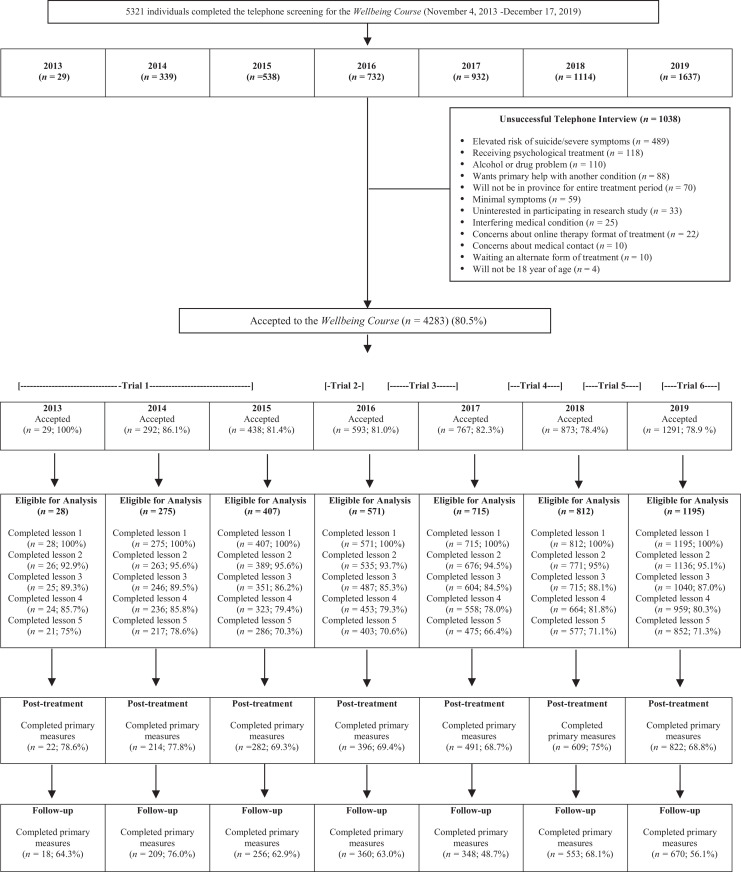
- Over 6 years, 5,321 telephone screenings were completed and 4,283 patients were accepted for treatment, an 80.5% acceptance rate; treatment use grew by 37% per year, with the Online Therapy Unit showing average annual increases of 37.7% in screenings and 35.3% in starts.
- Patient characteristics were largely stable across years; 83.7% (n = 3,352) had depression and/or anxiety in the clinical range, 60.7% (n = 2,290) reported psychotropic medication use in the last 3 months, and 57.3% were concurrently using medication.
- Symptom outcomes improved significantly on all measures at post-treatment and were maintained at follow-up; among those in the clinical range, effect sizes were large for all post-treatment and follow-up measures except social anxiety, which had a moderate post-treatment effect.
- Recovery and deterioration rates reported in the discussion were 55.7% for depression recovery, 58.7% for anxiety recovery, 1.3% for depression deterioration, and 1.7% for anxiety deterioration; engagement was high, with 80.4% (n = 3,217) accessing at least 4 lessons and 96.3% saying the course was worth their time.
## Methods
- Uncontrolled observational cohort analysis of patients who requested iCBT between November 2013 and December 2019; the paper combines data across and between several registered trials of the Wellbeing Course.
- Patients completed online screening and telephone screening, then provided pre-treatment, 8-week/post-treatment, and 3- to 4-month follow-up measures; treatment engagement and satisfaction were also assessed.
- Analyses used chi-square tests for categorical yearly trends, ANOVA for continuous trends, and generalized estimating equation (GEE) models for symptom change from baseline to post-treatment to follow-up, with missing data imputed.
## Limitations
- The paper states that post-treatment and follow-up data were missing for approximately 30% and 40% of patients, respectively, although it used imputation.
- The study had no control group, used self-report measures rather than diagnostic interviews, and did not track key demographics such as gender and sexual orientation, so some groups may be under-represented.
- The paper also notes that healthcare-use data were only collected in a subsample and with a brief measure, so it could not fully determine whether iCBT reduced use of other services; it did not track additional resource use either.
Model-written summary. Check it against the paper before relying on it.
Integrity signals
Registry
Cites
Statistics
Figures
Verification
Claims the paper makes
14 Valid · 3 Not valid · 5 Not checked · 58 Own results and interpretations
The cited sources support only part of this claim — read each source’s verdict below.
In the paper
“Examining trends also adds to evidence regarding iCBT in routine care as there are few reports of iCBT outcomes sustained over longer periods after initial implementation efforts conclude. 35”
§ Utilization, Patient Characteristics, and Longitudinal Improvements among Patients from a Provincially Funded Transdiagnostic Internet-delivered Cognitive Behavioural Therapy Program: Observational Study of Trends over 6 Years > Introduction
What the sources say
- Partly supportedcites [35] Mohr DC Riper H Schueller SM. A solution-focused research approach to achieve an implementable revolution in digital mental health. JAMA Psychiatry. 2018; 75(2): 113– 114. 29238805 sourceExperimental — accuracy not yet measured
The Sustainable Implementation section (page not available) says funded research often ends with publication of an efficacy trial and argues for sustaining digital mental health interventions after research support is withdrawn. It does not say that reports of long-term iCBT outcomes after initial implementation efforts are few. (LLM, conf=0.78)
plain- Asserted: passes — The authors put it forward as true.
- Checkable: passes — It can be checked against evidence.
- Load-bearing: passes — The paper’s conclusions depend on it.
- Based: passes — The paper gives a reason why it holds.
- Rests on an assumption not shown here.
- Partly supported
A result the paper reports from its own data — it cites no other source for it, so there is none to check. The quote shows it is in the paper.
In the paper
“A considerable number of patients met criteria for recovery (55.7% for depression; 58.7% for anxiety), and deterioration rates were very low (1.3% for depression; 1.7% for anxiety).”
§ Utilization, Patient Characteristics, and Longitudinal Improvements among Patients from a Provincially Funded Transdiagnostic Internet-delivered Cognitive Behavioural Therapy Program: Observational Study of Trends over 6 Years > Discussion
plain- Asserted: passes — The authors put it forward as true.
- Checkable: passes — It can be checked against evidence.
- Load-bearing: passes — The paper’s conclusions depend on it.
- Based: passes — The paper gives a reason why it holds.
A result the paper reports from its own data — it cites no other source for it, so there is none to check. The quote shows it is in the paper.
In the paper
“Table 2 shows baseline symptom severity for patients who started iCBT each year remained stable (Supplementary Material Table 2 also shows the clinical profile was stable across trials).”
§ Utilization, Patient Characteristics, and Longitudinal Improvements among Patients from a Provincially Funded Transdiagnostic Internet-delivered Cognitive Behavioural Therapy Program: Observational Study of Trends over 6 Years > Results > Clinical Profile at Screening
plain- Asserted: passes — The authors put it forward as true.
- Checkable: passes — It can be checked against evidence.
- Load-bearing: unclear — It is unclear whether the paper’s conclusions depend on it.
- Based: passes — The paper gives a reason why it holds.
A result the paper reports from its own data — it cites no other source for it, so there is none to check. The quote shows it is in the paper.
In the paper
“There were no differences in patient characteristics over time, except for the proportion who indicated having children (range: 51.0% to 63.8%).”
§ Utilization, Patient Characteristics, and Longitudinal Improvements among Patients from a Provincially Funded Transdiagnostic Internet-delivered Cognitive Behavioural Therapy Program: Observational Study of Trends over 6 Years > Results > Background
plain- Asserted: passes — The authors put it forward as true.
- Checkable: passes — It can be checked against evidence.
- Load-bearing: unclear — It is unclear whether the paper’s conclusions depend on it.
- Based: passes — The paper gives a reason why it holds.
A result the paper reports from its own data — it cites no other source for it, so there is none to check. The quote shows it is in the paper.
In the paper
“For the sub-sample who completed healthcare questions at screening (n = 655) and follow-up (n = 453), there was no change in the proportion of patients who reported visits to a psychiatrist (16.6% vs. 16.6%), mental health professional (27% vs. 21.6%), medical or health professional (7.2% vs. 4.9%), or having an emergency room/hospital admission (4.7% vs. 2.6%).”
§ Utilization, Patient Characteristics, and Longitudinal Improvements among Patients from a Provincially Funded Transdiagnostic Internet-delivered Cognitive Behavioural Therapy Program: Observational Study of Trends over 6 Years > Results > Secondary Analysis of Healthcare Use
plainn = 453- Asserted: passes — The authors put it forward as true.
- Checkable: passes — It can be checked against evidence.
- Load-bearing: unclear — It is unclear whether the paper’s conclusions depend on it.
- Based: passes — The paper gives a reason why it holds.
34 more claims
Create a free account to see all 80 claims and every source verdict.
- Probably not a substantial claim. 27
- It may state two separate claims as one. 22
- The quote only partly states this claim. 1
Statistics recomputed
Every reported test result, recomputed from its test statistic and degrees of freedom. A result shows as not adding up only once an independent check has confirmed it.
- Consistentχ²(1) = 88.16reported p < .001 · recomputed p < .001
“χ2 (1, N = 655) = 88.16, p < .001”
- Consistentχ²(1) = 81.82reported p < .001 · recomputed p < .001
“χ2 (1, N = 655) = 81.82, p < .001”
Self-check
Percentages, sums and reported differences re-computed from the paper’s own numbers.
Self-check results appear here once an independent check has confirmed them.
Citations
Cites
The PHQ-9: Validity of a brief depression severity measure
Kroenke, K., Spitzer, R. L., & Williams, J. B. W. (2001) · Journal of General Internal Medicine · doi:10.1046/j.1525-1497.2001.016009606.x · Cited by 44,910 · cited 1×
“The PHQ-9 is a 9-item questionnaire assessing depression over the past 2 weeks (range 0 to 27).(36) Scoring 10 suggests a likely depression diagnosis.”
BackgroundA Brief Measure for Assessing Generalized Anxiety Disorder: The GAD-7
Spitzer, R. L., Kroenke, K., Williams, J. B. W., & Löwe, B. (2006) · Archives of Internal Medicine · doi:10.1001/archinte.166.10.1092 · Cited by 31,765 · cited 1×
“The GAD-7 is a 7-item questionnaire measuring anxiety over the past 2 weeks (range 0 to 21).(37) Scoring 8 suggests a likely generalized anxiety disorder diagnosis.”
BackgroundVos, T., Abajobir, A. A., Abate, K. H., Abbafati, C., Abbas, K. M., Abd-Allah, F., Abdulkader, R. S., Abdulle, A. M., Abebo, T. A., Abera, S. F., et al. (2017) · The Lancet · doi:10.1016/s0140-6736(17)32154-2 · Cited by 13,220
KESSLER, R. C., ANDREWS, G., COLPE, L. J., HIRIPI, E., MROCZEK, D. K., NORMAND, S.-L. T., WALTERS, E. E., & ZASLAVSKY, A. M. (2002) · Psychological Medicine · doi:10.1017/s0033291702006074 · Cited by 10,327 · cited 1×
“The K10 includes10 items of psychological distress (ranges 10 to 50).(42) Score > 21 suggests significant distress.”
BackgroundManea, L., Gilbody, S., & McMillan, D. (2012) · Canadian Medical Association Journal · doi:10.1503/cmaj.110829 · Cited by 1,966
Development and validation of a revised short version of the working alliance inventory
Hatcher, R. L., & Gillaspy, J. A. (2006) · Psychotherapy Research · doi:10.1080/10503300500352500 · Cited by 1,355 · cited 1×
“The 12-item WAI-SR, administered at 8 weeks, resulted in a total working alliance score (range 15 to 60), and task, goal, and bond sub-scores (range 5 to 20).(44)”
MethodPersuasive System Design Does Matter: a Systematic Review of Adherence to Web-based Interventions
Kelders, S. M., Kok, R. N., Ossebaard, H. C., & Van Gemert-Pijnen, J. E. (2012) · Journal of Medical Internet Research · doi:10.2196/jmir.2104 · Cited by 1,308 · cited 1×
“, therapist, psychologist) to offer support via weekly asynchronous emails and or telephone calls(10) and for programs to include persuasive design features such as automated emails.(12) While iCBT research emerged over 20 years ago,(13) within Canada, there has been limited access to publicly funded therapist-assiste…”
BackgroundHubbard (2010) · doi:10.1097/ede.0b013e3181caeb90 · Cited by 1,139
Barriers to mental health treatment: results from the National Comorbidity Survey Replication
Mojtabai, R., Olfson, M., Sampson, N. A., Jin, R., Druss, B., Wang, P. S., Wells, K. B., Pincus, H. A., & Kessler, R. C. (2011) · Psychological Medicine · doi:10.1017/s0033291710002291 · Cited by 951 · cited 1×
“, stigma) barriers to treatment.(3) Public health crises, like COVID-19, highlight the need for digital mental health treatments.”
BackgroundThe COVID-19 pandemic: the ‘black swan’for mental health care and a turning point for e-health
Wind, T. R., Rijkeboer, M., Andersson, G., & Riper, H. (2020) · Internet Interventions · doi:10.1016/j.invent.2020.100317 · Cited by 782 · cited 1×
“Public health crises, like COVID-19, highlight the need for digital mental health treatments.(4) Consequently, the Canadian government announced “an investment of $240.”
Background
Research works printed but not linked: 2
- Canadian Agency for Drugs and Technologies in Health. Internet-delivered cognitive behavioural therapy for major depressive disorder and anxiety disorders: an environmental scan. Environmental Scan. 2018. [ accessed 2020]. https://cadth.ca/internet-delivered-cognitive-behavioural-therapy-major-depressive-disorder-and-anxiety-disorders-1 31454188
- Sheehan DV. The anxiety disease. Scribner, (NY): Bantam Books. 1983.
Cited by
Cross, S. P., Karin, E., Staples, L. G., Bisby, M. A., Ryan, K., Duke, G., Nielssen, O., Kayrouz, R., Fisher, A., Dear, B. F., et al. (2022) · Internet Interventions · doi:10.1016/j.invent.2022.100506 · Cited by 57
“DMHS already provide treatment as part of routine care in several countries (Titov et al., 2019a; Titov et al., 2018) (Hadjistavropoulos et al., 2021; Nordgreen et al., 2019; Titov et al., 2019b; Ruwaard et al., * Corresponding author at: MindSpot Clinic, Macquarie University, Sydney, Australia.”
Self-citationEustis, E. H., Graham-LoPresti, J. R., Aguilera, A., & Schueller, S. M. (2023) · Journal of Medical Internet Research · doi:10.2196/45409 · Cited by 31
“As such, TESs for mental health are recommended and used as frontline treatments around the world [4,6,7].”
Staples, L., Webb, N., Asrianti, L., Cross, S. P. M., Rock, D. J., Kayrouz, R., Karin, E., Dear, B. F., Nielssen, O. B., & Titov, N. (2022) · International Journal of Environmental Research and Public Health · doi:10.3390/ijerph19020905 · Cited by 40
Self-citationHarty, S., Enrique, Á., Akkol‐Solakoglu, S., Adegoke, A., Farrell, H., Connon, G., Ward, F., Kennedy, C., Chambers, D., & Richards, D. (2023) · International Journal of Mental Health Systems · doi:10.1186/s13033-023-00592-9 · Cited by 47
“User satisfaction ratings were also very high, exceeding 94% for overall satisfaction, consistent with those reported for Mindspot and another well-established national digital CBT service in Canada [32, 48, 49].”
MethodResultSoucy, J. N., Hadjistavropoulos, H. D., Karin, E., Dear, B. F., & Titov, N. (2021) · Internet Interventions · doi:10.1016/j.invent.2021.100394 · Cited by 21
Self-citationHadjistavropoulos, H. D., Peynenburg, V., Thiessen, D., Schneider, L. H., Nugent, M., Wilhelms, A., Karin, E., Titov, N., & Dear, B. F. (2022) · European Journal of Pain · doi:10.1002/ejp.1866 · Cited by 16
Self-citationMcCall, H. C., Dear, B. F., Landry, C. A., Beahm, J. D., Gregory, J., Titov, N., Carleton, R. N., & Hadjistavropoulos, H. D. (2023) · Internet Interventions · doi:10.1016/j.invent.2023.100656 · Cited by 24
Self-citationDuffy, D. J., Richards, D., Hisler, G. C., & Timulák, L. (2025) · Journal of Medical Internet Research · doi:10.2196/47927 · Cited by 43
“Services in Australia and Canada reported that they regularly conducted audits of service effectiveness [38,64,71], and such routine monitoring data were used so that staff could evaluate and understand the effectiveness of iCBT in their service [28,65] and to ensure compliance with treatment…”
InfluentialBisby, M. A., Titov, N., Dear, B. F., Karin, E., Wilhelms, A., Nugent, M., & Hadjistavropoulos, H. D. (2022) · Journal of Clinical Medicine · doi:10.3390/jcm11206001 · Cited by 16
“This may be a result of the ongoing impacts of the pandemic on people’s lives that are less amenable to change via psychological skills, such as reduced employment (note that fewer individuals were in paid employment in the current sample compared to previous samples from the same setting [51]), social isolation, and…”
BackgroundResultSelf-citationSapkota, R. P., Valli, E., Wilhelms, A., Adlam, K., Bourgeault, L., Heron, V., Dickerson, K. C., Nugent, M., & Hadjistavropoulos, H. D. (2023) · Healthcare · doi:10.3390/healthcare11152135 · Cited by 11
“, [72], and patient perspectives on the strengths and challenges of the Course [80,81].”
BackgroundSelf-citationMcCall, H. C., Landry, C. A., Ogunade, A., Carleton, R. N., & Hadjistavropoulos, H. D. (2021) · International Journal of Environmental Research and Public Health · doi:10.3390/ijerph182211972 · Cited by 20
“Public Health 2021, 18, 11972 3 of 14 population in Saskatchewan through the Online Therapy Unit [36].”
BackgroundSelf-citationEdmonds, M., Peynenburg, V. A., Kaldo, V., Jernelöv, S., Titov, N., Dear, B. F., & Hadjistavropoulos, H. D. (2024) · Internet Interventions · doi:10.1016/j.invent.2024.100729 · Cited by 11
“Consistent with previous ICBT research (e.g., Hadjistavropoulos et al., 2021), large reductions in symptoms of anxiety and depression were observed at post-treatment and maintained at 20-week follow-up.”
MethodSelf-citationSapkota, R. P., Valli, E., Dear, B. F., Titov, N., & Hadjistavropoulos, H. D. (2024) · Frontiers in Psychiatry · doi:10.3389/fpsyt.2024.1270543 · Cited by 13
Self-citationHadjistavropoulos, H. D., McCall, H. C., Dear, B. F., Beahm, J. D., Carleton, R. N., & Titov, N. (2024) · Journal of Anxiety Disorders · doi:10.1016/j.janxdis.2024.102861 · Cited by 14
Self-citationFisher, A. C., Corrigan, E., Cross, S. P. M., Ryan, K., Staples, L., Tan, R. L., Webb, N., Titov, N., & Dear, B. F. (2023) · Clinical Psychologist · doi:10.1080/13284207.2022.2163157 · Cited by 11
Self-citationDuffy, D. J., Richards, D., Earley, C., & Timulák, L. (2023) · Frontiers in Digital Health · doi:10.3389/fdgth.2023.1139125 · Cited by 10
Reid, N., Oberthier, S., Cramm, H. A., Beahm, J. D., Reiser, S. J., Cox, M., Dena, I., & Hadjistavropoulos, H. D. (2024) · Journal of Military Veteran and Family Health · doi:10.3138/jmvfh-2023-0041 · Cited by 6
Self-citationBeck, C. D., Peynenburg, V. A., Patterson, T., Titov, N., Dear, B. F., & Hadjistavropoulos, H. D. (2024) · Internet Interventions · doi:10.1016/j.invent.2024.100709 · Cited by 5
“In an observational study of 4283 clients accepted into the WC over the span of 6 years, Hadjistavropoulos et al. (2022) reported similarly large effect sizes of g = 1.01 (95 % CI [0.97, 1.05]) and g = 1.19 (95 % CI [0.97, 1.05]) for improvements in depression and anxiety from pre-treatment to…”
BackgroundInfluentialSelf-citationKhan, B. N., Liu, R. H., Chu, C., Bolea-Alamanac, B. M., Nguyen, M., Thapar, S., Fanaieyan, R., Leon-Carlyle, M., Tadrous, M., Kurdyak, P. A., et al. (2024) · International Journal of Mental Health Systems · doi:10.1186/s13033-024-00651-9 · Cited by 6
“Several clinical trials suggest that iCBT is effective and broadly accessible [10, 11, 13], with growing evidence of successful iCBT implementation as part of routine care in Canadian provinces and other juris-dictions [14–18].”
BackgroundMethodInfluentialCross, S. P., Staples, L. G., Bisby, M. A., Nielssen, O., Fisher, A., Titov, N., & Dear, B. F. (2023) · Internet Interventions · doi:10.1016/j.invent.2023.100655 · Cited by 4
“, 2018), and iCBT is now delivered as part of routine care in several countries (Titov et al., 2018; Titov et al., 2019; Hadjistavropoulos et al., 2021; Nordgreen et al., 2019; Ruwaard et al., 2012; Johansson et al., 2019; Staples et al., 2021).”
Self-citationPeynenburg, V. A., Sapkota, R. P., Titov, N., Dear, B. F., & Hadjistavropoulos, H. D. (2024) · Internet Interventions · doi:10.1016/j.invent.2024.100796 · Cited by 5
Self-citationSapkota, R. P., Peynenburg, V. A., Dear, B. F., Titov, N., & Hadjistavropoulos, H. D. (2025) · SSM - Mental Health · doi:10.1016/j.ssmmh.2025.100561 · Cited by 4
Self-citationFisher, A. C., Bisby, M. A., Hathway, T., Rezwan, A., Ayre, J., Muscat, D. M., Titov, N., & Dear, B. F. (2025) · Advances in Mental Health · doi:10.1080/18387357.2025.2536801 · Cited by 4
Self-citationLeBlanc, J., Talbot, F., Fournier, V., Titov, N., & Dear, B. F. (2022) · Internet Interventions · doi:10.1016/j.invent.2022.100529 · Cited by 4
Self-citationRoemmel, N., Bahmane, S., Hadjistavropoulos, H. D., Nugent, M., Lieb, R., & Meinlschmidt, G. (2025) · BMJ Open · doi:10.1136/bmjopen-2024-097651 · Cited by 6
“Reviewer #1; Specific Comment #2:”
Self-citationPeynenburg, V. A., Ababei, A., Wilhelms, A., Edmonds, M., Titov, N., Dear, B. F., Kaldo, V., Jernelöv, S., & Hadjistavropoulos, H. D. (2022) · International Journal of Environmental Research and Public Health · doi:10.3390/ijerph19159337 · Cited by 5
“Transdiagnostic internet-delivered cognitive behavior therapy represents a valuable approach for improving patient access to care [1].”
BackgroundSelf-citationFournier, V., Talbot, F., Hadjistavropoulos, H. D., Titov, N., Dear, B. F., Lang, R., Saulnier, V., Hébert, H., & Cloutier, G. (2025) · Internet Interventions · doi:10.1016/j.invent.2025.100813 · Cited by 3
“Treatment outcomes were consistent with the ones obtained in Sas-katchewan and Australia (Hadjistavropoulos et al., 2022; Titov et al., 2017).”
Self-citationNielssen, O. B., Staples, L., Karin, E., Ryan, K., Kayrouz, R., Dear, B. F., Cross, S. P. M., & Titov, N. (2023) · BJPsych Open · doi:10.1192/bjo.2023.60 · Cited by 3
Self-citationPrice, J. A. B., Gregory, J., McCall, H. C., Landry, C. A., Beahm, J. D., & Hadjistavropoulos, H. D. (2024) · JMIR Formative Research · doi:10.2196/64454 · Cited by 4
“PSPNET adapted a previously established ICBT course that has excellent treatment outcomes in Australia [10] and Canada [12,13] to address common mental health concerns of PSP.”
BackgroundSelf-citationTitov, N., Dear, B. F., Staples, L., Fisher, A. C., Hadjistavropoulos, H. D., & Nielssen, O. B. (2025) · Internet Interventions · doi:10.1016/j.invent.2025.100857 · Cited by 4
“…policy makers and funders when establishing and operating successful DMHSs in Australia and other countries (e.g., Dear et al., 2024a; Dear et al., 2024b; Fournier et al., 2025; Hadjistavropoulos et al., 2022; LeBlanc et al., 2022; Staples et al., 2022; Titov et al., 2020a; Titov et al., 2020b).”
Self-citationHadjistavropoulos, H. D., Dear, B. F., Titov, N., & Sapkota, R. P. (2025) · Internet Interventions · doi:10.1016/j.invent.2025.100894 · Cited by 3
“These results align with a growing body of research showing transdiagnostic ICBT is associated with improvements in diverse mental health concerns (Andersson et al., 2019a; Hadjistavropoulos et al., 2022; Titov et al., 2018).”
Self-citationFisher, A. C., Rochesson, S. E. D., Bisby, M. A., Scott, A. J., Gandy, M., Heriseanu, A. I., Titov, N., & Dear, B. F. (2024) · Health Expectations · doi:10.1111/hex.13976 · Cited by 4
“While some treatments are therapist ‐ guided 21,22 , others are self ‐ guided without guidance or support from a trained health professional either before or during the intervention.”
BackgroundSelf-citationMcCall, H. C., & Hadjistavropoulos, H. D. (2024) · Journal of Medical Internet Research · doi:10.2196/59699 · Cited by 5
“The original Wellbeing Course was initially developed by the eCentreClinic at Macquarie University, Australia, and has since shown excellent outcomes among the general population in Australia [67] and Canada [68].”
Self-citationNikdanesh, M., Ashuri, A., Gharraee, B., & Farahani, H. (2025) · Journal of Education and Health Promotion · doi:10.4103/jehp.jehp_203_24 · Cited by 3
Dear, B. F., Fisher, A. C., Bisby, M. A., Scott, A. J., & Titov, N. (2025) · Internet Interventions · doi:10.1016/j.invent.2025.100887 · Cited by 1
Self-citationGatov, E., Bhattacharyya, O. K., Strudwick, G., Wiljer, D., & Kurdyak, P. (2025) · Journal of Technology in Behavioral Science · doi:10.1007/s41347-025-00555-6 · Cited by 1
Health Literacy Recommendations for Digital Mental Health Treatments
Fisher, A. C., Rezwan, A., Muscat, D. M., Ayre, J., Bisby, M. A., Hathway, T., Choi, I., Titov, N., & Dear, B. F. (2026) · HLRP Health Literacy Research and Practice · doi:10.3928/24748307-20250714-01 · Cited by 2
“…of mental health conditions (Bassilios, Ftanou, et al., 2022; Bassilios, Morgan, et al., 2022), and are offered as part of routine care in several countries around the world (Hadjistavropoulos et al., 2021; Johansson et al., 2019; Nordgreen et al., 2019; Ruwaard et al., 2012; Titov et al., 2020).”
Self-citationNielssen, O. B., Staples, L., Dear, B. F., & Titov, N. (2025) · Australasian Psychiatry · doi:10.1177/10398562251344490 · Cited by 1
Self-citationSapkota, R. P., Valli, E., Dear, B. F., et al. (2023) · Preprints.org · doi:10.20944/preprints202307.1574.v1 · Cited by 1
Self-citationBeck, C. D., Peynenburg, V. A., Patterson, T., Titov, N., Dear, B. F., & Hadjistavropoulos, H. D. (2023) · SSRN Electronic Journal · doi:10.2139/ssrn.4600119
Self-citationSapkota, R. P., Peynenburg, V. A., Dear, B. F., Titov, N., & Hadjistavropoulos, H. D. (2024) · Research Square · doi:10.21203/rs.3.rs-5634185/v1
Self-citationHadjistavropoulos, H. D., Peynenburg, V. A., Sapkota, R. P., Valli, E., Nugent, M., Keough, M. T., Sundström, C., Schaub, M. P., Titov, N., & Dear, B. F. (2025) · Internet Interventions · doi:10.1016/j.invent.2025.100809 · Cited by 2
“…was conducted by the Online Therapy Unit (OTU) which is based at the University of Regina and funded by the Saskatchewan Government (Ministry of Health) to provide free ICBT to Saskatchewan residents as part of public health care (Hadjistavropoulos et al., 2014; Hadjistavropoulos et al., 2021b).”
Self-citationLee, C. T., Harty, S., Enrique, Á., Jiménez-Díaz, A., Hisler, G. C., Duffy, D. J., & Richards, D. (2025) · doi:10.2196/preprints.80689
Harty, S., Enrique, Á., Akkol‐Solakoglu, S., Adegoke, A., Farrell, H., Connon, G., Ward, F., Kennedy, C., Chambers, D., & Richards, D. (2023) · Figshare · doi:10.6084/m9.figshare.24286561
Harty, S., Enrique, Á., Akkol‐Solakoglu, S., Adegoke, A., Farrell, H., Connon, G., Ward, F., Kennedy, C., Chambers, D., & Richards, D. (2024) · Figshare · doi:10.6084/m9.figshare.24286649
Lee, C. T., Harty, S., Enrique, Á., Jiménez-Díaz, A., Hisler, G. C., Duffy, D. J., & Richards, D. (2026) · Journal of Medical Internet Research · doi:10.2196/80689
Gatov, E., Strudwick, G., Wiljer, D., Bhattacharyya, O. K., & Kurdyak, P. A. (2026) · Cognitive Behaviour Therapy · doi:10.1080/16506073.2026.2624695 · Cited by 1
Choi, I., Mahoney, A., & Shiner, C. T. (2026) · Australian Psychologist · doi:10.1080/00050067.2026.2666418
“A routine evaluation of users of a routine Canadian iCBT Program also found low usage among people of Asian ethnicity (Hadjistavropoulos et al., 2022).”
Nguyen, K., Nair, A., Olaizola, S., Corkum, P. V., Feldman, B. M., Jibb, L., & Stinson, J. (2026) · Sleep Medicine · doi:10.1016/j.sleep.2026.109003
Roemmel, N., Hadjistavropoulos, H. D., Nugent, M., Lieb, R., & Meinlschmidt, G. (2026) · Internet Interventions · doi:10.1016/j.invent.2026.100974
Self-citationGatov, E., de Oliveira, C., Strudwick, G., Wiljer, D., Bhattacharyya, O. K., & Kurdyak, P. A. (2026) · The Canadian Journal of Psychiatry · doi:10.1177/07067437261477547
Gretton, A., Sapkota, R. P., Orobosa, G. O., Dear, B. F., Titov, N., & Hadjistavropoulos, H. D. (2026) · Internet Interventions · doi:10.1016/j.invent.2026.100998 · Cited by 1
“Men are also consistently underrepresented among ICBT users, with women typically comprising the majority of clients (Hadjistavropoulos et al., 2022; van der Vaart et al., 2019).”
Self-citation
Metadata
- Authors
- Hadjistavropoulos, H. D., Peynenburg, V., Thiessen, D. L., Nugent, M., Karin, E., Staples, L., Dear, B. F., & Titov, N.
- Affiliations
- University of Regina (CA)
- Macquarie University (AU)
- Corresponding author
- Hadjistavropoulos, Heather D.
- ORCID
- Venue
- The Canadian Journal of Psychiatry
- Publisher
- SAGE Publications
- Published
- 2021-04-12
- Volume
- 67
- Issue
- 3
- Pages
- 192-206
- ISSN
- 0706-7437 (ISSN-L)
- 1497-0015
- PMC
- PMC8935601
- OpenAlex
- W3155574916
- Cited by
- 52
- References
- 51
- Citations by year
- 2026: 10 · 2025: 12 · 2024: 13 · 2023: 10 · 2022: 4 · 2021: 3
- FWCI
- 6.66
- Type
- journal article
- Language
- en
- Open access
- hybrid
- doi.org
- Licence
- Locations
- The Canadian Journal of Psychiatry (publishedVersion, cc-by-nc)
- PubMed Central (publishedVersion, cc-by-nc)
- PubMed (publishedVersion)
- Funders
- Canadian Institutes of Health Research (152917)
- Topics
- Social Sciences › Psychology › Applied Psychology › Digital Mental Health Interventions
- Health Sciences › Medicine › Public Health, Environmental and Occupational Health › Telemedicine and Telehealth Implementation
- Social Sciences › Psychology › Experimental and Cognitive Psychology › Anxiety, Depression, Psychometrics, Treatment, Cognitive Processes
- Keywords
- internet-based cognitive behavioral therapy, transdiagnostic treatment, depression, anxiety, treatment utilization, patient characteristics, treatment engagement, treatment satisfaction, telephone screening, medication use, waiting lists, resource allocation
- MeSH terms
- Anxiety Disorders, Humans, Saskatchewan, Cognitive Behavioral Therapy, Treatment Outcome, Internet
About these checks
Registry, retraction, Cites and statistics results are computed, not judged, with one exception: a printed reference that no index lists is read once by a model before it counts as a citation error. Claims are extracted by a model and kept only when their quote appears verbatim in the text; each cited source is then checked, with a model’s help, for whether it says what the claim relies on. Those verdicts can be wrong — read the claim’s quote and the cited source before relying on one.
The claim verdicts this report counts are experimental: their accuracy is not yet measured.
A language model drew the claims from the paper on 2026-10-11, under version 3 of the claim definition (model deepseek-v4.1-flash, prompt extract-v3).
A second model labelled each claim on 2026-10-11 (model jev-1.13-20260917, definition revision gold-guideline-v0.2).
Cited sources are checked with a language model’s help (gpt-6-sol).
Statistics and arithmetic are recomputed, not judged.
Confidence bands are shown only for fields calibrated on our annotated test set. None is calibrated yet, so no band is shown.
What counts as a claim ›How we measure confidence ›How we check this ›
Are you an author, or do you see a problem with this page? Request a review
Data sources
Bibliographic data: Semantic Scholar, OpenAlex, Crossref.
Contains information from the Semantic Scholar Academic Graph Datasets, made available under the ODC Attribution License (ODC-BY 1.0).
Semantic Scholar’s data is described in: Kinney, R., et al. (2023). The Semantic Scholar Open Data Platform. arXiv:2301.10140.
