

Navigating the Risks of Using Large Language Models for Text Annotation in Social Science Research
Open accessThe DOI matches its Crossref record; 79 of the 80 references it cites were found in a registry or an index, and 1 are not checked yet; 3 of the 22 sources its claims cite were checked for support.
Abstract
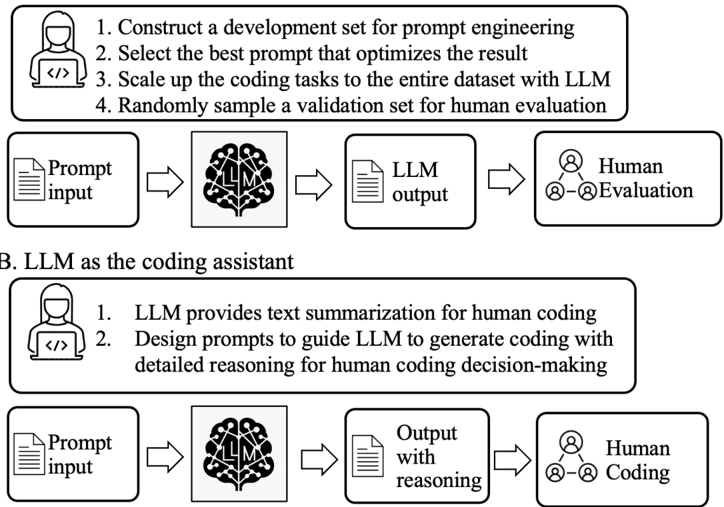
Large language models (LLMs) have the potential to revolutionize computational social science, particularly in automated textual analysis. In this paper, we conduct a systematic evaluation of the promises and risks associated with using LLMs for text classification tasks, using social movement studies as an example. We propose a framework for social scientists to incorporate LLMs into text annotation, either as the primary coding decision-maker or as a coding assistant. This framework offers researchers tools to develop the potential best-performing prompt, and to systematically examine and report the validity and reliability of LLMs as a methodological tool. Additionally, we evaluate and discuss its epistemic risks associated with validity, reliability, replicability, and transparency. We conclude with several practical guidelines for using LLMs in text annotation tasks and offer recommendations for more effectively communicating epistemic risks in research.
Verified 2026-11-25 · 1 reference not checked yet
Overview
CoChat Summary
TL;DR
This paper systematically evaluates OpenAI GPT-4 (and Meta Llama3-8B) as text annotators for social movement coding tasks, benchmarking against the human-coded Dynamics of Collective Action (DoCA) dataset. It proposes a workflow in which LLMs act either as primary coders or as coding assistants, and argues that validity, reliability, replicability, and transparency risks grow with task complexity.
Key findings
- GPT-4 accuracy/F1 declined as task complexity rose: binary police presence scored 0.84/0.63 (zero-shot), 0.85/0.64 (zero-shot CoT), and 0.82/0.61 (zero-shot ToT); multiclass protest size scored 0.499/0.464, 0.484/0.449, and 0.461/0.426; multilabel protest activity scored 0.548, 0.409, and 0.564 (subset accuracy, no F1 reported).
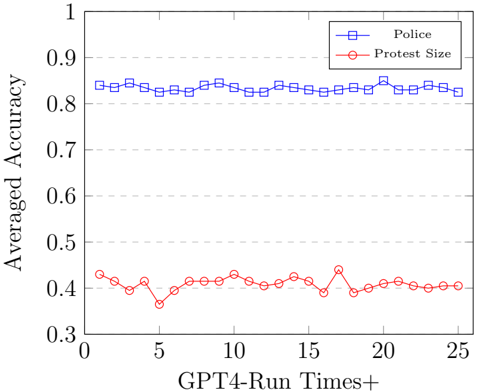
- Reliability also tracked complexity: across 25 repeated runs on 200 articles, ICC was 0.934 (95% CI [0.921, 0.946]) for police presence (excellent) but only 0.518 (95% CI [0.463, 0.577]) for protest size (moderate).
- Prompting strategy mattered: zero-shot CoT outperformed others on binary classification, while zero-shot ToT worked better for multiclass classification.
- Llama3-8B (4-bit quantized, CoT, temperature 0.2, run locally via ollama) performed worse than GPT-4: 0.762/0.566 (binary), 0.367/0.284 (multiclass), and 0.099 (multilabel), with runtimes of 1.6, 2.2, and 5.5 hours respectively.
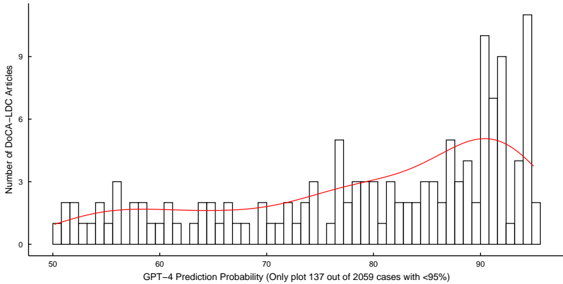
- Human review of 100 articles found GPT-4's step-by-step CoT reasoning factually correct, while Llama3 made inference errors (e.g., inferring police presence not stated in the article); most police-presence predictions had token probabilities above 95%, with 137 cases below that threshold flagged for further investigation.
Methods
- Design: systematic evaluation of LLM coding against human-coded ground truth, using social movement studies as an illustrative domain; three task types (binary police presence, multiclass protest size on a 1–6 scale, multilabel protest activity scored by subset accuracy).
- Data: the DoCA project's annotated New York Times articles (1960–1995) aligned with the Linguistic Data Consortium NYT corpus; a 200-article random subset for reliability testing and 100 articles for manual evaluation of reasoning outputs.
- Analysis: GPT-4-turbo queried with zero-shot role-play, zero-shot CoT, and zero-shot ToT prompts; intraclass correlation (ICC) across 25 repeated runs treated as raters, using Koo and Li's (2016) thresholds; logprob values inspected for prediction confidence; Llama3-8B compared under the same zero-shot CoT prompt.
Limitations
- Stated by the paper: only zero-shot classification with different prompting strategies was tested (few-shot prompting and fine-tuning left untested); rapid advances in generative AI may mitigate some risks; findings are specific to social movement studies and may not generalize across domains; only GPT-4 and Llama3-8B were compared, not the newer Llama3.1-405B.
- Evident from the text: the reliability demonstration used only two tasks (police presence and protest size) on a 200-article subset, and the manual reasoning audit covered only 100 articles, so the transparency findings rest on a small sample; the paper reports accuracy and F1 for some tasks but only subset accuracy for the multilabel task, limiting comparability across tasks.
Model-written summary. Check it against the paper before relying on it.
Integrity signals
Registry
Cites
Statistics
Figures
Verification
Claims the paper makes
3 Valid · 1 Not valid · 15 Not checked · 38 Own results and interpretations
Every source the paper cites for this claim was checked and supports it.
In the paper
“A recent work conducted by Barrie et al. (2024) shows that the prompt stability of outputs generally decreases with increasing temperature due to the degradation in the quality of prompts.”
§ The Risks of Using Large Language Models for Text Annotation in Social Science Research > Are Generative AI coding results replicable?
What the sources say
- Supportedcites Barrie et al. (2024) matched to “Prompt Stability Scoring for Text Annotation with Large Language Models” (2024) source
The Results section (Section 5) states that 'the stability of outputs generally decreases as temperature increases' and attributes this to the prompt becoming 'more semantically distant from the original,' i.e. 'degradation in quality of coding guidelines (prompts)' — exactly what the citing sentence attributes. Section 5.2 and 4.2.2 corroborate the mechanism (higher temperature -> more semantically distant/garbled prompts -> lower inter-PSS). (LLM, conf=0.90)
plainstates a cause- Asserted: passes — The authors put it forward as true.
- Checkable: passes — It can be checked against evidence.
- Load-bearing: unclear — It is unclear whether the paper’s conclusions depend on it.
- Based: passes — The paper gives a reason why it holds.
- Supported
The cited sources support only part of this claim — read each source’s verdict below.
In the paper
“The potential lack of replicability is another hurdle that lowers social scientists' enthusiasm to adopt LLMs in their research (Barrie, Palaiologou, & Törnberg, 2024).”
§ The Risks of Using Large Language Models for Text Annotation in Social Science Research > Are Generative AI coding results replicable?
What the sources say
- Partly supportedcites Barrie, Palaiologou, & Törnberg, 2024 matched to “Prompt Stability Scoring for Text Annotation with Large Language Models” (2024) sourceExperimental — accuracy not yet measured
The Introduction (p. 1) of Barrie et al. supports the 'hurdle' half of the claim: reliability concerns are 'absent from recent contributions', classifications may be vulnerable to small prompt changes, and 'future research may therefore struggle to replicate a given approach'; Section 3 adds that 'social scientists lack any coherent approach or software to tackle this problem' and cites Ziems et al. [2024] on avoiding another replication crisis. However, no passage states that this potential lack of replicability lowers social scientists' enthusiasm or willingness to adopt LMs — the attitudinal/behavioural part of the claim is unsupported, and the paper instead reports that 'many researchers are now adopting LMs as classifiers in the absence of validation data' and that a large number of contributions already use LMs for classification. So the source establishes the replicability concern but not its alleged dampening effect on adoption. (LLM, conf=0.72)
plainstates a cause- Asserted: passes — The authors put it forward as true.
- Checkable: passes — It can be checked against evidence.
- Load-bearing: unclear — It is unclear whether the paper’s conclusions depend on it.
- Based: passes — The paper gives a reason why it holds.
- Partly supported
Every source the paper cites for this claim was checked and supports it.
In the paper
“LLMs may just simply produce results conforming to the prompt instead of learning what LLMs have seen (B.Wang et al., 2023).”
§ The Risks of Using Large Language Models for Text Annotation in Social Science Research > Are Generative AI text annotation results transparent?
What the sources say
- Supportedcites B.Wang et al., 2023 matched to “Towards Understanding Chain-of-Thought Prompting: An Empirical Study of What Matters” (2023) source
The Discussion (§6, 'Do LLMs learn to reason from CoT demonstrations?') states that what the LLM learns from the demonstrations about how to reason properly is limited, and that the provided reasoning steps 'serve more as the role of an output format/space, that regularizes the LLM to generate rationales that look step-by-step' — i.e. the model conforms to the prompt's format rather than learning from the demonstrations. The same conclusion is restated in the §4 summary ('Invalid Reasoning') and supported by the §4.2 result that invalid demonstrations retain over 90% of CoT performance while generated rationales remain valid. The paper bounds this to the reasoning/QA tasks it evaluates ('at least for tasks we experiment on') and phrases it with the same hedge ('may', 'could be limited') as the citing sentence, so the paraphrase matches in content and in degree of confidence. (LLM, conf=0.85)
hedgedstates a possible cause- Asserted: passes — The authors put it forward as true.
- Checkable: passes — It can be checked against evidence.
- Load-bearing: passes — The paper’s conclusions depend on it.
- Based: passes — The paper gives a reason why it holds.
- Supported
A result the paper reports from its own data — it cites no other source for it, so there is none to check. The quote shows it is in the paper.
In the paper
“| Multilabel (Activity) | 0.099, - |”
§ The Risks of Using Large Language Models for Text Annotation in Social Science Research > Conclusion and Discussion
plain- Asserted: passes — The authors put it forward as true.
- Checkable: passes — It can be checked against evidence.
- Load-bearing: unclear — It is unclear whether the paper’s conclusions depend on it.
- Based: passes — The paper gives a reason why it holds.
A result the paper reports from its own data — it cites no other source for it, so there is none to check. The quote shows it is in the paper.
In the paper
“| Binary (Police) | 0.762,0.566 |”
§ The Risks of Using Large Language Models for Text Annotation in Social Science Research > Conclusion and Discussion
plain- Asserted: passes — The authors put it forward as true.
- Checkable: passes — It can be checked against evidence.
- Load-bearing: unclear — It is unclear whether the paper’s conclusions depend on it.
- Based: passes — The paper gives a reason why it holds.
25 more claims
Create a free account to see all 57 claims and to verify the 17 references still open.
- It may state two separate claims as one. 15
- Probably not a substantial claim. 23
- The quote only partly states this claim. 1
Self-check
Percentages, sums and reported differences re-computed from the paper’s own numbers.
Each contradiction between two passages listed here was confirmed by an independent check.
Rated minor: it would not touch a result — a value no result rests on, a p-value that stays on the same side of the significance level, or a conflict that is clerical, resolved elsewhere in the paper, or outside its own findings.
In the paper
§ The Risks of Using Large Language Models for Text Annotation in Social Science Research > Are Generative AI coding results replicable?
“But for binary classification, we show that the zero-shot CoT outperforms others, while for multiclass classification, zero-shot ToT works better.”
§ The Risks of Using Large Language Models for Text Annotation in Social Science Research > Conclusion and Discussion
“| Multiclass (Size) | 0.499, 0.464 | 0.484, 0.449 | 0.461, 0.426 |”
Citations
Cites
Vaswani, A., Shazeer, N., Parmar, N., Uszkoreit, J., Jones, L., Gomez, A. N., Kaiser, L., & Polosukhin, I. (2017) · arXiv · doi:10.48550/arxiv.1706.03762 · Cited by 120,404
BERT: Pre-training of Deep Bidirectional Transformers for Language Understanding
Devlin, J., Chang, M.-W., Lee, K., & Toutanova, K. (2018) · arXiv · doi:10.48550/arxiv.1810.04805 · Cited by 73,173
A guideline of selecting and reporting intraclass correlation coefficients for reliability research
Koo, T. K., & Li, M. Y. (2016) · Journal of Chiropractic Medicine · doi:10.1016/j.jcm.2016.02.012 · Cited by 31,709
Language Models are Few-Shot Learners
Brown, T. B., Mann, B., Ryder, N., Subbiah, M., Kaplan, J., Dhariwal, P., Neelakantan, A., Shyam, P., Sastry, G., Askell, A., et al. (2020) · arXiv · doi:10.48550/arxiv.2005.14165 · Cited by 23,372
Advances in Neural Information Processing Systems 29
Teymur, O., Zygalakis, K., & Calderhead, B. (2016) · Cited by 13,887
Tree of Thoughts: Deliberate Problem Solving with Large Language Models
Yao, S., Yu, D., Zhao, J., Shafran, I., Griffiths, T. L., Cao, Y., & Narasimhan, K. (2023) · arXiv · doi:10.48550/arxiv.2305.10601 · Cited by 7,650 · cited 2×
“This method allows language models to self-evaluate multiple intermediate thoughts through a deliberate reasoning process (Yao et al., 2023).”
On the Dangers of Stochastic Parrots: Can Language Models Be Too Big? 🦜
Bender, E. M., Gebru, T., McMillan-Major, A., & Shmitchell, S. (2021) · Proceedings of the 2021 ACM Conference on Fairness, Accountability, and Transparency · doi:10.1145/3442188.3445922 · Cited by 6,988 · cited 1×
“It is important to note that we are not AI-Luddites; as advancements continue, we anticipate improvements that may mitigate these limitations and challenges, enabling more effective and ethical use of LLMs in social science research.”
Chain-Of-Thought Prompting Elicits Reasoning in Large Language Models
Wei, J., Wang, X., Schuurmans, D., Bosma, M., Ichter, B., Xia, F., Chi, E., Le, Q. V., & Zhou, D. (2022) · Advances in Neural Information Processing Systems 35 · doi:10.52202/068431-1800 · Cited by 4,505
Longformer: The Long-Document Transformer
Beltagy, I., Peters, M. E., & Cohan, A. (2020) · arXiv · doi:10.48550/arxiv.2004.05150 · Cited by 2,281 · cited 1×
“…tasks, particularly in contexts where training datasets are relatively limited, by leveraging the advantages of transfer learning (Vaswani et al., 2017; Devlin, Chang, Lee, & Toutanova, 2018; Liu & Salganik, 2019; Beltagy, Peters, & Cohan, 2020; Do, Ollion, & Shen, 2022; Wankm¨uller, 2022).”
Structural Topic Models for Open‐Ended Survey Responses
Roberts, M. E., Stewart, B. M., Tingley, D., Lucas, C., Leder‐Luis, J., Gadarian, S. K., Albertson, B., & Rand, D. G. (2014) · American Journal of Political Science · doi:10.1111/ajps.12103 · Cited by 1,952
Cited by
Generative AI has lowered the barriers to computational social sciencesPreprint
Zhang, Y. (2023) · arXiv (Cornell University) · doi:10.48550/arxiv.2311.10833 · Cited by 19
Self-citationEl‐Bassel, N., David, J., Mukherjee, T. I., Aggarwal, M., Wu, E., Gilbert, L., Walters, S. T., Chandler, R. K., Hunt, T., Frye, V. A., et al. (2025) · Implementation Science · doi:10.1186/s13012-025-01447-2 · Cited by 11
Gender disparity in U.S. patenting
Wang, J., & Maynard, A. (2025) · Humanities and Social Sciences Communications · doi:10.1057/s41599-025-06038-6 · Cited by 10
Benchmarking Debiasing Methods for LLM-based Parameter Estimates
de Pieuchon, N. A., Daoud, A., Jerzak, C., Johansson, M., & Johansson, R. (2025) · Conference on Empirical Methods in Natural Language Processing (EMNLP) · doi:10.18653/v1/2025.emnlp-main.1000 · Cited by 10
Vibe researching: can AI agents with skills replace or augment social scientists?
Zhang, Y. (2026) · Chinese Sociological Review · doi:10.1080/21620555.2026.2707167 · Cited by 8
Self-citation
Metadata
- Authors
- Lin, H., & Zhang, Y.
- Affiliations
- Stony Brook University (US)
- Corresponding author
- Zhang, Yongjun
- Venue
- Social Science Computer Review
- Publisher
- SAGE Publications
- Published
- 2025-08-08
- Volume
- 44
- Issue
- 3
- Pages
- 403-427
- ISSN
- 0894-4393 (ISSN-L)
- 1552-8286
- OpenAlex
- W4413121431
- Cited by
- 33
- References
- 69
- Citations by year
- 2026: 26 · 2025: 6
- FWCI
- 15.15
- Type
- journal article
- Language
- en
- Open access
- green
- doi.org
- Licence
- cc-by
- journals.sagepub.com/page/policies/text-and-data-mining-license (tdm)
- Locations
- Social Science Computer Review (publishedVersion)
- SocArXiv (OSF Preprints) (submittedVersion, cc-by)
- arXiv (Cornell University) (submittedVersion)
- arXiv (Cornell University)
- Topics
- Social Sciences › General Social Sciences › Computational and Text Analysis Methods
- Physical Sciences › Computer Science › Artificial Intelligence › Ethics and Social Impacts of AI
- Physical Sciences › Computer Science › Artificial Intelligence › Sentiment Analysis and Opinion Mining
- Keywords
- large language models, textual annotation, text classification, social movement studies, automated coding, prompt engineering, epistemic risk, reliability and validity, replicability, transparency, computational social science, research guidelines
About these checks
Registry, retraction, Cites and statistics results are computed, not judged, with one exception: a printed reference that no index lists is read once by a model before it counts as a citation error. Claims are extracted by a model and kept only when their quote appears verbatim in the text; each cited source is then checked, with a model’s help, for whether it says what the claim relies on. Those verdicts can be wrong — read the claim’s quote and the cited source before relying on one.
The claim verdicts this report counts are experimental: their accuracy is not yet measured.
A language model drew the claims from the paper on 2026-11-21, under version 3 of the claim definition (model deepseek-v4.1-flash, prompt extract-v3).
A second model labelled each claim on 2026-11-21 (model jev-1.13-20260917, definition revision gold-guideline-v0.2).
Cited sources are checked with a language model’s help (qwen3.8-omni-flash).
Statistics and arithmetic are recomputed, not judged.
Confidence bands are shown only for fields calibrated on our annotated test set. None is calibrated yet, so no band is shown.
What counts as a claim ›How we measure confidence ›How we check this ›
Are you an author, or do you see a problem with this page? Request a review
Data sources
Bibliographic data: Semantic Scholar, OpenAlex, Crossref.
Contains information from the Semantic Scholar Academic Graph Datasets, made available under the ODC Attribution License (ODC-BY 1.0).
Semantic Scholar’s data is described in: Kinney, R., et al. (2023). The Semantic Scholar Open Data Platform. arXiv:2301.10140.
