

Experience of Playing a Musical Instrument and Lifetime Change in General Cognitive Ability: Evidence From the Lothian Birth Cohort 1936
Open accessThe DOI matches its Crossref record; 36 of the 36 references it cites were found in a registry or an index; none of the 28 sources its claims cite is checked for support yet.
Abstract
We tested whether experience of playing a musical instrument was associated with lifetime change in cognitive ability. Participants were 366 older adults from the Lothian Birth Cohort 1936 who had completed general cognitive-ability assessments at ages 11 and 70 and reported their lifetime experience of playing a musical instrument at age 82. This sample included 117 participants with musical-instrument experience, mostly at a beginner or an intermediate level. There was a small, statistically significant positive association between experience of playing a musical instrument and change in general cognitive ability between ages 11 and 70; specifically, individuals with more musical-instrument experience were likely to show greater gains in general cognitive ability. This association was reduced but remained statistically significant following adjustment for covariates (childhood and adulthood socioeconomic status, years of education, and disease history). These findings suggest that playing a musical instrument is associated with a long-term cognitive advantage.
Overview
CoChat Summary
TL;DR
Experience of playing a musical instrument was associated with slightly more positive change in general cognitive ability from age 11 to 70 in Lothian Birth Cohort 1936 participants, with a small effect that remained after adjustment. The observational design cannot establish causality.
Key findings
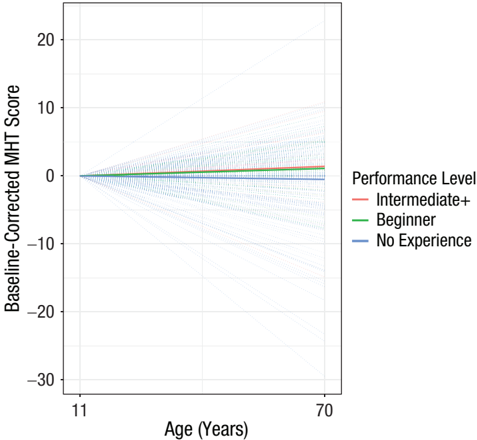
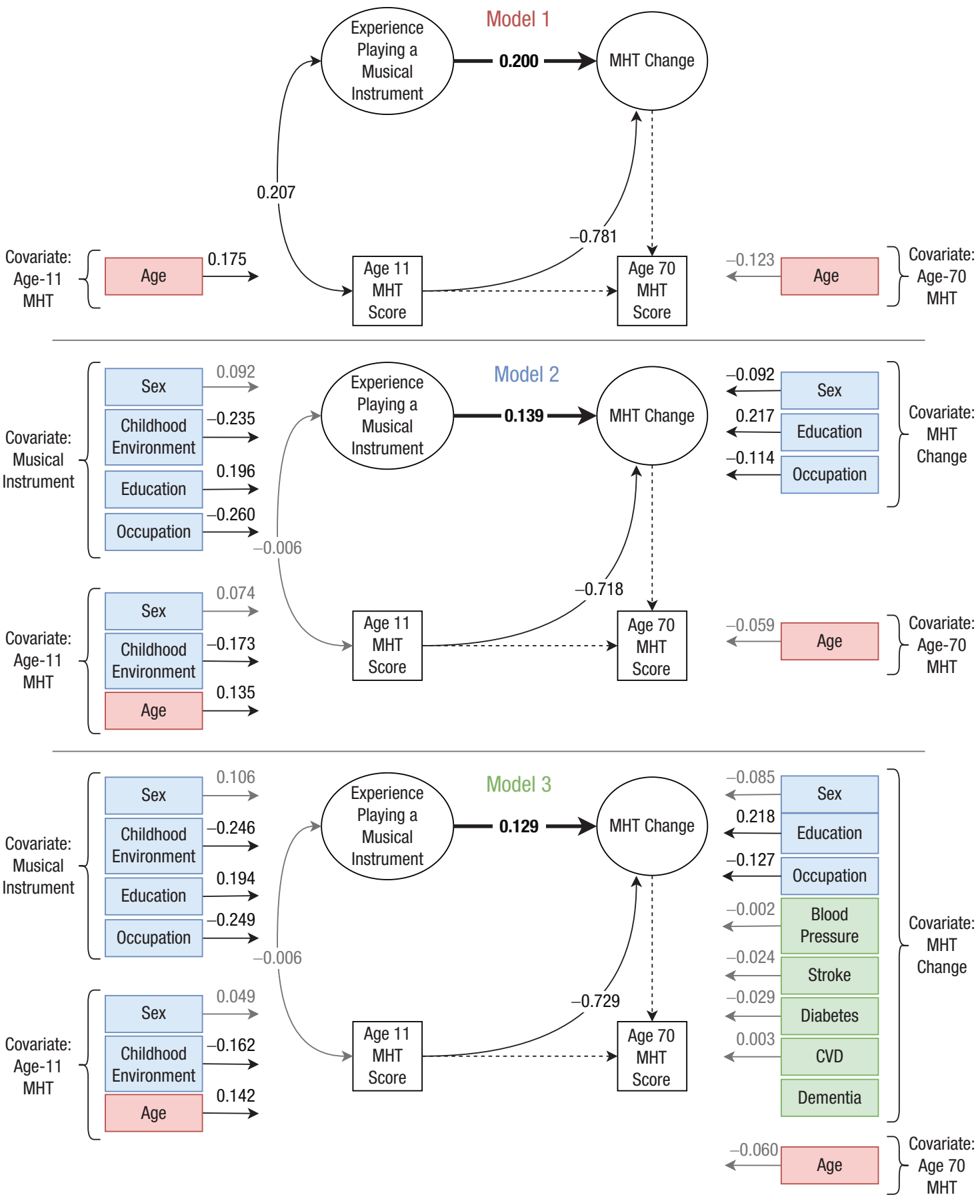
- In 366 older adults (117 with musical-instrument experience, mostly beginner or intermediate level), greater experience was associated with more positive lifetime change in Moray House Test No. 12 (MHT) score: minimally adjusted β = 0.200, 95% CI [0.111, 0.289], p < .001.
- After adjustment for sex, childhood environment, years of education, and adult occupational class, the association was reduced but remained statistically significant: β = 0.139, 95% CI [0.062, 0.215], p < .001; fully adjusted including disease history and excluding possible dementia: β = 0.129, 95% CI [0.049, 0.208], p = .002.
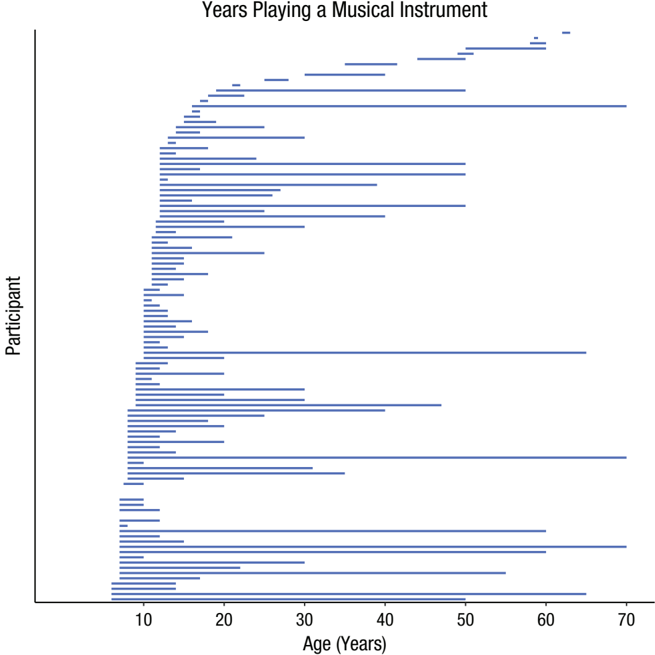
- Indicators of musical experience correlated positively with residualized MHT change (rs = .12–.13) but not with raw MHT change; subsidiary analyses suggested the association was potentially driven by childhood musical experience and by the contrast between any experience versus none.
- Participants with musical experience had higher MHT scores at age 11 (M = 53.287, SD = 11.193) and age 70 (M = 68.709, SD = 5.610) than those without experience (age 11: M = 49.788, SD = 11.089; age 70: M = 65.157, SD = 8.016).
Methods
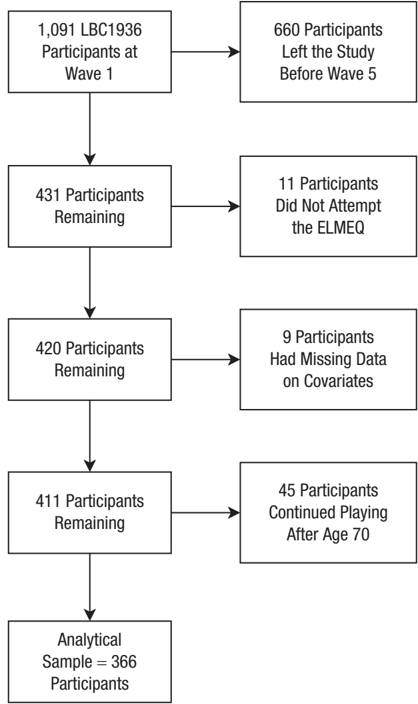
- Longitudinal observational study using the Lothian Birth Cohort 1936; analytical sample was 366 participants with MHT assessments at ages 11 and 70 and Edinburgh Lifetime Musical Experience Questionnaire (ELMEQ) data at age 82; 194 (53.0%) were women.
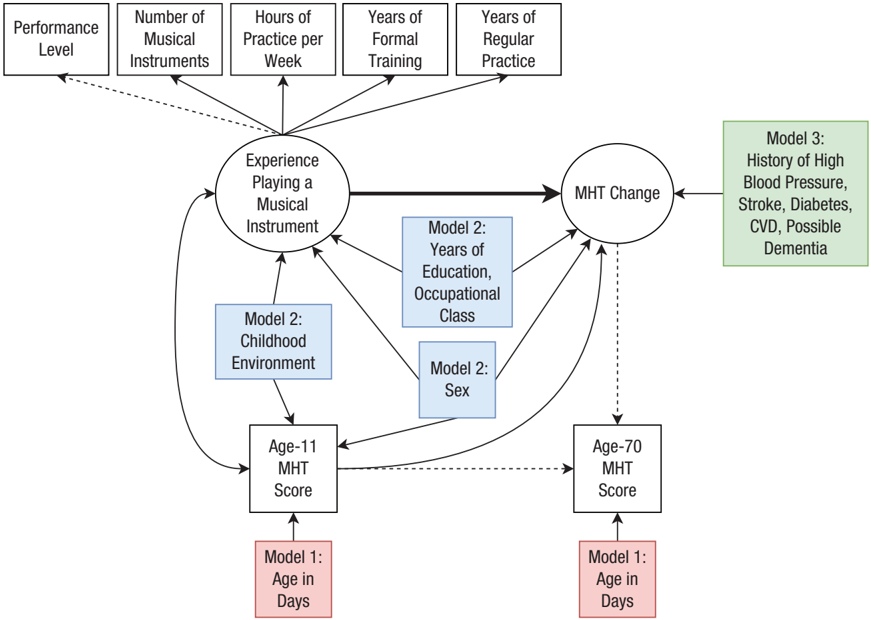
- Experience of playing a musical instrument was modeled as a latent variable using five ELMEQ items (number of instruments, years of formal training, years of regular practice, hours of practice per week, performance level); general cognitive ability was measured with the MHT at ages 11 and 70.
- Structural equation modeling with a latent-change-score model and weighted least squares mean and variance-adjusted (WLSMV) estimation; Models 1–3 added age, sex, childhood environment, years of education, adult occupational class, and disease history; the study was preregistered on OSF.
Limitations
- Stated: LBC1936 is a self-selecting group that on average has higher cognitive ability, socioeconomic status, and physical health than the general older Scottish population, likely attenuating true associations; only six participants reported reaching an advanced musical-performance level, limiting tests of more advanced experience.
- Stated: The available data assessed general cognitive ability rather than specific cognitive domains; the distribution of musical experience was skewed; childhood environment was indexed by self-reported household overcrowding and toilet access, and other childhood confounders (nonmusical extracurricular activities, parent characteristics) and genetic variables were not available.
- Stated/evident: The observational design cannot conclusively show that musical training causes cognitive improvement, and genetic or parent-characteristic confounding remains possible; the paper also notes that excluding 45 participants who continued playing between ages 70 and 82 was not specified in the preregistration.
Model-written summary. Check it against the paper before relying on it.
Integrity signals
Registry
Cites
Statistics
Figures
Verification
Claims the paper makes
0 Valid · 0 Not valid · 29 Not checked · 41 Own results and interpretations
A result the paper reports from its own data — it cites no other source for it, so there is none to check. The quote shows it is in the paper.
In the paper
“Age-11 MHT score was positively correlated with experience of playing a musical instrument (r = .207,p < .001)”
§ Experience of Playing a Musical Instrument and Lifetime Change in General Cognitive Ability: Evidence From the Lothian Birth Cohort 1936 > Main results
plainstates an association- Asserted: passes — The authors put it forward as true.
- Checkable: passes — It can be checked against evidence.
- Load-bearing: unclear — It is unclear whether the paper’s conclusions depend on it.
- Based: passes — The paper gives a reason why it holds.
A result the paper reports from its own data — it cites no other source for it, so there is none to check. The quote shows it is in the paper.
In the paper
“There was a small, statistically significant positive association between experience of playing a musical instrument and change in general cognitive ability between ages 11 and 70; specifically, individuals with more musical-instrument experience were likely to show greater gains in general cognitive ability.”
- Also stated in: § Main results · plain
“In this model, greater experience of playing a musical instrument was significantly associated with more positive lifetime change in MHT score (β = 0.200, 95% CI = [0.111,0.289], p < .001).”
§ Experience of Playing a Musical Instrument and Lifetime Change in General Cognitive Ability: Evidence From the Lothian Birth Cohort 1936 > Abstract
plainstates an associationn = 366- Asserted: passes — The authors put it forward as true.
- Checkable: passes — It can be checked against evidence.
- Load-bearing: passes — The paper’s conclusions depend on it.
- Based: passes — The paper gives a reason why it holds.
- Also stated in: § Main results · plain
A result the paper reports from its own data — it cites no other source for it, so there is none to check. The quote shows it is in the paper.
In the paper
“This association was reduced but remained statistically significant following adjustment for covariates (childhood and adulthood socioeconomic status, years of education, and disease history).”
§ Experience of Playing a Musical Instrument and Lifetime Change in General Cognitive Ability: Evidence From the Lothian Birth Cohort 1936 > Abstract
plainstates an associationn = 366- Asserted: passes — The authors put it forward as true.
- Checkable: passes — It can be checked against evidence.
- Load-bearing: passes — The paper’s conclusions depend on it.
- Based: passes — The paper gives a reason why it holds.
A result the paper reports from its own data — it cites no other source for it, so there is none to check. The quote shows it is in the paper.
In the paper
“and negatively associated with lifetime change in MHT score (β = -0.781,95% CI = [-0.825,-0.737], p < .001).”
§ Experience of Playing a Musical Instrument and Lifetime Change in General Cognitive Ability: Evidence From the Lothian Birth Cohort 1936 > Main results
plainstates an association- Asserted: passes — The authors put it forward as true.
- Checkable: passes — It can be checked against evidence.
- Load-bearing: unclear — It is unclear whether the paper’s conclusions depend on it.
- Based: passes — The paper gives a reason why it holds.
A result the paper reports from its own data — it cites no other source for it, so there is none to check. The quote shows it is in the paper.
In the paper
“Our results show that experience of playing a musical instrument is positively associated with lifetime change in general cognitive ability (minimally adjusted β = 0.200).”
§ Experience of Playing a Musical Instrument and Lifetime Change in General Cognitive Ability: Evidence From the Lothian Birth Cohort 1936 > Discussion
plainstates an association- Asserted: passes — The authors put it forward as true.
- Checkable: passes — It can be checked against evidence.
- Load-bearing: passes — The paper’s conclusions depend on it.
- Based: passes — The paper gives a reason why it holds.
22 more claims
Create a free account to see all 70 claims and to verify the 19 references still open.
- It may state two separate claims as one. 18
- Probably not a substantial claim. 32
Self-check
Percentages, sums and reported differences re-computed from the paper’s own numbers.
Each contradiction between two passages listed here was confirmed by an independent check.
Rated minor: it would not touch a result — a value no result rests on, a p-value that stays on the same side of the significance level, or a conflict that is clerical, resolved elsewhere in the paper, or outside its own findings.
In the paper
§ Experience of Playing a Musical Instrument and Lifetime Change in General Cognitive Ability: Evidence From the Lothian Birth Cohort 1936 > Descriptive statistics
“MHT score at age 11 (rs = .17-.20)”
§ Experience of Playing a Musical Instrument and Lifetime Change in General Cognitive Ability: Evidence From the Lothian Birth Cohort 1936 > Transparency
“| 6. MHT score at age 11 | 0.17** | 0.19** | 0.21** | 0.20** | 0.20** | - | | |”
Rated minor: it would not touch a result — a value no result rests on, a p-value that stays on the same side of the significance level, or a conflict that is clerical, resolved elsewhere in the paper, or outside its own findings.
In the paper
§ Experience of Playing a Musical Instrument and Lifetime Change in General Cognitive Ability: Evidence From the Lothian Birth Cohort 1936 > Abstract
“Participants were 366 older adults from the Lothian Birth Cohort 1936 who had completed general cognitive-ability assessments at ages 11 and 70 and reported their lifetime experience of playing a musical instrument at age 82.”
§ Experience of Playing a Musical Instrument and Lifetime Change in General Cognitive Ability: Evidence From the Lothian Birth Cohort 1936 > Analytical sample
“there were 23 participants with missing MHT scores at age 11 and 2 with missing MHT scores at age 70.”
Citations
Cites
Folstein, M. F., Folstein, S. E., & McHugh, P. R. (1975) · Journal of Psychiatric Research · doi:10.1016/0022-3956(75)90026-6 · Cited by 88,282
Evaluating Effect Size in Psychological Research: Sense and Nonsense
Funder, D. C., & Ozer, D. J. (2019) · Advances in Methods and Practices in Psychological Science · doi:10.1177/2515245919847202 · Cited by 3,295
Indicators of socioeconomic position (part 1): Figure 1
Galobardes, B., Shaw, M., Lawlor, D. A., Lynch, J. W., & Davey Smith, G. (2006) · Journal of Epidemiology and Community Health · doi:10.1136/jech.2004.023531 · Cited by 2,867
Schellenberg, E. G. (2004) · Psychological Science · doi:10.1111/j.0956-7976.2004.00711.x · Cited by 980
Musical Training Shapes Structural Brain Development
Hyde, K. L., Lerch, J., Norton, A., Forgeard, M., Winner, E., Evans, A. C., & Schlaug, G. (2009) · The Journal of Neuroscience · doi:10.1523/jneurosci.5118-08.2009 · Cited by 968
Deary, I. J., Whiteman, M. C., Starr, J. M., Whalley, L. J., & Fox, H. C. (2004) · Journal of Personality and Social Psychology · doi:10.1037/0022-3514.86.1.130 · Cited by 809
Self-citationShort-Term Music Training Enhances Verbal Intelligence and Executive Function
Moreno, S., Bialystok, E., Barac, R., Schellenberg, E. G., Cepeda, N. J., & Chau, T. (2011) · Psychological Science · doi:10.1177/0956797611416999 · Cited by 803
Trajectories of normal cognitive aging
Salthouse, T. A. (2019) · Psychology and Aging · doi:10.1037/pag0000288 · Cited by 730
How Much Does Education Improve Intelligence? A Meta-Analysis
Ritchie, S. J., & Tucker-Drob, E. M. (2018) · Psychological Science · doi:10.1177/0956797618774253 · Cited by 680
Deary, I. J., Gow, A. J., Taylor, M. D., Corley, J., Brett, C., Wilson, V., Campbell, H., Whalley, L. J., Visscher, P. M., Porteous, D. J., et al. (2007) · BMC Geriatrics · doi:10.1186/1471-2318-7-28 · Cited by 448
Self-citation
Research works printed but not linked: 4
- McArdle, J. J., & Nesselroade, J. R. (1994). Using multivariate data to structure developmental change. In S. H. Cohen & H. W. Reese (Eds.), Life-span developmental psychology: Methodological contributions (pp. 223-268). Psychology Press.
- Muthén, L. K., & Muthén, B. O. (2017). Mplus user's guide (8th ed.). Author. Office of Population Censuses and Surveys. (1980). Classi- fication of occupations 1980. Her Majesty's Stationary Office.
- Office of Population Censuses and Surveys, 1980, Classification of occupations 1980
- Scottish Council for Research in Education, 1949, The trend of Scottish intelligence
Cited by
Music Training and Nonmusical Abilities
Schellenberg, E. G., & Lima, C. F. (2023) · Annual Review of Psychology · doi:10.1146/annurev-psych-032323-051354 · Cited by 131
Music Engagement as a Source of Cognitive Reserve
Wolff, L., Quan, Y., Perry, G., & Thompson, W. F. (2023) · American Journal of Alzheimer s Disease & Other Dementias® · doi:10.1177/15333175231214833 · Cited by 62
“43 Thus, it appears music engagement may yield bene fi ts for both domain-speci fi c and broad-spectrum cognitive functions, which, in turn, may foster resilience against age-speci fi c cognitive deterioration while optimizing cognitive domains which remain intact in later life.”
BackgroundWei, L., Yu, Y., Qin, Y., & Zhang, S. (2025) · Information · doi:10.3390/info16080656 · Cited by 51
Vetere, G., Williams, G. H., Ballard, C. G., Creese, B., Hampshire, A., Palmer, A., Pickering, E., Richards, M., Brooker, H. J., & Corbett, A. (2024) · International Journal of Geriatric Psychiatry · doi:10.1002/gps.6061 · Cited by 26
“15 18 A study from 2012 found that the auditory brain stem was more responsive in adults if they had received formal music lessons during childhood, although these effects decline over time.”
BackgroundMethodInfluentialCognitive aging and experience of playing a musical instrument.
Okely, J. A., Cox, S. R., Deary, I. J., Luciano, M., & Overy, K. (2023) · Psychology and Aging · doi:10.1037/pag0000768 · Cited by 22
Self-citation
Metadata
- Authors
- Okely, J. A., Overy, K., & Deary, I. J.
- Affiliations
- Edinburgh Napier University (GB)
- University of Edinburgh (GB)
- Corresponding author
- Okely, Judith A.
- Venue
- Psychological Science
- Publisher
- SAGE Publications
- Published
- 2022-08-28
- Volume
- 33
- Issue
- 9
- Pages
- 1495-1508
- ISSN
- 0956-7976 (ISSN-L)
- 1467-9280
- OpenAlex
- W4293657302
- Semantic Scholar
- ee695749ed5552bb86e407cec22e9ee7a31683c9
- Cited by
- 22
- References
- 36
- Citations by year
- 2026: 6 · 2025: 4 · 2024: 6 · 2023: 6
- FWCI
- 2.39
- Type
- journal article
- Language
- en
- Open access
- hybrid
- doi.org
- Locations
- Psychological Science (publishedVersion, cc-by)
- Edinburgh Napier Research Repository (Edinburgh Napier University) (publishedVersion, cc-by)
- PubMed (publishedVersion)
- Edinburgh Research Explorer (University of Edinburgh) (publishedVersion, cc-by)
- Edinburgh Napier Research Repository (Edinburgh Napier University) (submittedVersion, other-oa)
- Funders
- Economic and Social Research Council (ES/S015604/1)
- Age UK (Disconnected Mind project)
- Topics
- Social Sciences › Psychology › Experimental and Cognitive Psychology › Cognitive Abilities and Testing
- Social Sciences › Arts and Humanities › Music › Diverse Music Education Insights
- Life Sciences › Neuroscience › Cognitive Neuroscience › Neuroscience and Music Perception
- Keywords
- instrumental performance, general intelligence, cognitive aging, older adults, Lothian Birth Cohort 1936, socioeconomic status, disease history, cognitive advantage
- MeSH terms
- Birth Cohort, Adolescent, Adult, Aged, Aged, 80 and over, Aptitude, Child, Cognition, Humans, Middle Aged, Music, Young Adult
About these checks
Registry, retraction, Cites and statistics results are computed, not judged, with one exception: a printed reference that no index lists is read once by a model before it counts as a citation error. Claims are extracted by a model and kept only when their quote appears verbatim in the text; each cited source is then checked, with a model’s help, for whether it says what the claim relies on. Those verdicts can be wrong — read the claim’s quote and the cited source before relying on one.
A language model drew the claims from the paper on 2026-11-27, under version 3 of the claim definition (model deepseek-v4.1-flash, prompt extract-v3).
A second model labelled each claim on 2026-11-27 (model jev-1.13-20260917, definition revision gold-guideline-v0.2).
Statistics and arithmetic are recomputed, not judged.
Confidence bands are shown only for fields calibrated on our annotated test set. None is calibrated yet, so no band is shown.
What counts as a claim ›How we measure confidence ›How we check this ›
Are you an author, or do you see a problem with this page? Request a review
How to cite
Cite CoChat for the checks on this page, and the paper for its own findings.
- This page
- CoChat. (2026). Citation check: Experience of Playing a Musical Instrument and Lifetime Change in General Cognitive Ability: Evidence From the Lothian Birth Cohort 1936. https://app.cochat.ai/papers/10.1177/09567976221092726
- The paper
- Okely, J. A., Overy, K., & Deary, I. J. (2022). Experience of Playing a Musical Instrument and Lifetime Change in General Cognitive Ability: Evidence From the Lothian Birth Cohort 1936. Psychological Science. https://doi.org/10.1177/09567976221092726
Data sources
Bibliographic data: Semantic Scholar, OpenAlex, Crossref.
Contains information from the Semantic Scholar Academic Graph Datasets, made available under the ODC Attribution License (ODC-BY 1.0).
Semantic Scholar’s data is described in: Kinney, R., et al. (2023). The Semantic Scholar Open Data Platform. arXiv:2301.10140.
