

The DOI matches its Crossref record; 12 of the 12 references it cites were found in a registry or an index.
The impact of episodic screening interruption: COVID-19 and population-based cancer screening in Canada
Open accessAbstract
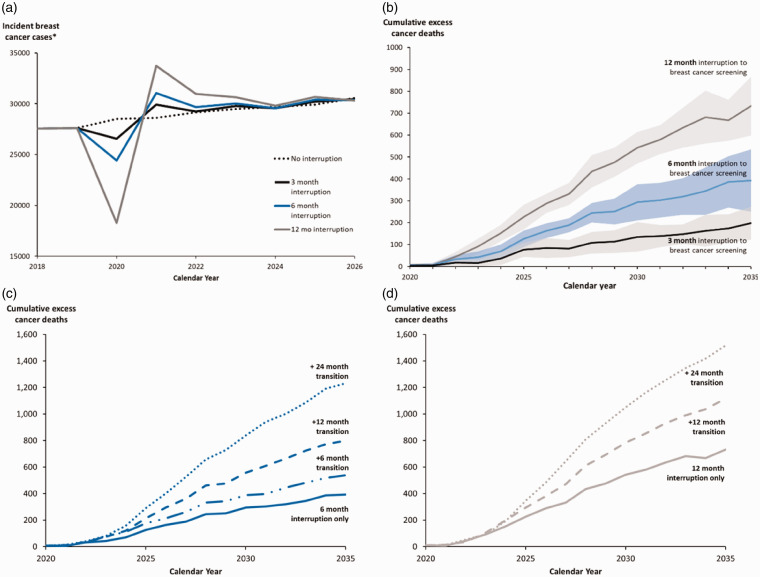
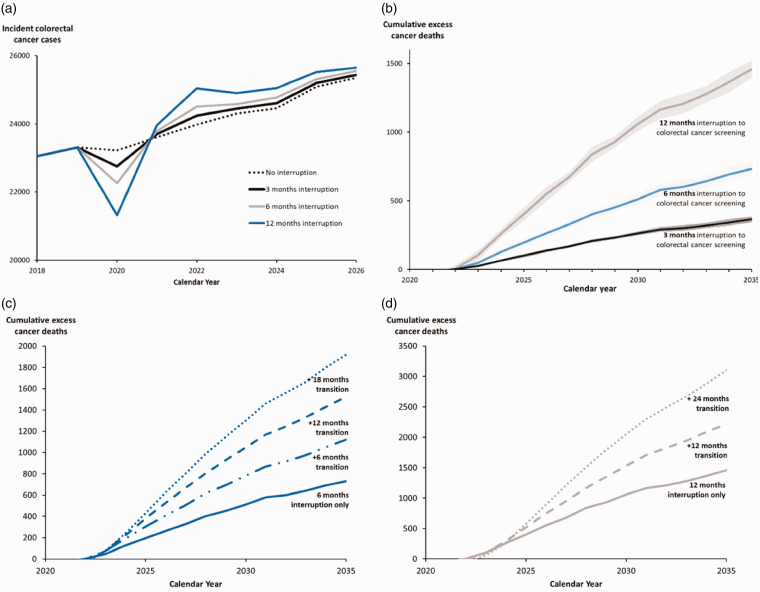
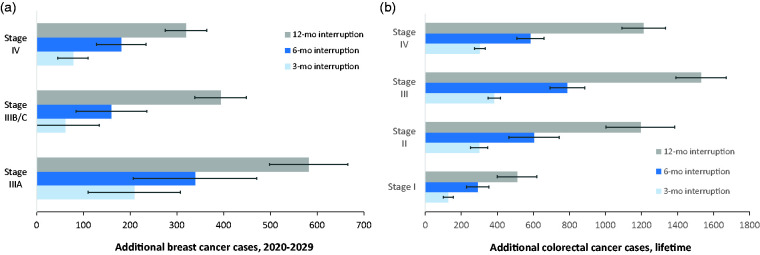
Background: Population-based cancer screening can reduce cancer burden but was interrupted temporarily due to the COVID-19 pandemic. We estimated the long-term clinical impact of breast and colorectal cancer screening interruptions in Canada using a validated mathematical model. Methods: We used the OncoSim breast and colorectal cancers microsimulation models to explore scenarios of primary screening stops for 3, 6, and 12 months followed by 6–24-month transition periods of reduced screening volumes. For breast cancer, we estimated changes in cancer incidence over time, additional advanced-stage cases diagnosed, and excess cancer deaths in 2020–2029. For colorectal cancer, we estimated changes in cancer incidence over time, undiagnosed advanced adenomas and colorectal cancers in 2020, and lifetime excess cancer incidence and deaths. Results: Our simulations projected a surge of cancer cases when screening resumes. For breast cancer screening, a three-month interruption could increase cases diagnosed at advanced stages (310 more) and cancer deaths (110 more) in 2020–2029. A six-month interruption could lead to 670 extra advanced cancers and 250 additional cancer deaths. For colorectal cancers, a six-month suspension of primary screening could increase cancer incidence by 2200 cases with 960 more cancer deaths over the lifetime. Longer interruptions, and reduced volumes when screening resumes, would further increase excess cancer deaths. Conclusions: Interruptions in cancer screening will lead to additional cancer deaths, additional advanced cancers diagnosed, and a surge in demand for downstream resources when screening resumes. An effective strategy is needed to minimize potential harm to people who missed their screening.
Overview
The claims and statistics of this paper haven’t been checked yet.
Run the check — free, no account needed. It reads the open-access text and checks the sources it cites.
Integrity signals
Registry
Cites
Statistics
Figures
Verification
Claims the paper makes
The claims and statistics of this paper haven’t been checked yet.
Run the check — free, no account needed. It reads the open-access text and checks the sources it cites.
Claims other papers make about this one
Each is checked against this paper’s own text: does it say what the citing paper says it does?
The source backs part of the claim, not all of it — or backs it for a different population, condition or comparison.
In the citing paper
“It is also important to note that recruitment for this study was conducted during the second and third waves of the COVID-19 pandemic [81]. Because of the impact that the pandemic had on the health care system (e.g., postponement of certain tests), this may have temporarily increased the participants’ anxiety about their medical condition [82, 83].”
From Fear of cancer recurrence in breast cancer survivors carrying a BRCA1 or 2 genetic mutation : a cross-sectional study (2024) · cites this paper as [83]
Experimental — accuracy not yet measured
Self-check
Percentages, sums and reported differences re-computed from the paper’s own numbers.
The self-check needs the paper’s full text.
Citations
Cites
Sharpless, N. E. (2020) · Science · doi:10.1126/science.abd3377 · Cited by 408
Projected estimates of cancer in Canada in 2020
Brenner, D. R., Weir, H. K., Demers, A. A., Ellison, L. F., Louzado, C., Shaw, A., Turner, D., Woods, R. R., & Smith, L. M. (2020) · Canadian Medical Association Journal · doi:10.1503/cmaj.191292 · Cited by 375
Self-citationComparison of Treatment Costs for Breast Cancer, by Tumor Stage and Type of Service.
Blumen, H., Fitch, K., & Polkus, V. (2016) · Europe PMC (PubMed Central) · Cited by 256
Chapter 7: The Wisconsin Breast Cancer Epidemiology Simulation Model
Fryback, D. G., Stout, N. K., Rosenberg, M. A., Trentham‐Dietz, A., Kuruchittham, V., & Remington, P. (2006) · JNCI Monographs · doi:10.1093/jncimonographs/lgj007 · Cited by 164
Impact of the COVID‐19 pandemic on a population‐based breast cancer screening program
Peng, S.-M., Yang, K., Chan, W. P., Wang, Y., Lin, L., Yen, A. M., Smith, R. A., & Chen, T. H. (2020) · Cancer · doi:10.1002/cncr.33180 · Cited by 70
The University of Wisconsin Breast Cancer Epidemiology Simulation Model: An Update
Alagöz, O., Ergün, M. A., Çevik, M., Sprague, B. L., Fryback, D. G., Gangnon, R. E., Hampton, J. M., Stout, N. K., & Trentham‐Dietz, A. (2018) · Medical Decision Making · doi:10.1177/0272989x17711927 · Cited by 53
Rutter, C. M., Kim, J. J., Meester, R. G. S., Sprague, B. L., Burger, E. A., Zauber, A. G., Ergün, M. A., Campos, N. G., Doubeni, C. A., Trentham‐Dietz, A., et al. (2017) · Cancer Epidemiology Biomarkers & Prevention · doi:10.1158/1055-9965.epi-17-0378 · Cited by 46
The OncoSim Model: Development and Use for Better Decision-Making in Canadian Cancer Control
Gauvreau, C. L., Fitzgerald, N. R., Memon, S., Flanagan, W. M., Nadeau, C., Asakawa, K., Garner, R., Miller, A. B., Evans, W. K., Popadiuk, C. M., et al. (2017) · Current Oncology · doi:10.3747/co.24.3850 · Cited by 39
Self-citationUsing the Cancer Risk Management Model to Evaluate Colorectal Cancer Screening Options for Canada
Coldman, A. J., Phillips, N., Brisson, J., Flanagan, W., Wolfson, M. C., Nadeau, C., Fitzgerald, N. R., & Miller, A. B. (2015) · Current Oncology · doi:10.3747/co.22.2013 · Cited by 32
Self-citationThe Value of All-Cause Mortality as a Metric for Assessing Breast Cancer Screening
Yaffe, M. J., & Mainprize, J. G. (2020) · JNCI Journal of the National Cancer Institute · doi:10.1093/jnci/djaa025 · Cited by 13
Self-citation
Research works printed but not linked: 5
- Canadian Partnership Against Cancer, 2019, 2019–2029 Canadian strategy for cancer control
- Canadian Partnership Against Cancer, 2018, Colorectal cancer screening in Canada: Environmental scan
- Canadian Partnership Against Cancer, 2018, Breast cancer screening in Canada: environmental scan
- Cancer Care Ontario., 2016, Ontario cancer screening performance report 2016
- Blumen H, 2016, Am Health Drug Benefits, 9, 23
Cited by
Projected estimates of cancer in Canada in 2022
Brenner, D. R., Poirier, A., Woods, R. R., Ellison, L. F., Billette, J.-M., Demers, A. A., Zhang, S. X., Yao, C., Finley, C., Fitzgerald, N., et al. (2022) · Canadian Medical Association Journal · doi:10.1503/cmaj.212097 · Cited by 298
Self-citationImpact of the COVID-19 pandemic on cancer care in OECD countries
Fujisawa, R. (2022) · OECD health working papers · doi:10.1787/c74a5899-en · Cited by 251
Baccolini, V., Isonne, C., Salerno, C., Giffi, M., Migliara, G., Mazzalai, E., Turatto, F., Sinopoli, A., Rosso, A., Vito, C. D., et al. (2021) · Preventive Medicine · doi:10.1016/j.ypmed.2021.106927 · Cited by 204
Alagöz, O., Lowry, K. P., Kurian, A. W., Mandelblatt, J. S., Ergün, M. A., Huang, H., Lee, S. J., Schechter, C. B., Tosteson, A. N. A., Miglioretti, D. L., et al. (2021) · JNCI Journal of the National Cancer Institute · doi:10.1093/jnci/djab097 · Cited by 181
Has COVID-19 Affected Cancer Screening Programs? A Systematic Review
Alkatout, İ., Biebl, M., Momenimovahed, Z., Giovannucci, E. L., Hadavandsiri, F., Salehiniya, H., & Allahqoli, L. (2021) · Frontiers in Oncology · doi:10.3389/fonc.2021.675038 · Cited by 152
Metadata
- Authors
- Yong, J. H., Mainprize, J. G., Yaffe, M. J., Ruan, Y., Poirier, A. E., Coldman, A., Nadeau, C., Iragorri, N., Hilsden, R. J., & Brenner, D. R.
- Affiliations
- Independent Consultant, Toronto, Canada
- Sunnybrook Hospital (CA)
- University of Toronto (CA)
- Alberta Health Services (CA)
- British Columbia Cancer Research, Vancouver, Canada
- Statistics Canada (CA)
- Corresponding author
- Yaffe, Martin J
- ORCID
- Venue
- Journal of Medical Screening
- Publisher
- SAGE Publications
- Published
- 2020-11-26
- Volume
- 28
- Issue
- 2
- Pages
- 100-107
- ISSN
- 0969-1413 (ISSN-L)
- 1475-5793
- PMC
- PMC7691762
- OpenAlex
- W3108766839
- Cited by
- 187
- References
- 12
- Citations by year
- 2026: 6 · 2025: 13 · 2024: 29 · 2023: 45 · 2022: 63 · 2021: 30 · 2020: 1
- FWCI
- 12.54
- Type
- journal article
- Language
- en
- Open access
- hybrid
- doi.org
- Locations
- Journal of Medical Screening (publishedVersion, cc-by)
- PubMed Central (publishedVersion, cc-by)
- PubMed (publishedVersion)
- Topics
- Health Sciences › Medicine › Oncology › Global Cancer Incidence and Screening
- Health Sciences › Medicine › Oncology › COVID-19 and healthcare impacts
- Health Sciences › Medicine › Oncology › Colorectal Cancer Screening and Detection
- Keywords
- COVID-19 pandemic, breast cancer screening, colorectal cancer screening, mass screening, advanced cancer, cancer incidence, cancer mortality, missed screening, Canada
- MeSH terms
- COVID-19, Breast Neoplasms, Canada, Female, Humans, Male, Colorectal Neoplasms, Incidence, Early Detection of Cancer
About these checks
Registry, retraction, Cites and statistics results are computed, not judged, with one exception: a printed reference that no index lists is read once by a model before it counts as a citation error. Claims are extracted by a model and kept only when their quote appears verbatim in the text; each cited source is then checked, with a model’s help, for whether it says what the claim relies on. Those verdicts can be wrong — read the claim’s quote and the cited source before relying on one.
Statistics and arithmetic are recomputed, not judged.
Confidence bands are shown only for fields calibrated on our annotated test set. None is calibrated yet, so no band is shown.
What counts as a claim ›How we measure confidence ›How we check this ›
Are you an author, or do you see a problem with this page? Request a review
How to cite
Cite CoChat for the checks on this page, and the paper for its own findings.
- This page
- CoChat. (2026). Citation check: The impact of episodic screening interruption: COVID-19 and population-based cancer screening in Canada. https://app.cochat.ai/papers/10.1177/0969141320974711
- The paper
- Yong, J. H., Mainprize, J. G., Yaffe, M. J., Ruan, Y., Poirier, A. E., Coldman, A., Nadeau, C., Iragorri, N., Hilsden, R. J., & Brenner, D. R. (2021). The impact of episodic screening interruption: COVID-19 and population-based cancer screening in Canada. Journal of Medical Screening. https://doi.org/10.1177/0969141320974711
Data sources
Bibliographic data: Semantic Scholar, OpenAlex, Crossref.
Contains information from the Semantic Scholar Academic Graph Datasets, made available under the ODC Attribution License (ODC-BY 1.0).
Semantic Scholar’s data is described in: Kinney, R., et al. (2023). The Semantic Scholar Open Data Platform. arXiv:2301.10140.
