

The DOI matches its Crossref record; 53 of the 53 references it cites were found in a registry or an index.
Exploring adolescents’ perspectives on social media and mental health and well-being – A qualitative literature review
Open accessAbstract
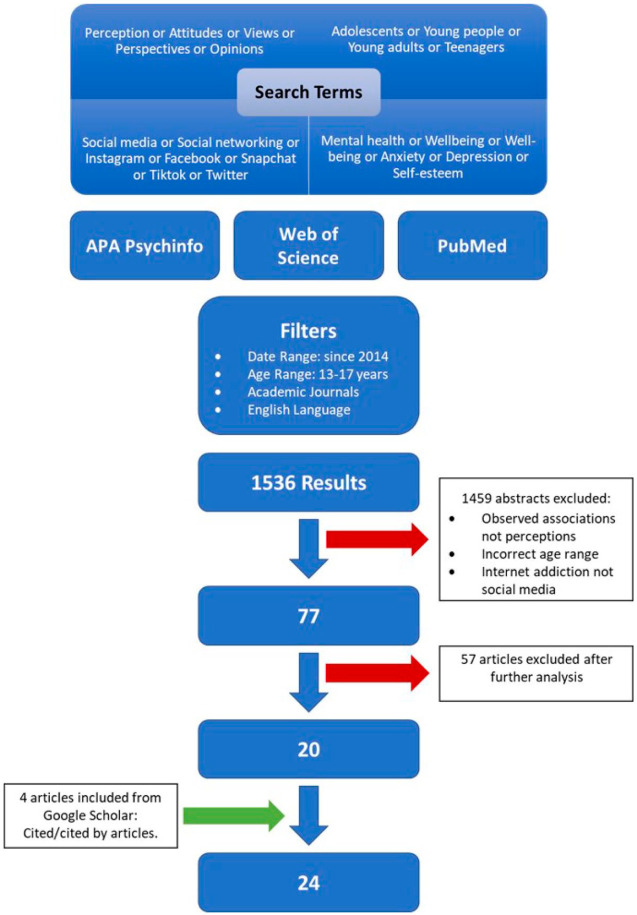
Many quantitative studies have supported the association between social media use and poorer mental health, with less known about adolescents’ perspectives on social media’s impact on their mental health and wellbeing. This narrative literature review aimed to explore their perspectives, focusing on adolescents aged between 13 and 17. It reviewed qualitative studies published between January 2014 and December 2020, retrieved from four databases: APA Psychinfo, Web of Science, PubMed and Google Scholar. The literature search obtained 24 research papers. Five main themes were identified: 1) Self-expression and validation, 2) Appearance comparison and body ideals, 3) Pressure to stay connected, 4) Social engagement and peer support and 5) Exposure to bullying and harmful content. This review has highlighted how social media use can contribute to poor mental health – through validation-seeking practices, fear of judgement, body comparison, addiction and cyberbullying. It also demonstrates social media’s positive impact on adolescent wellbeing - through connection, support and discussion forums for those with similar diagnoses. Future research should consider adolescent views on improvements to social media, studying younger participants, and the impact of COVID-19 on social media use and its associated mental health implications.
Overview
The claims and statistics of this paper haven’t been checked yet.
Run the check — free, no account needed. It reads the open-access text and checks the sources it cites.
Integrity signals
Registry
Cites
Statistics
Figures
Verification
Claims the paper makes
The claims and statistics of this paper haven’t been checked yet.
Run the check — free, no account needed. It reads the open-access text and checks the sources it cites.
Claims other papers make about this one
Each is checked against this paper’s own text: does it say what the citing paper says it does?
The source backs part of the claim, not all of it — or backs it for a different population, condition or comparison.
In the citing paper
“Consistent with previous research (e.g., [4]), social media was identifed as a complex and multifaceted tool, ofering opportunities for connection, education, and identity exploration [19, 55, 56], while also highlighting concerns relating to misinformation, social comparison, online victimisation and highly immersive or difcult-to-disengage-from forms of engagement [24, 25, 28, 57].”
From The Complex and Multifaceted Nature of Social Media: Perspectives From Young Adolescents, Parents and Experts (2026) · cites this paper as [56]
Experimental — accuracy not yet measuredThe cited source says what the claim attributes to it.
In the citing paper
“Social media can also serve as a platform for seeking support during the times of psychological distress (Bailey et al., 2022; Popat and Tarrant, 2023).”
From Will restricting the age of access to social media reduce mental illness in Australian youth? (2025) · cites this paper as Popat and Tarrant, 2023
Self-check
Percentages, sums and reported differences re-computed from the paper’s own numbers.
The self-check needs the paper’s full text.
Citations
Cites
Methods for the thematic synthesis of qualitative research in systematic reviews
Thomas, J., & Harden, A. (2008) · BMC Medical Research Methodology · doi:10.1186/1471-2288-8-45 · Cited by 9,312
Levesque, R. J. R. (2017) · Springer eBooks · doi:10.1007/978-3-319-32132-5_447-2 · Cited by 4,060
Casey, B. J., Jones, R. M., & Hare, T. A. (2008) · Annals of the New York Academy of Sciences · doi:10.1196/annals.1440.010 · Cited by 3,345
Beyond PICO: The SPIDER Tool for Qualitative Evidence Synthesis
Cooke, A., Smith, D., & Booth, A. (2012) · Qualitative Health Research · doi:10.1177/1049732312452938 · Cited by 2,608
Keles, B., McCrae, N., & Grealish, A. (2020) · International Journal of Adolescence and Youth · doi:10.1080/02673843.2019.1590851 · Cited by 1,909
Casey, B. J., Getz, S., & Galvan, A. (2008) · Developmental Review · doi:10.1016/j.dr.2007.08.003 · Cited by 1,810
Social Media: Defining, Developing, and Divining
Carr, C. T., & Hayes, R. A. (2015) · Atlantic Journal of Communication · doi:10.1080/15456870.2015.972282 · Cited by 1,443
Judd, C. H. (1928) · Journal of Education · doi:10.1177/002205742810700706 · Cited by 1,410
Woods, H. C., & Scott, H. (2016) · Journal of Adolescence · doi:10.1016/j.adolescence.2016.05.008 · Cited by 1,302
Lin, L. Y., Sidani, J. E., Shensa, A., Radovic, A., Miller, E., Colditz, J. B., Hoffman, B. L., Giles, L. M., & Primack, B. A. (2016) · Depression and Anxiety · doi:10.1002/da.22466 · Cited by 1,111
Research works printed but not linked: 4
- Bradbook G., 2008, Metting their potential: The role of education and technology in overcoming disadvantage and disaffection in young people
- Erikson E. H., 1950, Childhood and society
- Stec C., 2015, Social media definitions: The ultimate glossary of terms you should know
- Walker M., 2018, Why we sleep
Cited by
Sorted by citations
Social Media Use and adolescents' mental health and well-being: An umbrella review
Sala, A., Porcaro, L., & Gómez, E. (2024) · Computers in Human Behavior Reports · doi:10.1016/j.chbr.2024.100404 · Cited by 120
Conte, G., Iorio, G. D., Esposito, D., Romano, S., Panvino, F., Maggi, S., Altomonte, B., Casini, M. P., Ferrara, M., & Terrinoni, A. (2025) · European Child & Adolescent Psychiatry · doi:10.1007/s00787-024-02581-w · Cited by 84
Effects of Social Media Use on Youth and Adolescent Mental Health: A Scoping Review of Reviews
Agyapong-Opoku, N., Agyapong-Opoku, F., & Greenshaw, A. J. (2025) · Behavioral Sciences · doi:10.3390/bs15050574 · Cited by 133
Bhatiasevi, V. (2024) · Frontiers in Psychiatry · doi:10.3389/fpsyt.2024.1260565 · Cited by 92
Adolescent Social Media Use through a Self-Determination Theory Lens: A Systematic Scoping Review
West, M., Rice, S., & Vella‐Brodrick, D. (2024) · International Journal of Environmental Research and Public Health · doi:10.3390/ijerph21070862 · Cited by 91
Metadata
- Authors
- Popat, A., & Tarrant, C.
- Affiliations
- University of Leicester (GB)
- Corresponding author
- Popat, Anjali
- Venue
- Clinical Child Psychology and Psychiatry
- Publisher
- SAGE Publications
- Published
- 2022-06-07
- Volume
- 28
- Issue
- 1
- Pages
- 323-337
- ISSN
- 1359-1045 (ISSN-L)
- 1461-7021
- PMC
- PMC9902994
- OpenAlex
- W4281609450
- Cited by
- 186
- References
- 53
- Citations by year
- 2026: 56 · 2025: 58 · 2024: 48 · 2023: 23
- FWCI
- 46.38
- Type
- journal article
- Language
- en
- Open access
- hybrid
- doi.org
- Locations
- Clinical Child Psychology and Psychiatry (publishedVersion, cc-by)
- PubMed Central (publishedVersion, cc-by)
- PubMed (publishedVersion)
- Topics
- Social Sciences › Sociology and Political Science › Impact of Technology on Adolescents
- Social Sciences › Psychology › Clinical Psychology › Body Image and Dysmorphia Studies
- Social Sciences › Psychology › Social Psychology › Mental Health via Writing
- Keywords
- social media use, adolescents, adolescent mental health, well-being, self-expression, validation seeking, body image, appearance comparison, cyberbullying, harmful content exposure, social connectedness, peer support, fear of judgment, social media addiction
- MeSH terms
- COVID-19, Adolescent, Humans, Mental Health, Narration, Social Media
About these checks
Registry, retraction, Cites and statistics results are computed, not judged, with one exception: a printed reference that no index lists is read once by a model before it counts as a citation error. Claims are extracted by a model and kept only when their quote appears verbatim in the text; each cited source is then checked, with a model’s help, for whether it says what the claim relies on. Those verdicts can be wrong — read the claim’s quote and the cited source before relying on one.
Statistics and arithmetic are recomputed, not judged.
Confidence bands are shown only for fields calibrated on our annotated test set. None is calibrated yet, so no band is shown.
What counts as a claim ›How we measure confidence ›How we check this ›
Are you an author, or do you see a problem with this page? Request a review
