

Measuring the effects of listening for leisure on outcome after stroke (MELLO): A pilot randomized controlled trial of mindful music listening
Open accessThe DOI matches its Crossref record; 27 of the 27 references it cites were found in a registry or an index.
Abstract
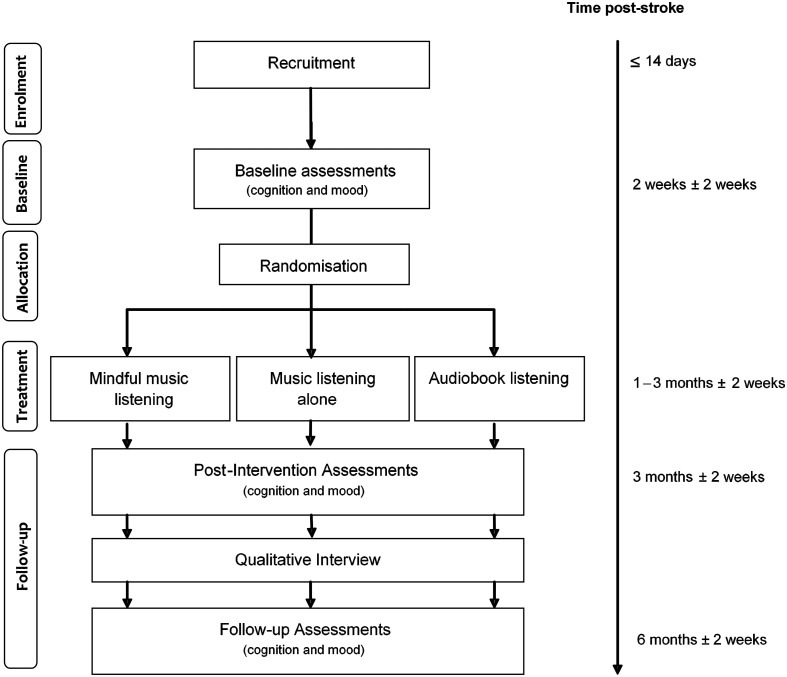
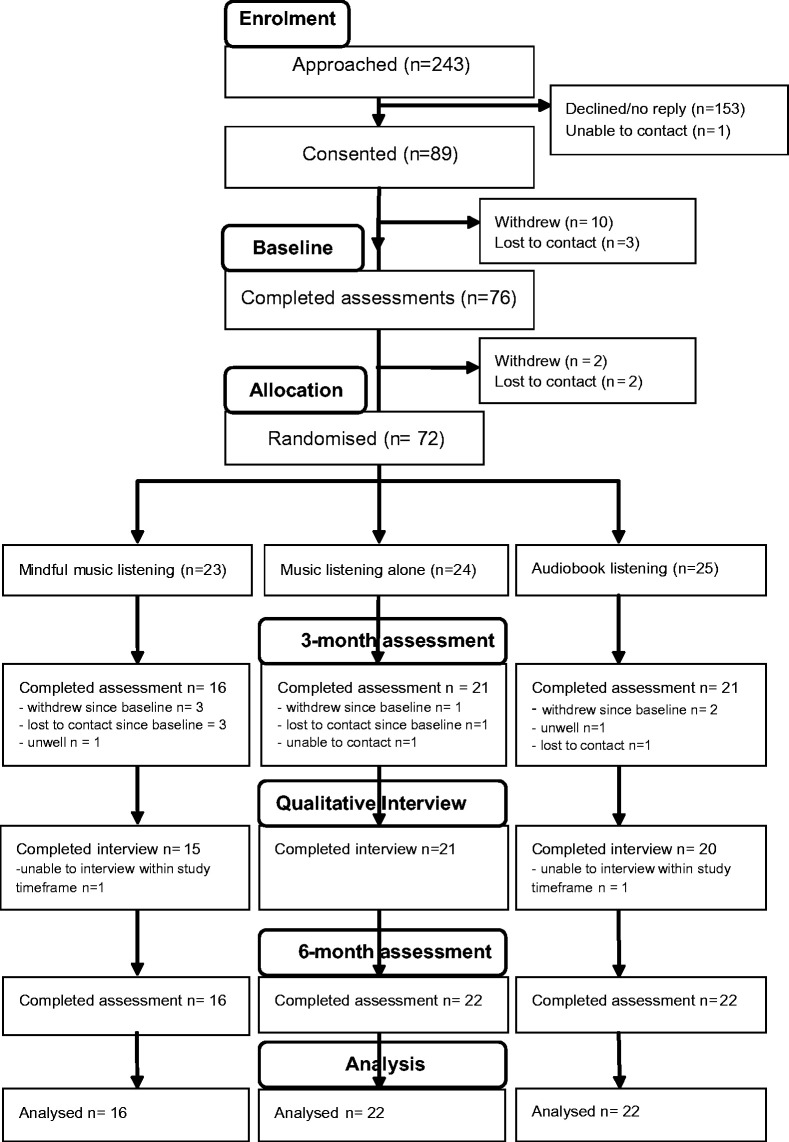
Background: Cognitive deficits and low mood are common post-stroke. Music listening is suggested to have beneficial effects on cognition, while mindfulness may improve mood. Combining these approaches may enhance cognitive recovery and improve mood early post-stroke. Aims: To assess the feasibility and acceptability of a novel mindful music listening intervention. Methods: A parallel group randomized controlled feasibility trial with ischemic stroke patients, comparing three groups; mindful music listening, music listening and audiobook listening (control group), eight weeks intervention. Feasibility was measured using adherence to protocol and questionnaires. Cognition (including measures of verbal memory and attention) and mood (Hospital Anxiety and Depression Scale) were assessed at baseline, end of intervention and at six-months post-stroke. Results: Seventy-two participants were randomized to mindful music listening ( n = 23), music listening ( n = 24), or audiobook listening ( n = 25). Feasibility and acceptability measures were encouraging: 94% fully consistent with protocol; 68.1% completing ≥6/8 treatment visits; 80–107% listening adherence; 83% retention to six-month endpoint. Treatment effect sizes for cognition at six month follow-up ranged from d = 0.00 ([−0.64,0.64], music alone), d = 0.31, ([0.36,0.97], mindful music) for list learning; to d = 0.58 ([0.06,1.11], music alone), d = 0.51 ([−0.07,1.09], mindful music) for immediate story recall; and d = 0.67 ([0.12,1.22], music alone), d = 0.77 ([0.16,1.38]mindful music) for attentional switching compared to audiobooks. No signal of change was seen for mood. A definitive study would require 306 participants to detect a clinically substantial difference in improvement (z-score difference = 0.66, p = 0.017, 80% power) in verbal memory (delayed story recall). Conclusions: Mindful music listening is feasible and acceptable post-stroke. Music listening interventions appear to be a promising approach to improving recovery from stroke.
Overview
The claims and statistics of this paper haven’t been checked yet.
Free: it reads the open-access text and checks the first 5 claims that cite a source we can check. Create a free account to check every claim.
Integrity signals
Registry
Cites
Statistics
Figures
Verification
Claims the paper makes
The claims and statistics of this paper haven’t been checked yet.
Free: it reads the open-access text and checks the first 5 claims that cite a source we can check. Create a free account to check every claim.
Claims other papers make about this one
Each is checked against this paper’s own text: does it say what the citing paper says it does?
The source backs part of the claim, not all of it — or backs it for a different population, condition or comparison.
In the citing paper
“Both intervention approaches appear to enhance mood, attention, and cognitive recovery in a variety of settings.”
From Nursing Implications of Mindfulness-Informed Interventions for Stroke Survivors and Their Families. (2022) · cites this paper as [10]
Experimental — accuracy not yet measuredThe cited source says what the claim attributes to it.
In the citing paper
“Findings suggest that mindful music group is better able to refocus after mind wandering.”
From Nursing Implications of Mindfulness-Informed Interventions for Stroke Survivors and Their Families. (2022) · cites this paper as Baylan et al, 2020
The cited source says what the claim attributes to it.
In the citing paper
“Mindful music listening is feasible and acceptable in stroke survivors.”
From Nursing Implications of Mindfulness-Informed Interventions for Stroke Survivors and Their Families. (2022) · cites this paper as Baylan et al, 2020
The cited source says what the claim attributes to it.
In the citing paper
“Descriptive preliminary results of this study showed that patients in the mindful music group performed better on immediate memory recall and attention switching tasks than those who listened to an audiobook.”
From Nursing Implications of Mindfulness-Informed Interventions for Stroke Survivors and Their Families. (2022) · cites this paper as [10]
Self-check
Percentages, sums and reported differences re-computed from the paper’s own numbers.
The self-check needs the paper’s full text.
Citations
Cites
The Hospital Anxiety and Depression Scale
Zigmond, A. S., & Snaith, R. P. (1983) · Acta Psychiatrica Scandinavica · doi:10.1111/j.1600-0447.1983.tb09716.x · Cited by 47,139
The Montreal Cognitive Assessment, MoCA: a brief screening tool for mild cognitive impairment
Nasreddine, Z. S., Phillips, N. A., Bédirian, V., Charbonneau, S., Whitehead, V., Collin, I., Cummings, J. L., & Chertkow, H. (2005) · Journal of the American Geriatrics Society · doi:10.1111/j.1532-5415.2005.53221.x · Cited by 25,553
Statistical Power Analysis for the Behavioral Sciences
Cohen, J. (2013) · doi:10.4324/9780203771587 · Cited by 25,373
CONSORT 2010 statement: extension to randomised pilot and feasibility trials.
Eldridge, S. M., Chan, C. L., Campbell, M. J., Bond, C. M., Hopewell, S., Thabane, L., & Lancaster, G. A. (2016) · BMJ · doi:10.1136/bmj.i5239 · Cited by 3,404
CONSORT 2010 statement: extension to randomised pilot and feasibility trials
on behalf of the PAFS consensus group, Eldridge, S. M., Chan, C. L., Campbell, M. J., Bond, C. M., Hopewell, S., Thabane, L., & Lancaster, G. A. (2016) · Pilot and Feasibility Studies · doi:10.1186/s40814-016-0105-8 · Cited by 2,843
Robertson, I. H., Manly, T., Andrade, J., Baddeley, B. T., & Yiend, J. (1997) · Neuropsychologia · doi:10.1016/s0028-3932(97)00015-8 · Cited by 2,059
Positive psychology interventions: a meta-analysis of randomized controlled studies
Bolier, L., Haverman, M., Westerhof, G. J., Riper, H., Smit, F., & Bohlmeijer, E. (2013) · BMC Public Health · doi:10.1186/1471-2458-13-119 · Cited by 1,996 · cited 1×
“All treatment arms had attrition rates equal to or better than what might be typically expected for psychological therapies post-stroke.(28) Our recruitment and adherence results are also aligned with previous studies of post-stroke music listening.”
ResultModelling cognition in emotional disorder: the S-REF model
Wells, A., & Matthews, G. (1996) · Behaviour Research and Therapy · doi:10.1016/s0005-7967(96)00050-2 · Cited by 1,067
Bohlmeijer, E., ten Klooster, P. M., Fledderus, M., Veehof, M., & Baer, R. (2011) · Assessment · doi:10.1177/1073191111408231 · Cited by 990
Ayerbe, L., Ayis, S., Wolfe, C. D. A., & Rudd, A. G. (2013) · British Journal of Psychiatry · doi:10.1192/bjp.bp.111.107664 · Cited by 980 · cited 6×
“International Journal of Stroke, 15(2) International Journal of Stroke”
BackgroundInfluential
Research works printed but not linked: 4
- Robertson IH Nimmo-Smith I Ward T, et al. The test of everyday attention (TEA), London: Pearson, 1994.
- CANTAB®, Cambridge Cognition, www.cantab.com (accessed 18 March 2019).
- Weschler D. Wechsler adult intelligence scale – fourth UK edition (WAIS-IV UK). London: Pearson, 2010.
- Wechsler D. Wechsler memory scale – fourth UK edition (WMS-IV UK). London: Pearson, 2010.
Cited by
Vocal music enhances memory and language recovery after stroke: pooled results from two RCTs
Sihvonen, A. J., Leo, V., Ripollés, P., Lehtovaara, T., Ylönen, A., Rajanaro, P., Laitinen, S., Forsblom, A., Saunavaara, J. P., Autti, T. H., et al. (2020) · Annals of Clinical and Translational Neurology · doi:10.1002/acn3.51217 · Cited by 114
Harney, C., Johnson, J., Bailes, F., & Havelka, J. (2022) · Musicae Scientiae · doi:10.1177/10298649211046979 · Cited by 95
Occupational therapy for cognitive impairment in stroke patients
Gibson, E. M., Koh, C., Eames, S., Bennett, S. H., Scott, A. M., & Hoffmann, T. (2022) · Cochrane Database of Systematic Reviews · doi:10.1002/14651858.cd006430.pub3 · Cited by 91
Vocal Music Listening Enhances Poststroke Language Network Reorganization
Sihvonen, A. J., Ripollés, P., Leo, V., Saunavaara, J. P., Parkkola, R. K., Rodríguez‐Fornells, A., Soinila, S. O., & Särkämö, T. (2021) · eNeuro · doi:10.1523/eneuro.0158-21.2021 · Cited by 48
A Narrative Review on the Non-Pharmacologic Interventions in Post-Stroke Depression
Wijeratne, T., Sales, C., & Wijeratne, C. (2022) · Psychology Research and Behavior Management · doi:10.2147/prbm.s310207 · Cited by 47
Duan, H., Yan, X., Meng, S., Qiu, L., Zhang, J., Yang, C., & Liu, S. (2023) · International Journal of Environmental Research and Public Health · doi:10.3390/ijerph20020930 · Cited by 45
Nursing Implications of Mindfulness-Informed Interventions for Stroke Survivors and Their Families.
Saban, K. L., Tell, D., & De La Pena, P. (2022) · Stroke · doi:10.1161/strokeaha.122.038457 · Cited by 22
Rajakumar, K. D., & Jagannath, M. (2024) · Results in Engineering · doi:10.1016/j.rineng.2024.102224 · Cited by 27
Motivation and music interventions in adults: A systematic review
Dimitriadis, T., Porta, D. D., Perschl, J., Evers, A. W. M., Magee, W. L., & Schaefer, R. (2023) · Neuropsychological Rehabilitation · doi:10.1080/09602011.2023.2224033 · Cited by 41
Sihvonen, A. J., Soinila, S. O., & Särkämö, T. (2022) · Brain Imaging and Behavior · doi:10.1007/s11682-022-00661-6 · Cited by 24
Fan, L.-P., Quijano-Ruiz, A., Wang, C., Zhao, H., Wang, D., Wu, H.-M., Liu, L., Zhan, Y., & Zhou, X.-B. (2024) · Complementary Therapies in Clinical Practice · doi:10.1016/j.ctcp.2024.101885 · Cited by 19
Innes, K. E., Montgomery, C., Selfe, T. K., Wen, S., Khalsa, D. S., & Flick, M. (2021) · Journal of Alzheimer s Disease Reports · doi:10.3233/adr-200249 · Cited by 24
Meditation for the primary and secondary prevention of cardiovascular disease
Rees, K., Takeda, A., Court, R. A., Kudrna, L., Hartley, L., & Ernst, E. (2024) · Cochrane Database of Systematic Reviews · doi:10.1002/14651858.cd013358.pub2 · Cited by 23
Stubberud, J., Løvstad, M., Solbakk, A., Schanke, A., & Tornås, S. (2020) · Frontiers in Neurology · doi:10.3389/fneur.2020.01011 · Cited by 19
Stahl, B., Millrose, S., Denzler, P., Lucchese, G., Jacobi, F., & Flöel, A. (2022) · Stroke · doi:10.1161/strokeaha.122.039995 · Cited by 16
Han, A. (2023) · Rehabilitation Counseling Bulletin · doi:10.1177/00343552211043257 · Cited by 14
Alashram, A. R., Annino, G., & Padua, E. (2022) · Applied Neuropsychology Adult · doi:10.1080/23279095.2022.2130319 · Cited by 16
Korupolu, R., Malik, A., Ratcliff, C., Robinson-Whelen, S., & Taylor, H. B. (2022) · Archives of Physical Medicine and Rehabilitation · doi:10.1016/j.apmr.2022.05.020 · Cited by 8
Clinical and Neural Predictors of Treatment Response to Music Listening Intervention after Stroke
Sihvonen, A. J., & Särkämö, T. (2021) · Brain Sciences · doi:10.3390/brainsci11121576 · Cited by 9
Pfeiffer, C. F., Magee, W. L., Fülöp, R., Nace, T., Castro, C., Iturri, A., Franceschi, J., Echauri, G., Gassull, L., & Russo, M. J. (2024) · NeuroSci · doi:10.3390/neurosci5040041 · Cited by 7
The effects of mobile primary health teams: Evidence from the Médico del Barrio strategy in Ecuador
Galárraga, O., Quijano-Ruiz, A., & Faytong‐Haro, M. (2024) · World Development · doi:10.1016/j.worlddev.2024.106659 · Cited by 6
Motivation and music interventions in adults: A systematic reviewPreprint
Dimitriadis, T., Porta, D. D., Perschl, J., Evers, A. W. M., Magee, W. L., & Schaefer, R. S. (2022) · doi:10.31234/osf.io/zqm2y · Cited by 6
Navarro, L., Mallah, N. E. Z., Pardo-Seco, J., Gómez‐Carballa, A., Pischedda, S., Nowak, W., Segura, E., Rodríguez‐Fornells, A., Martinón‐Torres, F., & Salas, A. (2026) · Frontiers in Integrative Neuroscience · doi:10.3389/fnint.2026.1720473 · Cited by 5
Mathew, R., Sapru, K., Gandhi, D. N., Surve, T. A. N., Pande, D., Parikh, A., Sharma, R. B., Kaur, R., & Hasibuzzaman, M. A. (2025) · World Journal of Methodology · doi:10.5662/wjm.v15.i3.98132 · Cited by 3
Somani, N., Street, A. J., Beukes, E. W., Zhang, J., & Allen, P. M. (2025) · Frontiers in Psychiatry · doi:10.3389/fpsyt.2025.1505283 · Cited by 2
Young, S. D., & Hanley, A. W. (2025) · European Journal of Investigation in Health Psychology and Education · doi:10.3390/ejihpe15120239 · Cited by 1
Music Therapy in Post-Stroke Patient Anxiety Problems: Scoping Review
Mbau, E. Y. S., Handayani, F., & Kusumaningrum, N. (2020) · STRADA JURNAL ILMIAH KESEHATAN · doi:10.30994/sjik.v9i2.521 · Cited by 1
Fernie, P., Street, A. J., Fachner, J. C., Muller-Rodriguez, L., Hsu, M., Vito, P. D. C. S., Brewster, S. A., Banerjee, S., Farina, N., Shaji, H. V., et al. (2024) · Geriatric Nursing · doi:10.1016/j.gerinurse.2024.07.022 · Cited by 1
Oferta de audiolibros digitales en español: propuesta de análisis de aplicaciones de audiolectura
Rodríguez, P. M. F. (2021) · RiuNet (Universitat Politècnica de València) · doi:10.4995/thesis/10251/177354 · Cited by 2
Aplicabilidade da musicoterapia em pacientes com demência: uma revisão integrativa da literatura
Saraiva, Y. D. O., Morais, A. K. D. A., de Almeida, G. M., & Carneiro, W. M. (2024) · Cuadernos de Educación y Desarrollo · doi:10.55905/cuadv16n2-ed.esp.160
Rajagopal, S., Street, A. J., & Philip, S. W. (2024) · Voices A World Forum for Music Therapy · doi:10.15845/voices.v24i1.3724 · Cited by 1
Rehabilitation von Menschen mit einem Schlaganfall
Frommelt, P., & Meinhart, M. (2024) · Springer eBooks · doi:10.1007/978-3-662-66957-0_29
Application of Music Therapy in the Rehabilitation of Post-Stroke Depression
谢, 小. (2025) · Advances in Psychology · doi:10.12677/ap.2025.155264
Dance and Somatic-Informed Movement in an Acute Inpatient Stroke Unit
Beaudry, L., Odier, C., & Fortin, S. (2025) · Medicina · doi:10.3390/medicina61060966
Provias, V., Kucukoglu, A., Robinson, A., Yandun-Oyola, S., He, R., Palumbo, A., Sihvonen, A. J., Shi, Y., Malgaroli, M., Schambra, H. M., et al. (2025) · BMJ Open · doi:10.1136/bmjopen-2025-109467
Street, A. J., Pool, J., Parke, S., Gilbert, L., Motaghilotf, P., Blake, J., & Wollersberger, N. (2025) · Neuropsychological Rehabilitation · doi:10.1080/09602011.2025.2526655
Music Listening and Multiple Dimensions of Well-Being in Acute Stroke
Giacalone, G., Boni, S., Pezzotta, S., Dotto, E., Colombo, F., Chieffo, R., Orrico, M., Cannizzaro, M., Gueye, M., Filippi, M., et al. (2026) · JAMA Network Open · doi:10.1001/jamanetworkopen.2026.23732
Gong, X., Kong, J., Zhang, Z., & Sun, H. (2026) · Topics in Stroke Rehabilitation · doi:10.1080/10749357.2026.2733390
Laakso, E., Oksanen, E., Ahveninen, L. M., Salakka, I., Kauramäki, J., Lahdenperä, N., Pitkäniemi, A., Sihvonen, A. J., Moisseinen, N., & Särkämö, T. (2026) · BMJ Open · doi:10.1136/bmjopen-2026-124110
Metadata
- Authors
- Baylan, S., Haig, C., MacDonald, M., Stiles, C., Easto, J., Thomson, M., Cullen, B., Quinn, T. J., Stott, D., Mercer, S. W., Broomfield, N. M., Murray, H., & Evans, J. J.
- Affiliations
- University of Glasgow (GB)
- NHS Greater Glasgow and Clyde (GB)
- University of East Anglia (GB)
- Corresponding author
- Evans, Jonathan J
- ORCID
- Venue
- International Journal of Stroke
- Publisher
- SAGE Publications
- Published
- 2019-04-02
- Volume
- 15
- Issue
- 2
- Pages
- 149-158
- ISSN
- 1747-4930 (ISSN-L)
- 1747-4949
- PMC
- PMC7045280
- OpenAlex
- W2929168468
- Semantic Scholar
- 1e65777aa8830fcfb44e471a081b544c148bb2e5
- Cited by
- 39
- References
- 27
- Citations by year
- 2026: 4 · 2025: 7 · 2024: 9 · 2023: 2 · 2022: 9 · 2021: 5 · 2020: 3
- FWCI
- 5.34
- Type
- journal article
- Language
- en
- Open access
- hybrid
- doi.org
- Licence
- cc-by
- journals.sagepub.com/page/policies/text-and-data-mining-license (tdm)
- Locations
- International Journal of Stroke (publishedVersion, cc-by)
- PubMed Central (publishedVersion, cc-by)
- PubMed (publishedVersion)
- ENLIGHTEN (Jurnal Bimbingan dan Konseling Islam) (acceptedVersion, cc-by-sa)
- Edinburgh Research Explorer (University of Edinburgh) (submittedVersion, cc-by)
- UEA Digital Repository (University of East Anglia) (submittedVersion)
- Funders
- Scottish Executive Chief Scientist Office
- Dr Mortimer and Theresa Sackler Foundation
- Dunhill Medical Trust (R432/0214)
- Stroke Association
- Topics
- Social Sciences › Psychology › Social Psychology › Music Therapy and Health
- Health Sciences › Medicine › Rehabilitation › Stroke Rehabilitation and Recovery
- Life Sciences › Neuroscience › Cognitive Neuroscience › Neuroscience and Music Perception
- Keywords
- music listening, audiobook listening, ischemic stroke, verbal memory, attentional shift, mood, anxiety and depression, feasibility and acceptability, stroke rehabilitation
- MeSH terms
- Stroke Rehabilitation, Affect, Aged, Cognition, Female, Humans, Leisure Activities, Male, Middle Aged, Music, Pilot Projects, Treatment Outcome, Recovery of Function, Stroke, Cognitive Dysfunction, Mindfulness
About these checks
Registry, retraction, Cites and statistics results are computed, not judged, with one exception: a printed reference that no index lists is read once by a model before it counts as a citation error. Claims are extracted by a model and kept only when their quote appears verbatim in the text; each cited source is then checked, with a model’s help, for whether it says what the claim relies on. Those verdicts can be wrong — read the claim’s quote and the cited source before relying on one.
Statistics and arithmetic are recomputed, not judged.
Confidence bands are shown only for fields calibrated on our annotated test set. None is calibrated yet, so no band is shown.
What counts as a claim ›How we measure confidence ›How we check this ›
Are you an author, or do you see a problem with this page? Request a review
Data sources
Bibliographic data: Semantic Scholar, OpenAlex, Crossref.
Contains information from the Semantic Scholar Academic Graph Datasets, made available under the ODC Attribution License (ODC-BY 1.0).
Semantic Scholar’s data is described in: Kinney, R., et al. (2023). The Semantic Scholar Open Data Platform. arXiv:2301.10140.
