

Bone and joint complications in patients with hereditary hemochromatosis: a cross-sectional study of 93 patients
Open accessThe DOI matches its Crossref record; 32 of the 32 references it cites were found in a registry or an index.
Abstract
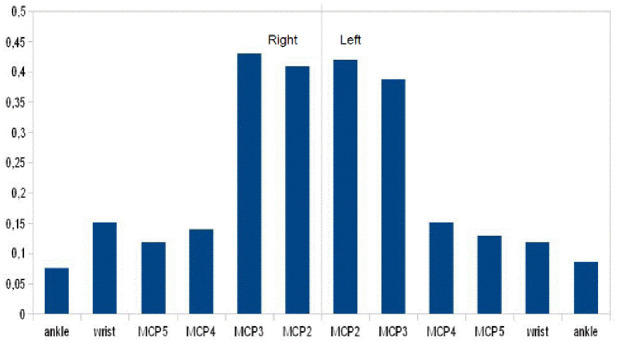
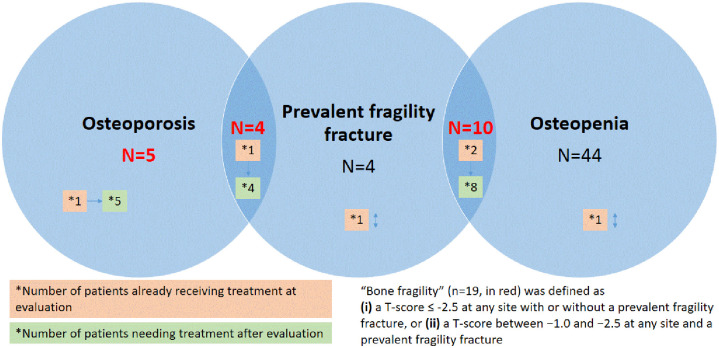
Background: The aim of this study was to determine the frequency and characteristics of bone and joint complications, specifically bone fragility, joint replacement surgery, and arthropathy, in hereditary hemochromatosis (HH) and related factors. Methods: This study was a cross-sectional observational study of 93 patients with HH. Radiographs of the hands, wrists, knees, and ankles were scored for joint space narrowing, erosions and cysts, osteophytes, and chondrocalcinosis. Prevalent (vertebral and non-vertebral) fragility fractures were recorded and bone mineral density (BMD) was systematically evaluated by dual energy X-ray absorptiometry. Bone fragility was defined as (i) a T-score ⩽ −2.5 at any site with or without a prevalent fragility fracture, or (ii) a T-score between −1.0 and −2.5 at any site and a prevalent fragility fracture. Results: The mean age of the patients was 60.0 (11.2) years, and 58.0% of them were men. The frequency of radiographic MCP2–3 arthropathy was 37.6% (95% CI 0.28–0.48). Radiographic MCP2–3 arthropathy was independently associated with older age [OR 1.17 (1.09–1.26) per year, p < 0.0001], male sex [OR 3.89 (1.17–12.97), p = 0.027] and C282Y+/+ genotype [OR 4.78 (1.46–15.68), p = 0.010]. The frequency of joint replacement surgery was 12.9% (95% CI 0.07–0.21). The frequency of bone fragility was 20.4% (95% CI 0.13–0.30). Bone fragility was independently associated with hepatic cirrhosis [OR 8.20 (1.74–38.68), p = 0.008]. Discussion: Radiographic MCP2–3 arthropathy was found to occur in 37.6% of patients with HH. The association observed between this form of arthropathy and C282Y homozygosity, male sex, and older age suggests that demographic characteristics and genetic background are likely to be major determinants of this joint disorder and play a more important role than severity of iron overload. Bone fragility was observed in a fifth of the patients with HH, independently of genetic background and severity of iron overload, and was strongly associated with hepatic cirrhosis. Conclusion: Future investigations should focus on pathogenesis and early identification of patients at risk of developing bone and joint complications secondary to HH.
Overview
The claims and statistics of this paper haven’t been checked yet.
Free: it reads the open-access text and checks the first 5 claims that cite a source we can check. Create a free account to check every claim.
Integrity signals
Registry
Cites
Statistics
Figures
Verification
Claims the paper makes
The claims and statistics of this paper haven’t been checked yet.
Free: it reads the open-access text and checks the first 5 claims that cite a source we can check. Create a free account to check every claim.
Claims other papers make about this one
Each is checked against this paper’s own text: does it say what the citing paper says it does?
In the citing paper
“This has been confirmed by a cross-sectional study of 93 patients with HH, where bone fragility was observed in 25 % of patients with HH and was independent of the severity of iron overload but strongly associated with cirrhosis [187].”
From Emerging role of liver-bone axis in osteoporosis (2024) · cites this paper as [187]
Self-check
Percentages, sums and reported differences re-computed from the paper’s own numbers.
The self-check needs the paper’s full text.
Citations
Cites
Iron-Overload–Related Disease in HFE Hereditary Hemochromatosis
Allen, K. J., Gurrin, L. C., Constantine, C. C., Osborne, N. J., Delatycki, M. B., Nicoll, A. J., McLaren, C. E., Bahlo, M., Nisselle, A. E., Vulpe, C. D., et al. (2008) · New England Journal of Medicine · doi:10.1056/nejmoa073286 · Cited by 731
EASL clinical practice guidelines for HFE hemochromatosis
European Association for the Study of the Liver (2010) · Journal of Hepatology · doi:10.1016/j.jhep.2010.03.001 · Cited by 587
Bone loss caused by iron overload in a murine model: importance of oxidative stress
Tsay, J., Yang, Z., Ross, F. P., Cunningham-Rundles, S., Lin, H., Coleman, R., Mayer-Kuckuk, P., Doty, S. B., Grady, R. W., Giardina, P. J., et al. (2010) · Blood · doi:10.1182/blood-2009-12-260083 · Cited by 340
Powell, L. W., Seckington, R. C., & Deugnier, Y. (2016) · The Lancet · doi:10.1016/s0140-6736(15)01315-x · Cited by 266
Bone mineral density in men with genetic hemochromatosis and HFE gene mutation
Guggenbuhl, P., Deugnier, Y., Boisdet, J. F., Rolland, Y., Perdriger, A., Pawlotsky, Y., & Chalès, G. (2005) · Osteoporosis International · doi:10.1007/s00198-005-1934-0 · Cited by 207
Association between iron overload and osteoporosis in patients with hereditary hemochromatosis
Valenti, L., Varenna, M., Fracanzani, A. L., Rossi, V., Fargion, S., & Sinigaglia, L. (2009) · Osteoporosis International · doi:10.1007/s00198-008-0701-4 · Cited by 203
Pilling, L. C., Tamosauskaite, J., Jones, G., Wood, A. R., Jones, L., Kuo, C.-L., Kuchel, G. A., Ferrucci, L., & Melzer, D. (2019) · BMJ · doi:10.1136/bmj.k5222 · Cited by 198
Osteoporosis in Hemochromatosis: Iron Excess, Gonadal Deficiency, or Other Factors?
Diamond, T., Stiel, D., & Posen, S. (1989) · Annals of Internal Medicine · doi:10.7326/0003-4819-110-6-430 · Cited by 182
Excess iron inhibits osteoblast metabolism
Yamasaki, K., & Hagiwara, H. (2009) · Toxicology Letters · doi:10.1016/j.toxlet.2009.08.023 · Cited by 168
2018 update of French recommendations on the management of postmenopausal osteoporosis
Briot, K., Roux, C., Thomas, T., Blain, H., Buchon, D., Chapurlat, R., Debiais, F., Feron, J. M., Gauvain, J. B., Guggenbuhl, P., et al. (2018) · Joint Bone Spine · doi:10.1016/j.jbspin.2018.02.009 · Cited by 167
Self-citation
Cited by
The Impact of Trace Elements on Osteoarthritis
Li, G., Cheng, T., & Yu, X. (2021) · Frontiers in Medicine · doi:10.3389/fmed.2021.771297 · Cited by 91
Iron effects versus metabolic alterations in hereditary hemochromatosis driven bone loss
Baschant, U., Altamura, S., Steele-Perkins, P., Muckenthaler, M. U., Spasić, M. V., Hofbauer, L. C., Steinbicker, A. U., & Rauner, M. (2022) · Trends in Endocrinology and Metabolism · doi:10.1016/j.tem.2022.06.004 · Cited by 39
Emerging role of liver-bone axis in osteoporosis
Gao, H., Peng, X., Li, N., Gou, L., Xu, T., Wang, Y., Qin, J., Liang, H., Ma, P., Li, S., et al. (2024) · Journal of Orthopaedic Translation · doi:10.1016/j.jot.2024.07.008 · Cited by 36
“This has been confirmed by a cross-sectional study of 93 patients with HH, where bone fragility was observed in 25 % of patients with HH and was independent of the severity of iron overload but strongly associated with cirrhosis [187].”
ResultBanfield, L. R., KNAPP, K. M., Pilling, L. C., Melzer, D. R., & Atkins, J. L. (2023) · JBMR Plus · doi:10.1002/jbm4.10794 · Cited by 19
“contributory factors; however, the published data are contradictory as to which of these has the strongest association.((7,30)) While studies have demonstrated an increased risk of OP independent of cirrhosis and hypogonadism but that it is still related to severity of iron overload, in contrast, another more recent c…”
Robin, F., Chappard, D., Leroyer, P., Latour, C., Mabilleau, G., Monbet, V., Cavey, T., Horeau, M., Derbré, F., Roth, M., et al. (2023) · The FASEB Journal · doi:10.1096/fj.202301184r · Cited by 14
“10,11 In addition, importantly, among post-menopausal women not primarily affected by iron overload, a significant positive correlation has been reported between serum ferritin level increase—which may reflect an increase in iron storage—and osteoporosis, even when the ferritin level remained in…”
BackgroundMethod
Metadata
- Authors
- Nguyen, C.-D., Morel, V., Pierache, A., Lion, G., Cortet, B., Flipo, R.-M., Canva-Delcambre, V., & Paccou, J.
- Affiliations
- Centre Hospitalier Universitaire de Lille (FR)
- EA 2694 – Santé Publique: épidémiologie et qualité des soins, Université de Lille, CHU Lille, F-Lille, France
- Université de Lille (FR)
- Corresponding author
- Paccou, Julien
- Venue
- Therapeutic Advances in Musculoskeletal Disease
- Publisher
- SAGE Publications
- Published
- 2020-01
- Volume
- 12
- Pages
- 1759720X20939405-1759720X20939405
- ISSN
- 1759-720X (ISSN-L)
- 1759-7218
- PMC
- PMC7366396
- OpenAlex
- W3042691539
- Cited by
- 18
- References
- 32
- Citations by year
- 2025: 3 · 2024: 3 · 2023: 6 · 2022: 4 · 2021: 2
- FWCI
- 1.89
- Type
- journal article
- Language
- en
- Open access
- gold
- doi.org
- Licence
- Locations
- Therapeutic Advances in Musculoskeletal Disease (publishedVersion, cc-by-nc)
- PubMed Central (publishedVersion, cc-by-nc)
- PubMed (publishedVersion)
- DOAJ (DOAJ: Directory of Open Access Journals) (submittedVersion, cc-by-sa)
- Topics
- Health Sciences › Medicine › Hematology › Iron Metabolism and Disorders
- Life Sciences › Neuroscience › Neurology › Neurological diseases and metabolism
- Health Sciences › Medicine › Orthopedics and Sports Medicine › Bone and Joint Diseases
- Keywords
- hereditary hemochromatosis, bone fragility, joint replacement, C282Y homozygosity, bone mineral density, liver cirrhosis, osteophytes, chondrocalcinosis, osteoporosis, sex differences, age as risk factor, hand radiographs, knee radiographs
About these checks
Registry, retraction, Cites and statistics results are computed, not judged, with one exception: a printed reference that no index lists is read once by a model before it counts as a citation error. Claims are extracted by a model and kept only when their quote appears verbatim in the text; each cited source is then checked, with a model’s help, for whether it says what the claim relies on. Those verdicts can be wrong — read the claim’s quote and the cited source before relying on one.
Statistics and arithmetic are recomputed, not judged.
Confidence bands are shown only for fields calibrated on our annotated test set. None is calibrated yet, so no band is shown.
What counts as a claim ›How we measure confidence ›How we check this ›
Are you an author, or do you see a problem with this page? Request a review
How to cite
Cite CoChat for the checks on this page, and the paper for its own findings.
- This page
- CoChat. (2026). Citation check: Bone and joint complications in patients with hereditary hemochromatosis: a cross-sectional study of 93 patients. https://app.cochat.ai/papers/10.1177/1759720x20939405
- The paper
- Nguyen, C.-D., Morel, V., Pierache, A., Lion, G., Cortet, B., Flipo, R.-M., Canva-Delcambre, V., & Paccou, J. (2020). Bone and joint complications in patients with hereditary hemochromatosis: a cross-sectional study of 93 patients. Therapeutic Advances in Musculoskeletal Disease. https://doi.org/10.1177/1759720x20939405
Data sources
Bibliographic data: Semantic Scholar, OpenAlex, Crossref.
Contains information from the Semantic Scholar Academic Graph Datasets, made available under the ODC Attribution License (ODC-BY 1.0).
Semantic Scholar’s data is described in: Kinney, R., et al. (2023). The Semantic Scholar Open Data Platform. arXiv:2301.10140.
