

Safety and efficacy of extended release ketamine tablets in patients with treatment-resistant depression and anxiety: open label pilot study
Open accessThe DOI matches its Crossref record; 19 of the 19 references it cites were found in a registry or an index.
Abstract
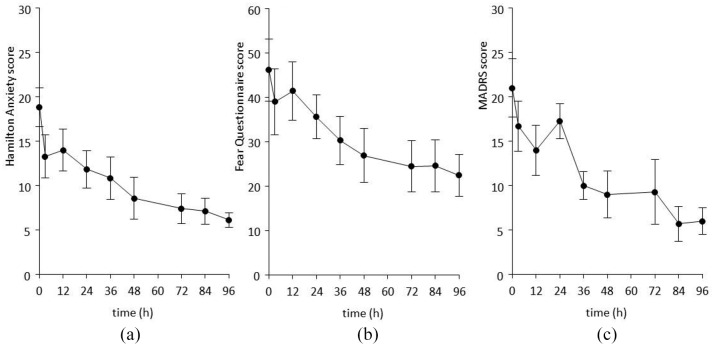
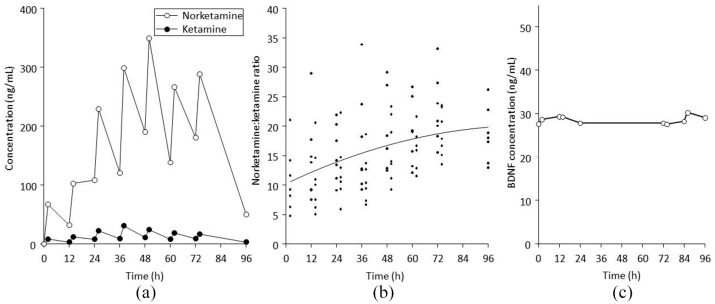
Background: Ketamine’s defining side effects are dissociation and increased blood pressure/heart rate. An oral formulation with delayed absorption could minimize these effects. We recently reported safety and tolerability data for an extended release ketamine tablet in healthy volunteers. Methods: To assess safety, tolerability, efficacy, and pharmacokinetics of an extended release oral ketamine tablet in patients with treatment-resistant depression/anxiety. This was a multiple dose open-label flexible dose uncontrolled study in seven patients with treatment-resistant depression/anxiety, who had all previously demonstrated mood improvement to subcutaneous ketamine. Assessments included ratings of anxiety, depression and dissociation, safety and tolerability, and blood samples for ketamine pharmacokinetics and brain-derived neurotrophic factor (BDNF) concentrations. Results: Improvements in anxiety and depression ratings occurred gradually over 96 h; all patients had >50% improvements in mood ratings. Ketamine was safe and well tolerated, with no changes in vital signs, and a single brief report of dissociation. Ketamine may induce its own metabolism, as the ratio of norketamine to ketamine increased out to 96 h. Serum BDNF concentrations did not change during the study. Conclusion: Ketamine’s safety/tolerability may be improved with an extended release oral formulation. Onset of mood improvement is slightly delayed compared with parenteral dosing. These data support the further development of extended release ketamine tablets for treatment of resistant depression and anxiety disorders.
Overview
The claims and statistics of this paper haven’t been checked yet.
Free: it reads the open-access text and checks the first 5 claims that cite a source we can check. Create a free account to check every claim.
Integrity signals
Registry
Cites
Statistics
Figures
Verification
Claims the paper makes
The claims and statistics of this paper haven’t been checked yet.
Free: it reads the open-access text and checks the first 5 claims that cite a source we can check. Create a free account to check every claim.
Claims other papers make about this one
Each is checked against this paper’s own text: does it say what the citing paper says it does?
The cited source says what the claim attributes to it.
In the citing paper
“an extended-release oral ketamine tablet gradually decreased depressive and anxiety symptoms in seven participants with TRD and anxiety within 96 h of administration [97]”
From Ketamine in neuropsychiatric disorders: an update (2024) · cites this paper as [97]
Self-check
Percentages, sums and reported differences re-computed from the paper’s own numbers.
The self-check needs the paper’s full text.
Citations
Cites
A new depression scale designed to be sensitive to change
Montgomery, S. A., & Åsberg, M. (1979) · British Journal of Psychiatry · doi:10.1192/bjp.134.4.382 · Cited by 13,962
The assessment of anxiety states by rating
HAMILTON, M. (1959) · British Journal of Medical Psychology · doi:10.1111/j.2044-8341.1959.tb00467.x · Cited by 11,455
Liebowitz, M. R. (2015) · Modern Trends in Pharmacopsychiatry · doi:10.1159/000414022 · Cited by 2,266
Brief standard self-rating for phobic patients
Marks, I. M., & Mathews, A. M. (1979) · Behaviour Research and Therapy · doi:10.1016/0005-7967(79)90041-x · Cited by 1,801
NMDAR inhibition-independent antidepressant actions of ketamine metabolites
Zanos, P., Moaddel, R., Morris, P. J., Georgiou, P., Fischell, J., Elmer, G. I., Alkondon, M., Yuan, P., Pribut, H. J., Singh, N. S., et al. (2016) · Nature · doi:10.1038/nature17998 · Cited by 1,609
Mechanisms of ketamine action as an antidepressant
Zanos, P., & Gould, T. D. (2018) · Molecular Psychiatry · doi:10.1038/mp.2017.255 · Cited by 1,127
Bremner, J. D., Krystal, J. H., Putnam, F. W., Southwick, S. M., Marmar, C., Charney, D. S., & Mazure, C. M. (1998) · Journal of Traumatic Stress · doi:10.1023/a:1024465317902 · Cited by 817
Columbia-Suicide Severity Rating Scale (C-SSRS)
Shahid, A., Wilkinson, K., Marcu, S., & Shapiro, C. M. (2011) · STOP, THAT and One Hundred Other Sleep Scales · doi:10.1007/978-1-4419-9893-4_24 · Cited by 384
Loo, C. K., Gálvez, V., O'Keefe, E., Mitchell, P. B., Hadzi‐Pavlovic, D., Leyden, J., Harper, S., Somogyi, A. A., Lai, R., Weickert, C. S., et al. (2016) · Acta Psychiatrica Scandinavica · doi:10.1111/acps.12572 · Cited by 257
Self-citationHaile, C. N., Murrough, J. W., Iosifescu, D. V., Chang, L. C., Al Jurdi, R. K., Foulkes, A., Iqbal, S., Mahoney, J. J., De La Garza, R., Charney, D. S., et al. (2014) · The International Journal of Neuropsychopharmacology · doi:10.1017/s1461145713001119 · Cited by 253
Research works printed but not linked: 1
- Glue P Medlicott NJ Surman PW Extended release pharmaceutical formulation. US Patent Office, 10,441,544 B2, 2019.
Cited by
Ketamine in neuropsychiatric disorders: an update
Johnston, J. N., Kadriu, B., Kraus, C., Henter, I. D., & Zarate, C. A. (2024) · Neuropsychopharmacology · doi:10.1038/s41386-023-01632-1 · Cited by 108
Ketamine treatment for refractory anxiety: A systematic review
Tully, J. L., Dahlén, A. D., Haggarty, C. J., Schiöth, H. B., & Brooks, S. J. (2022) · British Journal of Clinical Pharmacology · doi:10.1111/bcp.15374 · Cited by 104
Oral ketamine for depression: An updated systematic review
Meshkat, S., Haikazian, S., Vincenzo, J. D. D., Fancy, F., Johnson, D. E., Chen-Li, D. C. J., McIntyre, R. S., Mansur, R. B., & Rosenblat, J. D. (2023) · The World Journal of Biological Psychiatry · doi:10.1080/15622975.2023.2169349 · Cited by 70
“The results of this trial indicated that MADRS scores decreased gradually up to 96 hours (final mean score ¼ 5.7) (Glue et al. 2020).”
InfluentialKetamine as a Treatment for Anorexia Nervosa: A Narrative Review
Keeler, J. L., Treasure, J. L., Juruena, M. F., Kan, C., & Himmerich, H. (2021) · Nutrients · doi:10.3390/nu13114158 · Cited by 61
“Later studies have investigated its use to treat chronic PTSD, and whilst, to date, there are few randomisedcontrolled trials (RCTs), the results are promising.”
BackgroundInfluentialAgnorelli, C., Spriggs, M. J., Godfrey, K., Sawicka, G., Bohl, B., Douglass, H. M., Fagiolini, A. M., Hashemi, P., Carhart-Harris, R. L., Nutt, D. J., et al. (2025) · Neuroscience & Biobehavioral Reviews · doi:10.1016/j.neubiorev.2025.106132 · Cited by 69
“However, interpreting such result in the context of neuroplasticity is challenging.”
Van Amsterdam, J., & Van Den Brink, W. (2022) · Expert Opinion on Drug Safety · doi:10.1080/14740338.2021.1949454 · Cited by 44
Robison, R., Lafrance, A., Brendle, M., Smith, M., Moore, C., Ahuja, S., Richards, S., Hawkins, N., & Strahan, E. (2022) · Journal of Eating Disorders · doi:10.1186/s40337-022-00588-9 · Cited by 36
Glue, P., Russell, B., & Medlicott, N. J. (2020) · European Journal of Clinical Pharmacology · doi:10.1007/s00228-020-03047-z · Cited by 33
“…2.59 15 13 7 Loo 2016 [5] S 0.27 105% 2.43 11 18 20 Bitter 2011 [19] R 0.5 93% 2.64 22 - - Clements 1982 [15] Solution/SC Rac 0.5 - 1.98 30 7.1 2.5 Glue 2020a [6] Rac 0.5 91% 2.21 15 7.5 4 Loo 2016 [5] Solution/nebulized S 0.7 70% 1.93 22 - - Jonkman 2017 [26] Solution/nasal spray Rac 0.3 45%…”
InfluentialSelf-citationSmith-Apeldoorn, S. Y., Veraart, J. K. E., Kamphuis, J., Spijker, J., van der Meij, A., van Asselt, A. D. I., Rot, M. A. H., & Schoevers, R. A. (2024) · Molecular Psychiatry · doi:10.1038/s41380-024-02478-9 · Cited by 34
Hassan, K., Struthers, W. M., Sankarabhotla, A., & Davis, P. (2022) · Frontiers in Psychiatry · doi:10.3389/fpsyt.2022.992624 · Cited by 33
Oral ketamine may offer a solution to the ketamine conundrum
Dutton, M., Can, A., Lagopoulos, J., & Hermens, D. F. (2023) · Psychopharmacology · doi:10.1007/s00213-023-06480-x · Cited by 23
Calder, A. E., Hase, A., & Hasler, G. (2024) · Molecular Psychiatry · doi:10.1038/s41380-024-02830-z · Cited by 25
Rossi, G. N., Hallak, J. E. C., Baker, G. B., Dursun, S. M., & SANTOS, R. G. D. (2022) · European Archives of Psychiatry and Clinical Neuroscience · doi:10.1007/s00406-022-01460-2 · Cited by 16
Weiss, M., & Siegmund, W. (2022) · Clinical Pharmacology in Drug Development · doi:10.1002/cpdd.993 · Cited by 13
Karami, T., Ghobadi, E., Akrami, M., & Haririan, I. (2024) · Polymers · doi:10.3390/polym16060746 · Cited by 14
“Interestingly, the evidence of greater tolerability, as well as minimized side effects, in treatment-resistant depression have been obtained for an extended release oral medication [15].”
Hasan, M., Modeß, C., Roustom, T., Dokter, A., Grube, M., Link, A., Rey, H., Adler, S., Meissner, K., & Siegmund, W. (2021) · Anesthesiology · doi:10.1097/aln.0000000000003829 · Cited by 13
“Other authors reported that ascending repeated oral dosing of prolonged-release ketamine up to 240 mg daily almost completely lacked dissociative/hallucinogenic disturbances; of 12 patients with treatment-resistant depression and anxiety, 1 subject complained of dizziness, 1 of dissociation, and 3 of headaches.(25) In…”
BackgroundGuhathakurta, D., Petrušková, A., Akdaş, E. Y., Perelló‐Amorós, B., Frischknecht, R., Anni, D., Weiss, E., Walter, M., & Fejtová, A. (2024) · Translational Psychiatry · doi:10.1038/s41398-024-02744-y · Cited by 12
Bottemanne, H., Claret, A., & Fossati, P. (2020) · L Encéphale · doi:10.1016/j.encep.2020.08.006 · Cited by 15
Núñez, N. A., Joseph, B., Pahwa, M., Seshadri, A., Prokop, L. J., Kung, S., Schak, K. M., Voort, J. L. V., Frye, M. A., & Singh, B. (2025) · Psychopharmacology Bulletin · doi:10.64719/pb.4376 · Cited by 11
Klučková, T., Nikolič, M., Tylš, F., Viktorin, V., Vejmola, Č., Viktorinová, M., Bravermanová, A., Androvičová, R., Andrashko, V., Korčák, J., et al. (2025) · Pharmacological Reports · doi:10.1007/s43440-025-00742-5 · Cited by 10
Veraart, J. K. E., Smith-Apeldoorn, S. Y., van der Meij, A., Spijker, J., Schoevers, R. A., & Kamphuis, J. (2025) · Journal of Psychopharmacology · doi:10.1177/02698811251332831 · Cited by 10
Depression and Anxiety Disorders
Karamustafalıoğlu, O., & Yumrukçal, H. (2025) · Wiley eBooks · doi:10.1002/9781119870203.mpg003.pub2 · Cited by 8
Thornton, N. L. R., Wright, D. J., & Glozier, N. (2024) · Australian & New Zealand Journal of Psychiatry · doi:10.1177/00048674241237094 · Cited by 6
“Other preparations of ketamine have been trialled (e.g. extended-release tablets; Glue et al., 2020) with promising results (Douglas Pharmaceuticals, 2021).”
BackgroundZhang, Y., Song, Z., Zhang, H., Lin, H., Xu, P., Li, Z., He, Q., & Wei, B. (2025) · Biomedicines · doi:10.3390/biomedicines13051081 · Cited by 6
“However, their slower onset ( ≥ 4 weeks to peak efficacy) may limit utility in acute settings [135].”
Schiele, M. A., Fagan, H. A., Baldwin, D. S., & Domschke, K. (2025) · Psychotherapy and Psychosomatics · doi:10.1159/000547926 · Cited by 8
“In another study, seven patients who had already been found to respond well to SC ketamine were given open label extended-release oral ketamine [67].”
Qureshi, M. M., Silman, D., Gadelrab, R., Stein, H., Carmellini, P., Duncan, G., Mehta, M. A., Young, A. H., Reilly, C., & Juruena, M. F. (2025) · Journal of Psychopharmacology · doi:10.1177/02698811251340925 · Cited by 4
Quigley, B. L., Can, A., Dutton, M., Gallay, C. C., Forsyth, G., Jones, M., Randall, F., Wilson, P. A., Lagopoulos, J., & Hermens, D. F. (2025) · European Neuropsychopharmacology · doi:10.1016/j.euroneuro.2025.01.003 · Cited by 4
Auto-Induction in Oral Esketamine Treatment for Treatment-Resistant Depression: An Exploratory Study
Veraart, J. K. E., Vos, C. F., Punt, N. C., Visser, D., Wessels, A. M. A., Smith-Apeldoorn, S. Y., Kamphuis, J., Schoevers, R. A., & Touw, D. J. (2025) · Pharmaceuticals · doi:10.3390/ph18050627 · Cited by 3
“In patients with major depressive disorder (MDD), an open label, flexible-dose pilot study of the same group including seven patients showed an increased norketamine-to-ketamine ratio after four days of repeated oral ketamine administration, which suggests the occurrence of auto-induction [23].”
Oral Prolonged-Release Ketamine for Treatment-Resistant Depression: Two Randomized Clinical Trials
Walter, M., zu Eulenburg, C., Damyanova, A., Schmid, K., Schwienbacher, I., Papanastasiou, E., Maiboe, K., Arvastson, L., Strote, C., Gehrlach, D., et al. (2026) · JAMA Network Open · doi:10.1001/jamanetworkopen.2026.19121 · Cited by 4
Masdrakis, V. G., Tebbs, Z., Natsis, V., & Baldwin, D. S. (2025) · Journal of Psychopharmacology · doi:10.1177/02698811251389583 · Cited by 4
“For example, within 1 hour of subcutaneous ketamine in GAD/SAD patients, significant reduction of anxiety was observed, sustained up to 7 days (Glue et al., 2020b).”
InfluentialStojanova, J., Murnion, B. P., Burrows, F. S., Carlos, L., Mizuno, T., Nadai, T., Irie, K., Helsby, N. A., Muthiah, K., & DAY, R. (2026) · Pharmacotherapy The Journal of Human Pharmacology and Drug Therapy · doi:10.1002/phar.70150 · Cited by 1
Anxiety disorders in clinical practice - a modern view on the problem of therapy
", C. F., & Kuanova, L. (2021) · Journal Medicine · doi:10.31082/1728-452x-2020-215-216-5-6-63-70 · Cited by 1
Identification and management of anxious depression in patients with treatment-resistant depression
Hershenberg, R., Rapaport, M. H., & Weischedel, K. (2022) · Elsevier eBooks · doi:10.1016/b978-0-12-824067-0.00029-3 · Cited by 3
Ketamin in Anästhesie und Intensivmedizin
Himmelseher, S., & Meyer‐Frießem, C. H. (2024) · Springer Reference Medizin · doi:10.1007/978-3-662-45539-5_19-2
Evaluating oral ketamine’s adverse side effects in chronic pain patients
Hom, B. M., McIntee, D., Zhang, Y.-P., Hershenhouse, J. S., Nash, A., & Richeimer, S. H. (2025) · Saudi Journal of Anaesthesia · doi:10.4103/sja.sja_87_25
“[19,36,37] Interestingly, when comparing our cohort as an aggregate using maximum average daily dose, we saw no difference in the count of adverse side effects ( P = 0.10).”
InfluentialProlonged Release Ketamine Tablets: Isomer Pharmacokinetics and Metabolites in Human Volunteers
Erlenwein, J., & Meissner, K. (2025) · Neuromethods · doi:10.1007/978-1-0716-4603-8_20
Oral Racemic Ketamine and Esketamine: Emerging Indications and Future Directions
Arango, J. A. R., & Fernandez-Villarreal, W. (2025) · Neuromethods · doi:10.1007/978-1-0716-4603-8_19
Ketamin in Anästhesie und Intensivmedizin
Himmelseher, S., & Meyer‐Frießem, C. H. (2025) · Springer Reference Medizin · doi:10.1007/978-3-662-45539-5_19-3
A Novel Tertiary Carbamate Prodrug Strategy to Overcome Metabolic Barriers in Oral Ketamine Delivery
Järvinen, J., Adla, S. K., Tampio, J., Jalkanen, A. J., Sloan, K. B., Huttunen, K. M., & Rautio, J. (2026) · ChemMedChem · doi:10.1002/cmdc.202500856
McNaughton, N., Shadli, S. M., Beaglehole, B., & Glue, P. (2026) · Journal of the Royal Society of New Zealand · doi:10.1002/snz2.70002 · Cited by 1
“The generality of ketamine ’ s action across the neurotic disorders, the specificity of many conventional treatments, and the differing neural results of ketamine treatment can all be explained by our “ double hit ” hypothesis of neurotic disorders (McNaughton and Glue 2020).”
Self-citationOral Ketamine for Treatment-Resistant Depression—Not Yet Time?
Cusin, C. (2026) · JAMA Network Open · doi:10.1001/jamanetworkopen.2026.19140
Massetti, S., Smith-Apeldoorn, S. Y., Veraart, J. K. E., Kamphuis, J., Muller, K. A., Tzavara, E. T., Meerlo, P., Schoevers, R. A., & van Dalfsen, J. H. (2026) · Journal of Affective Disorders · doi:10.1016/j.jad.2026.122265
Metadata
- Authors
- Glue, P., Medlicott, N. J., Neehoff, S., Surman, P., Lam, F., Hung, N., & Hung, C.-T.
- Affiliations
- University of Otago (NZ)
- Douglas Pharmaceuticals (New Zealand) (NZ)
- Zenith Technology Ltd, Dunedin, New Zealand
- Corresponding author
- Glue, Paul
- Venue
- Therapeutic Advances in Psychopharmacology
- Publisher
- SAGE Publications
- Published
- 2020-01
- Volume
- 10
- Pages
- 2045125320922474-2045125320922474
- ISSN
- 2045-1253 (ISSN-L)
- 2045-1261
- PMC
- PMC7235665
- OpenAlex
- W3026895695
- Cited by
- 42
- References
- 19
- Citations by year
- 2026: 6 · 2025: 15 · 2024: 6 · 2023: 3 · 2022: 5 · 2021: 5 · 2020: 2
- FWCI
- 2.25
- Type
- journal article
- Language
- en
- Open access
- gold
- doi.org
- Licence
- Locations
- Therapeutic Advances in Psychopharmacology (publishedVersion, cc-by-nc)
- PubMed Central (publishedVersion, cc-by-nc)
- PubMed (publishedVersion)
- DOAJ (DOAJ: Directory of Open Access Journals) (submittedVersion, cc-by-sa)
- Funders
- douglas pharmaceuticals
- Topics
- Health Sciences › Medicine › Pharmacology (medical) › Treatment of Major Depression
- Health Sciences › Medicine › Psychiatry and Mental health › Electroconvulsive Therapy Studies
- Social Sciences › Psychology › Clinical Psychology › Psychedelics and Drug Studies
- Keywords
- treatment-resistant depression, anxiety disorders, dissociation, brain-derived neurotrophic factor, safety and tolerability
About these checks
Registry, retraction, Cites and statistics results are computed, not judged, with one exception: a printed reference that no index lists is read once by a model before it counts as a citation error. Claims are extracted by a model and kept only when their quote appears verbatim in the text; each cited source is then checked, with a model’s help, for whether it says what the claim relies on. Those verdicts can be wrong — read the claim’s quote and the cited source before relying on one.
Statistics and arithmetic are recomputed, not judged.
Confidence bands are shown only for fields calibrated on our annotated test set. None is calibrated yet, so no band is shown.
What counts as a claim ›How we measure confidence ›How we check this ›
Are you an author, or do you see a problem with this page? Request a review
Data sources
Bibliographic data: Semantic Scholar, OpenAlex, Crossref.
Contains information from the Semantic Scholar Academic Graph Datasets, made available under the ODC Attribution License (ODC-BY 1.0).
Semantic Scholar’s data is described in: Kinney, R., et al. (2023). The Semantic Scholar Open Data Platform. arXiv:2301.10140.
