

An online survey of postmenopausal women to determine their attitudes and knowledge of the menopause
Open accessThe DOI matches its Crossref record; 26 of the 26 references it cites were found in a registry or an index.
Abstract
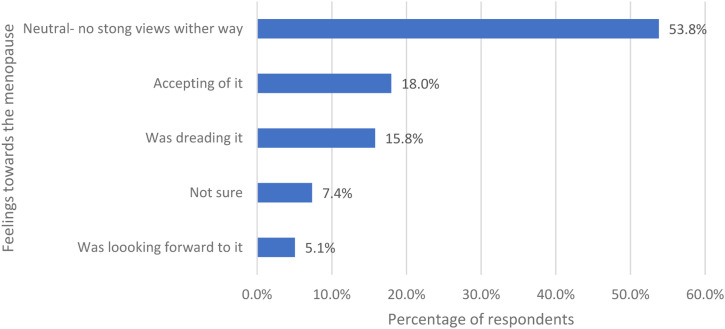
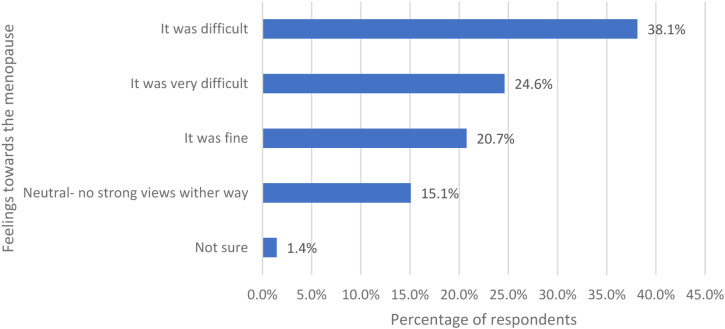
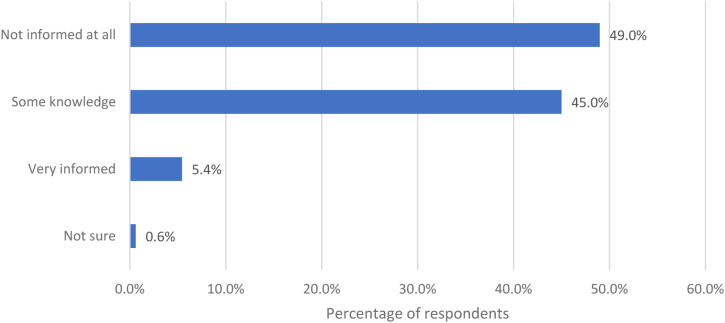
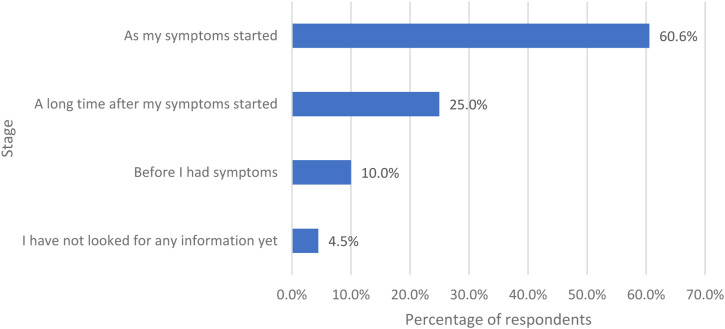
Objective: To explore postmenopausal women’s attitudes and knowledge of the menopause. Study design: An online survey to evaluate women’s attitudes and knowledge of the menopause, promoted via social media. In this study, only the data from 829 women who identified as postmenopausal were analysed. Main outcome measures: Quantitative and qualitative data. Results: Regarding women’s attitudes towards the menopause before they went through it, 18.0% were accepting of it, 15.8% were dreading it and 5.1% were looking forward to it. 38.1% of women felt that the menopause was difficult, 24.6% felt it was very difficult and 20.7% felt it was fine. 94.1% of women had never been taught about the menopause at school, and 49.0% did not feel informed at all about the menopause. More than 60% started looking for information regarding menopause as their symptoms started. The qualitative thematic analysis of the participants’ responses produced six themes: the need for education, knowledge and understanding of symptoms, why is getting treatment so difficult, feelings and attitudes towards the menopause, the impact of menopause on a woman’s life, the importance of the media – are they getting it right. Conclusion: Women’s lack of education and their healthcare professionals’ lack of adequate training on the menopause means that women enter this critical life stage uneducated and unsupported. It is vital that everyone is taught about the menopause and that general practitioners receive proper training. The negative narrative of menopause needs to be re-addressed to normalise the menopause and give postmenopause women hope.
Overview
The claims and statistics of this paper haven’t been checked yet.
Free: it reads the open-access text and checks the first 5 claims that cite a source we can check. Create a free account to check every claim.
Integrity signals
Registry
Cites
Statistics
Figures
Verification
Claims the paper makes
The claims and statistics of this paper haven’t been checked yet.
Free: it reads the open-access text and checks the first 5 claims that cite a source we can check. Create a free account to check every claim.
Claims other papers make about this one
Each is checked against this paper’s own text: does it say what the citing paper says it does?
The source backs part of the claim, not all of it — or backs it for a different population, condition or comparison.
In the citing paper
“women with PCOS report inadequate information and disconcerting interactions with health care professionals [1112]”
From Availability and Use of Digital Technology Among Women With Polycystic Ovary Syndrome: Scoping Review (2025) · cites this paper as [12]
Experimental — accuracy not yet measured
Self-check
Percentages, sums and reported differences re-computed from the paper’s own numbers.
The self-check needs the paper’s full text.
Citations
Cites
Writing Group for the Women's Health Initiative Investigators (2002) · JAMA: The Journal of the American Medical Association · doi:10.1001/jama.288.3.321 · Cited by 15,889 · cited 1×
“Some studies have indicated that the flawed findings of the 2002 WHI study are still being used by some HCPs as the basis for their advice to patients even though there have been more current studies and reanalysis of existing data showing contrasting results.(21) Access to HCPs who are up to date with evidence-based…”
ResultThe impact of attitudes towards the menopause on women's symptom experience: A systematic review
Ayers, B., Forshaw, M., & Hunter, M. S. (2010) · Maturitas · doi:10.1016/j.maturitas.2009.10.016 · Cited by 368 · cited 1×
“11,12 This study was part of an online survey done by Harper et al. exploring attitudes and knowledge of women over 40 years about the menopause and the perimenopause data has been reported.”
BackgroundHill, K. (1996) · Maturitas · doi:10.1016/0378-5122(95)00968-x · Cited by 285 · cited 1×
“By 2030, it is estimated that over one billion women across the globe will be perimenopausal or postmenopausal, and nearly 50 million women will be expected to reach the menopause each year.(3,4) Since the median age at death of women in the UK is 85.”
BackgroundDepressive disorders and the menopause transition
Llaneza, P., García-Portilla, M. P., Llaneza-Suárez, D., Armott, B., & Pérez-López, F. R. (2012) · Maturitas · doi:10.1016/j.maturitas.2011.11.017 · Cited by 230
An online survey of perimenopausal women to determine their attitudes and knowledge of the menopause
Harper, J. C., Phillips, S., Biswakarma, R., Yasmin, E., Sarıdoğan, E., Radhakrishnan, S., Davies, M. C., & Talaulikar, V. S. (2022) · Women s Health · doi:10.1177/17455057221106890 · Cited by 214 · cited 2×
“It was clear that many women in this study were uninformed about the menopause and had not been taught about it at school, which was similar to what we found in peri-menopausal women 6 and women under 40.”
BackgroundResultSelf-citationMishra, G. D., & Kuh, D. (2012) · BMJ · doi:10.1136/bmj.e402 · Cited by 161 · cited 1×
“24,25 Many of the women in our study experienced a loss of identity and felt like their body did not belong to them as a result of these changes.”
BackgroundSocial Determinants of Health in Menopause: An Integrative Review
Namazi, M., Sadeghi, R., & Behboodi Moghadam, Z. (2019) · International Journal of Women's Health · doi:10.2147/ijwh.s228594 · Cited by 158 · cited 1×
“A Husband’s education affects the quality of life of postmenopausal women, especially in the psychosocial dimension, which may be due to a better understanding and supporting were their wives.(17)”
BackgroundAttitudes Toward Menopause and Aging Across Ethnic/Racial Groups
Sommer, B., Avis, N. E., Meyer, P., Ory, M. G., Madden, T. A., Kagawa‐Singer, M., Mouton, C. P., Rasor, N. O., & Adler, S. R. (1999) · Psychosomatic Medicine · doi:10.1097/00006842-199911000-00023 · Cited by 151 · cited 1×
“23 The media plays a signi fi cant role in shaping perceptions and public opinion and feeding into the taboos and myths around menopause.”
BackgroundWomenʼs experience of menopause: a systematic review of qualitative evidence
Hoga, L., Rodolpho, J., Gonçalves, B., & Quirino, B. (2015) · JBI Database of Systematic Reviews and Implementation Reports · doi:10.11124/jbisrir-2015-1948 · Cited by 126 · cited 1×
“26 The qualitative analysis revealed the impact menopause has beyond physical health.”
BackgroundCognition and mental health in menopause: A review
Hogervorst, E., Craig, J., & O’Donnell, E. (2021) · Best Practice & Research Clinical Obstetrics & Gynaecology · doi:10.1016/j.bpobgyn.2021.10.009 · Cited by 123 · cited 1×
“Women who suffer menopausal symptoms such as hot flushes, night sweats and vaginal dryness are more likely to report anxiety and depressive symptoms(27) 47% of the women in the Nuffield Health Survey reported feeling depressed and 37% suffered from anxiety.(28) It is important to note that mid-life is a time of transi…”
Background
Research works printed but not linked: 2
- Namazi M Sadeghi R Behboodi Moghadam Z. Social determinants of health in menopause: an integrative review. Int J Womens Health 2019; 11: 637– 647. DOI: 10.2147/IJWH.S228594 31849539 PMC6910086 · DOI · Paper page
- CIPD (2019). https://www.cipd.co.uk/about/media/press/menopause-at-work#gref
Cited by
Tariq, B., Phillips, S. M., Biswakarma, R., Talaulikar, V. S., & Harper, J. C. (2023) · BMC Women s Health · doi:10.1186/s12905-023-02424-x · Cited by 122
“Harper et al. (2022) designed an online survey to evaluate women’s knowledge and attitudes towards the menopause [4, 5].”
BackgroundInfluentialSelf-citationA systematic review and critical appraisal of menopause guidelines
Hemachandra, C., Taylor, S., Islam, R. M., Fooladi, E., & Davis, S. R. (2024) · BMJ Sexual & Reproductive Health · doi:10.1136/bmjsrh-2023-202099 · Cited by 46
Jermyn, D. (2024) · European Journal of Cultural Studies · doi:10.1177/13675494241287931 · Cited by 39
“…testimonies shared in Sex, Mind and The Menopause , that their doctors proved consistently unsupportive of them when they sought help (see also Aljumah et al., 2023: 79)–for as De Vuyst and De Graeve (2023) note, older women’s ‘articulations of dissent are often overlooked, delegitimised and…”
InfluentialMenopause at work—An organisation‐based case study
Cronin, C., Abbott, J., Asiamah, N., & Smyth, S. (2023) · Nursing Open · doi:10.1002/nop2.2058 · Cited by 33
“The lack of teaching on menopause in schools and minimal education for healthcare professionals has only exacerbated this issue contributing to the lack of knowledge and its negative impact on attitudes and perceptions in women's health (Aljumah et al., 2023).”
BackgroundWomen's Menopausal Experiences in the UK: A Systemic Literature Review of Qualitative Studies
Anto, A., Basu, A., Selim, R., & Eisingerich, A. B. (2025) · Health Expectations · doi:10.1111/hex.70167 · Cited by 29
Maslowski, K., Biswakarma, R., Reiss, M. J., & Harper, J. C. (2024) · Health Education Journal · doi:10.1177/00178969241227314 · Cited by 25
“Menopause surveys have shown that women under 40 (Munn et al., 2022) and over 40 (Aljumah et al., 2022; Harper et al., 2022; Tariq et al., 2023) have very little knowledge of menopause, which negatively affects their experience.”
BackgroundSelf-citationMenopause Decoded: What’s Happening and How to Manage It
Strelow, B., O’Laughlin, D. J., Anderson, T., Cyriac, J., Buzzard, J., & Klindworth, A. (2024) · Journal of Primary Care & Community Health · doi:10.1177/21501319241307460 · Cited by 22
Osborne, A. K., & Sillence, E. (2025) · Women & Health · doi:10.1080/03630242.2025.2523258 · Cited by 14
“…with accessing further support, aiding users in decision making and accessing alternative perspectives and solutions to the menopause experience (Aljumah, Phillips, and Harper 2023; Edwards et al. 2021; Lopez Burst, Ciolfi Felice, and O’Kane 2024; Shaw et al. 2022; Sillence et al. 2007;…”
InfluentialMcNulty, K. L., Lane, A., Kealy, R., & Heavey, P. (2024) · BMC Women s Health · doi:10.1186/s12905-024-03524-y · Cited by 19
Poucke, M. V. (2025) · Atlantic Journal of Communication · doi:10.1080/15456870.2025.2453738 · Cited by 15
“Individuals transitioning through (peri)menopause frequently lack knowledge about what they are experiencing (Aljumah et al., 2023), which may drive them to browse the Internet for more information.”
Rodrigues, M. A. H., Reis, Z. S. N., Verona, A. P., Teixeira, M. C., Pappa, G. L., Soares, J. M., Filho, A. L. D. S., Baracat, E. C., & Maciel, G. A. R. (2025) · PLoS ONE · doi:10.1371/journal.pone.0316873 · Cited by 19
“…of Italian women received no information, or and reproduction in any medium, provided the original author and source are credited. described it as poor and conflicting [12], similar to Lebanese women, where 47.9% were unsure when to start therapy [13], a trend observed in other countries [14–16].”
InfluentialHow do women feel cold water swimming affects their menstrual and perimenopausal symptoms?
Pound, M., Massey, H. C., Roseneil, S., Williamson, R., Harper, C. M., Tipton, M., Shawe, J., Felton, M., & Harper, J. C. (2024) · Post Reproductive Health · doi:10.1177/20533691241227100 · Cited by 13
Self-citationKingsberg, S. A., Nappi, R. E., Scott, M., Schoof, N., Möeller, C., Lee, L., Janssenswillen, C., Caetano, C., & Banks, V. (2024) · Climacteric · doi:10.1080/13697137.2024.2401366 · Cited by 12
“These women are frequently dissatisfied with their interactions with physicians and subsequent treatment outcomes, causing them to feel unsupported or dismissed [10,11].”
Wright, P. J., Burts, C., Harmon, C., & Corbett, C. F. (2025) · JMIR Infodemiology · doi:10.2196/68469 · Cited by 8
“Study findings indicate that women with PCOS report inadequate information and disconcerting interactions with health care professionals [11,12], such that many women with PCOS pursue health care information and social support via the internet [13,14].”
Sharp, C., Dennis, N., Hobson, G., Hamilton-Kirkwood, M., & Hughes, K. E. (2025) · International Journal of Environmental Research and Public Health · doi:10.3390/ijerph22020287 · Cited by 8
“This difference in perception influences people’s attitudes towards menopause [7].”
The time has come for a UK-wide menopause education and support programme: InTune
Harper, J. C., Keay, N., Rowe, F., Alstyne, P. V., & Tariq, S. (2024) · Women s Health · doi:10.1177/17455057241277535 · Cited by 8
Self-citationFarhana, F., Sultana, M. A., Hia, R. A., & Hegde, V. K. (2025) · Neuroscience & Biobehavioral Reviews · doi:10.1016/j.neubiorev.2025.106501 · Cited by 10
Funnell, E. L., McConnell, F., Martin-Key, N. A., Qian, L., Babbitt, K., & Bahn, S. (2025) · JMIR Formative Research · doi:10.2196/75335 · Cited by 6
“This is similar to previous qualitative research in postmenopausal women, which found that support groups, including online support groups, enable knowledge sharing and reduce feelings of isolation [31].”
McCartney, M., Morgan-Young, R., Sullivan, F., Murphy, D. J., Albulushi, J., & Larkin, J. (2025) · BMJ Open · doi:10.1136/bmjopen-2024-094773 · Cited by 9
“16 The risks and benefits of HRT have been differently promoted and contested over time.”
Daly, R., & Hynes, S. M. (2025) · British Journal of Occupational Therapy · doi:10.1177/03080226241310032 · Cited by 5
“Menopausal changes can have deleterious impacts on women’s lives (Hooper et al., 2022), including their roles and relationships (Aljumah et al., 2023), work (O’Neill et al., 2023), and daily activities (Arar and Erbil, 2023).”
Seeking Control: How Women Evaluate and Use Menopause Related Information
Emter, F., & Chavula, C. (2025) · Conference on Human Information Interaction and Retrieval · doi:10.1145/3698204.3716455 · Cited by 8
Calvin, A., Cina, S., Byrskog, U., Erlandsson, K., & Borneskog, C. (2025) · European Journal of Midwifery · doi:10.18332/ejm/209571 · Cited by 6
“In addition, it is estimated that approximately 49% of women do not feel informed at all about menopause before going through it 11 .”
Kim, C., Marples, L., Platts, A., Bermingham, K. M., Amati, F., Hamoda, H., Pounis, G., Wolf, J., Spector, T. D., Hall, W. L., et al. (2025) · Post Reproductive Health · doi:10.1177/20533691251335807 · Cited by 7
Baghdadi, R., Singh, N., & Gatuguta, A. (2025) · Post Reproductive Health · doi:10.1177/20533691251322823 · Cited by 6
“5,6 Participants reported negative, sometimes traumatic experiences of MRH, citing dif fi culty receiving appropriate HRT, feeling unheard by GPs and negative encounters with HCPs.”
Influential“Just Deal With It:” Memorable Messages About Menopause as Anticipatory Education
Rubinsky, V., Tolman, C., & Cooke-Jackson, A. F. (2025) · American Journal of Sexuality Education · doi:10.1080/15546128.2025.2531761 · Cited by 4
The role of masturbation in relieving symptoms associated with menopause
Lehmiller, J. J., Graham, C. A., Ferrall, L., Mendelson, E. A., & Prine, M. S. (2025) · Menopause The Journal of The North American Menopause Society · doi:10.1097/gme.0000000000002675 · Cited by 6
Baker, P. A., Moore, S. R., & Smith‐Ryan, A. E. (2025) · Clinical Physiology and Functional Imaging · doi:10.1111/cpf.70011 · Cited by 3
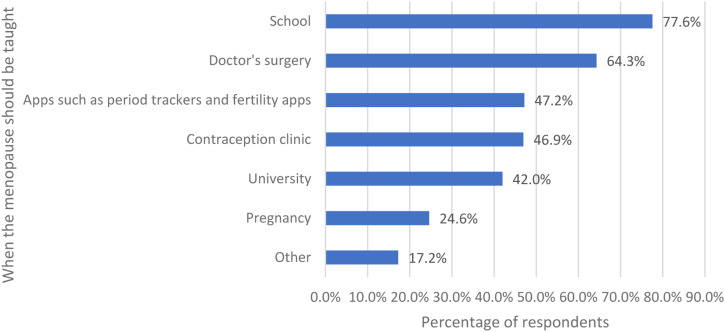
“Despite this, knowledge about the physiological effects of this transition remains limited and to date, studies indicate that over 94% of females have not received education about the changes they will experience (Aljumah et al., 2023; O'Reilly et al., 2023).”
de Paula, S. R. C., Mendes, M. C., Okano, S. H. P., Ferriani, R. A., dos Reis, R. M., & Lara, L. A. D. S. (2025) · Menopause The Journal of The North American Menopause Society · doi:10.1097/gme.0000000000002589 · Cited by 5
Hirschberg, A. L., Morga, A., Bruon, F., Martins, K., Schild, A. L., Hawryluk, E., Roberts, K., Williams, B., & Nappi, R. E. (2025) · Maturitas · doi:10.1016/j.maturitas.2025.108670 · Cited by 5
“I feel like it gets worse as I get older”: perspectives of peri-postmenopausal women with PCOS
Wright, P. J., Corbett, C. F., Dawson, R. M., & Burts, C. (2025) · Frontiers in Global Women s Health · doi:10.3389/fgwh.2025.1588505 · Cited by 4
Harper, J. C., Keay, N., Mir, M., Mukherjee, A., Plumb, J., Kumar, G., Lindsay, J., Barratt, J., Strachan, S., & Tariq, S. (2025) · Post Reproductive Health · doi:10.1177/20533691251372818 · Cited by 4
Self-citationMenopausal hormone therapy use among active duty service women
Janvrin, M. L., Banaag, A. L., Brown, J. E., Shvartsman, K., & Koehlmoos, T. P. (2024) · Menopause The Journal of The North American Menopause Society · doi:10.1097/gme.0000000000002469 · Cited by 3
Kalpakjian, C. Z., Hanks, R. A., Quint, E. H., Millis, S. R., Sander, A. M., Lequerica, A. H., Bushnik, T. L., Brunner, R. C., & Rapport, L. J. (2023) · Women & Health · doi:10.1080/03630242.2023.2294969 · Cited by 3
“Contextual factors such as stressful life events (Arnot, Emmott, and Mace 2021; Thomas et al. 2023), attitudes about menopause (Aljumah, Phillips, and Harper 2023), demographic characteristics (Avis, Crawford, and Green 2018; Prairie et al. 2015; Sternfeld et al. 2020) and self-perceived health…”
BackgroundStute, P., Currie, H. D., & Palacios, S. (2025) · Climacteric · doi:10.1080/13697137.2025.2548802 · Cited by 2
“Lifestyle changes (e.g. exercise, weight loss and improved nutrition) should be recommended first as improved general health can alleviate mild-to-moderate symptoms and promote overall well-being [9,17,23,30].”
InfluentialWarwick-Booth, L., Thompson, S., & Dhingra, K. (2025) · Health Education Journal · doi:10.1177/00178969251377900 · Cited by 2
“Burgin et al. (2024) note that women’s experiences of menopause are affected by inequities in a range of areas, including educational provision, which results in many entering this life stage uneducated, and in other instances unsupported (Aljumah et al., 2023).”
Giggins, O. M., Smith, S. C., McLysaght, A., & Doyle, J. (2026) · BMC Women s Health · doi:10.1186/s12905-025-04204-1 · Cited by 4
Enhancing gender equality for women using person-centred care and cultural curiosity
Moss, J., & Roberts, S. (2024) · Nursing Standard · doi:10.7748/ns.2024.e12221 · Cited by 2
The Contribution of Isoflavones in Menopausal Symptomatic as Alternative Treatment Option
Tsikouras, P. N., Chalkidou, A., Iatrakis, G. M., Oikonomou, E., Bothou, Α., Kyriakou, D., Mouchterem, A. C. I., Alexiou, A., Nikolettos, K., Kritsotaki, N., et al. (2024) · IntechOpen eBooks · doi:10.5772/intechopen.114215 · Cited by 3
A Call to Action for Examining Perimenopause and Menopause Education in Doctor of Pharmacy Curricula
Brand-Eubanks, D. C., Winter, A. M., Buchman, C. R., & Hughes, J. A. (2025) · American Journal of Pharmaceutical Education · doi:10.1016/j.ajpe.2025.101411 · Cited by 1
Navigating power and silence: Communicative disenfranchisement in menopause healthcare communication
Tolman, C., Rubinsky, V., & Cooke-Jackson, A. F. (2025) · Journal of Women & Aging · doi:10.1080/08952841.2025.2601019 · Cited by 1
“It may be due to a lack of training, education, or understanding of menopause-related issues, which hinders patients’ ability to make informed decisions (Aljumah et al., 2023; Currie & Moger, 2019; Harper et al., 2022).”
Trevino, M., Leiker, P., Palnati, S. R., & Bhakta, S. (2025) · Cureus · doi:10.7759/cureus.99210 · Cited by 4
“Studies have shown that this cohort of women lacked education on and desired more information about what their body was going through and how to manage it [2].”
Badgett, N. M., Taylor-Swanson, L. J., Quist, S., Price, J., & Villanueva, J. (2026) · Frontiers in Reproductive Health · doi:10.3389/frph.2026.1762773 · Cited by 1
“This issue is further compounded by the challenges women face in accessing menopause education and support (4).”
What is in the bottle? An analysis of the ingredients in menopause supplements
Sullivan, P., Boylan, A. R., & Harper, J. C. (2026) · Climacteric · doi:10.1080/13697137.2026.2719016 · Cited by 1
Self-citationGreeshma, S. S. (2023) · Psychology & Psychological Research International Journal · doi:10.23880/pprij-16000363 · Cited by 1
Health Care, Free at the Point of Delivery
O'Neill, M. F. (2024) · The Sociological Review Magazine · doi:10.51428/tsr.gaeo4119
Harmonizing Midlife Motherhood
Komalasari, R. (2024) · Advances in medical technologies and clinical practice book series · doi:10.4018/979-8-3693-2342-7.ch006
Ramezanzadeh, F., Hamidia, A., Pourhadi, S., & Shirafkan, H. (2024) · Research Square · doi:10.21203/rs.3.rs-5256521/v1
Angaye, U., Scent, G. A. T., & Sibiri, E. A. (2025) · Student s Journal of Health Research Africa · doi:10.51168/sjhrafrica.v6i9.1857
Research Progress on the Treatment of Mood Disorders in Perimenopausal Women with Meridian Formulae
任, 雪. (2025) · Advances in Clinical Medicine · doi:10.12677/acm.2025.15102881
Disparities in Clinical Management of Menopause Within China’s Hierarchical Medical Framework
Liang, W., Liu, Y., Zhu, S., Ding, X., 邓燕, Ma, X., Gan, J., Wang, Y., & Sun, A. (2026) · Clinical and Experimental Obstetrics & Gynecology · doi:10.31083/ceog45361
Silva, S. (2026) · Conference on Human Information Interaction and Retrieval · doi:10.1145/3786304.3787941
“As a result, women often struggle to distinguish between evidence-based information and commercial driven information, which increase the risks of misinformation [2, 17, 33].”
InfluentialBlack women’s knowledge and attitudes to menopause: an online survey
Balakumar, H., Ayoade, A., Oliver, D., Garuba, Y., Brown, A.-A., & Harper, J. C. (2026) · Post Reproductive Health · doi:10.1080/20533691.2026.2630581
“The latest study on postmenopausal women further highlighted the knowledge gap, with the majority feeling unsupported due to a lack of education from their General Practitioner (GP) [17].”
Self-citationDevelopment and validation of a menopausal health education training programme for women
Latif, U., Riaz, H., Kundi, M. K., Ejaz, Z., & Zafar, R. (2026) · Health Education Journal · doi:10.1177/00178969261435827
“Research indicates that many women have insufficient awareness and negative feelings about menopause, which can contribute to psychological discomfort and hinder their ability to cope effectively (Aljumah et al., 2023; Harper et al., 2022; Kwak et al., 2014).”
Barwick, E., Cox, J., Wilson, T. L., Turner, V., & Borah, A. (2026) · Cureus · doi:10.7759/cureus.107380
Agarwal, V., & Malik, R. (2026) · Springer eBooks · doi:10.1007/978-981-95-7498-8_1
Osborne, A. K., Sillence, E., Claisse, C., & Durrant, A. C. (2026) · Journal of Medical Internet Research · doi:10.2196/78215
“However, in terms of menopause information, this contradicts existing research suggesting there is a paucity of readily available, relevant, reliable, and accessible resources of menopause information [27].”
Klukas, I. F., & Schotanus-Dijkstra, M. (2026) · Journal of Happiness Studies · doi:10.1007/s10902-026-01059-7 · Cited by 1
Şahin, S., Aydın, E. İ., Dikmen, R., & Ünsal, A. (2026) · BMC Women s Health · doi:10.1186/s12905-026-04525-9
“Occurring typically between ages 45 and 55, menopause signifies the end of a woman’s reproductive years [2–4].”
InfluentialOsborne, A., Brown, R. D., & Sillence, E. (2026) · JMIR Formative Research · doi:10.2196/85788 · Cited by 1
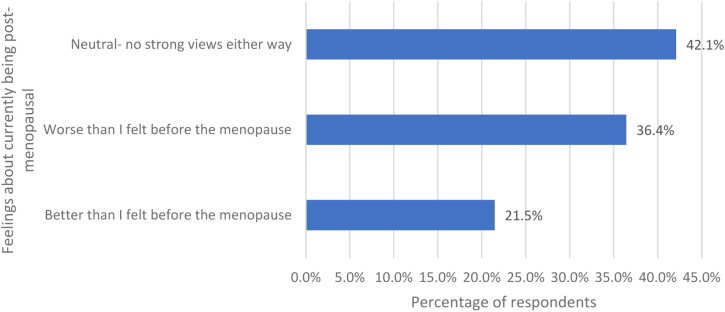
“Two-thirds of postmenopausal women report feeling better or at least neutral about menopause after the transition compared with before [34].”
Nappi, R. E., Carabelli, S., Dellacasa, I., Dipasquale, S., Mento, V., Orthmann, N., Palagini, L., Pantanella, A., Perrotta, M., Tedone, F., et al. (2026) · Post Reproductive Health · doi:10.1080/20533691.2026.2630422
“Overall, Italian menopausal women who were active on social media platforms showed a satisfactory health literacy as compared to a similar more detailed international survey [31].”
Experiences of Dutch nurses and doctors with pregnancy and menopause in the workplace
Bendien, E., & Verdonk, P. (2026) · Work · doi:10.1177/10519815261434232
Championing Women’s Voices in Menopause: Broadening the Clinical Lens
Boreham, H. (2026) · European Medical Journal · doi:10.33590/emj/755og471
Solmaz, E., & Çelik, A. S. (2026) · Journal of Nursing Scholarship · doi:10.1111/jnu.70116
Therapists’ journeys through the menopause transition and their emergence as empowered practitioners
Clair, F. B.-S., Farish-Edwards, F., & Tebble, G. (2026) · Person-Centered & Experiential Psychotherapies · doi:10.1080/14779757.2026.2696859
Diremsizoğlu, E., Arslan, E. A., Demirbaş, A., & Fabi, S. G. (2026) · Journal of Cosmetic Dermatology · doi:10.1111/jocd.71101
“Qualitative research has consistently documented cancer concerns, risk misperception, and limited knowledge as drivers of HRT avoidance [16, 17]; the present findings extend this by demonstrating, at scale, that these attitudes are actively expressed in online public discourse.”
Angaye, U., & Michael, T. O. (2026) · Reproductive Female and Child Health · doi:10.1002/rfc2.70097
Sillence, E., & Osborne, A. (2026) · Palgrave Studies in Cyberpsychology. · doi:10.1007/978-3-032-25909-7_6
Awareness of Menopause and Health Risks Among Reproductive-Age Women in Latvia
Jurkans, J., Kolosovska, J., & Pumpure, E. (2026) · Journal of Clinical Medicine · doi:10.3390/jcm15166295
“This investigator-designed survey was developed specifically for the present study based on the study objectives and English-language survey questionnaires described in previous studies [4,12–15].”
Yurdal, N. E. Ö., Öter, E. G., Pek, E., & Duran, M. N. (2026) · Revista da Escola de Enfermagem da USP · doi:10.1590/1980-220x-reeusp-2026-0107en · Cited by 1
Yurdal, N. E. Ö., Öter, E. G., Pek, E., & Duran, M. N. (2026) · Revista da Escola de Enfermagem da USP · doi:10.1590/1980-220x-reeusp-2026-0107es
Problems of providing assistance to women in menopause and ways to overcome them
Andreeva, E. N., & Yarmolinskaya, M. I. (2026) · Russian Journal of Human Reproduction · doi:10.17116/repro20263204171
Agrawal, A., Paikane, M., & Kumar, N. (2026) · SN Social Sciences · doi:10.1007/s43545-026-01774-1
“…health being the most searched topic/s. Demographically, menopause most commonly affects women between the ages of 45 and 55, but experiences and perceptions can vary widely based on education, socioeconomic status, and cultural background (Aljumah et al. 2023 ; Mohamed El swerky et al. 2020 ).”
Pourshahrokhi, N., Farokhzadian, J., Hunter, M. S., Azaraeen, S., & Ahmadian, L. (2026) · Health Expectations · doi:10.1111/hex.70938
Metadata
- Authors
- Aljumah, R., Phillips, S., & Harper, J. C.
- Affiliations
- University College London (GB)
- Corresponding author
- Harper, Joyce C
- ORCID
- Harper, Joyce C
- Venue
- Post Reproductive Health
- Publisher
- Informa UK Limited
- Published
- 2023-03-29
- Volume
- 29
- Issue
- 2
- Pages
- 67-84
- ISSN
- 2053-3370 (ISSN-L)
- 2053-3691
- 2053-3705
- PMC
- PMC10273865
- OpenAlex
- W4361275809
- Cited by
- 73
- References
- 26
- Citations by year
- 2026: 27 · 2025: 28 · 2024: 14 · 2023: 4
- FWCI
- 14.98
- Type
- journal article
- Language
- en
- Open access
- hybrid
- doi.org
- Locations
- Post Reproductive Health (publishedVersion, cc-by)
- PubMed Central (publishedVersion, cc-by)
- PubMed (publishedVersion)
- UCL Discovery (University College London) (submittedVersion, cc-by)
- Funders
- University College London
- Topics
- Health Sciences › Medicine › Endocrinology, Diabetes and Metabolism › Menopause: Health Impacts and Treatments
- Health Sciences › Medicine › Public Health, Environmental and Occupational Health › Reproductive Health and Contraception
- Health Sciences › Health Professions › General Health Professions › Health Literacy and Information Accessibility
- Keywords
- menopause, postmenopausal women, menopause knowledge, menopause education, menopausal symptoms, general practice training, health information seeking
- MeSH terms
- Emotions, Female, Humans, Health Knowledge, Attitudes, Practice, Menopause, Surveys and Questionnaires, Postmenopause
About these checks
Registry, retraction, Cites and statistics results are computed, not judged, with one exception: a printed reference that no index lists is read once by a model before it counts as a citation error. Claims are extracted by a model and kept only when their quote appears verbatim in the text; each cited source is then checked, with a model’s help, for whether it says what the claim relies on. Those verdicts can be wrong — read the claim’s quote and the cited source before relying on one.
Statistics and arithmetic are recomputed, not judged.
Confidence bands are shown only for fields calibrated on our annotated test set. None is calibrated yet, so no band is shown.
What counts as a claim ›How we measure confidence ›How we check this ›
Are you an author, or do you see a problem with this page? Request a review
Data sources
Bibliographic data: Semantic Scholar, OpenAlex, Crossref.
Contains information from the Semantic Scholar Academic Graph Datasets, made available under the ODC Attribution License (ODC-BY 1.0).
Semantic Scholar’s data is described in: Kinney, R., et al. (2023). The Semantic Scholar Open Data Platform. arXiv:2301.10140.
