

Testosterone versus hCG in Hypogonadotropic Hypogonadism – Comparing Clinical Effects and Evaluating Current Practice
Open accessThe DOI matches its Crossref record; 30 of the 30 references it cites were found in a registry or an index; none of the 26 sources its claims cite is checked for support yet.
Abstract
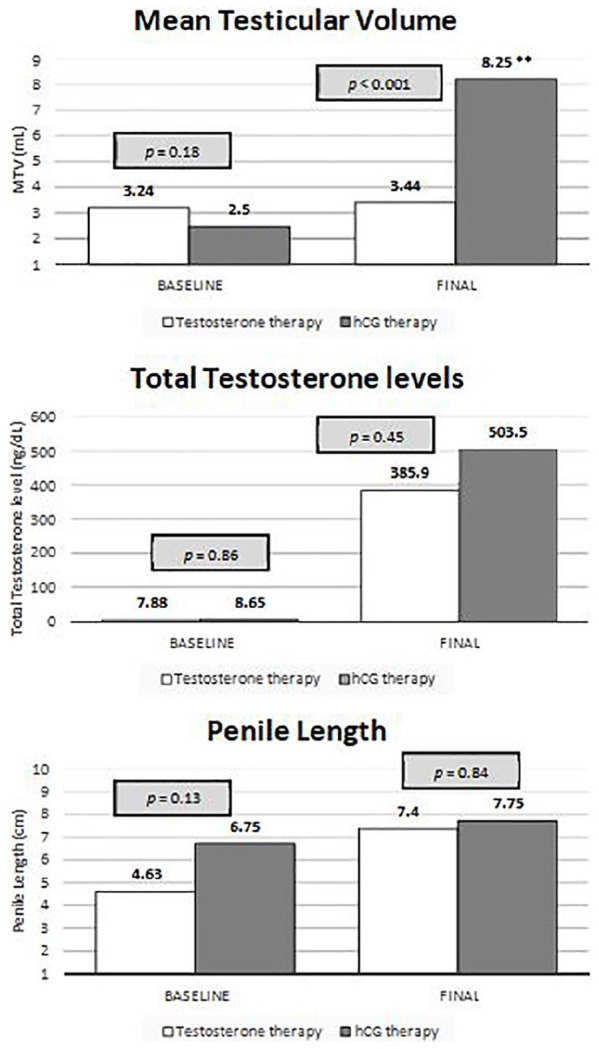
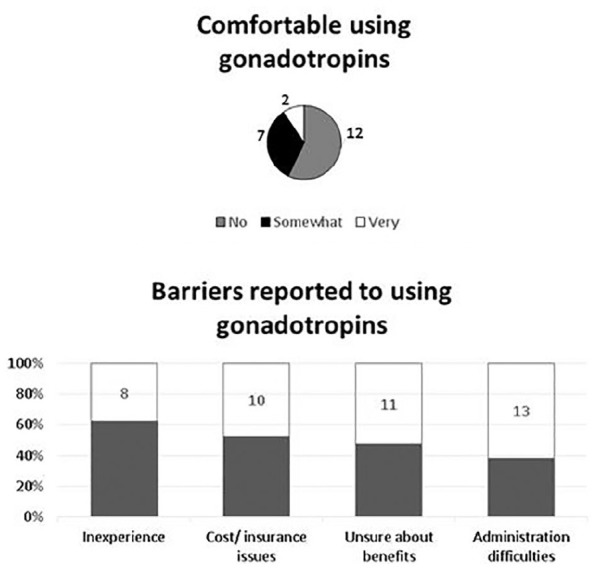
Background. Gonadotropin therapy is not typically used for pubertal induction in hypogonadotropic hypogonadism (HH), however, represents a promising alternative to testosterone. It can potentially lead to the maintenance of future fertility in addition to testicular growth. We compared the pubertal effects of human chorionic gonadotropin (hCG) versus testosterone in adolescent males with HH. We evaluated the current practice, among pediatric endocrinologists, to identify barriers against gonadotropin use. Methods. In this retrospective review, we compared the effect of testosterone versus hCG therapy on mean testicular volume (MTV), penile length, growth velocity, and testosterone levels. We surveyed pediatric endocrinologists at our center, using RedCap. Results. Outcomes were assessed in 52 male patients with HH (hCG, n = 4; T, n = 48) after a mean treatment duration of 13.4 (testosterone) and 13.8 months (hCG; P = .79). Final MTV was higher with hCG (8.25 mL) than testosterone (3.4 mL; P < .001). The groups did not differ in penile length, growth velocity, or testosterone levels. Survey results showed that more than half the providers were aware of the benefits of gonadotropins, however, 91% were uncomfortable prescribing hCG. Commonly reported barriers to prescribing hCG were lack of experience (62%) and insurance coverage concerns (52%). Conclusions. Larger testicular volume predicts faster induction of spermatogenesis. Since hCG promoted better testicular growth, compared to testosterone, it may potentially improve future fertility outcomes in HH patients. Our results identify an opportunity to improve current practice among pediatric endocrinologists worldwide and reduce barriers to prescribing gonadotropins in the adolescent population.
Overview
CoChat Summary
TL;DR
In a single-center retrospective review of 52 adolescent males with hypogonadotropic hypogonadism, hCG therapy produced greater final mean testicular volume than testosterone after about 12 months, with no differences in penile length, growth velocity, or testosterone levels. A provider survey found most pediatric endocrinologists were uncomfortable prescribing hCG, citing inexperience/lack of guidelines and insurance coverage as barriers.
Key findings
- Final mean testicular volume was higher with hCG (8.3 mL [SD 4.5]; abstract reports 8.25 mL) than with testosterone (3.4 mL [SD 1.39]; P < .001), after mean treatment durations of 13.8 months (hCG) and 13.4 months (testosterone; P = .79).
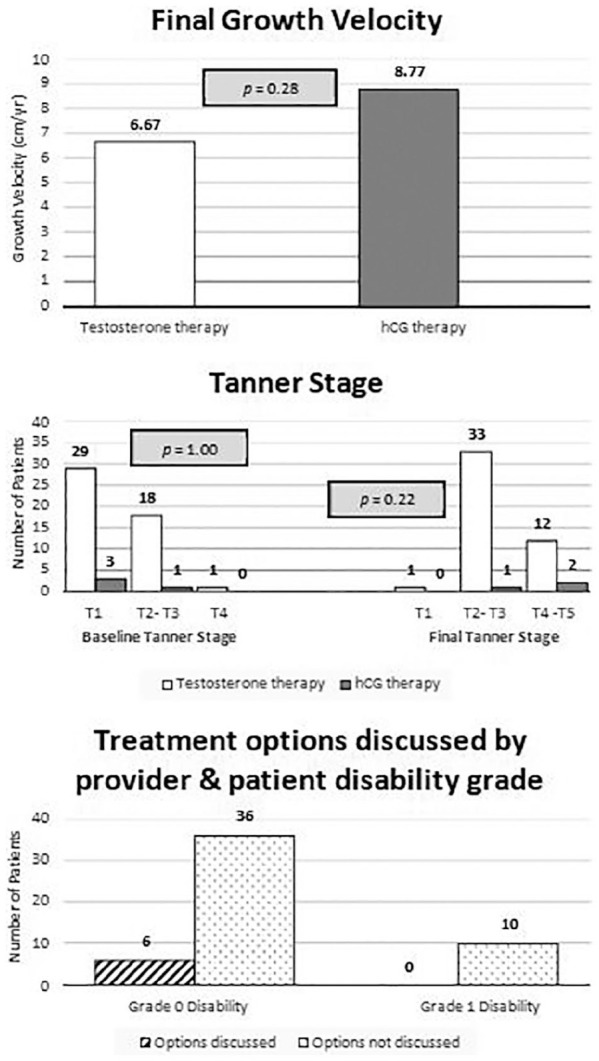
- The groups did not differ significantly in final testosterone (hCG 503.5 ng/dL vs testosterone 385.9 ng/dL; P = .45), Tanner stage (P = .22), penile length (hCG 7.8 cm vs testosterone 7.4 cm; P = .84), or height velocity (hCG 8.8 cm/y vs testosterone 6.7 cm/y; P = .28).
- Only 6 of 52 charts documented a pre-therapy discussion of treatment options; 4 of those patients chose hCG, while all 46 patients without documented discussion started testosterone. Among 42 patients with grade 0/no disability, 36 had no documented discussion.
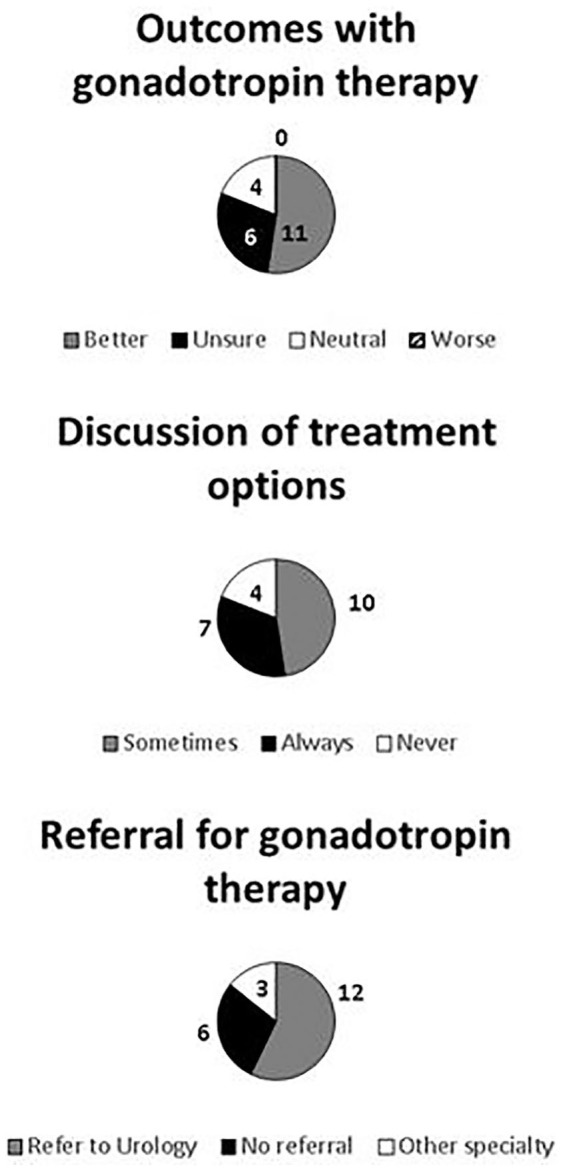
- Survey results (21 responses): 19/21 reported >80% of their patients were on testosterone; 11/21 perceived greater benefit with gonadotropins; 7/21 always discussed both options; 15/21 referred interested patients to Urology or other specialties. Barriers were inexperience/lack of guidelines (13/21; 62%), cost/insurance issues (11/21; 52%), lack of conviction about benefits (10/21; 48%), and parent difficulties with injections (8/21; 38%). The abstract states 91% were uncomfortable prescribing hCG; in the results, 12/21 (57%) were not comfortable, 7/21 (33%) partially comfortable, and 2/21 (10%) absolutely comfortable.
Methods
- Two-part study: a retrospective chart review of pre-pubertal males with HH referred to the Pediatric Endocrinology Clinic at Texas Children’s Hospital between 2012 and 2018, plus a provider survey. Inclusion required age 13–21 years, diagnosis of congenital or pre-pubertally acquired HH, and testicular volume <4 mL; exclusions included constitutional delay of growth and puberty, precocious puberty, other induction therapies, loss to follow-up, non-adherence, or inadequate follow-up. Of 79 initially included, 27 were excluded, leaving 52 analyzed (hCG n = 4; testosterone n = 48).
- Primary endpoints were mean testicular volume and testosterone levels after approximately 12 months of therapy; secondary endpoints were Tanner stage, penile length, growth velocity, and whether treatment options were documented. Groups were compared using Fisher’s exact test for categorical variables or Student’s t-test for continuous variables.
- The provider survey was an 8-question, pretested questionnaire distributed to 28 board-certified pediatric endocrinologists at Texas Children’s Hospital using REDCap; 21 responses were collected.
Limitations
- Paper-stated: the major limitation was the low number of patients who received hCG (n = 4; 8% of eligible males during the study period). As a retrospective chart review, the study relied on physician documentation, resulting in missing outcome data and limiting statistical conclusions. Survey results cannot be generalized because they come from a single center and may be biased by institutional management protocols and insurance policies; larger multi-institutional studies are needed.
- Text-evident: the treatment groups were highly imbalanced (4 vs 48), there was no randomization, follow-up was only about 12 months, and fertility itself was not measured—testicular growth was used as a surrogate for future fertility potential.
- Text-evident: outcome data were incomplete for some endpoints (final MTV in 47 participants, final testosterone in 41, penile length in only 14), further limiting precision.
Model-written summary. Check it against the paper before relying on it.
Integrity signals
Registry
Cites
Statistics
Figures
Verification
Claims the paper makes
0 Valid · 0 Not valid · 10 Not checked · 55 Own results and interpretations
A result the paper reports from its own data — it cites no other source for it, so there is none to check. The quote shows it is in the paper.
In the paper
“The majority of providers (19/21) reported having >80% of their patients on testosterone therapy.”
§ Testosterone versus hCG in Hypogonadotropic Hypogonadism – Comparing Clinical Effects and Evaluating Current Practice > Results > Provider Survey Results
plain- Asserted: passes — The authors put it forward as true.
- Checkable: passes — It can be checked against evidence.
- Load-bearing: passes — The paper’s conclusions depend on it.
- Based: passes — The paper gives a reason why it holds.
- Rests on an assumption not shown here.
A result the paper reports from its own data — it cites no other source for it, so there is none to check. The quote shows it is in the paper.
In the paper
“The sample population represented a variety of HH etiologies, including tumors of the brain and pituitary, septo-optic dysplasia, pituitary stalk interruption syndrome, HH with anosmia, and idiopathic congenital HH.”
§ Testosterone versus hCG in Hypogonadotropic Hypogonadism – Comparing Clinical Effects and Evaluating Current Practice > Results > Retrospective Review Results
plainn = 52- Asserted: passes — The authors put it forward as true.
- Checkable: passes — It can be checked against evidence.
- Load-bearing: unclear — It is unclear whether the paper’s conclusions depend on it.
- Based: passes — The paper gives a reason why it holds.
A result the paper reports from its own data — it cites no other source for it, so there is none to check. The quote shows it is in the paper.
In the paper
“Our findings also identify the barriers to using gonadotropin therapy.”
§ Testosterone versus hCG in Hypogonadotropic Hypogonadism – Comparing Clinical Effects and Evaluating Current Practice > Discussion > Strengths and Limitations
plain- Asserted: passes — The authors put it forward as true.
- Checkable: passes — It can be checked against evidence.
- Load-bearing: passes — The paper’s conclusions depend on it.
- Based: passes — The paper gives a reason why it holds.
A result the paper reports from its own data — it cites no other source for it, so there is none to check. The quote shows it is in the paper.
In the paper
“Four out of the 6 patients that had a documented discussion, chose to be on hCG therapy.”
- Also stated in: § Discussion · plain
“Only 6 patients had a documented discussion about various treatment options out of which 4 patients chose to be on hCG therapy.”
§ Testosterone versus hCG in Hypogonadotropic Hypogonadism – Comparing Clinical Effects and Evaluating Current Practice > Results > Retrospective Review Results
plainn = 6- Asserted: passes — The authors put it forward as true.
- Checkable: passes — It can be checked against evidence.
- Load-bearing: passes — The paper’s conclusions depend on it.
- Based: passes — The paper gives a reason why it holds.
- Also stated in: § Discussion · plain
A result the paper reports from its own data — it cites no other source for it, so there is none to check. The quote shows it is in the paper.
In the paper
“Final MTV was higher with hCG (8.25 mL) than testosterone (3.4 mL; P < .001).”
- Also stated in: § Retrospective Review Results · plain
“Mean final MTV (SD) with testosterone therapy was 3.4 mL (1.39) compared to 8.3 mL (4.5) with hCG (P < .001).”
- Also stated in: § Discussion · plain
“pubertal induction with hCG therapy yields significantly better outcomes for testicular size when compared to testosterone therapy after about 12 months of therapy”
§ Testosterone versus hCG in Hypogonadotropic Hypogonadism – Comparing Clinical Effects and Evaluating Current Practice > Abstract
plainstates a causen = 47 ·- Asserted: passes — The authors put it forward as true.
- Checkable: passes — It can be checked against evidence.
- Load-bearing: passes — The paper’s conclusions depend on it.
- Based: passes — The paper gives a reason why it holds.
- Rests on 4 assumptions not shown here.
- Also stated in: § Retrospective Review Results · plain
21 more claims
Create a free account to see all 65 claims and to verify the 26 references still open.
- Probably not a substantial claim. 19
- It may state two separate claims as one. 28
- The quote only partly states this claim. 2
Self-check
Percentages, sums and reported differences re-computed from the paper’s own numbers.
Rated minor: it would not touch a result — a value no result rests on, a p-value that stays on the same side of the significance level, or a conflict that is clerical, resolved elsewhere in the paper, or outside its own findings.
In the paper
“| Grade 0 (mild to none) | 4 | 38 (89) | |”
§ Testosterone versus hCG in Hypogonadotropic Hypogonadism – Comparing Clinical Effects and Evaluating Current Practice > Results > Retrospective Review Results
Reported 89 · recomputed 79.166667
Citations
Cites
Harris, P. A., Taylor, R., Thielke, R., Payne, J., Gonzalez, N., & Conde, J. G. (2009) · Journal of Biomedical Informatics · doi:10.1016/j.jbi.2008.08.010 · Cited by 51,384
The REDCap consortium: building an international community of software platform partners
Harris, P. A., Taylor, R., Minor, B. L., Elliott, V., Fernandez, M., O'Neal, L., McLeod, L., Delacqua, G., Delacqua, F., Kirby, J., et al. (2019) · Journal of Biomedical Informatics · doi:10.1016/j.jbi.2019.103208 · Cited by 24,013
Boehm, U., Bouloux, P.-M., Dattani, M. T., de Roux, N., Dodé, C., Dunkel, L., Dwyer, A. A., Giacobini, P., Hardelin, J.-P., Juul, A., et al. (2015) · Nature Reviews Endocrinology · doi:10.1038/nrendo.2015.112 · Cited by 874
Liu, P. Y., Baker, H. W. G., Jayadev, V., Zacharin, M., Conway, A. J., & Handelsman, D. J. (2009) · The Journal of Clinical Endocrinology & Metabolism · doi:10.1210/jc.2008-1648 · Cited by 253
Hypogonadotropic Hypogonadism Revisited
Fraietta, R., Zylberstejn, D. S., & Esteves, S. C. (2013) · Clinics · doi:10.6061/clinics/2013(sup01)09 · Cited by 248
Stimulation of Spermatogenesis by Gonadotropins in Men with Hypogonadotropic Hypogonadism
Finkel, D. M., Phillips, J. L., & Snyder, P. J. (1985) · New England Journal of Medicine · doi:10.1056/nejm198509123131102 · Cited by 240
BURRIS, A. S., RODBARD, H. W., WINTERS, S. J., & SHERINS, R. J. (1988) · The Journal of Clinical Endocrinology & Metabolism · doi:10.1210/jcem-66-6-1144 · Cited by 185
Rohayem, J., Hauffa, B. P., Zacharin, M., Kliesch, S., Zitzmann, M., & the “German Adolescent Hypogonadotropic Hypogonadism Study Group” (2017) · Clinical Endocrinology · doi:10.1111/cen.13164 · Cited by 148 · cited 3×
“86 Cause of HH, n (%) Central nervous system tumor (± radiation) 2 (50) 13 (27) Pituitary tumors s/p resection 3 (6) Pituitary stalk interruption syndrome 6 (13) Septo-optic dysplasia 4 (8) HH with anosmiaa 6 (13) Idiopathic 2 (50) 4 (8) Pituitary hypoplasia 2 (4) Iron overload 2 (4) Syndromicb 2 (4) Mutation in PROKR…”
BackgroundVICARI, E., MONGIOÌ, A., CALOGERO, A. E., MONCADA, M. L., SIDOTI, G., POLOSA, P., & D'AGATA, R. (1992) · International Journal of Andrology · doi:10.1111/j.1365-2605.1992.tb01131.x · Cited by 145 · cited 1×
“86 Cause of HH, n (%) Central nervous system tumor (± radiation) 2 (50) 13 (27) Pituitary tumors s/p resection 3 (6) Pituitary stalk interruption syndrome 6 (13) Septo-optic dysplasia 4 (8) HH with anosmiaa 6 (13) Idiopathic 2 (50) 4 (8) Pituitary hypoplasia 2 (4) Iron overload 2 (4) Syndromicb 2 (4) Mutation in PROKR…”
BackgroundLiu, P. Y., Turner, L., Rushford, D., McDonald, J., Baker, H. W. G., Conway, A. J., & Handelsman, D. J. (1999) · Human Reproduction · doi:10.1093/humrep/14.6.1540 · Cited by 139
Cited by
The use of hormone stimulation in male infertility
Foran, D., Chen, R., Jayasena, C. N., Minhas, S., & Tharakan, T. (2022) · Current Opinion in Pharmacology · doi:10.1016/j.coph.2022.102333 · Cited by 20
Ataikiru, U.-O., Iacob, E. R., Miron, I. C., Popoiu, C. M., & Boia, E. S. (2021) · Journal of Pediatric Endocrinology and Metabolism · doi:10.1515/jpem-2021-0382 · Cited by 2
Yoo, J. E., Kim, Y. K., Kim, J. Y., Cho, K. W., Kim, S. J., Kim, S., Choi, Y., Song, K., Lee, E. B., Chae, H. W., et al. (2025) · Hormone Research in Paediatrics · doi:10.1159/000550258 · Cited by 1
Spermatogenesis induction audit over a 5-year period at a UK male fertility centre
Dimakopoulou, A., Walker, A., Pahariya, P., Adenubi, F., Williamson, E., Conway, G. S., Sangster, P., & Srirangalingam, U. (2024) · Obstetrics & Gynecology International Journal · doi:10.15406/ogij.2024.15.00749
Puberty induction in boys with congenital isolated hypogonadotropic hypogonadism
Kokoreva, K., Чугунов, І., Kareva, M., & Bezlepkina, O. B. (2023) · Problems of Endocrinology · doi:10.14341/probl13141
Metadata
- Authors
- Agarwal, S., Tu, D. D., Austin, P. F., Scheurer, M. E., & Karaviti, L. P.
- Affiliations
- Baylor College of Medicine (US)
- Corresponding author
- Agarwal, Swashti
- Venue
- Global Pediatric Health
- Publisher
- SAGE Publications
- Published
- 2020-01
- Volume
- 7
- Pages
- 2333794X20958980-2333794X20958980
- ISSN
- 2333-794X (ISSN-L)
- PMC
- PMC8851198
- OpenAlex
- W3088270495
- Semantic Scholar
- 98ce70770b058345cafe66a3ed06e881cd6211e0
- Cited by
- 7
- References
- 30
- Citations by year
- 2026: 1 · 2025: 2 · 2024: 1 · 2023: 1 · 2022: 1 · 2021: 1
- FWCI
- 0.45
- Type
- journal article
- Language
- en
- Open access
- gold
- doi.org
- Licence
- Locations
- Global Pediatric Health (publishedVersion, cc-by-nc)
- PubMed Central (publishedVersion, cc-by-nc)
- PubMed (publishedVersion)
- DOAJ (DOAJ: Directory of Open Access Journals) (submittedVersion)
- Global Pediatric Health
- Topics
- Health Sciences › Medicine › Reproductive Medicine › Hypothalamic control of reproductive hormones
- Health Sciences › Medicine › Endocrinology, Diabetes and Metabolism › Hormonal and reproductive studies
- Health Sciences › Medicine › Endocrinology, Diabetes and Metabolism › Sexual Differentiation and Disorders
- Keywords
- hypogonadotropic hypogonadism, human chorionic gonadotropin, testosterone replacement therapy, puberty induction, gonadotropin therapy, testicular volume, penile length, growth rate, spermatogenesis, male fertility preservation, barriers to prescribing, pediatric endocrinologists, adolescent boys
About these checks
Registry, retraction, Cites and statistics results are computed, not judged, with one exception: a printed reference that no index lists is read once by a model before it counts as a citation error. Claims are extracted by a model and kept only when their quote appears verbatim in the text; each cited source is then checked, with a model’s help, for whether it says what the claim relies on. Those verdicts can be wrong — read the claim’s quote and the cited source before relying on one.
A language model drew the claims from the paper on 2026-11-27, under version 3 of the claim definition (model deepseek-v4.1-flash, prompt extract-v3).
A second model labelled each claim on 2026-11-27 (model jev-1.13-20260917, definition revision gold-guideline-v0.2).
Statistics and arithmetic are recomputed, not judged.
Confidence bands are shown only for fields calibrated on our annotated test set. None is calibrated yet, so no band is shown.
What counts as a claim ›How we measure confidence ›How we check this ›
Are you an author, or do you see a problem with this page? Request a review
Data sources
Bibliographic data: Semantic Scholar, OpenAlex, Crossref.
Contains information from the Semantic Scholar Academic Graph Datasets, made available under the ODC Attribution License (ODC-BY 1.0).
Semantic Scholar’s data is described in: Kinney, R., et al. (2023). The Semantic Scholar Open Data Platform. arXiv:2301.10140.
