

Cognitive Behavioral Therapy for Children with Dental Anxiety: A Randomized Controlled Trial
Open accessThe DOI matches its Crossref record; 25 of the 26 references it cites were found in a registry or an index.
Abstract
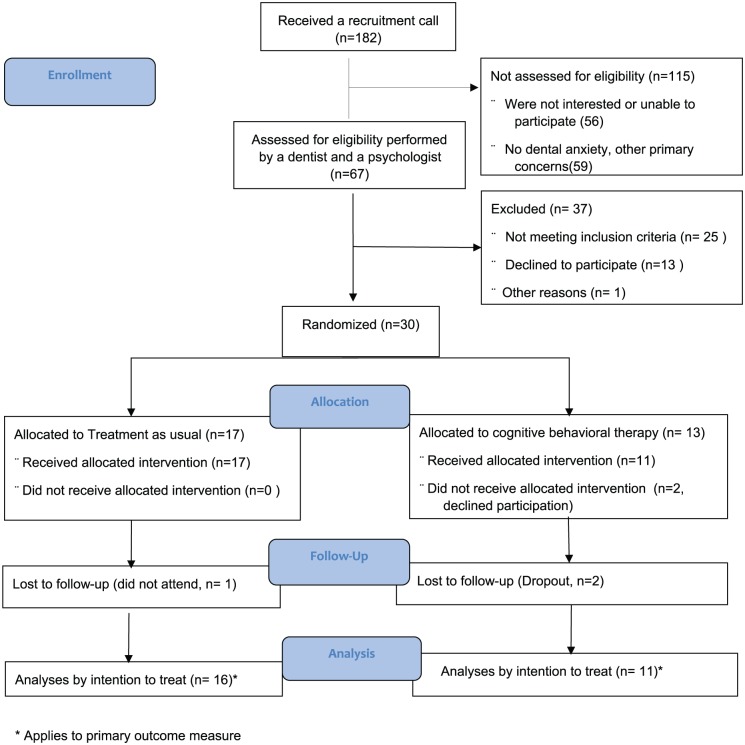
Dental anxiety affects approximately 9% of children and is associated with poor oral health, pain, and psychosocial problems. The objective of this study was to investigate the efficacy of cognitive behavioral therapy (CBT) for children with dental anxiety in specialist pediatric dentistry. The study used a parallel-group superiority randomized controlled trial design. The primary outcome measure was the behavioral avoidance test; assessors were blind to treatment allocation. Participants were 8 boys and 22 girls 7 to 18 y old (mean ± SD, 10 ± 3.1). Children fulfilling the diagnostic criteria for dental anxiety were randomized to CBT (n = 13) or treatment as usual (n = 17), such as various sedation methods. Psychologists provided 10 h of CBT based on a treatment manual. Treatments were conducted in a naturalistic real-world clinical setting. Assessments were conducted before the treatment, 3 mo after the start of treatment, and at 1-y follow-up. The analyses of the primary outcome measure by repeated-measures analysis of variance and independent t test showed that children receiving CBT made superior, statistically significant improvements at follow-up (16.8 ± 2.4) compared with treatment as usual (11.4 ± 3.1, P < 0.01). A large between-group effect size (Cohen’s d = 1.9) was found. Following treatment, 73% of those in the CBT group managed all stages of the dental procedures included in the behavioral avoidance test compared with 13% in the treatment-as-usual group. Furthermore, 91% in the CBT group compared with 25% in the treatment-as-usual group no longer met the diagnostic criteria for dental anxiety at the 1-y follow-up according to the secondary outcome measure. Measures of dental anxiety and self-efficacy showed larger improvements in the CBT group compared with controls. We conclude that CBT is an efficacious treatment for children and adolescents with dental anxiety and should be made accessible in pediatric dentistry (ClinicalTrials.gov: NCT01798355). Knowledge transfer statement: The results of this study can be used by decision makers and clinicians when planning to implement evidence-based treatment in pediatric dentistry and give children and adolescents access to methods for treating dental anxiety. The results can also be used by parents of children with dental anxiety when asking dentists to cooperate with psychologists using cognitive behavioral therapy.
Overview
The claims and statistics of this paper haven’t been checked yet.
Free: it reads the open-access text and checks the first 5 claims that cite a source we can check. Create a free account to check every claim.
Integrity signals
Registry
Cites
Statistics
Figures
Verification
Claims the paper makes
The claims and statistics of this paper haven’t been checked yet.
Free: it reads the open-access text and checks the first 5 claims that cite a source we can check. Create a free account to check every claim.
Claims other papers make about this one
Each is checked against this paper’s own text: does it say what the citing paper says it does?
The cited source says what the claim attributes to it.
In the citing paper
“In five studies 9,19,21-23 CBT showed significant decreased levels of anxiety/fear compared to controls, regardless of the method used to evaluate anxiety/fear 9,19,21-23 or the evaluation time of CBT after receiving the treatment 21,22 .”
From Cognitive behaviour therapy for anxious paediatric dental patients: a systematic review. (2018) · cites this paper as [21]
The cited source says what the claim attributes to it.
In the citing paper
“and two studies 21,22 showed improvement on avoidance behaviour to dental clinical situations.”
From Cognitive behaviour therapy for anxious paediatric dental patients: a systematic review. (2018) · cites this paper as [21]
Self-check
Percentages, sums and reported differences re-computed from the paper’s own numbers.
The self-check needs the paper’s full text.
Citations
Cites
Self-efficacy: Toward a unifying theory of behavioral change
Bandura, A. (1977) · Psychological Review · doi:10.1037/0033-295x.84.2.191 · Cited by 43,925 · cited 1×
“It consists of 14 questions (scale 1–5, from low to high self-efficacy) assessing the level of self-efficacy, defined as people’s belief in their ability to accomplish given achievements (Bandura 1977).”
BackgroundDiagnostic and Statistical Manual of Mental Disorders, Fourth Edition, Text Revision (DSM-IV-TR)
American Psychiatric Association (2000) · doi:10.1176/appi.books.9780890423349 · Cited by 11,069
Self-efficacy: Toward a unifying theory of behavioral change
Bandura, A. (1978) · Advances in Behaviour Research and Therapy · doi:10.1016/0146-6402(78)90002-4 · Cited by 10,586
KLINGBERG, G., & BROBERG, A. G. (2007) · International Journal of Paediatric Dentistry · doi:10.1111/j.1365-263x.2007.00872.x · Cited by 755
Empirically supported treatments for children with phobic and anxiety disorders: Current status
Ollendick, T. H., & King, N. J. (1998) · Journal of Clinical Child Psychology · doi:10.1207/s15374424jccp2702_3 · Cited by 385
Psychotherapy of Childhood Anxiety Disorders: A Meta-Analysis
In-Albon, T., & Schneider, S. (2007) · Psychotherapy and Psychosomatics · doi:10.1159/000096361 · Cited by 373 · cited 1×
“Findings in the present study are consistent with results of CBT and its efficiency in treating children and adolescents with anxiety disorders (In-Albon and Schneider 2007; Davis et al. 2012).”
ResultDental fear in adults: a meta-analysis of behavioral interventions
Kvale, G., Berggren, U., & Milgrom, P. (2004) · Community Dentistry and Oral Epidemiology · doi:10.1111/j.1600-0528.2004.00146.x · Cited by 198 · cited 2×
“The sample size and power of this study are comparable to other studies of CBT and dental anxiety (Kvale et al. 2004; Haukebø et al. 2008).”
BackgroundResultGallagher, M. W., Payne, L. A., White, K. S., Shear, K. M., Woods, S. W., Gorman, J. M., & Barlow, D. H. (2013) · Behaviour Research and Therapy · doi:10.1016/j.brat.2013.09.001 · Cited by 153
Behaviour Management Techniques in Paediatric Dentistry
Roberts, J. F., Curzon, M. E. J., Koch, G., & MARTENS, L. C. (2010) · European Archives of Paediatric Dentistry · doi:10.1007/bf03262738 · Cited by 151 · cited 1×
“Pediatric dentistry commonly employs several methods to deal with dental anxiety, which include tell-show-do, premedication with midazolam, nitrous oxide sedation, and general anesthesia (Klingberg et al. 2010; Roberts et al. 2010).”
BackgroundPsychological treatment of dental anxiety among adults: A systematic review
Wide Boman, U., Carlsson, V., Westin, M., & Hakeberg, M. (2013) · European Journal of Oral Sciences · doi:10.1111/eos.12032 · Cited by 142 · cited 1×
“These negative consequences also include sense of embarrassment related to poor oral health, reduced self-confidence, and increased absence from work (Wide Boman et al. 2013).”
Background
Research works printed but not linked: 1
- Lyneham HJ Abbott MJ Rapee RM. 2003 The cool kids family program-therapist manual. Sydney (Australia): Macquaire University.
Cited by
Cognitive behavioural therapy for anxiety disorders in children and adolescents
James, A. C., James, G., Cowdrey, F. A., Soler, A., & Choke, A. (2015) · Cochrane Database of Systematic Reviews · doi:10.1002/14651858.cd004690.pub4 · Cited by 876
Cognitive behavioural therapy for anxiety disorders in children and adolescents
James, A. C., Reardon, T., Soler, A., James, G., & Creswell, C. (2020) · Cochrane Database of Systematic Reviews · doi:10.1002/14651858.cd013162.pub2 · Cited by 344
Factors Associated with Dental Fear and Anxiety in Children Aged 7 to 9 Years
Dahlander, A., Soares, F. C., Grindefjord, M., & Dahllöf, G. (2019) · Dentistry Journal · doi:10.3390/dj7030068 · Cited by 161
Self-citationDuker, L. I. S., Grager, M., Giffin, W., Hikita, N. H., & Polido, J. C. (2022) · International Journal of Environmental Research and Public Health · doi:10.3390/ijerph19042380 · Cited by 120
Shahnavaz, S., Hedman-Lagerlöf, E., Hasselblad, T., Reuterskiöld, L., Kaldo, V., & Dahllöf, G. (2018) · Journal of Medical Internet Research · doi:10.2196/jmir.7803 · Cited by 48
“In a recently conducted randomized clinical trial, our research group showed that CBT has similarly large effects in children and adolescents [14].”
BackgroundMethodResultInfluentialSelf-citationGujjar, K. R., van Wijk, A., Kumar, R., & de Jongh, A. (2019) · Journal of Evidence Based Dental Practice · doi:10.1016/j.jebdp.2019.01.009 · Cited by 38
Cognitive behaviour therapy for anxious paediatric dental patients: a systematic review.
Gomes, H. S., Viana, K. A., Batista, A. C., Costa, L. R., Hosey, M. T., & Newton, T. (2018) · International Journal of Paediatric Dentistry · doi:10.1111/ipd.12405 · Cited by 35
Buldur, B., & Candan, M. (2021) · Pesquisa Brasileira em Odontopediatria e Clínica Integrada · doi:10.1590/pboci.2021.002 · Cited by 47
Alabduljabbar, R., Almutawa, M., Alkathiri, R., Alqahtani, A., & Alshamlan, H. (2023) · Applied Sciences · doi:10.3390/app13095603 · Cited by 20
Children's experiences following a CBT intervention to reduce dental anxiety: One year on
Rodd, H., Kirby, J., Duffy, E., Porritt, J., Morgan, A., Prasad, S., Baker, S., & Marshman, Z. (2018) · British Dental Journal · doi:10.1038/sj.bdj.2018.540 · Cited by 17
Schibbye, R., Hedman‐Lagerlöf, E., Kaldo, V., Dahllöf, G., & Shahnavaz, S. (2024) · Journal of Medical Internet Research · doi:10.2196/42322 · Cited by 30
Self-citationDahlan, M., Alsaywed, R. A., Alamoudi, R., Batarfi, A. A., Basodan, O. Y., Gazzaz, Y., Alqarni, Y. A., & Alamoudi, A. A. (2023) · Cureus · doi:10.7759/cureus.42366 · Cited by 20
“This finding has also been supported by several studies [41].”
ResultRational thinking as a mediator of the relationship between mindfulness and dental anxiety
Yao, J., Carciofo, R., & Pan, L. (2023) · Scientific Reports · doi:10.1038/s41598-023-28879-4 · Cited by 8
Coxon, J. D., Hosey, M. T., & Newton, T. (2019) · BDJ · doi:10.1038/s41415-019-0196-8 · Cited by 10
Asokan, S., Priya, P. G., Mathiazhagan, T., & Viswanath, S. (2022) · International Journal of Clinical Pediatric Dentistry · doi:10.5005/jp-journals-10005-2452 · Cited by 8
MacDonald, D. S., Stojkova, B. J., & Reitzik, S. (2024) · Imaging Science in Dentistry · doi:10.5624/isd.20240062 · Cited by 5
Johnsen, I. B., Wichstrøm, L., & Dahllöf, G. (2023) · Acta Paediatrica · doi:10.1111/apa.17003 · Cited by 9
Self-citationMao, Y., Li, Y., Gong, D., An, P., & Luo, Y. (2025) · Proceedings of the ACM on Human-Computer Interaction · doi:10.1145/3757527 · Cited by 5
Unnikrishnan, G., Singh, A., & Purohit, B. (2024) · Evidence-Based Dentistry · doi:10.1038/s41432-024-01081-9 · Cited by 3
“Many studies have shown the ef fi cacy of behavioural therapies and inhalation sedation in managing dental anxiety 16 – 18 .”
Marshman, Z., & Williams, C. (2017) · Springer eBooks · doi:10.1007/978-3-319-48729-8_13 · Cited by 5
Duker, L. I. S., McGuire, R., Hernandez, J., Goodman, E., & Polido, J. C. (2024) · International Journal of Paediatric Dentistry · doi:10.1111/ipd.13263 · Cited by 7
Dental Anxiety and Behavior Problems in Children Attending for Dental Treatment
Newton, T., Hare, J., & Bruj-Milasan, G. (2019) · Journal of the California Dental Association · doi:10.1080/19424396.2019.12220819 · Cited by 3
Cognitive behavioural therapy and the adolescent patient
Marshman, Z., Kirby, J., & RODD, H. D. (2018) · Dental Update · doi:10.12968/denu.2018.45.4.311 · Cited by 2
Binandeh, E. S., Sarai-Khorami, N., Asgari, P., Feizi, G., & Tahani, B. (2020) · International Journal of Body, Mind and Culture · doi:10.22122/ijbmc.v7i3.221 · Cited by 1
Positive Encounters for Children to Prevent Dental Anxiety – Theory and Practice
RODD, H. D., Rønneberg, A., Fredriksen, T. V., Johnsen, I. B., & Marshman, Z. (2022) · Textbooks in contemporary dentistry · doi:10.1007/978-3-031-04248-5_9 · Cited by 1
‘Your teeth you are in control’
Marshman, Z., Noble, F., & RODD, H. D. (2018) · Dental Nursing · doi:10.12968/denn.2018.14.6.292 · Cited by 1
Shahnavaz, S., Hedman‐Lagerlöf, E., Hasselblad, T., Reuterskiöld, L., Kaldo, V., & Dahllöf, G. (2017) · doi:10.2196/preprints.7803
Self-citationAn Internet-delivered treatment for Flying Phobia using 360º images: a feasibility study
Mor, S. (2022) · Tesis Doctorals en Xarxa (Consorci de Serveis Universitaris de Catalunya) · doi:10.6035/14109.2022.366833
Agdal, M. L., Vegsund, I. R., Øvland, L., Berge, K. G., & Vika, M. E. (2020) · Den norske tannlegeforenings Tidende · doi:10.56373/2020-5-4
Pediatrik Hastada Dental Anksiyete ve Bilişsel Davranışçı Terapi Yöntemi
Şimşek, Ç., & Koruyucu, M. (2024) · Türk Diş Hekimliği Araştırma Dergisi · doi:10.58711/turkishjdentres.vi.1344229
Schibbye, R., Hedman‐Lagerlöf, E., Kaldo, V., Dahllöf, G., & Shahnavaz, S. (2025) · JMIR Pediatrics and Parenting · doi:10.2196/80376 · Cited by 3
Self-citationRoth, J. C., Ludwig, J. D. C., Zander, L. R. M., & Alves, F. B. T. (2026) · Revista de Geopolítica · doi:10.56238/revgeov17n4-038
Moura, A. M. S., da Silveira, M. A. C., Miranda, V. E. V. L., Marshman, Z., & Colares, V. (2026) · Journal of Dental Education · doi:10.1002/jdd.70258
Özgül Fobi Tedavisinde Bilişsel Davranışçı Terapi: Sistematik Bir Derleme
Çolak, Y., & Karaaziz, M. (2026) · 19 Mayıs Sosyal Bilimler Dergisi · doi:10.52835/19maysbd.1923489
NON-PHARMACOLOGICAL METHODS FOR REDUCING DENTAL ANXIETY IN CHILDREN AND ADULTS: A NARRATIVE REVIEW
Kucia, Z., Pilch, G., Ciepiela, A., Berowska, M., Sagan, J., & Zemowski, M. (2026) · International Journal of Innovative Technologies in Social Science · doi:10.31435/ijitss.3(51).2026.6338
Metadata
- Authors
- Shahnavaz, S., Hedman, E., Grindefjord, M., Reuterskiöld, L., & Dahllöf, G.
- Affiliations
- Karolinska Institutet (SE)
- Department of Clinical Neuroscience, Karolinska Institutet, Stockholm, Sweden
- Stockholm University (SE)
- Corresponding author
- Shahnavaz, S.
- Venue
- JDR Clinical & Translational Research
- Publisher
- SAGE Publications
- Published
- 2016-08-20
- Volume
- 1
- Issue
- 3
- Pages
- 234-243
- ISSN
- 2380-0844 (ISSN-L)
- 2380-0852
- PMC
- PMC5772454
- OpenAlex
- W2510667993
- Cited by
- 35
- References
- 26
- Citations by year
- 2026: 4 · 2025: 2 · 2024: 4 · 2023: 5 · 2022: 4 · 2020: 4 · 2019: 4 · 2018: 5 · 2017: 2
- FWCI
- 4.96
- Type
- journal article
- Language
- en
- Open access
- hybrid
- doi.org
- Licence
- cc-by-nc
- journals.sagepub.com/page/policies/text-and-data-mining-license (tdm)
- Locations
- JDR Clinical & Translational Research (publishedVersion, cc-by-nc)
- Europe PMC (PubMed Central) (publishedVersion, cc-by-nc)
- PubMed Central (publishedVersion, cc-by-nc)
- PubMed (publishedVersion)
- Topics
- Health Sciences › Dentistry › Oral Surgery › Dental Anxiety and Anesthesia Techniques
- Social Sciences › Psychology › Experimental and Cognitive Psychology › Anxiety, Depression, Psychometrics, Treatment, Cognitive Processes
- Social Sciences › Psychology › Clinical Psychology › Child and Adolescent Psychosocial and Emotional Development
- Keywords
- dental anxiety, cognitive behavioral therapy, children, adolescents, pediatric dentistry, dental sedation, self-efficacy
About these checks
Registry, retraction, Cites and statistics results are computed, not judged, with one exception: a printed reference that no index lists is read once by a model before it counts as a citation error. Claims are extracted by a model and kept only when their quote appears verbatim in the text; each cited source is then checked, with a model’s help, for whether it says what the claim relies on. Those verdicts can be wrong — read the claim’s quote and the cited source before relying on one.
Statistics and arithmetic are recomputed, not judged.
Confidence bands are shown only for fields calibrated on our annotated test set. None is calibrated yet, so no band is shown.
What counts as a claim ›How we measure confidence ›How we check this ›
Are you an author, or do you see a problem with this page? Request a review
Data sources
Bibliographic data: Semantic Scholar, OpenAlex, Crossref.
Contains information from the Semantic Scholar Academic Graph Datasets, made available under the ODC Attribution License (ODC-BY 1.0).
Semantic Scholar’s data is described in: Kinney, R., et al. (2023). The Semantic Scholar Open Data Platform. arXiv:2301.10140.
