

Noninferiority of Copper Dressings Compared to Negative Pressure Wound Therapy in Diabetic Foot – An RCT Study
Open accessThe DOI matches its Crossref record.
Abstract
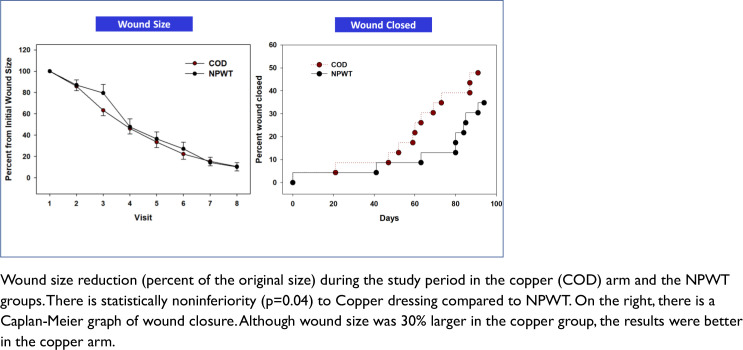
Category: Diabetes; Other Introduction/Purpose: Compare the wound healing rate, cost, and convenience between Negative Pressure Wound Therapy (NPWT) and Copper OxideDressings (COD) in the management of diabetic foot wounds (DFW). Methods: A Randomized controlled trial (RCT) lasting three months with 46 Diabetic Foot Wounds (DFW), recovering from infectious episodes that necessitated debridement or partial foot amputation. Patients in whom the wound was stable with resolution of the infection and in whom NPWT was indicated were enrolled in the study: 23 patients in the COD arm and 23 in the control NPWT arm. NPWT was succeeded by Aquacell extra or Granuflex dressings for up to 3 months. The primary endpoint was wound size reduction, assessed by an artificial intelligence program. The study was set as a non-inferiority study with a 20% margin. Secondary endpoints were convenience to the patient and caregiver, and pain, were assessed by visual analog score (VAS); application time (minutes), and calculated cost. Results: Twenty-three patients participated in the study in each arm. Seven patients dropped from the study in the NPWT arm and one in the COD group. The initial wound area was 19.9±4.36 and 14.1±2.32 cm 2 in the COD and NPWT arms, respectively (p=0.25). Wound size reduction was statistically significant non-inferior of the COD Arm compared to the NPWT (p=0.04) and superior in the last visit (T-test, p=0.032). COD therapy was more convenient for the patients - VAS was 8.44 vs. 5.33; (p=0.002) and the medical personnel (8.29 vs. 6.0; p=0.007) and less painful (1.15 vs. 2.19; p=0.67) compared to NPWT. The COD's mean application time was shorter (8.5 vs. 13.25 minutes; p< 0.001). The cost of COD was calculated to be 84% less than NPWT treatment. Conclusion: This RCT study indicates statistically significant non-inferiority of COD dressing therapy than NPWT in terms of wound healing rate of DFW. Better convenience and reduced costs in the COD arm justify initial copper dressing attempts in patients with diabetic foot wounds before NPWT treatment.
Overview
Integrity signals
Registry
Cites
Statistics
Figures
Verification
Claims the paper makes
Self-check
Percentages, sums and reported differences re-computed from the paper’s own numbers.
The text we found for this paper looks like another document, so the self-check wasn’t run.
Citations
Cited by
Borkow, G., & Melamed, E. (2025) · Biomedicines · doi:10.3390/biomedicines13030562 · Cited by 24
Self-citationFuture clinical dressings for chronic wound repair: Pioneer strategies for accelerated angiogenesis
Rezaei, L., Naseri, S., Assadollahi, V., Shojaei, S., Heidari, R., Elahian, F., & Mirzaei, S. A. (2026) · European Polymer Journal · doi:10.1016/j.eurpolymj.2026.114570 · Cited by 1
Copper oxide-impregnated dressings in the management of complex diabetic foot wounds: a case series
Davids, B. (2026) · Wound Healing Southern Africa · doi:10.36303/whsa.4132
Metadata
- Authors
- Melamed, E. A., Dabbah, J., Roth, T., Borkow, G., & Pinzur, M. S.
- Venue
- Foot & Ankle Orthopaedics
- Publisher
- SAGE Publications
- Published
- 2024-10
- Volume
- 9
- Issue
- 4
- ISSN
- 2473-0114 (ISSN-L)
- PMC
- PMC11683806
- OpenAlex
- W4405823051
- Semantic Scholar
- 7d9b70ea1a9e3138f923aacf542f404dd8bd0daf
- Cited by
- 3
- References
- 0
- Citations by year
- 2026: 2 · 2025: 1
- FWCI
- 0.98
- Type
- journal article
- Language
- en
- Open access
- gold
- doi.org
- Licence
- Locations
- Foot & Ankle Orthopaedics (publishedVersion, cc-by-nc)
- PubMed Central (publishedVersion, cc-by-nc)
- DOAJ (DOAJ: Directory of Open Access Journals) (submittedVersion, cc-by-sa)
- Topics
- Health Sciences › Medicine › Endocrinology, Diabetes and Metabolism › Diabetic Foot Ulcer Assessment and Management
- Health Sciences › Medicine › Surgery › Wound Healing and Treatments
- Health Sciences › Medicine › Surgery › Surgical site infection prevention
- Keywords
- foot wounds, negative pressure wound therapy, wound healing, non-inferiority, wound size reduction, pain, treatment costs, patient convenience, diabetic foot infection, debridement, foot amputation, wound dressings, patient satisfaction, caregiver burden
About these checks
Registry, retraction, Cites and statistics results are computed, not judged, with one exception: a printed reference that no index lists is read once by a model before it counts as a citation error. Claims are extracted by a model and kept only when their quote appears verbatim in the text; each cited source is then checked, with a model’s help, for whether it says what the claim relies on. Those verdicts can be wrong — read the claim’s quote and the cited source before relying on one.
Statistics and arithmetic are recomputed, not judged.
Confidence bands are shown only for fields calibrated on our annotated test set. None is calibrated yet, so no band is shown.
What counts as a claim ›How we measure confidence ›How we check this ›
Are you an author, or do you see a problem with this page? Request a review
How to cite
Cite CoChat for the checks on this page, and the paper for its own findings.
- This page
- CoChat. (2026). Citation check: Noninferiority of Copper Dressings Compared to Negative Pressure Wound Therapy in Diabetic Foot – An RCT Study. https://app.cochat.ai/papers/10.1177/2473011424s00381
- The paper
- Melamed, E. A., Dabbah, J., Roth, T., Borkow, G., & Pinzur, M. S. (2024). Noninferiority of Copper Dressings Compared to Negative Pressure Wound Therapy in Diabetic Foot – An RCT Study. Foot & Ankle Orthopaedics. https://doi.org/10.1177/2473011424s00381
Data sources
Bibliographic data: Semantic Scholar, OpenAlex, Crossref.
Contains information from the Semantic Scholar Academic Graph Datasets, made available under the ODC Attribution License (ODC-BY 1.0).
Semantic Scholar’s data is described in: Kinney, R., et al. (2023). The Semantic Scholar Open Data Platform. arXiv:2301.10140.
