

Patterns of Technology Use Among Patients With Head and Neck Cancer and Implications for Telehealth
Open accessThe DOI matches its Crossref record; 20 of the 20 references it cites were found in a registry or an index.
Abstract
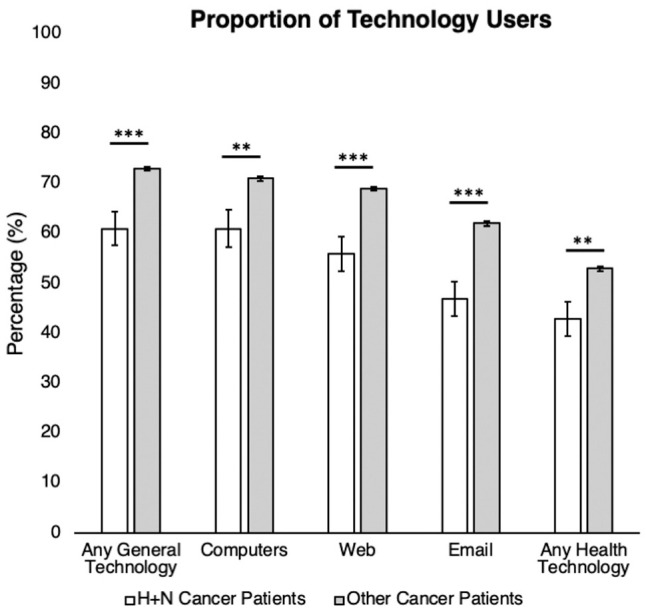
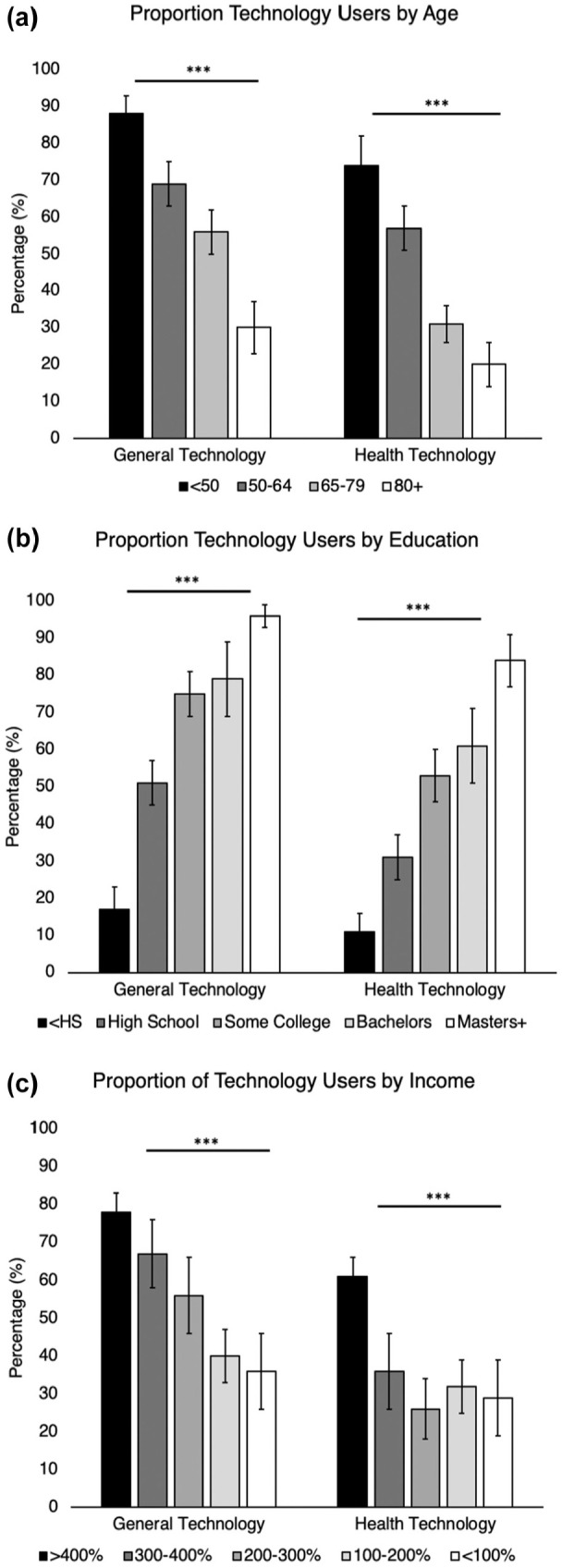
Objective: To describe baseline technology use within the head and neck cancer (HNC) population prior to the COVID‐19 pandemic. Study Design: Cross‐sectional analysis of National Health Interview Survey (NHIS) data. Setting: The NHIS is a survey of population health administered in person annually to a nationally representative sample of noninstitutionalized US residents via a complex clustered sampling design. Methods: Data regarding technology use, cancer history, and demographics were extracted from the NHIS. The study population comprised individuals who completed the NHIS Sample Adult survey from 2012 to 2018 and self‐reported a cancer diagnosis. Poisson regression was used to evaluate associations between demographics and general or health‐related technology use and prevalence ratios reported. Results: Patients with HNC were less likely to use general technology (computers, internet, or email) when compared with other patients with cancer (60% vs 73%, P <. 001), although this difference was not statistically significant after controlling for sociodemographic factors. Among patients with HNC, older age, lower education, and lower income were negatively associated with general technology use (adjusted prevalence ratio [aPR], 0.71 [95% CI, 0.59‐0.87] for age 65‐79 years vs <50 years; aPR, 0.66 [95% CI, 0.51‐0.85] for high school vs master; aPR, 0.66 [95% CI, 0.48‐0.91] for income 100%‐200% vs >400% federal poverty level). Older age and lower education were negatively associated with health‐related technology use (aPR, 0.46 [95% CI, 0.32‐0.67] for age 65‐79 years vs <50 years; aPR, 0.47 [95% CI, 0.30‐0.74] for high school vs master). Conclusion: Socioeconomic disparities exist in technology use rates among patients with HNC. Access to technology may pose a barrier to telehealth visits for many patients with HNC due to the unique socioeconomic demographics of this patient population.
Overview
The claims and statistics of this paper haven’t been checked yet.
Free: it reads the open-access text and checks the first 5 claims that cite a source we can check. Create a free account to check every claim.
Integrity signals
Registry
Cites
Statistics
Figures
Verification
Claims the paper makes
The claims and statistics of this paper haven’t been checked yet.
Free: it reads the open-access text and checks the first 5 claims that cite a source we can check. Create a free account to check every claim.
Claims other papers make about this one
Each is checked against this paper’s own text: does it say what the citing paper says it does?
The source backs part of the claim, not all of it — or backs it for a different population, condition or comparison.
In the citing paper
“Household income has been associated with other important sociodemographic factors (eg, education, ownership of mobile devices, internet access) that were associated with cancer survivors’ intentions to adopt telehealth before and during the COVID-19 pandemic [42,43].”
From Applying the Unified Theory of Acceptance and Use of Technology to Identify Factors Associated With Intention to Use Teledelivered Supportive Care Among Recently Diagnosed Breast Cancer Survivors During COVID-19 in Hong Kong: Cross-Sectional Survey (2024) · cites this paper as [42]
Experimental — accuracy not yet measured
Self-check
Percentages, sums and reported differences re-computed from the paper’s own numbers.
The self-check needs the paper’s full text.
Citations
Cites
Virtually perfect? Telemedicine for COVID-19
Hollander, J. E., & Carr, B. G. (2020) · New England Journal of Medicine · doi:10.1056/nejmp2003539 · Cited by 2,970
Epidemiology of Head and Neck Cancer
Rettig, E. M., & D’Souza, G. (2015) · Surgical Oncology Clinics of North America · doi:10.1016/j.soc.2015.03.001 · Cited by 524
Self-citationSocioeconomic differences in cancer incidence and mortality.
Faggiano, F., Partanen, T. J., Kogevinas, M., & Boffetta, P. (1997) · PubMed · Cited by 373
Videoconference compared to telephone in healthcare delivery: A systematic review
Rush, K. L., Howlett, L., Munro, A., & Burton, L. (2018) · International Journal of Medical Informatics · doi:10.1016/j.ijmedinf.2018.07.007 · Cited by 235 · cited 1×
“Other studies have shown that videoconferencing visits were associated with improved diagnostic accuracy, superior treatment decision making, and fewer medication errors when compared with telephone-only visits.(22) While studies have not yet compared videoconferencing and telephone care for oncology visits, published…”
BackgroundBauerly, B. C., McCord, R. F., Hulkower, R., & Pepin, D. (2019) · Journal of Law, Medicine & Ethics · doi:10.1177/1073110519857314 · Cited by 167 · cited 1×
“The expansion of existing programs that provide federal funds for broadband access for telehealth would improve access of low-income patients to virtual care.(23) There may be a role for providing a laptop, tablet, smartphone, or other internet- and camera-enabled device to facilitate telehealth as a health insurance…”
BackgroundImpact of Time to Diagnosis and Treatment in Head and Neck Cancer: A Systematic Review
Schutte, H. W., Heutink, F., Wellenstein, D. J., van den Broek, G. B., van den Hoogen, F. J. A., Marres, H. A. M., van Herpen, C. M. L., Kaanders, J. H. A. M., Merkx, T. M. A. W., & Takes, R. P. (2020) · Otolaryngology–Head and Neck Surgery · doi:10.1177/0194599820906387 · Cited by 161
Prasad, A., Brewster, R., Newman, J. G., & Rajasekaran, K. (2020) · Head & Neck · doi:10.1002/hed.26197 · Cited by 94
Socioeconomic factors in head and neck cancer.
Johnson, S. R., McDonald, J. T., & Corsten, M. J. (2008) · PubMed · Cited by 78
Head and Neck Cancer: A Review of the Impact of Treatment Delay on Outcome
Pelaz, A. C., Takes, R. P., Hutcheson, K. A., Saba, N. F., Haigentz, M., Bradford, C. R., de Bree, R., Strojan, P., Lund, V. J., Mendenhall, W. M., et al. (2018) · Advances in Therapy · doi:10.1007/s12325-018-0663-7 · Cited by 78
Health information technology use among older adults in the United States, 2009–2018
Hung, L.-Y., Lyons, J. G., & Wu, C.-H. (2020) · Current Medical Research and Opinion · doi:10.1080/03007995.2020.1734782 · Cited by 73
Research works printed but not linked: 3
- Faggiano F Partanen T Kogevinas M Boffetta P. Socioeconomic differences in cancer incidence and mortality. IARC Sci Publ. 1997; 138: 65- 176. 9353664
- Blewett LA Rivera Drew JA King ML Williams K. IPUMS Health Surveys: National Health Interview Survey. Version 6.4. IPUMS; 2019.
- Farlie RW. Are We Really a Nation Online? Ethnic and Racial Disparities in Access to Technology and Their Consequences. Leadership Conference on Civil Rights Education Fund; 2005.
Cited by
Jacob, C., Sezgin, E., Sanchez-Vazquez, A., & Ivory, C. (2022) · JMIR mHealth and uHealth · doi:10.2196/36284 · Cited by 168
“This was explained in some studies by lower access to, and skills in using technology [89,90], and lower eHealth literacy among the less educated in some contexts [44].”
InfluentialThe impact of digital inequities on laryngeal cancer disparities in the US
Edwards, E. R., Fei‐Zhang, D. J., Stein, A. P., Lott, D. G., Chelius, D. C., Sheyn, A. M., & Rastatter, J. C. (2023) · American Journal of Otolaryngology · doi:10.1016/j.amjoto.2023.104066 · Cited by 11
Telehealth Availability for Cancer Care During the COVID-19 Pandemic: Cross-Sectional Study
Marks, V. A., Hsiang, W. R., Nie, J., Umer, W., Haleem, A., Galal, B., Pak, I., Kim, D., Salazar, M. C., Pantel, H., et al. (2023) · JMIR Cancer · doi:10.2196/45518 · Cited by 9
Neuroethics in the Era of Teleneurology
Young, M. J. (2022) · Seminars in Neurology · doi:10.1055/s-0041-1741496 · Cited by 7
Ewers, C., Patterson, J. M., & Watson, L. (2023) · International Journal of Language & Communication Disorders · doi:10.1111/1460-6984.12974 · Cited by 4
Metadata
- Authors
- Warinner, C. B., Hayirli, T. C., Bergmark, R. W., Sethi, R., & Rettig, E. M.
- Affiliations
- Harvard University (US)
- Brigham and Women's Hospital (US)
- Corresponding author
- Warinner, Chloe B.
- Venue
- OTO Open
- Publisher
- Wiley
- Published
- 2021-04
- Volume
- 5
- Issue
- 2
- Pages
- 2473974X211018612-2473974X211018612
- ISSN
- 2473-974X (ISSN-L)
- PMC
- PMC8188980
- OpenAlex
- W3168703358
- Cited by
- 9
- References
- 20
- Citations by year
- 2024: 3 · 2023: 3 · 2022: 3
- FWCI
- 1.95
- Type
- journal article
- Language
- en
- Open access
- gold
- doi.org
- Licence
- Locations
- OTO Open (publishedVersion, cc-by-nc)
- PubMed Central (publishedVersion, cc-by-nc)
- PubMed (publishedVersion)
- DOAJ (DOAJ: Directory of Open Access Journals) (submittedVersion, cc-by-sa)
- Funders
- National Institute of General Medical Sciences (T32GM007753)
- Topics
- Health Sciences › Medicine › Public Health, Environmental and Occupational Health › Telemedicine and Telehealth Implementation
- Health Sciences › Medicine › Geriatrics and Gerontology › Technology Use by Older Adults
- Health Sciences › Health Professions › General Health Professions › Health Literacy and Information Accessibility
- Keywords
- head and neck cancer, technology use, telemedicine, socioeconomic disparities, digital divide, access to technology, older adults, income, COVID-19 pandemic
About these checks
Registry, retraction, Cites and statistics results are computed, not judged, with one exception: a printed reference that no index lists is read once by a model before it counts as a citation error. Claims are extracted by a model and kept only when their quote appears verbatim in the text; each cited source is then checked, with a model’s help, for whether it says what the claim relies on. Those verdicts can be wrong — read the claim’s quote and the cited source before relying on one.
Statistics and arithmetic are recomputed, not judged.
Confidence bands are shown only for fields calibrated on our annotated test set. None is calibrated yet, so no band is shown.
What counts as a claim ›How we measure confidence ›How we check this ›
Are you an author, or do you see a problem with this page? Request a review
How to cite
Cite CoChat for the checks on this page, and the paper for its own findings.
- This page
- CoChat. (2026). Citation check: Patterns of Technology Use Among Patients With Head and Neck Cancer and Implications for Telehealth. https://app.cochat.ai/papers/10.1177/2473974x211018612
- The paper
- Warinner, C. B., Hayirli, T. C., Bergmark, R. W., Sethi, R., & Rettig, E. M. (2021). Patterns of Technology Use Among Patients With Head and Neck Cancer and Implications for Telehealth. OTO Open. https://doi.org/10.1177/2473974x211018612
Data sources
Bibliographic data: Semantic Scholar, OpenAlex, Crossref.
Contains information from the Semantic Scholar Academic Graph Datasets, made available under the ODC Attribution License (ODC-BY 1.0).
Semantic Scholar’s data is described in: Kinney, R., et al. (2023). The Semantic Scholar Open Data Platform. arXiv:2301.10140.
