

Food Insecurity and Social Policy: A Comparative Analysis of Welfare State Regimes in 19 Countries
Open accessThe DOI matches its Crossref record; 64 of the 64 references it cites were found in a registry or an index; 2 of the 21 sources its claims cite were checked for support.
Abstract
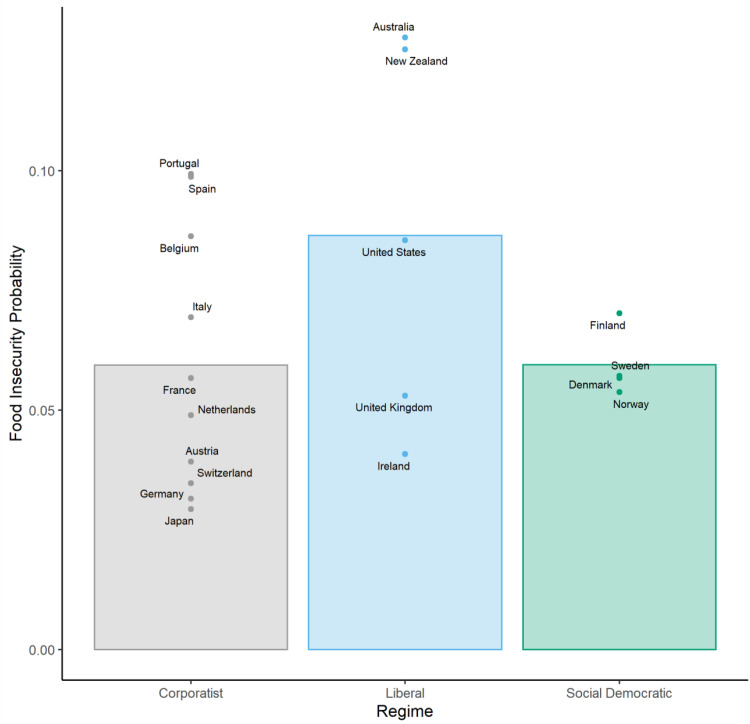
We sought to determine whether a country's social policy configuration—its welfare state regime—is associated with food insecurity risk. We conducted a cross-sectional study of 2017 U.N. Food and Agriculture Organization individual-level food insecurity survey data from 19 countries (the most recent data available prior to COVID-19). Countries were categorized into three welfare state regimes: liberal (e.g., the United States), corporatist (e.g., Germany), or social democratic (e.g., Norway). Food insecurity probability, calibrated to an international reference standard, was calculated using a Rasch model. We used linear regression to compare food insecurity probability across regime types, adjusting for per-capita gross domestic product, age, gender, education, and household composition. There were 19,008 participants. The mean food insecurity probability was 0.067 (SD: 0.217). In adjusted analyses and compared with liberal regimes, food insecurity probability was lower in corporatist (risk difference: −0.039, 95% CI −0.066 to −0.011, p = .006) and social democratic regimes (risk difference: −0.037, 95% CI −0.062 to −0.012, p = .004). Social policy configuration is strongly associated with food insecurity risk. Social policy changes may help lower food insecurity risk in countries with high risk.
Overview
CoChat Summary
TL;DR
This cross-sectional study of 19,008 people in 19 countries found that welfare state regime was associated with food insecurity probability. Compared with liberal regimes, corporatist and social democratic regimes had significantly lower adjusted food insecurity risk.
Key findings
- Across the full sample, the mean probability of experiencing moderate or severe food insecurity was 0.067 (SD 0.217).
- In adjusted analyses, compared with liberal regimes, food insecurity probability was lower in corporatist regimes (risk difference −0.039, 95% CI −0.066 to −0.011, p = .006) and social democratic regimes (risk difference −0.037, 95% CI −0.062 to −0.012, p = .004).
- In models adjusted only for GDP per capita, corporatist regimes had lower food insecurity probability than liberal regimes (risk difference −0.038, 95% CI −0.068 to −0.008, p = .01), as did social democratic regimes (risk difference −0.027, 95% CI −0.052 to −0.002, p = .03).
- The paper estimates that if the United States adopted a social democratic welfare regime, mean food insecurity probability would fall from 0.075 (95% CI 0.055 to 0.096) to 0.038 (95% CI 0.026 to 0.050).
Methods
- Cross-sectional comparative study using 2017 Food and Agriculture Organization / Gallup World Poll food insecurity data, with 19,008 participants across 19 countries; the United States came from the Current Population Survey, and Canada was excluded because the needed harmonized data were unavailable.
- Countries were classified into liberal, corporatist, or social democratic welfare state regimes, based on an Esping-Andersen-inspired typology.
- Main analysis used country- and year-specific Rasch models to estimate probability of moderate or severe food insecurity, then linear regression with predictive margins, adjusting for GDP per capita, age, gender, education, area of residence, and household composition; fractional logistic regression was used as a robustness check.
Limitations
- The paper states that findings are not readily generalizable beyond the included wealthy democratic countries, especially outside Europe or countries with historical connections to the United Kingdom.
- The welfare regime typology is described as a pragmatic and somewhat fuzzy classification, so country membership is not crisp.
- The paper notes that the U.S. data came from a different source and instrument than the other countries, which could affect results.
- Because the study is cross-sectional, the paper states it cannot test causal relationships.
Model-written summary. Check it against the paper before relying on it.
Integrity signals
Registry
Cites
Statistics
Figures
Verification
Claims the paper makes
1 Valid · 0 Not valid · 8 Not checked · 16 Own results and interpretations
Every source the paper cites for this claim was checked and supports it.
In the paper
“the 2021 reform of the Child Tax Credit in the United States, which has since expired, was associated with reductions in food hardship among families with children of similar magnitudes to those predicted by the results of this study.”
§ Food Insecurity and Social Policy: A Comparative Analysis of Welfare State Regimes in 19 Countries > Discussion
What the sources say
- Supportedcites [68] Bovell-Ammon A McCann NC Mulugeta M Ettinger de Cuba S Raifman J Shafer P. Association of the expiration of child tax credit advance payments with food insufficiency in US households. JAMA Netw Open. 2022; 5(10): e2234438. doi: 10.1001/jamanetworkopen.2022.34438 PMC9587477 36269356 source
The Introduction reports prior research finding a 26% decrease in food insufficiency among households with children after the 2021 Child Tax Credit payments began. It also states that the advance payments ended in December 2021. The comparison with predictions from the citing authors’ study is their own framing, not a finding attributed to this source. (LLM, conf=0.90)
- Supportedcites [69] Adams E Brickhouse T Dugger R Bean M. Patterns of food security and dietary intake during the first half of the child tax credit expansion. Health Aff Proj Hope. 2022; 41(5): 680- 688. doi: 10.1377/hlthaff.2021.01864 PMC9614666 35500174 source
The Abstract reports that, among participating households, very low food security fell from 12.7% to 5.6% during the first three months of expanded Child Tax Credit payments. The Conclusion describes parallel reductions during that period and states that the expansion expired. The comparison with the citing study’s predictions is the citing authors’ own assessment, not a finding attributed to this source. (LLM, conf=0.91)
plainstates an association- Asserted: passes — The authors put it forward as true.
- Checkable: passes — It can be checked against evidence.
- Load-bearing: unclear — It is unclear whether the paper’s conclusions depend on it.
- Based: passes — The paper gives a reason why it holds.
- Supported
A result the paper reports from its own data — it cites no other source for it, so there is none to check. The quote shows it is in the paper.
In the paper
“as did those living in social democratic regimes (risk difference: −0.027 in favor of social democratic regimes 95% CI −0.052 to −0.002, p = .03).”
§ Food Insecurity and Social Policy: A Comparative Analysis of Welfare State Regimes in 19 Countries > Results
plainstates an associationn = 19,008 ·- Asserted: passes — The authors put it forward as true.
- Checkable: passes — It can be checked against evidence.
- Load-bearing: passes — The paper’s conclusions depend on it.
- Based: passes — The paper gives a reason why it holds.
A result the paper reports from its own data — it cites no other source for it, so there is none to check. The quote shows it is in the paper.
In the paper
“and social democratic regimes (risk difference: −0.037 in favor of social democratic regimes 95% CI −0.062 to −0.012, p = .004).”
§ Food Insecurity and Social Policy: A Comparative Analysis of Welfare State Regimes in 19 Countries > Results
plainstates an association- Asserted: passes — The authors put it forward as true.
- Checkable: passes — It can be checked against evidence.
- Load-bearing: passes — The paper’s conclusions depend on it.
- Based: passes — The paper gives a reason why it holds.
A result the paper reports from its own data — it cites no other source for it, so there is none to check. The quote shows it is in the paper.
In the paper
“In models adjusted for age, gender, education, area, number of adults in household, number of children in household, and GDP per capita, and compared with liberal regimes, the probability of food insecurity for an individual was again lower for those living in corporatist (risk difference: −0.039 in favor of corporatist regimes 95% CI −0.066 to −0.011, p = .006)”
§ Food Insecurity and Social Policy: A Comparative Analysis of Welfare State Regimes in 19 Countries > Results
plainstates an associationn = 19,008 ·- Asserted: passes — The authors put it forward as true.
- Checkable: passes — It can be checked against evidence.
- Load-bearing: passes — The paper’s conclusions depend on it.
- Based: passes — The paper gives a reason why it holds.
A result the paper reports from its own data — it cites no other source for it, so there is none to check. The quote shows it is in the paper.
In the paper
“Individuals living in corporatist regimes had significantly lower food insecurity probability than those living in liberal regimes (risk difference: −0.038 in favor of corporatist regimes, 95% CI −0.068 to −0.008, p = .01)”
§ Food Insecurity and Social Policy: A Comparative Analysis of Welfare State Regimes in 19 Countries > Results
plainstates an associationn = 19,008 ·- Asserted: passes — The authors put it forward as true.
- Checkable: passes — It can be checked against evidence.
- Load-bearing: passes — The paper’s conclusions depend on it.
- Based: passes — The paper gives a reason why it holds.
7 more claims
Create a free account to see all 25 claims and to verify the 12 references still open.
- Probably not a substantial claim. 8
- It may state two separate claims as one. 7
Citations
Cites
The three worlds of welfare capitalism
(1990) · Choice Reviews Online · doi:10.5860/choice.28-1046 · Cited by 16,528
Korpi, W., & Palme, J. (1998) · American Sociological Review · doi:10.2307/2657333 · Cited by 2,307 · cited 4×
“…categorize into one of the three welfare state regime types articulated by Esping-Anderson and the body work that followed his account 27,37,41,42 : Australia, Austria, Belgium, Canada, Denmark, Finland, France, Germany, Ireland, Italy, Japan, the Netherlands, New Zealand, Norway, Portugal,…”
BackgroundInfluentialFood Insecurity And Health Outcomes
Gundersen, C., & Ziliak, J. P. (2015) · Health Affairs · doi:10.1377/hlthaff.2015.0645 · Cited by 1,868
Health Care Spending in the United States and Other High-Income Countries
Papanicolas, I., Woskie, L. R., & Jha, A. K. (2018) · JAMA · doi:10.1001/jama.2018.1150 · Cited by 1,626
When Should You Adjust Standard Errors for Clustering?
Abadie, A., Athey, S., Imbens, G. W., & Wooldridge, J. M. (2022) · The Quarterly Journal of Economics · doi:10.1093/qje/qjac038 · Cited by 1,460
Just Institutions Matter: The Moral and Political Logic of the Universal Welfare State
Rothstein, B. (1998) · doi:10.1017/cbo9780511598449 · Cited by 1,403
Predictive Margins with Survey Data
Graubard, B. I., & Korn, E. L. (1999) · Biometrics · doi:10.1111/j.0006-341x.1999.00652.x · Cited by 871
The Economics of the Welfare State.
Robinson, R., & Barr, N. (1988) · Economica · doi:10.2307/2554028 · Cited by 851
A Brief History of Neoliberalism
Schwarzmantel, J. (2007) · Contemporary Political Theory · doi:10.1057/palgrave.cpt.9300286 · Cited by 742
Administrative Burden: Policymaking by Other Means
Herd, P., & Moynihan, D. P. (2019) · Russell Sage Foundation eBooks · doi:10.7758/9781610448789 · Cited by 579
A Systematic Review of Interventions on Patients’ Social and Economic Needs
Gottlieb, L. M., Wing, H., & Adler, N. E. (2017) · American Journal of Preventive Medicine · doi:10.1016/j.amepre.2017.05.011 · Cited by 455
Rich Democracies: Political Economy, Public Policy, and Performance
Wilensky, H. L. (2002) · University of California Press eBooks · doi:10.1525/9780520928336 · Cited by 440
Austerity and health: the impact in the UK and Europe
Stuckler, D., Reeves, A., Loopstra, R., Karanikolos, M., & McKee, M. (2017) · European Journal of Public Health · doi:10.1093/eurpub/ckx167 · Cited by 409 · cited 1×
“27,48,49 However, regimes have experienced these trends differently.”
BackgroundBambra, C. (2007) · Journal of Epidemiology and Community Health · doi:10.1136/jech.2007.064295 · Cited by 405 · cited 2×
“27 43, 46, 60 While recognizing several The welfare state typology we used in this study represents a trade-off.”
BackgroundMethodUniversity Press, C. (2021) · doi:10.26226/morressier.60dd99435d86378f03b413f9 · Cited by 351
Association between household food insecurity and annual health care costs
Tarasuk, V., Cheng, J., de Oliveira, C., Dachner, N., Gundersen, C., & Kurdyak, P. (2015) · Canadian Medical Association Journal · doi:10.1503/cmaj.150234 · Cited by 324
Food insecurity, healthcare utilization, and high cost: a longitudinal cohort study.
Berkowitz, S. A., Seligman, H. K., Meigs, J. B., & Basu, S. (2018) · PubMed · Cited by 310
Self-citationBrady, D. (2009) · Oxford University Press eBooks · doi:10.1093/acprof:oso/9780195385878.001.0001 · Cited by 307
Arenas, D. J., Thomas, A., Wang, J., & DeLisser, H. M. (2019) · Journal of General Internal Medicine · doi:10.1007/s11606-019-05202-4 · Cited by 289
Thematic Review: Welfare regime debate: past, present, futures?
Ferragina, E., & Seeleib-Kaiser, M. (2011) · Policy & Politics · doi:10.1332/030557311x603592 · Cited by 272
Food Insecurity and Health Care Expenditures in the United States, 2011–2013
Berkowitz, S. A., Basu, S., Meigs, J. B., & Seligman, H. K. (2018) · Health Services Research · doi:10.1111/1475-6773.12730 · Cited by 271
Self-citationIs there an extended family of Mediterranean welfare states?
Gal, J. (2010) · Journal of European Social Policy · doi:10.1177/0958928710374374 · Cited by 254 · cited 1×
“27,77 That trend aligns with our fi ndings, with countries like Spain and Portugal having higher food insecurity probability than other corporatist states like Germany or Switzerland.”
BackgroundParadoxes of Social Policy: Welfare Transfers, Relative Poverty, and Redistribution Preferences
Brady, D., & Bostic, A. (2015) · American Sociological Review · doi:10.1177/0003122415573049 · Cited by 214
Interventions Addressing Food Insecurity in Health Care Settings: A Systematic Review
De Marchis, E. H., Torres, J. M., Benesch, T., Fichtenberg, C., Allen, I. E., Whitaker, E. M., & Gottlieb, L. M. (2019) · The Annals of Family Medicine · doi:10.1370/afm.2412 · Cited by 195
Food Insecurity and Cardiometabolic Conditions: a Review of Recent Research
Te‐Vazquez, J., Feng, S. N., Orr, C. J., & Berkowitz, S. A. (2021) · Current Nutrition Reports · doi:10.1007/s13668-021-00364-2 · Cited by 173
Self-citationSocial Determinants of Health: What’s a Healthcare System to Do?
Gottlieb, L., Fichtenberg, C., Alderwick, H., & Adler, N. (2019) · Journal of Healthcare Management · doi:10.1097/jhm-d-18-00160 · Cited by 150 · cited 1×
“16 – 21 Despite these efforts, food insecurity still remains a problem for many — for example, it affected over 33 million people in the United States in 2021, 1 and over seven million people in the United Kingdom 22 amidst an ongoing cost of living crisis in Europe.”
BackgroundTrends in food insecurity for adults with cardiometabolic disease in the United States: 2005-2012
Berkowitz, S. A., Berkowitz, T. S. Z., Meigs, J. B., & Wexler, D. J. (2017) · PLOS ONE · doi:10.1371/journal.pone.0179172 · Cited by 141
Self-citationWelfare regimes and welfare state outcomes in Europe
Kammer, A., Niehues, J., & Peichl, A. (2012) · Journal of European Social Policy · doi:10.1177/0958928712456572 · Cited by 136
Policy feedback and support for the welfare state
Jordan, J. (2013) · Journal of European Social Policy · doi:10.1177/0958928712471224 · Cited by 120 · cited 1×
“44,51,52 Prior studies examining categorizations of welfare regimes using both qualitative typologies and approaches that quantitatively try to isolate speci fi c aspects highlighted by the typologies have found that regime type is strongly associated with income distribution and poverty risk.”
BackgroundDiet and Food and Nutrition Insecurity and Cardiometabolic Disease
Brandt, E. J., Mozaffarian, D., Leung, C. W., Berkowitz, S. A., & Murthy, V. L. (2023) · Circulation Research · doi:10.1161/circresaha.123.322065 · Cited by 109
Self-citationFood insecurity status and mortality among adults in Ontario, Canada
Gundersen, C., Tarasuk, V., Cheng, J., de Oliveira, C., & Kurdyak, P. (2018) · PLOS ONE · doi:10.1371/journal.pone.0202642 · Cited by 96
Lindert, P. H. (2021) · Cambridge University Press eBooks · doi:10.1017/9781108784467 · Cited by 90 · cited 1×
“47,76 This study focused holistically on the welfare regime, but future work could (and should) seek to “ unpack the black box ” of these policies by identifying speci fi c policy subsets within overall regimes that most clearly reduce food insecurity.”
BackgroundSocial Policy Expenditures and Life Expectancy in High-Income Countries
Reynolds, M. M., & Avendaño, M. (2017) · American Journal of Preventive Medicine · doi:10.1016/j.amepre.2017.09.001 · Cited by 86
Byhoff, E., Kangovi, S., Berkowitz, S. A., DeCamp, M. W., Dzeng, E. W., Earnest, M. A., González, C. M., Hartigan, S., Karani, R., Memari, M., et al. (2020) · Journal of General Internal Medicine · doi:10.1007/s11606-020-05934-8 · Cited by 70
Self-citationBleich, S. N., Moran, A. J., Vercammen, K. A., Frelier, J. M., Dunn, C. G., Zhong, A., & Fleischhacker, S. E. (2020) · Annual Review of Public Health · doi:10.1146/annurev-publhealth-040119-094143 · Cited by 70
In defence of (social) democracy: on health inequalities and the welfare state
Bambra, C. L. (2013) · Journal of Epidemiology & Community Health · doi:10.1136/jech-2013-202937 · Cited by 67
Universalism in the British and Scandinavian Social Policy Debates
Anttonen, A., & Sipilä, J. (2012) · Edward Elgar Publishing eBooks · doi:10.4337/9781849805940.00007 · Cited by 60 · cited 2×
“37,39,40,44 Welfare state programs are thus “ second-line ” safety nets to turn to only when other options have been exhausted.”
BackgroundJacques, O., & Noël, A. (2021) · Journal of European Social Policy · doi:10.1177/0958928720918973 · Cited by 57 · cited 4×
“37,39,40,44 Welfare state programs are thus “ second-line ” safety nets to turn to only when other options have been exhausted.”
BackgroundInfluentialBovell-Ammon, A., McCann, N. C., Mulugeta, M., Ettinger de Cuba, S., Raifman, J., & Shafer, P. (2022) · JAMA Network Open · doi:10.1001/jamanetworkopen.2022.34438 · Cited by 51 · cited 1×
“68,69 The details of the 2021 Child Tax Credit reform (in particular, monthly payments and removal of income requirements) parallel child bene fi ts commonly issued in corporatist or social democratic states, 70 a fact that provides support for the estimates of this study.”
Food Insecurity among Households with Children: The Role of the State Economic and Policy Context
Bartfeld, J., & Men, F. (2017) · Social Service Review · doi:10.1086/695328 · Cited by 50 · cited 1×
“Food insecurity risk increases as income decreases, 53 – 55 so it is plausible that welfare state regimes may be associated with an individuals ’ food insecurity risk.”
BackgroundRubin, J. K., Taylor, J., Krapels, J., Sutherland, A., Felician, M., Liu, J., Davis, L. M., & Rohr, C. (2016) · RAND Corporation eBooks · doi:10.7249/rr1252 · Cited by 50
Food Insecurity Was Associated With Greater Family Health Care Expenditures In The US, 2016–17
Palakshappa, D., Garg, A., Peltz, A., Wong, C. A., Cholera, R., & Berkowitz, S. A. (2023) · Health Affairs · doi:10.1377/hlthaff.2022.00414 · Cited by 50
Self-citationPapanicolas, I., Woskie, L., Orlander, D., Orav, E. J., & Jha, A. K. (2019) · Health Affairs · doi:10.1377/hlthaff.2018.05187 · Cited by 48
Beyond Welfare Regimes: From Empirical Typology to Conceptual Ideal types
Rice, D. C. (2012) · Social Policy and Administration · doi:10.1111/spol.12001 · Cited by 47 · cited 4×
“37,46,47 Liberal regimes emerged in settings of early industrialization, relatively less organized labor movements, and political systems that allowed greater roles for business interests to shape legal arrangements.”
BackgroundMethodInfluentialReeves, A., Loopstra, R., & Tarasuk, V. (2021) · American Journal of Public Health · doi:10.2105/ajph.2020.306096 · Cited by 42 · cited 1×
“66 Moreover, studies of overall level of social spending, sometimes called “ welfare effort, ” have found that greater spending is associated with less food insecurity.”
BackgroundComparative Welfare State Politics: Development, Opportunities, and Reform
Kersbergen, K. V., & Vis, B. (2013) · doi:10.1017/cbo9781139021852 · Cited by 38
Adams, E., Brickhouse, T., Dugger, R., & Bean, M. (2022) · Health Affairs · doi:10.1377/hlthaff.2021.01864 · Cited by 36 · cited 1×
“68,69 The details of the 2021 Child Tax Credit reform (in particular, monthly payments and removal of income requirements) parallel child bene fi ts commonly issued in corporatist or social democratic states, 70 a fact that provides support for the estimates of this study.”
Reig, M. C., Gasull, M., & Arnaiz, M. G. (2023) · PubMed Central · Cited by 33
Wu, J. H. Y., Trieu, K., Coyle, D. H., Huang, L., Wijesuriya, N. S., Nallaiah, K., Lung, T. W.-C., Tanna, G. L. D., Zheng, M., Mozaffarian, D., et al. (2022) · Journal of Nutrition · doi:10.1093/jn/nxac152 · Cited by 29
Gugushvili, D., & Laenen, T. (2021) · Journal of International and Comparative Social Policy · doi:10.1017/ics.2020.24 · Cited by 28 · cited 3×
“…could categorize into one of the three welfare state regime types articulated by Esping-Anderson and the body work that followed his account 27,37,41,42 : Australia, Austria, Belgium, Canada, Denmark, Finland, France, Germany, Ireland, Italy, Japan, the Netherlands, New Zealand, Norway,…”
BackgroundWhy the World Should Not Follow the Failed United States Model of Fighting Domestic Hunger
Berg, J., & Gibson, A. (2022) · International Journal of Environmental Research and Public Health · doi:10.3390/ijerph19020814 · Cited by 26 · cited 1×
“71 74 Such approaches often breed unintended consequences through administrative complexity and cumbersome means testing, with those most in need of assistance often least equipped to navigate the administrative burdens.”
BackgroundHossain, M. B., Long, M. A., & Stretesky, P. B. (2020) · Sustainability · doi:10.3390/su13010324 · Cited by 24 · cited 1×
“67 This study adds a holistic assessment of the connection between the policy environment and the way funds are spent with food insecurity risk.”
BackgroundOlstad, D. L., Beall, R. F., Spackman, E., Dunn, S., Lipscombe, L. L., Williams, K., Oster, R. T., Scott, S., Zimmermann, G. L., McBrien, K., et al. (2022) · BMJ Open · doi:10.1136/bmjopen-2021-050006 · Cited by 21 · cited 1×
“16 – 21 Despite these efforts, food insecurity still remains a problem for many — for example, it affected over 33 million people in the United States in 2021, 1 and over seven million people in the United Kingdom 22 amidst an ongoing cost of living crisis in Europe.”
BackgroundSelf-citationAligning US Spending Priorities Using the Health Impact Pyramid Lens
McCullough, J. M., Leider, J. P., Resnick, B. A., & Bishai, D. M. (2020) · American Journal of Public Health · doi:10.2105/ajph.2020.305645 · Cited by 20
The Convergence of Welfare State Indicators in Europe: Evidence from Panel Data
Paetzold, J. (2013) · European Journal of Social Security · doi:10.1177/138826271301500104 · Cited by 16
Association of Unmet Social Needs with Chronic Illness: A Cross-Sectional Study
Byhoff, E., Guardado, R., Xiao, N., Nokes, K., Garg, A., & Tripodis, Y. (2022) · Population Health Management · doi:10.1089/pop.2021.0351 · Cited by 14
Self-citationThe Logic of Policies to Address Income‐Related Health Inequity: A Problem‐Oriented Approach
Berkowitz, S. A. (2022) · Milbank Quarterly · doi:10.1111/1468-0009.12558 · Cited by 14
Self-citationGaps in the welfare state: A role-based model of poverty risk in the U.S.
Berkowitz, S. A., & Palakshappa, D. (2023) · PLoS ONE · doi:10.1371/journal.pone.0284251 · Cited by 13 · cited 1×
“37,45 Historically, corporatist welfare regimes often emerged in the setting of “ statism ” (efforts by central governments to encourage citizen loyalty and drain support for revolutionary movements), and strong Catholic political parties that sought to both address people ’ s basic needs and…”
BackgroundSelf-citationThe Public Health Case for a Universalist Child Tax Credit
Berkowitz, S. A., Orr, C. J., & Palakshappa, D. (2022) · Archives of Pediatrics and Adolescent Medicine · doi:10.1001/jamapediatrics.2022.2503 · Cited by 11 · cited 1×
“68,69 The details of the 2021 Child Tax Credit reform (in particular, monthly payments and removal of income requirements) parallel child bene fi ts commonly issued in corporatist or social democratic states, 70 a fact that provides support for the estimates of this study.”
Self-citationA Community Partnership to Reduce Food Insecurity and Improve Patient-Reported Depression
Byhoff, E., Guardado, R., Zack, R. M., Nokes, K., & Tripodis, Y. (2023) · NEJM Catalyst · doi:10.1056/cat.22.0330 · Cited by 11
Self-citationFood insecurity in the UK: a public health issue left to fester
Hepatology, T. L. G. (2022) · The Lancet. Gastroenterology & hepatology · doi:10.1016/s2468-1253(22)00178-9 · Cited by 8
Corporate Efforts to Adopt and Distort the Social Determinants of Health Framework
Himmelstein, D. U., & Woolhandler, S. J. (2023) · International Journal of Social Determinants of Health and Health Services · doi:10.1177/27551938231162573 · Cited by 8 · cited 1×
“71 74 Such approaches often breed unintended consequences through administrative complexity and cumbersome means testing, with those most in need of assistance often least equipped to navigate the administrative burdens.”
BackgroundUnderstanding the cost of welfare
Glennerster, H. (2017) · Policy Press eBooks · doi:10.56687/9781447342717 · Cited by 5
Food insecurity in French patients with diabetes
Pilot, S., Cohen, R., Reach, G., Cosson, E., Clésiau, H. L., Herçberg, S., & Bihan, H. (2014) · Diabetes & Metabolism · doi:10.1016/j.diabet.2014.02.005 · Cited by 4
Research works printed but not linked: 2
- Burmila E. Chaotic Neutral: How the Democrats Lost Their Soul in the Center. Bold Type Books; 2022.
- Nord M, Statistics Division. Introduction to Item Response Theory Applied to Food Security Measurement: Basic Concepts, Parameters and Statistics. FAO; 2014. Accessed July 15, 2021. http://www.fao.org/publications/card/en/c/577f6a79-9cbd-49f5-b606-500ea42bf88e/
Cited by
Drake, C., Alfaro, J. M., Rader, A., Maciejewski, M. L., Lee, M. S., Xu, H., Wilson, L. E., Berkowitz, S. A., & Eisenson, H. (2024) · Journal of General Internal Medicine · doi:10.1007/s11606-024-08774-y · Cited by 8
“51 Additionally, if a provision of social care is based on utilization potential and costs (to the exclusion of health outcomes and patient experience measures), the result could be a focus on only high utilizers and expand existing disparities.”
Self-citationProduce Prescription Subsidy for Patients With Diabetes: A Pragmatic Randomized Clinical Trial
Drake, C., Buckman, C., Brucker, A., Hinz, E. M., Pignone, M. P., Shaikha, H., Rader, A., Granados, I., Goldstein, B. A., Chamorro, C., et al. (2026) · JAMA Internal Medicine · doi:10.1001/jamainternmed.2025.8008 · Cited by 12
Self-citationGalseku, P., Keenan, G. S., Stevenson, L., Cousins, R., Lingwood, J., Dixon, H., & Bourke, L. (2026) · Current Nutrition Reports · doi:10.1007/s13668-026-00744-6 · Cited by 9
“Berkowitz et al. [ 69] reported that countries with more robust welfare state regimes such as corporatist (e.g., Germany) and social democratic (e.g., Norway) models have significantly lower food insecurity risk than liberal welfare regimes like the USA.”
Borku, A. W., Utallo, A. U., & Tora, T. T. (2024) · American Journal of Human Biology · doi:10.1002/ajhb.24135 · Cited by 7
“Food insecurity is a big deal that affects millions of households across the world (Berkowitz et al., 2023).”
Food System Policies: A global snapshot from the Food System Policy Database
Lowder, S. K., Laderchi, C. R., Cerutti, N., et al. (2025) · Global Food Security · doi:10.1016/j.gfs.2025.100894 · Cited by 3
Metadata
- Authors
- Berkowitz, S. A., Drake, C., & Byhoff, E.
- Affiliations
- University of North Carolina at Chapel Hill (US)
- Duke University (US)
- University of Massachusetts Chan Medical School (US)
- Corresponding author
- Berkowitz, Seth A.
- Venue
- International Journal of Social Determinants of Health and Health Services
- Publisher
- SAGE Publications
- Published
- 2023-12-12
- Volume
- 54
- Issue
- 2
- Pages
- 76-86
- ISSN
- 2755-1938 (ISSN-L)
- 2755-1946
- PMC
- PMC10954393
- OpenAlex
- W4389683058
- Cited by
- 14
- References
- 63
- Citations by year
- 2026: 7 · 2025: 5 · 2024: 2
- FWCI
- 4.94
- Type
- journal article
- Language
- en
- Open access
- hybrid
- doi.org
- Licence
- Locations
- International Journal of Social Determinants of Health and Health Services (publishedVersion, cc-by-nc)
- PubMed (publishedVersion)
- Funders
- National Institute on Minority Health and Health Disparities (K23MD015267)
- Topics
- Health Sciences › Medicine › Public Health, Environmental and Occupational Health › Food Security and Health in Diverse Populations
- Social Sciences › Political Science and International Relations › Social Policy and Reform Studies
- Life Sciences › Agricultural and Biological Sciences › General Agricultural and Biological Sciences › Food Security and Socioeconomic Dynamics
- Keywords
- food insecurity, welfare regimes, social policy, corporatist welfare state, social democratic welfare state, liberal welfare state, cross-national comparison, household food security, social determinants of health
- MeSH terms
- Food Insecurity, Cross-Sectional Studies, Humans, Norway, Public Policy, Surveys and Questionnaires, United States
About these checks
Registry, retraction, Cites and statistics results are computed, not judged, with one exception: a printed reference that no index lists is read once by a model before it counts as a citation error. Claims are extracted by a model and kept only when their quote appears verbatim in the text; each cited source is then checked, with a model’s help, for whether it says what the claim relies on. Those verdicts can be wrong — read the claim’s quote and the cited source before relying on one.
A language model drew the claims from the paper on 2026-10-10, under version 3 of the claim definition (model deepseek-v4.1-flash, prompt extract-v3).
A second model labelled each claim on 2026-10-10 (model jev-1.13-20260917, definition revision gold-guideline-v0.2).
Cited sources are checked with a language model’s help (gpt-6-sol).
Statistics and arithmetic are recomputed, not judged.
Confidence bands are shown only for fields calibrated on our annotated test set. None is calibrated yet, so no band is shown.
What counts as a claim ›How we measure confidence ›How we check this ›
Are you an author, or do you see a problem with this page? Request a review
Data sources
Bibliographic data: Semantic Scholar, OpenAlex, Crossref.
Contains information from the Semantic Scholar Academic Graph Datasets, made available under the ODC Attribution License (ODC-BY 1.0).
Semantic Scholar’s data is described in: Kinney, R., et al. (2023). The Semantic Scholar Open Data Platform. arXiv:2301.10140.
