

The DOI matches its Crossref record.
A novel subgroup Q5 of human Y-chromosomal haplogroup Q in India
Abstract
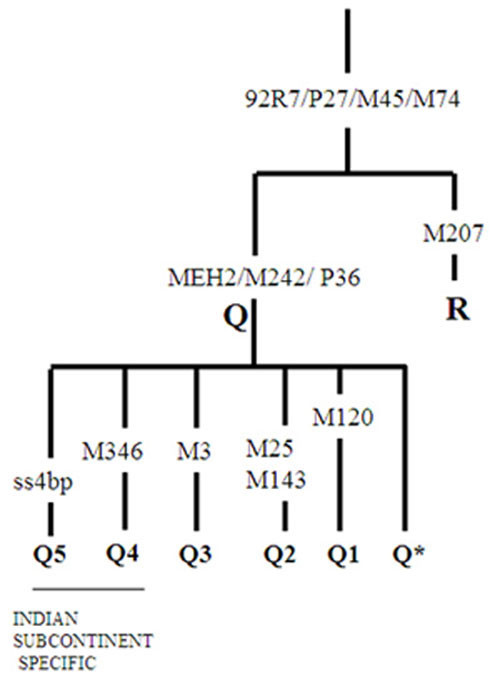
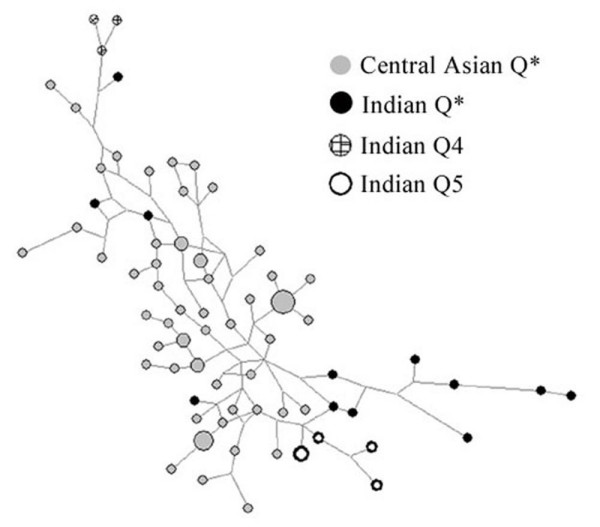
Background: Y-chromosomal haplogroup (Y-HG) Q is suggested to originate in Asia and represent recent founder paternal Native American radiation into the Americas. This group is delineated into Q1, Q2 and Q3 subgroups defined by biallelic markers M120, M25/M143 and M3, respectively. Recently, a novel subgroup Q4 has been identified which is defined by bi-allelic marker M346, representing HG Q (0.41%, 3/728) in Indian population. With scanty details of HG Q in Asia, especially India, it was pertinent to explore the status of the Y-HG Q in Indian population to gather an insight to determine the extent of diversity within this region. Results: We observed 15/630 (2.38%) Y-HG Q individuals in India with an ancestral state at M120, M25, M3 and M346 markers, indicating an absence of already known Q1, Q2, Q3 and Q4 sub-haplogroups. Interestingly, we further observed a novel 4 bp deletion/insertion polymorphism (ss4 bp, rs41352448) at 72,314 position of human arylsulfatase D pseudogene, defining a novel sub-lineage Q5 (in 5/15 individuals, i.e., 33.3 % of the observed Y-HG Q) with distributions independent of the social, cultural, linguistic and geographical affiliations in India. Conclusion: The study adds another sublineage Q5 in the already existing arrangement of Y-HG Q in literature. It was quite interesting to observe an ancestral state Q* and a novel sub-branch Q5, not reported elsewhere, in Indian subcontinent, though in low frequency. A novel subgroup Q4 was identified recently which is also restricted to Indian subcontinent. The most plausible explanation for these observations could be an ancestral migration of individuals bearing ancestral lineage Q* to Indian subcontinent followed by an autochthonous differentiation to Q4 and Q5 sublineages later on. However, other explanations of, either the presence of both the sub haplogroups (Q4 and Q5) in ancestral migrants or recent migrations from central Asia, cannot be ruled out till the distribution and diversity of these subgroups is explored extensively in Central Asia and other regions.
Overview
The claims and statistics of this paper haven’t been checked yet.
Run the check — free, no account needed. It reads the open-access text and checks the sources it cites.
Integrity signals
Registry
Cites
Statistics
Figures
Verification
Claims the paper makes
The claims and statistics of this paper haven’t been checked yet.
Run the check — free, no account needed. It reads the open-access text and checks the sources it cites.
Claims other papers make about this one
Each is checked against this paper’s own text: does it say what the citing paper says it does?
In the citing paper
“Haplogroup Q reaches its highest frequencies in Siberia, especially in Kets (90–94%) and Selkups (66–71%), and is rarely seen in Western, Southern and South-eastern Asia (Wells et al. 2001; Zerjal et al. 2002; Tambets et al. 2004; Sengupta et al. 2006; Sharma et al. 2007; Haber et al. 2011a, b; Dulik et al. 2011; Grugni et al. 2012; Di Cristofaro et al. 2013; Rasmussen et al. 2014).”
From Dispersals of the Siberian Y-chromosome haplogroup Q in Eurasia (2018) · cites this paper as Sharma et al. 2007
In the citing paper
“while Q1a2-M346 appears in Central, Western and Southern Asia, and most parts of Europe (Sengupta et al. 2006; Sharma et al. 2007; Abu-Amero et al. 2009; Bailliet et al. 2009).”
From Dispersals of the Siberian Y-chromosome haplogroup Q in Eurasia (2018) · cites this paper as Sharma et al. 2007
Self-check
Percentages, sums and reported differences re-computed from the paper’s own numbers.
The self-check needs the paper’s full text.
Citations
Cites
No references could be resolved yet.
Research works printed but not linked: 12
- Y-ChromosomeConsortium: A nomenclature system for the tree of human Y-chromosomal binary haplogroups. Genome Res. 2002, 12: 339-348. 10.1101/gr.217602. · DOI · Paper page
- Seielstad M, Yuldasheva N, Singh N, Underhill P, Oefner P, Shen P, Wells RS: A novel Y-chromosome variant puts an upper limit on the timing of first entry into the Americas. Am J Hum Genet. 2003, 73: 700-705. 10.1086/377589. · DOI · Paper page
- Karafet TM, Osipova LP, Gubina MA, Posukh OL, Zegura SL, Hammer MF: High levels of Y-chromosome differentiation among native Siberian populations and the genetic signature of a boreal hunter-gatherer way of life. Hum Biol. 2002, 74: 761-789. 10.1353/hub.2003.0006. · DOI · Paper page
- Sengupta S, Zhivotovsky LA, King R, Mehdi SQ, Edmonds CA, Chow CE, Lin AA, Mitra M, Sil SK, Ramesh A, Usha Rani MV, Thakur CM, Cavalli-Sforza LL, Majumder PP, Underhill PA: Polarity and temporality of high-resolution y-chromosome distributions in India identify both indigenous and exogenous expansions and reveal minor genetic influence of central asian pastoralists. Am J Hum Genet. 2006, 78: 202-221. 10.1086/499411. · DOI · Paper page
- Bandelt HJ, Forster P, Rohl A: Median-joining networks for inferring intraspecific phylogenies. Mol Biol Evol. 1999, 16: 37-48. · DOI · Paper page
- Bortolini MC, Salzano FM, Thomas MG, Stuart S, Nasanen SP, Bau CH, Hutz MH, Layrisse Z, Petzl-Erler ML, Tsuneto LT, Hill K, Hurtado AM, Castro-de-Guerra D, Torres MM, Groot H, Michalski R, Nymadawa P, Bedoya G, Bradman N, Labuda D, Ruiz-Linares A: Y-chromosome evidence for differing ancient demographic histories in the Americas. Am J Hum Genet. 2003, 73: 524-539. 10.1086/377588. · DOI · Paper page
- Cinnioglu C, King R, Kivisild T, Kalfoglu E, Atasoy S, Cavalleri GL, Lillie AS, Roseman CC, Lin AA, Prince K, Oefner PJ, Shen P, Semino O, Cavalli-Sforza LL, Underhill PA: Excavating Y-chromosome haplotype strata in Anatolia. Hum Genet. 2004, 114: 127-148. 10.1007/s00439-003-1031-4. · DOI · Paper page
- Sahoo S, Singh A, Himabindu G, Banerjee J, Sitalaximi T, Gaikwad S, Trivedi R, Endicott P, Kivisild T, Metspalu M, Villems R, Kashyap VK: A prehistory of Indian Y chromosomes: evaluating demic diffusion scenarios. Proc Natl Acad Sci U S A. 2006, 103: 843-848. 10.1073/pnas.0507714103. · DOI
- Saha A, Sharma S, Bhat A, Pandit A, Bamezai R: Genetic affinity among five different population groups in India reflecting a Y-chromosome gene flow. J Hum Genet. 2005, 50: 49-51. 10.1007/s10038-004-0219-3. · DOI
- Butler JM, Schoske R, Vallone PM, Kline MC, Redd AJ, Hammer MF: A novel multiplex for simultaneous amplification of 20 Y chromosome STR markers. Forensic Sci Int. 2002, 129: 10-24. 10.1016/S0379-0738(02)00195-0. · DOI
- Quintana-Murci L, Krausz C, Zerjal T, Sayar SH, Hammer MF, Mehdi SQ, Ayub Q, Qamar R, Mohyuddin A, Radhakrishna U, Jobling MA, Tyler-Smith C, McElreavey K: Y-chromosome lineages trace diffusion of people and languages in southwestern Asia. Am J Hum Genet. 2001, 68: 537-542. 10.1086/318200. · DOI · Paper page
- Zhivotovsky LA, Underhill PA, Cinnioglu C, Kayser M, Morar B, Kivisild T, Scozzari R, Cruciani F, Destro-Bisol G, Spedini G, Chambers GK, Herrera RJ, Yong KK, Gresham D, Tournev I, Feldman MW, Kalaydjieva L: The effective mutation rate at Y chromosome short tandem repeats, with application to human population-divergence time. Am J Hum Genet. 2004, 74: 50-61. 10.1086/380911. · DOI
Cited by
Dispersals of the Siberian Y-chromosome haplogroup Q in Eurasia
Huang, Y.-Z., Pamjav, H., Flegontov, P., Stenzl, V., Wen, S.-Q., Tong, X.-Z., Wang, C.-C., Wang, L.-X., Wei, L.-H., Gao, J.-Y., et al. (2018) · Molecular Genetics and Genomics · doi:10.1007/s00438-017-1363-8 · Cited by 34
Metadata
- Authors
- Sharma, S., Rai, E., Bhat, A. K., Bhanwer, A. S., & Bamezai, R. N.
- Venue
- BMC Evolutionary Biology
- Published
- 2007-11-19
- Volume
- 7
- Issue
- 1
- ISSN
- 1471-2148
- PMC
- PMC2258157
- Cited by
- 5
- References
- 0
- Language
- en
About these checks
Registry, retraction, Cites and statistics results are computed, not judged, with one exception: a printed reference that no index lists is read once by a model before it counts as a citation error. Claims are extracted by a model and kept only when their quote appears verbatim in the text; each cited source is then checked, with a model’s help, for whether it says what the claim relies on. Those verdicts can be wrong — read the claim’s quote and the cited source before relying on one.
Statistics and arithmetic are recomputed, not judged.
Confidence bands are shown only for fields calibrated on our annotated test set. None is calibrated yet, so no band is shown.
What counts as a claim ›How we measure confidence ›How we check this ›
Are you an author, or do you see a problem with this page? Request a review
How to cite
Cite CoChat for the checks on this page, and the paper for its own findings.
- This page
- CoChat. (2026). Citation check: A novel subgroup Q5 of human Y-chromosomal haplogroup Q in India. https://app.cochat.ai/papers/10.1186/1471-2148-7-232
- The paper
- Sharma, S., Rai, E., Bhat, A. K., Bhanwer, A. S., & Bamezai, R. N. (2007). A novel subgroup Q5 of human Y-chromosomal haplogroup Q in India. BMC Evolutionary Biology. https://doi.org/10.1186/1471-2148-7-232
