

The DOI matches its Crossref record.
Protein genes in repetitive sequence—antifreeze glycoproteins in Atlantic cod genome
Abstract
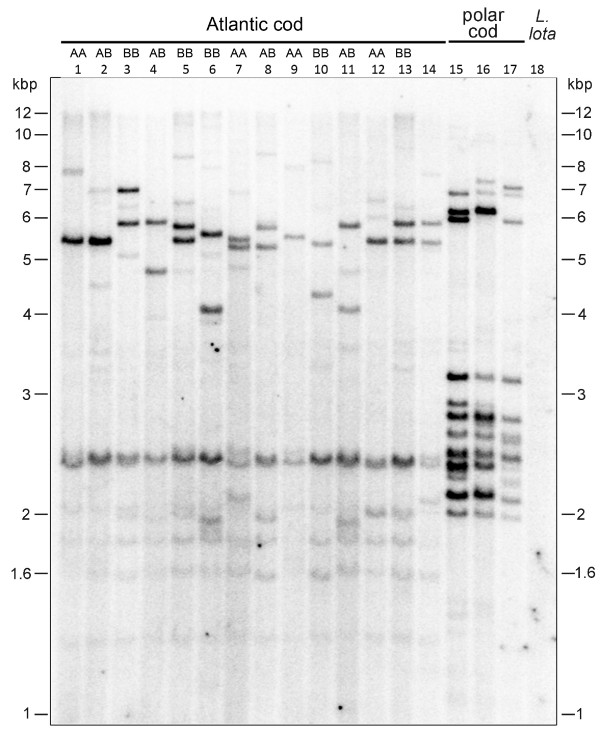
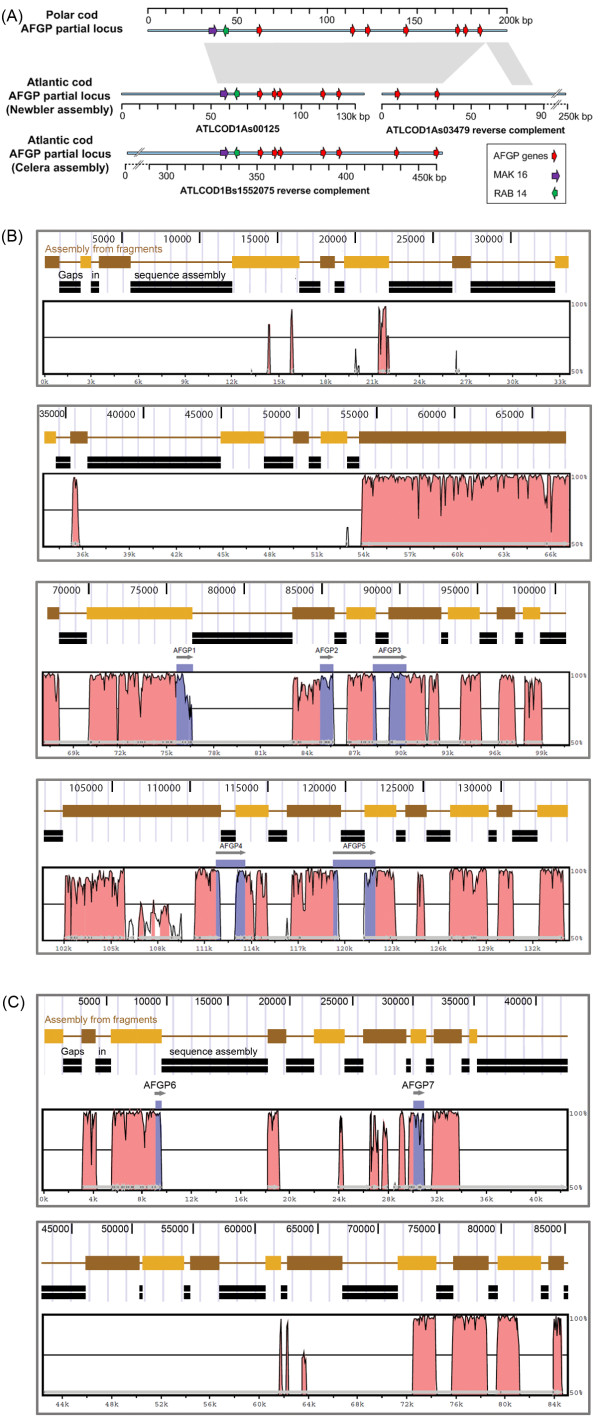
Background: Highly repetitive sequences are the bane of genome sequence assembly, and the short read lengths produced by current next generation sequencing technologies further exacerbates this obstacle. An adopted practice is to exclude repetitive sequences in genome data assembly, as the majority of repeats lack protein-coding genes. However, this could result in the exclusion of important genotypes in newly sequenced non-model species. The absence of the antifreeze glycoproteins (AFGP) gene family in the recently sequenced Atlantic cod genome serves as an example. Results: The Atlantic cod (Gadus morhua) genome was assembled entirely from Roche 454 short reads, demonstrating the feasibility of this approach. However, a well-known major adaptive trait, the AFGP, essential for survival in frigid Arctic marine habitats was absent in the annotated genome. To assess whether this resulted from population difference, we performed Southern blot analysis of genomic DNA from multiple individuals from the North East Arctic cod population that the sequenced cod belonged, and verified that the AFGP genotype is indeed present. We searched the raw assemblies of the Atlantic cod using our G. morhua AFGP gene, and located partial AFGP coding sequences in two sequence scaffolds. We found these two scaffolds constitute a partial genomic AFGP locus through comparative sequence analyses with our newly assembled genomic AFGP locus of the related polar cod, Boreogadus saida. By examining the sequence assembly and annotation methodologies used for the Atlantic cod genome, we deduced the primary cause of the absence of the AFGP gene family from the annotated genome was the removal of all repetitive Roche 454 short reads before sequence assembly, which would exclude most of the highly repetitive AFGP coding sequences. Secondarily, the model teleost genomes used in projection annotation of the Atlantic cod genome have no antifreeze trait, perpetuating the unawareness that the AFGP gene family is missing. Conclusions: We recovered some of the missing AFGP coding sequences and reconstructed a partial AFGP locus in the Atlantic cod genome, bringing to light that not all repetitive sequences lack protein coding information. Also, reliance on genomes of model organisms as reference for annotating protein-coding gene content of a newly sequenced non-model species could lead to omission of novel genetic traits.
Overview
The claims and statistics of this paper haven’t been checked yet.
Run the check — free, no account needed. It reads the open-access text and checks the sources it cites.
Integrity signals
Registry
Cites
Statistics
Figures
Verification
Claims the paper makes
The claims and statistics of this paper haven’t been checked yet.
Run the check — free, no account needed. It reads the open-access text and checks the sources it cites.
Claims other papers make about this one
Each is checked against this paper’s own text: does it say what the citing paper says it does?
In the citing paper
“For instance, the antifreeze glycoproteins were completely missing in the gadMor1 assembly (67), while they are found in gadMor2 (see section ‘Tandem repeats can hinder proper gene annotation’ below).”
From Tandem repeats lead to sequence assembly errors and impose multi-level challenges for genome and protein databases (2019) · cites this paper as [67]
Self-check
Percentages, sums and reported differences re-computed from the paper’s own numbers.
The self-check needs the paper’s full text.
Citations
Cites
No references could be resolved yet.
Research works printed but not linked: 27
- Green P: Whole-genome disassembly. Proc Natl Acad Sci USA. 2002, 99 (7): 4143- · DOI
- Finotello F, Lavezzo E, Fontana P, Peruzzo D, Albiero A, Barzon L, Falda M, Di Camillo B, Toppo S: Comparative analysis of algorithms for whole-genome assembly of pyrosequencing data. Brief Bioinform. 2011, 13 (3): 269-280. · DOI
- Star B, Nederbragt AJ, Jentoft S, Grimholt U, Malmstrom M, Gregers TF, Rounge TB, Paulsen J, Solbakken MH, Sharma A: The genome sequence of Atlantic cod reveals a unique immune system. Nature. 2011, 477 (7363): 207-210. · DOI · Paper page
- Goddard SV, Kao MH, Fletcher GL: Population differences in antifreeze production cycles of juvenile Atlantic cod (Gadus morhua) reflect adaptations to overwintering environment. Can J Fish Aquat Sci. 1999, 56: 1991-1999. · DOI
- Goddard SV, Wroblewski JS, Taggart CT, Howse KA, Bailey WL, Kao MH, Fletcher GL: Overwintering of adult northern Atlantic cod (Gadus morhua) in cold inshore waters as evidenced by plasma antifreeze glycoprotein levels. Can J Fish Aquat Sci. 1994, 51: 2834-2842. · DOI
- Hew CL, Slaughter D, Fletcher GL, Joshi S: Antifreeze glycoproteins in the plasma of Newfoundland Atlantic cod (Gadus morhua). Can J Zool. 1981, 59: 2186-2192. · DOI
- Cheng C-HC: Evolution of the diverse antifreeze proteins. Curr Opin Genet Dev. 1998, 8: 715-720. · DOI
- Fletcher GL, Hew CL, Davies PL: Antifreeze proteins of teleost fishes. Annu Rev Physiol. 2001, 63: 359-390. · DOI
- Chen L, DeVries AL, Cheng C-HC: Convergent evolution of antifreeze glycoproteins in Antarctic notothenioid fish and Arctic cod. Proc Natl Acad Sci USA. 1997, 94 (8): 3817-3822. · DOI · Paper page
- DeVries AL, Cheng C-HC: Antifreeze proteins and organismal freezing avoidance in polar fishes. The physiology of polar fishes. vol. 22. Edited by: Farrell AP, Steffensen JF. 2005, Elsevier Academic Press, San Diego, 155-201. · DOI
- Pogson GH, Fevolden SE: Natural selection and the genetic differentiation of coastal and Arctic populations of the Atlantic cod in northern Norway: a test involving nucleotide sequence variation at the pantophysin (PanI) locus. Mol Ecol. 2003, 12 (1): 63-74. · DOI
- Sarvas TH, Fevolden SE: Pantophysin (Pan I) locus divergence between inshore v. offshore and northern v. southern populations of Atlantic cod in the north-east Atlantic. J Fish Biol. 2005, 67: 444-469. · DOI
- Johansen SD, Coucheron DH, Andreassen M, Karlsen BO, Furmanek T, Jørgensen TE, Emblem Å, Breines R, Nordeide JT, Moum T: Large-scale sequence analyses of Atlantic cod. New Biotechnol. 2009, 25 (5): 263-271. · DOI
- Frazer KA, Pachter L, Poliakov A, Rubin EM, Dubchak I: VISTA: computational tools for comparative genomics. Nucleic Acids Res. 2004, 32: W273-W279. · DOI
- Nicodemus-Johnson J, Silic S, Ghigliotti L, Pisano E, Cheng CHC: Assembly of the Antifreeze Glycoprotein/Trypsinogen-Like Protease Genomic Locus in the Antarctic fish Dissostichus mawsoni (Norman). Genomics. 2011, 98: 194-201. · DOI
- Scott GK, Davies PL, Kao MH, Fletcher GL: Differential amplification of antifreeze protein genes in the pleuronectinae. J Mol Evol. 1988, 27 (1): 29-35. · DOI
- Graham LA, Davies PL: Glycine-rich antifreeze proteins from snow fleas. Science. 2005, 310 (5747): 461- · DOI
- Middleton AJ, Brown AM, Davies PL, Walker VK: Identification of the ice-binding face of a plant antifreeze protein. FEBS Lett. 2009, 583 (4): 815-819. · DOI
- Gatesy J, Hayashi C, Motriuk D, Woods J, Lewis R: Extreme diversity, conservation, and convergence of spider silk fibroin sequences. Science. 2001, 291 (5513): 2603- · DOI
- Regier JC: Evolution and higher-order structure of architectural proteins in silkmoth chorion. EMBO J. 1986, 5 (8): 1981- · DOI
- Lacruz RS, Lakshminarayanan R, Bromley KM, Hacia JG, Bromage TG, Snead ML, Moradian-Oldak J, Paine ML: Structural analysis of a repetitive protein sequence motif in strepsirrhine primate amelogenin. PLoS One. 2011, 6 (3): e18028- · DOI
- MacDougall M, Simmons D, Luan X, Nydegger J, Feng J, Gu TT: Dentin phosphoprotein and dentin sialoprotein are cleavage products expressed from a single transcript coded by a gene on human chromosome 4. J Biol Chem. 1997, 272 (2): 835- · DOI
- Eckert RL, Green H: Structure and evolution of the human involucrin gene. Cell. 1986, 46: 583-589. · DOI
- Yamada Y, Avvedimento VE, Mudryj M, Ohkubo H, Vogeli G, Irani M, Pastan I, de Crombrugghe B: The collagen gene: evidence for its evolutionary assembly by amplification of a DNA segment containing an exon of 54 bp. Cell. 1980, 22: 887-892. · DOI
- Alkan C, Sajjadian S, Eichler EE: Limitations of next-generation genome sequence assembly. Nat Methods. 2011, 8: 61-65. · DOI
- Kidd JM, Sampas N, Antonacci F, Graves T, Fulton R, Hayden HS, Alkan C, Malig M, Ventura M, Giannuzzi G: Characterization of missing human genome sequences and copy-number polymorphic insertions. Nat Methods. 2010, 7 (5): 365-371. · DOI
- Miyake T, Amemiya CT: BAC libraries and comparative genomics of aquatic chordate species. Comp Biochem Physiol C. 2004, 138: 233-244.
Cited by
Sorted by citations
Tørresen, O. K., Star, B., Mier, P., Andrade-Navarro, M. A., Bateman, A., Jarnot, P., Gruca, A., Grynberg, M., Kajava, A. V., Promponas, V. J., et al. (2019) · Nucleic Acids Research · doi:10.1093/nar/gkz841 · Cited by 347
Metadata
- Authors
- Zhuang, X., Yang, C., Fevolden, S.-E., & Cheng, C.-H. C.
- Venue
- BMC Genomics
- Published
- 2012-07-02
- Volume
- 13
- Issue
- 1
- ISSN
- 1471-2164
- PMC
- PMC3441883
- Cited by
- 12
- References
- 0
- Language
- en
About these checks
Registry, retraction, Cites and statistics results are computed, not judged, with one exception: a printed reference that no index lists is read once by a model before it counts as a citation error. Claims are extracted by a model and kept only when their quote appears verbatim in the text; each cited source is then checked, with a model’s help, for whether it says what the claim relies on. Those verdicts can be wrong — read the claim’s quote and the cited source before relying on one.
Statistics and arithmetic are recomputed, not judged.
Confidence bands are shown only for fields calibrated on our annotated test set. None is calibrated yet, so no band is shown.
What counts as a claim ›How we measure confidence ›How we check this ›
Are you an author, or do you see a problem with this page? Request a review
How to cite
Cite CoChat for the checks on this page, and the paper for its own findings.
- This page
- CoChat. (2026). Citation check: Protein genes in repetitive sequence—antifreeze glycoproteins in Atlantic cod genome. https://app.cochat.ai/papers/10.1186/1471-2164-13-293
- The paper
- Zhuang, X., Yang, C., Fevolden, S.-E., & Cheng, C.-H. C. (2012). Protein genes in repetitive sequence—antifreeze glycoproteins in Atlantic cod genome. BMC Genomics. https://doi.org/10.1186/1471-2164-13-293
