

Blomia tropicalis Blo t 5 and Blo t 21 recombinant allergens might confer higher specificity to serodiagnostic assays than whole mite extract
Open accessThe DOI matches its Crossref record; 33 of the 34 references it cites were found in a registry or an index.
Abstract
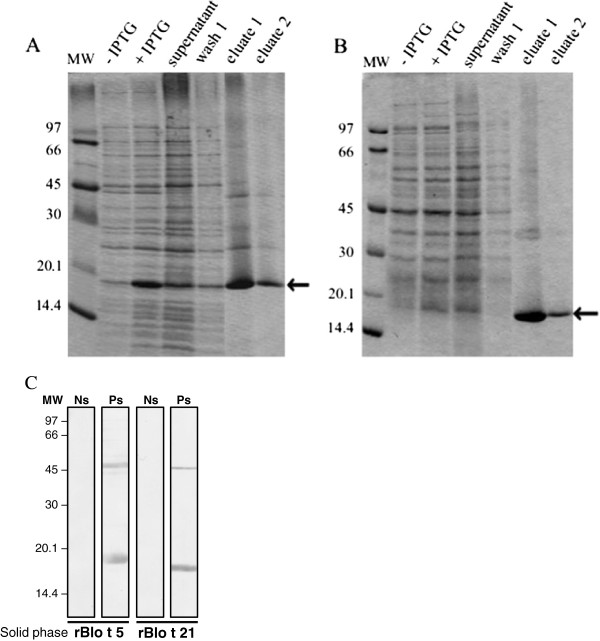
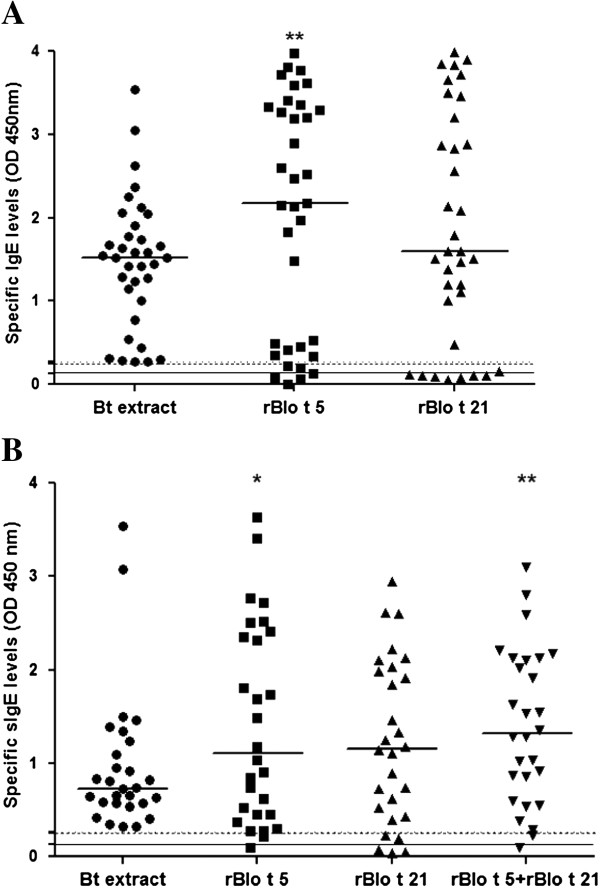
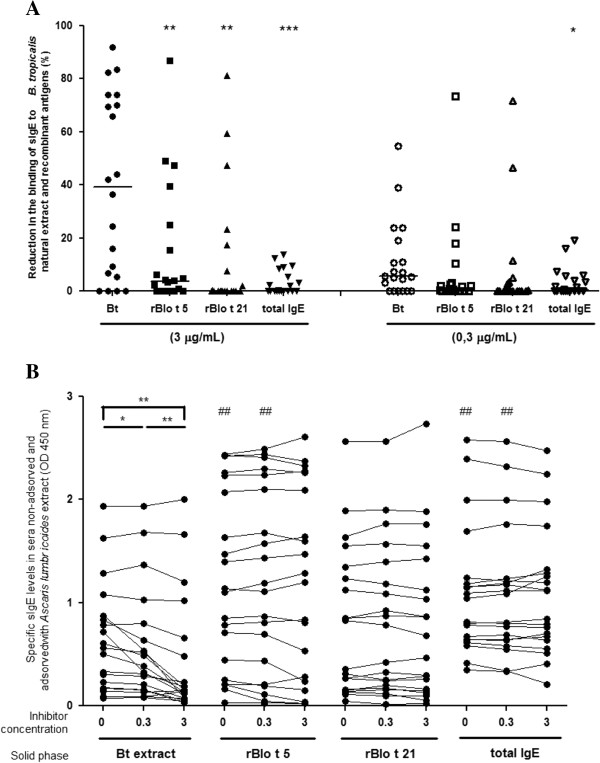
Background: Blomia tropicalis is a dust mite and an important source of allergens in tropical regions. Up to now, the assays to diagnose atopy to this mite use whole body extract as antigens. However, anti-B. tropicalis IgE antibodies cross-react with Ascaris lumbricoides antigens, hindering the diagnosis of allergy to this mite. In this study,B. tropicalis recombinant allergens were evaluated with the purpose of developing an immunodiagnostic assay for allergy to this mite with greater specificity than those commercially available. Methods: Two B. tropicalis allergens (Blo t 5 and Blo t 21) were cloned into a plasmidial expression vector, expressed in Escherichia coli and purified by affinity chromatography. Sixty-three sera containing anti-B. tropicalis extract (BtE) IgE antibodies were used to investigate IgE reactivity to the recombinant Blot 5 and 21 allergens. Inhibition assays with 20 sera pre-adsorbed with A. lumbricoides extract were performed using rBlo t 5, rBlo t 21, and BtE as antigens. All the assays were carried using indirect ELISA. Results: Eighty-two point nine percent and 80.0% of the sera with anti-BtE antibodies from 35 children reacted with rBlo t 5 and rBlo t 21, respectively, whereas 92.8% and 89.3% of the 28 sera with anti-BtE antibodies from adult asthma patients reacted with the same allergens, and 96.4% of these sera reacted with a mixture of rBlo t 5 and rBlo t 21. In an inhibition ELISA, the absorption of sera by A. lumbricoides extract affected less the reaction with rBlo t 5 and rBlo t 21 than with BtE. Conclusions: The rBlo t 5 and rBlo t 21 allergens contain important epitopes recognized by IgE antibodies of individuals allergic to B. tropicalis antigens. Moreover, the assays using the recombinant allergens had lower IgE cross-reactivity with A. lumbricoides antigens, a fact which would confers higher specificity to serodiagnostic assays than the crude mite extract. However, additional recombinant allergens should be evaluated in order to reach the same sensitivity of the commercially available assays based on mite extract.
Overview
The claims and statistics of this paper haven’t been checked yet.
Free: it reads the open-access text and checks the first 5 claims that cite a source we can check. Create a free account to check every claim.
Integrity signals
Registry
Cites
Statistics
Figures
Verification
Claims the paper makes
The claims and statistics of this paper haven’t been checked yet.
Free: it reads the open-access text and checks the first 5 claims that cite a source we can check. Create a free account to check every claim.
Claims other papers make about this one
Each is checked against this paper’s own text: does it say what the citing paper says it does?
The cited source says what the claim attributes to it.
In the citing paper
“and Blo t 5 for Blomia tropicalis (non-Pyroglyphidae mite).990”
From International Consensus Statement on Allergy and Rhinology: Allergic Rhinitis (2018) · cites this paper as [990]
Experimental — accuracy not yet measured
Self-check
Percentages, sums and reported differences re-computed from the paper’s own numbers.
The self-check needs the paper’s full text.
Citations
Cites
PROTEIN MEASUREMENT WITH THE FOLIN PHENOL REAGENT
Lowry, O., Rosebrough, N., Farr, A. L., & Randall, R. (1951) · Journal of Biological Chemistry · doi:10.1016/s0021-9258(19)52451-6 · Cited by 317,331 · cited 1×
“tropicalis aqueous extract was determined by the Folin reagent method [12].”
MethodCleavage of Structural Proteins during the Assembly of the Head of Bacteriophage T4
LAEMMLI, U. K. (1970) · Nature · doi:10.1038/227680a0 · Cited by 249,961
VALENTA, LIDHOLM, NIEDERBERGER, HAYEK, KRAFT, & GRÖNLUND (1999) · Clinical & Experimental Allergy · doi:10.1046/j.1365-2222.1999.00653.x · Cited by 531 · cited 3×
“Some studies indicate that mite allergy could be detected using a mixture of two or more major recombinant allergens (component-resolved diagnostics), replacing the natural extract [20].”
BackgroundGlobal Alliance against Chronic Respiratory Diseases
Bousquet, J., Dahl, R., & Khaltaev, N. (2007) · Allergy · doi:10.1111/j.1398-9995.2007.01307.x · Cited by 248 · cited 1×
“Background Allergic respiratory diseases, like asthma and rhinitis, are worldwide spread and their prevalences have increased over the past decades, reaching epidemic proportions [1].”
BackgroundRecombinant allergens for diagnosis and therapy of allergic disease
Chapman, M. D., Smith, A. M., Vailes, L. D., Arruda, L. K., Dhanaraj, V., & Pomés, A. (2000) · Journal of Allergy and Clinical Immunology · doi:10.1067/mai.2000.109832 · Cited by 246 · cited 1×
“In addition, the more sensitizing allergenic proteins in the mite extract can be found in low concentrations, requiring the use of higher doses of total extract, which is not always convenient in clinical practice [20,25,27,28].”
BackgroundVariability of IgE reactivity profiles among European mite allergic patients
Weghofer, M., Thomas, W. R., Kronqvist, M., Mari, A., Purohit, A., Pauli, G., Horak, F., Grönlund, H., Van Hage, M., Valenta, R., et al. (2008) · European Journal of Clinical Investigation · doi:10.1111/j.1365-2362.2008.02048.x · Cited by 174 · cited 1×
“Furthermore, the use of multiple recombinant allergens to detect sensitization profiles could be very important to guide and improve immunotherapy for mite allergies [19-21].”
BackgroundAllergic Symptoms, Atopy, and Geohelminth Infections in a Rural Area of Ecuador
Cooper, P. J., Chico, M. E., Bland, M., Griffin, G. E., & Nutman, T. B. (2003) · American Journal of Respiratory and Critical Care Medicine · doi:10.1164/rccm.200211-1320oc · Cited by 162 · cited 1×
“lumbricoides [10,29].”
Barreto, M. L., Cunha, S. S., Alcântara-Neves, N., Carvalho, L. P., Cruz, Á. A., Stein, R. T., Genser, B., Cooper, P. J., & Rodrigues, L. C. (2006) · BMC Pulmonary Medicine · doi:10.1186/1471-2466-6-15 · Cited by 134 · cited 2×
“tropicalis-sensitized individuals react with Blo t 5 and Blo t 21 [2,14].”
BackgroundSelf-citationAcevedo, N., Sánchez, J., Erler, A., Mercado, D., Briza, P., Kennedy, M., Fernandez, A., Gutierrez, M., Chua, K. Y., Cheong, N., et al. (2009) · Allergy · doi:10.1111/j.1398-9995.2009.02084.x · Cited by 114 · cited 1×
“This finding could be explained by the existence of IgE antibodies, raised in response to the helminth infection, that cross-react with allergens but are unable to lead to degranulation of mast cells, consequently increasing anti-allergen IgE antibody levels but not SPT positivity [9,33].”
BackgroundEarly infection with Trichuris trichiura and allergen skin test reactivity in later childhood
Rodrigues, L. C., Newcombe, P. J., Cunha, S. S., Alcantara‐Neves, N. M., Genser, B., Cruz, A. A., Simoes, S. M., Fiaccone, R., Amorim, L., Cooper, P. J., et al. (2008) · Clinical & Experimental Allergy · doi:10.1111/j.1365-2222.2008.03027.x · Cited by 112
Self-citation
Research works printed but not linked: 1
- Taketomi EA Almeida KP Silva DAO FL Allergens: sources, exposure and sensitization levels, diagnostic tools and immunotherapeutical applications J Med Med Sci 2010 1 580 588
Cited by
International Consensus Statement on Allergy and Rhinology: Allergic Rhinitis
Wise, S. K., Lin, S. Y., Toskala, E., Orlandi, R. R., Akdis, C. A., Alt, J. A., Azar, A., Baroody, F. M., Bachert, C., Canonica, G. W., et al. (2018) · International Forum of Allergy & Rhinology · doi:10.1002/alr.22073 · Cited by 557
International consensus statement on allergy and rhinology: Allergic rhinitis – 2023
Wise, S. K., Damask, C., Roland, L. T., Ebert, C., Levy, J. M., Lin, S., Luong, A., Rodriguez, K., Sedaghat, A. R., Toskala, E., et al. (2023) · International Forum of Allergy & Rhinology · doi:10.1002/alr.23090 · Cited by 507
EAACI Molecular Allergology User's Guide 2.0
Dramburg, S., Hilger, C., Santos, A. F., de las Vecillas, L., Aalberse, R. C., Acevedo, N., Aglas, L., Altmann, F., Arruda, K. L., Asero, R., et al. (2023) · Pediatric Allergy and Immunology · doi:10.1111/pai.13854 · Cited by 298
Particularities of allergy in the tropics
Caraballo, L., Zakzuk, J., Lee, B. W., Acevedo, N., Soh, J. Y., Sánchez-Borges, M., Hossny, E., García, E., Rosario, N., Ansotegui, I., et al. (2016) · World Allergy Organization Journal · doi:10.1186/s40413-016-0110-7 · Cited by 127
“4 % of the responders to the whole body extract [255].”
BackgroundHouse dust mite allergy: The importance of house dust mite allergens for diagnosis and immunotherapy
Huang, H., Sarzsinszky, E., & Vrtala, S. (2023) · Molecular Immunology · doi:10.1016/j.molimm.2023.04.008 · Cited by 105
Buendía, E., Zakzuk, J., Mercado, D., Alvarez, A., & Caraballo, L. (2015) · World Allergy Organization Journal · doi:10.1186/s40413-015-0058-z · Cited by 63
“has been demonstrated experimentally [39].”
Allergens of Blomia tropicalis: An Overview of Recombinant Molecules
Santos da Silva, E., Asam, C., Lackner, P., Hofer, H., Wallner, M., Silva Pinheiro, C., Alcântara-Neves, N. M., & Ferreira, F. (2017) · International Archives of Allergy and Immunology · doi:10.1159/000464325 · Cited by 48
Self-citationMolecular diagnosis and immunotherapy
Sastre, J., & Sastre-Ibañez, M. (2016) · Current Opinion in Allergy & Clinical Immunology · doi:10.1097/aci.0000000000000318 · Cited by 48
“tropicalis is an important allergen, and Blo t 5 can differentiate true cosensitization from a cross-reactivity phenomenon, as major and minor mites have partial crossreactivity [17,18].”
BackgroundHouse Dust Mite Allergens: New Discoveries and Relevance to the Allergic Patient
Thomas, W. R. (2016) · Current Allergy and Asthma Reports · doi:10.1007/s11882-016-0649-y · Cited by 46
Čelakovská, J., Bukač, J., Čermáková, E., Vaňková, R., Skalska, H., Krejsek, J., & Andrýs, C. (2021) · International Journal of Molecular Sciences · doi:10.3390/ijms22105286 · Cited by 46
“coli may be potential candidates to be used in a pool of different recombinant allergens for improving serodiagnosis assays of allergy to Blomia tropicalis [28].”
BackgroundAllergens from house dust and storage mites
Vrtala, S. (2022) · Allergo Journal International · doi:10.1007/s40629-022-00226-5 · Cited by 44
Molecular diagnosis and immunotherapy
Sastre, J. (2013) · Current Opinion in Allergy & Clinical Immunology · doi:10.1097/aci.0b013e328364f4c6 · Cited by 33
“In tropical or sub-tropical areas, Blomia tropicalis is an important allergen and Blo t 5 can differentiate a true co sensitization from a cross-reactivity phenomenon, as major and minor mites have partial cross-reactivity [13,14].”
Zakzuk, J., Mercado, D., Bornacelly, A., Sánchez, J., Ahumada, V., Acevedo, N., & Caraballo, L. R. (2018) · Pediatric Allergy and Immunology · doi:10.1111/pai.13004 · Cited by 27
Huang, Z., Zou, X., Chen, H., Liao, C., Hu, H., Luo, W., & Sun, B. (2019) · International Archives of Allergy and Immunology · doi:10.1159/000504320 · Cited by 30
Helminth-Induced IgE and Protection Against Allergic Disorders
Hamid, F., Amoah, A. S., van Ree, R., & Yazdanbakhsh, M. (2015) · Current topics in microbiology and immunology · doi:10.1007/978-3-319-13725-4_5 · Cited by 28
Ascariasis as a model to study the helminth/allergy relationships
Caraballo, L., Acevedo, N., & Zakzuk, J. (2019) · Parasite Immunology · doi:10.1111/pim.12595 · Cited by 25
The Blomia tropicalis allergen Blo t 7 stimulates innate immune signalling pathways through TLR 2
Soongrung, T., Mongkorntanyatip, K., Peepim, T., Buaklin, A., Mignon, M. L., Malainual, N., Nony, E., & Jacquet, A. (2018) · Clinical & Experimental Allergy · doi:10.1111/cea.13098 · Cited by 24
“tropicalis allergenic proteins are represented, up to now, by Blo t 5 and probably Blo t 21.(9) Surprisingly, the IgE-binding frequencies of Blo t 1 and Blo t 2 remained poorly characterized and such information gap is likely related to the difficulties to obtain properly folded recombinant allergens.”
BackgroundParasitic worms and allergies in childhood: Insights from population studies 2008–2013
Amoah, A. S., Boakye, D. A., van Ree, R., & Yazdanbakhsh, M. (2013) · Pediatric Allergy and Immunology · doi:10.1111/pai.12174 · Cited by 25
“tropicalis extract had IgE to rBlo t 5 and 80% had IgE to rBlo t 21 (64).”
BackgroundBlo t 2: Group 2 allergen from the dust mite Blomia tropicalis
Reginald, K., Pang, S. L., & Chew, F. T. (2019) · Scientific Reports · doi:10.1038/s41598-019-48688-y · Cited by 25
A hybrid of two major Blomia tropicalis allergens as an allergy vaccine candidate
da Silva, E. S., Aglas, L., Pinheiro, C. S., Belitardo, E. M. M. D. A., Silveira, E. F., Huber, S., Torres, R. T., Wallner, M., Briza, P., Lackner, P., et al. (2020) · Clinical & Experimental Allergy · doi:10.1111/cea.13611 · Cited by 20
Self-citationPinheiro, C. S., da Silva, E. S., Belitardo, E. M. M. D. A., Pacheco, L. G. C., Aguiar, E. R. G. R., Alcântara‐Neves, N. M., Gadermaier, G., & Ferreira, F. (2021) · Clinical and Translational Allergy · doi:10.1002/clt2.12004 · Cited by 21
Self-citationThe use of urethral stents for the treatment of urethral strictures.
Yachia, D. (1993) · PubMed · Cited by 24
Castro-Almarales, R. L., Ronquillo-Díaz, M., Castelló, M. Á., Canosa, J. S. R., León, M. G., Enríquez-Domínguez, I., Viltre, B. I. N., Mateo, M., Diaz, Y. O., Ramírez-González, W., et al. (2020) · World Allergy Organization Journal · doi:10.1016/j.waojou.2020.100098 · Cited by 20
Proteomic Analysis Reveals Allergen Variability among Breeds of the Dust Mite Blomia tropicalis
da Silva, E. S., Ponte, J. C. M., da Silva, M. B., Pinheiro, C. S., Pacheco, L. G. C., Ferreira, F., Briza, P., & Alcântara‐Neves, N. M. (2019) · International Archives of Allergy and Immunology · doi:10.1159/000501964 · Cited by 18
Self-citationZhou, Y., Cheng, Q., Chen, J., Klimov, P. B., Ren, Y., Zhou, D., Liao, Y., Yuan, C., Peng, J., Yu, H., et al. (2025) · International Immunopharmacology · doi:10.1016/j.intimp.2025.115833 · Cited by 20
Predicting Blomia tropicalis allergens using a multiomics approach
Hubert, J., Vrtala, S., Sopko, B., Dowd, S., He, Q.-X., Klimov, P., Harant, K., Talacko, P., & Erban, T. (2023) · bioRxiv · doi:10.1002/clt2.12302 · Cited by 13
“tropicalis.(10,14) Our analyses showed that both proteins contained a signal peptide and shared a Blo t 5 domain.”
BackgroundMolecular allergy diagnosis for the clinical characterization of asthma
Sastre-Ibañez, M., & Sastre, J. (2015) · Expert Review of Molecular Diagnostics · doi:10.1586/14737159.2015.1036745 · Cited by 14
“It has only partial cross-reactivity with allergens from Pyroglyphidae mites [31,32].”
BackgroundMartínez, D., Cantillo, J. F., Herazo, H., Wortmann, J., Keller, W., Caraballo, L. R., & Puerta, L. (2018) · Immunology Letters · doi:10.1016/j.imlet.2018.01.012 · Cited by 14
N‐terminal peptide deletion influences immunological and structural features of Blo t 5
da Silva, E. S., Huber, S., Alcântara‐Neves, N. M., Asam, C., Silveira, E. F., Belitardo, E. M. M. D. A., Aglas, L., Wallner, M., Gadermaier, G., Briza, P., et al. (2020) · Allergy · doi:10.1111/all.14176 · Cited by 13
Self-citationChen, S., Zheng, Y.-W., Chen, B., Zhong, H., Liao, F., Wang, X., Hui, S. F., & Lai, X. (2018) · International Archives of Allergy and Immunology · doi:10.1159/000494389 · Cited by 11
Lee, Y. Z., Kow, A. S. F., Jacquet, A., Lee, M. T., & Tham, C. L. (2023) · Experimental and Applied Acarology · doi:10.1007/s10493-023-00857-5 · Cited by 12
“These allergens do not cross-react despite having a very similar three-dimensional structure, yet co-sensitization is a common characteristic (Carvalho et al. 2013; Naik et al. 2008).”
BackgroundHussein, A., & Elawamy, W. E. (2015) · American Journal of Tropical Medicine and Hygiene · doi:10.4269/ajtmh.14-0837 · Cited by 10
“tropicalis extract,(8) the most important of which is the species-specific 14-KDa Blo t 5,(15,16) to which up to 92% of allergic patients are sensitized.(17) In this work, we surveyed a variety”
BackgroundDiagnostic use of recombinant Tha p 2 in the allergy to Thaumetopoea pityocampa
Rodríguez-Mahillo, A. I., Carballeda‐Sangiao, N., Vega, J. M., García-Ortiz, J. C., Alain Roques, B., Moneo, I., & González‐Muñoz, M. (2015) · Allergy · doi:10.1111/all.12678 · Cited by 9
Parasites and allergy: Observations from Brazil
de Andrade, C. M., Carneiro, V. L., Cerqueira, J. V., Fonseca, H. F., Queiroz, G. A., Costa, R. D. S., Alcântara‐Neves, N. M., Cooper, P. J., & Figueiredo, C. A. (2018) · Parasite Immunology · doi:10.1111/pim.12588 · Cited by 11
Conjunctival Provocation Test With Blomia tropicalis
Mourão, E. M. M., & Filho, N. A. R. (2021) · Frontiers in Allergy · doi:10.3389/falgy.2021.673462 · Cited by 8
Wong, K. H. S., Zhou, Q., Prabhu, N., Furuhashi, K., Chua, Y. L., Grotenbreg, G. M., & Kemeny, D. M. (2017) · Immunology · doi:10.1111/imm.12772 · Cited by 7
Rationally designed hypoallergenic mutant variants of the house dust mite allergen Der p 21
Santos, S. P. O., Lisboa, A. B. P., Silva, F. S. R., Tiwari, S., Azevedo, V., Cruz, Á. A., da Silva, E. S., Pinheiro, C. S., Alcântara‐Neves, N. M., & Pacheco, L. G. C. (2022) · Biochimica et Biophysica Acta (BBA) - General Subjects · doi:10.1016/j.bbagen.2022.130096 · Cited by 8
Self-citationZhou, Y., Zhu, K., Li, Q., Zhou, D., Ren, Y., Liao, Y., Cao, P., Gong, Y., & Cui, Y. (2023) · International Journal of Biological Macromolecules · doi:10.1016/j.ijbiomac.2023.127788 · Cited by 7
Luo, W., Zhang, J., Zheng, X., Li, A., Xv, M., Zhou, D., Yuan, C., Cui, Y., & Sun, B. (2024) · International Journal of Biological Macromolecules · doi:10.1016/j.ijbiomac.2024.129972 · Cited by 6
da Silva, E. S., Pacheco, L. G. C., Fernandes, A. M. S., Asam, C., Silveira, E. F., Pinheiro, C. S., & Alcântara‐Neves, N. M. (2021) · Molecular Biology Reports · doi:10.1007/s11033-021-06361-6 · Cited by 6
“indirect ELISA according to a protocol previously published by our group [11].”
BackgroundMethodResultSelf-citationRemoval of N-Terminal Peptide Impacts Structural Aspects of an IgE-Reactive Recombinant Der p 5
Vieira, C., Silva, R. C., Silveira, E. F., Fernandes, A. M. S., Hernández, D. A. J., Salazar-Garcés, L. F., Fonseca, L. M. D. S., Machado, B. A. S., Fernandes, J. S., Pinheiro, G. P., et al. (2023) · Allergies · doi:10.3390/allergies3030012 · Cited by 3
Self-citationSensitisation to molecular components of mites in atopic dermatitis patients
Čelakovská, J., Čermáková, E., Vaňková, R., Boudková, P., Andrýs, C., & Krejsek, J. (2022) · Food and Agricultural Immunology · doi:10.1080/09540105.2022.2100323 · Cited by 3
“…found all over the world, while Blomia tropicalis is the predominant mite species in tropical and subtropical regions, and in some areas, it coexists with Dermatophagoides pteronyssinus (Banerjee et al., 2015; Carvalho Kdos et al., 2013; Mueller, Gosavi, et al., 2010; Santos da Silva et al., 2017).”
BackgroundPei, Y., Xiao, Z., Wei, S., Peng, M., Luo, C., & Wang, D. (2022) · Journal of Inflammation Research · doi:10.2147/jir.s380526 · Cited by 4
Alves, C. F., Notário, A. F. O., Correia, L. I. V., Ferreira, K. N., de Araújo, K. C. L., Taketomi, E. A., de Souza, G. R. L., Medeiros, E. S. D., Cunha-Junior, J. P., Alves, R. P., et al. (2023) · Journal of The Electrochemical Society · doi:10.1149/1945-7111/acc0a2 · Cited by 2
Chen, J., Zhong, L., Wang, K., Ren, Y., Zhou, D., Zhou, Y., Chen, L., Liao, Y., Hao, C., & Cui, Y. (2026) · International Immunopharmacology · doi:10.1016/j.intimp.2026.116282 · Cited by 1
Allergy to Mites, Sensitivity to Tropical Species in Two Regions in Algeria
Lahiani, S., & Galleni, M. (2017) · Advances in Science, Technology & Innovation/Advances in science, technology & innovation · doi:10.1007/978-3-319-70548-4_575 · Cited by 1
Prevalence of asthma among 6-7 year-old schoolchildren in the city of Fortaleza, Brazil
de Luna, M. D. F. G., Fisher, G. B., de Luna, J. R. G., da Silva, M. G. C., de Almeida, P. C., & Chiesa, D. (2013) · Brazilian Journal of Allergy and Immunology (BJAI) · doi:10.5935/2318-5015.20130039
da Silva, E. M., Silva, G. D. A. E., Rubini, N. D. P. M., & de Sá, C. A. M. (2013) · Brazilian Journal of Allergy and Immunology (BJAI) · doi:10.5935/2318-5015.20130047
Los diversos efectos de las helmintiasis sobre la inflamación alérgica
Caraballo, L. R. (2016) · Revista de la Academia Colombiana de Ciencias Exactas Físicas y Naturales · doi:10.18257/raccefyn.355
Allergene von Hausstaub- und Vorratsmilben
Vrtala, S. (2022) · Allergo Journal · doi:10.1007/s15007-022-5640-4
Allergene von Hausstaub- und Vorratsmilben
Vrtala, S. (2023) · HNO Nachrichten · doi:10.1007/s00060-023-8690-7
Urrego, J., Aglas, L., Huber, S., Belitardo, E. M. M. D. A., Briza, P., Cruz, Á. A., Salazar-Garcés, L. F., Cooper, P. J., Zakzuk, J. A., Caraballo, L. R., et al. (2026) · Frontiers in Immunology · doi:10.3389/fimmu.2026.1815807
Self-citation
Metadata
- Authors
- Carvalho, K. D. A., de Melo-Neto, O. P., Magalhães, F. B., Ponte, J. C. M., Felipe, F. A. B., dos Santos, M. C. A., dos Santos Lima, G., Cruz, Á. A., Pinheiro, C. S., Pontes-de-Carvalho, L. C., & Alcantara-Neves, N. M.
- Affiliations
- Universidade Federal da Bahia (BR)
- Associação Caruaruense de Ensino Superior e Técnico (BR)
- Instituto Gonçalo Moniz (BR)
- Venue
- BMC Immunology
- Published
- 2013-02-27
- Volume
- 14
- Issue
- 1
- Pages
- 11-11
- ISSN
- 1471-2172 (ISSN-L)
- PMC
- PMC3605308
- OpenAlex
- W2020270527
- Cited by
- 53
- References
- 34
- Citations by year
- 2026: 2 · 2025: 1 · 2024: 1 · 2023: 9 · 2022: 5 · 2021: 4 · 2020: 3 · 2019: 3 · 2018: 8 · 2017: 3 · 2016: 4 · 2015: 5 · 2013: 4
- FWCI
- 4.19
- Type
- journal article
- Language
- en
- Open access
- gold
- doi.org
- Licence
- cc-by
- Locations
- BMC Immunology (publishedVersion, cc-by)
- Europe PMC (PubMed Central) (publishedVersion, cc-by)
- PubMed Central (publishedVersion, cc-by)
- PubMed (publishedVersion)
- Portuguese National Funding Agency for Science, Research and Technology (RCAAP Project by FCT) (publishedVersion, other-oa)
- Americanae (AECID Library) (publishedVersion, other-oa)
- Arca - Repositório Institucional da Fiocruz (submittedVersion, other-oa)
- LA Referencia (Red Federada de Repositorios Institucionales de Publicaciones Científicas) (submittedVersion, other-oa)
- Funders
- Coordenação de Aperfeiçoamento de Pessoal de Nível Superior
- Conselho Nacional de Desenvolvimento Científico e Tecnológico
- Topics
- Health Sciences › Medicine › Immunology and Allergy › Allergic Rhinitis and Sensitization
- Health Sciences › Medicine › Pulmonary and Respiratory Medicine › Asthma and respiratory diseases
- Health Sciences › Medicine › Immunology and Allergy › Food Allergy and Anaphylaxis Research
- Keywords
- Blomia tropicalis, house dust mite allergy, recombinant allergens, IgE antibodies, inhibition ELISA, allergen epitopes, asthma, affinity purification
- MeSH terms
- Adult, Allergens, Animals, Antigens, Helminth, Ascaris, Child, Preschool, Cross Reactions, Humans, Immunoglobulin E, Mites, Recombinant Fusion Proteins, Sensitivity and Specificity, Serologic Tests, Reproducibility of Results, Complex Mixtures
About these checks
Registry, retraction, Cites and statistics results are computed, not judged, with one exception: a printed reference that no index lists is read once by a model before it counts as a citation error. Claims are extracted by a model and kept only when their quote appears verbatim in the text; each cited source is then checked, with a model’s help, for whether it says what the claim relies on. Those verdicts can be wrong — read the claim’s quote and the cited source before relying on one.
Statistics and arithmetic are recomputed, not judged.
Confidence bands are shown only for fields calibrated on our annotated test set. None is calibrated yet, so no band is shown.
What counts as a claim ›How we measure confidence ›How we check this ›
Are you an author, or do you see a problem with this page? Request a review
Data sources
Bibliographic data: Semantic Scholar, OpenAlex, Crossref.
Contains information from the Semantic Scholar Academic Graph Datasets, made available under the ODC Attribution License (ODC-BY 1.0).
Semantic Scholar’s data is described in: Kinney, R., et al. (2023). The Semantic Scholar Open Data Platform. arXiv:2301.10140.
