

The DOI matches its Crossref record; 49 of the 49 references it cites were found in a registry or an index.
Cinnamaldehyde and cinnamaldehyde derivatives reduce virulence in Vibrio spp. by decreasing the DNA-binding activity of the quorum sensing response regulator LuxR
Open accessAbstract
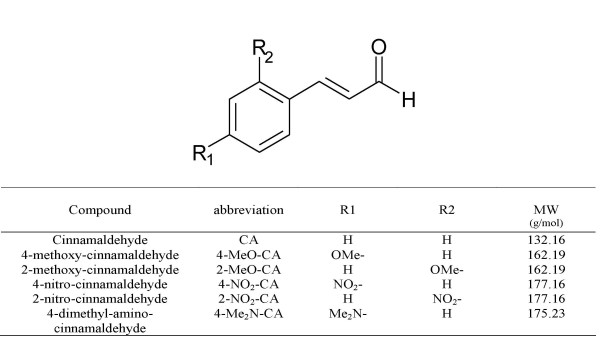
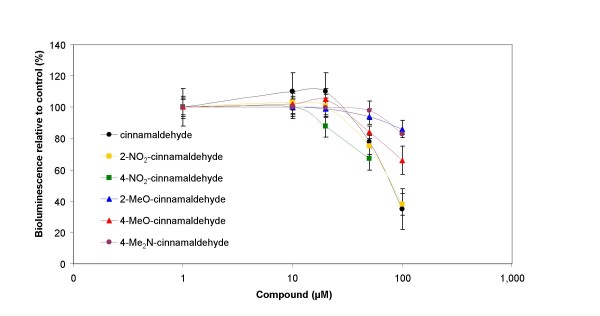
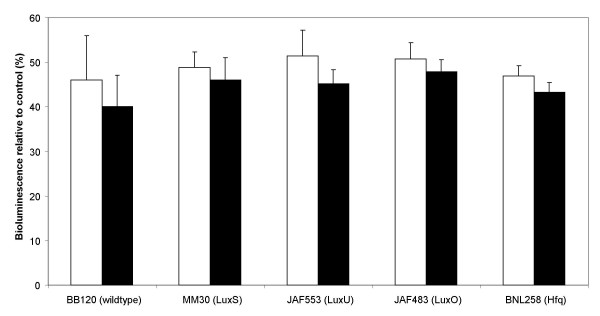
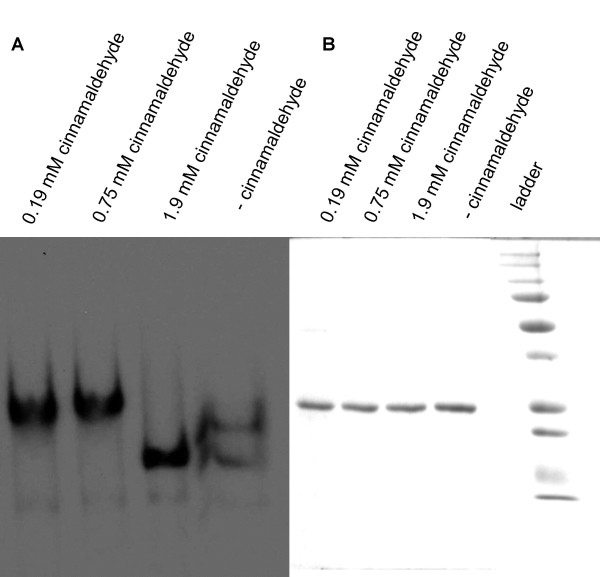
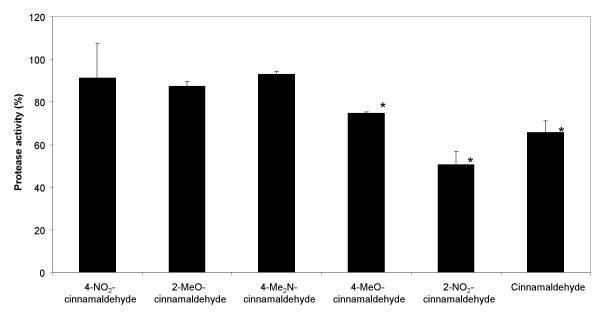
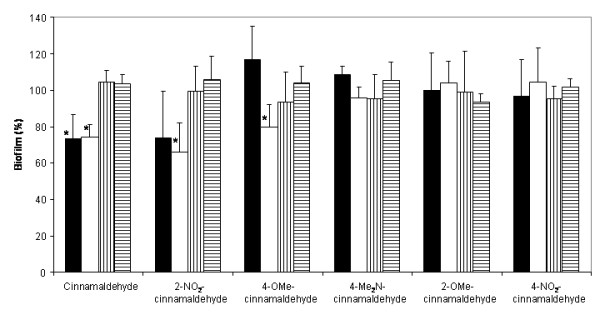
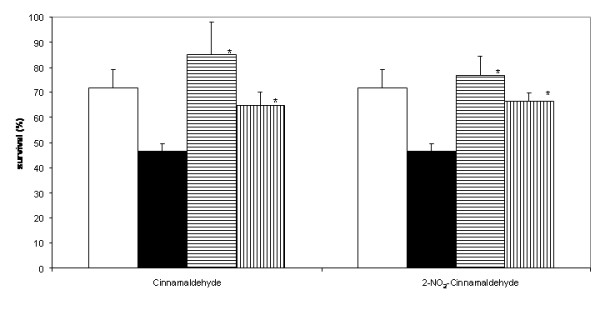
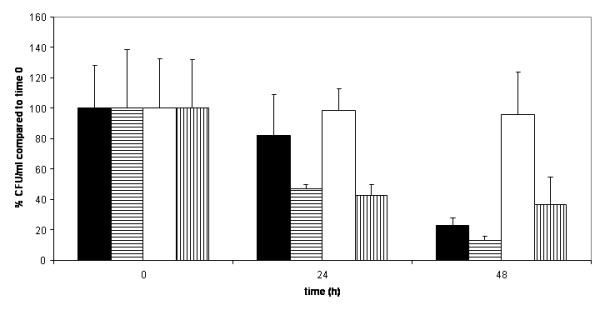
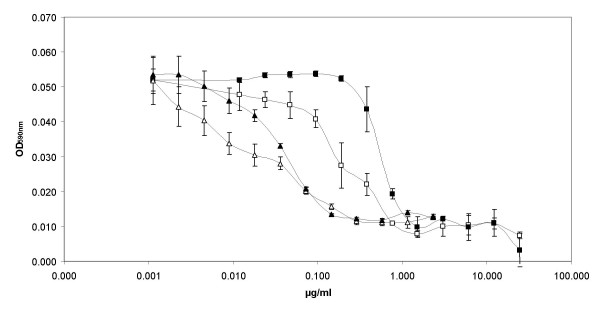
BACKGROUND: To date, only few compounds targeting the AI-2 based quorum sensing (QS) system are known. In the present study, we screened cinnamaldehyde and substituted cinnamaldehydes for their ability to interfere with AI-2 based QS. The mechanism of QS inhibition was elucidated by measuring the effect on bioluminescence in several Vibrio harveyi mutants. We also studied in vitro the ability of these compounds to interfere with biofilm formation, stress response and virulence of Vibrio spp. The compounds were also evaluated in an in vivo assay measuring the reduction of Vibrio harveyi virulence towards Artemia shrimp. RESULTS: Our results indicate that cinnamaldehyde and several substituted derivatives interfere with AI-2 based QS without inhibiting bacterial growth. The active compounds neither interfered with the bioluminescence system as such, nor with the production of AI-2. Study of the effect in various mutants suggested that the target protein is LuxR. Mobility shift assays revealed a decreased DNA-binding ability of LuxR. The compounds were further shown to (i) inhibit biofilm formation in several Vibrio spp., (ii) result in a reduced ability to survive starvation and antibiotic treatment, (iii) reduce pigment and protease production in Vibrio anguillarum and (iv) protect gnotobiotic Artemia shrimp against virulent Vibrio harveyi BB120. CONCLUSION: Cinnamaldehyde and cinnamaldehyde derivatives interfere with AI-2 based QS in various Vibrio spp. by decreasing the DNA-binding ability of LuxR. The use of these compounds resulted in several marked phenotypic changes, including reduced virulence and increased susceptibility to stress. Since inhibitors of AI-2 based quorum sensing are rare, and considering the role of AI-2 in several processes these compounds may be useful leads towards antipathogenic drugs.
Overview
The claims and statistics of this paper haven’t been checked yet.
Run the check — free, no account needed. It reads the open-access text and checks the sources it cites.
Integrity signals
Registry
Cites
Statistics
Figures
Verification
Claims the paper makes
The claims and statistics of this paper haven’t been checked yet.
Run the check — free, no account needed. It reads the open-access text and checks the sources it cites.
Claims other papers make about this one
Each is checked against this paper’s own text: does it say what the citing paper says it does?
In the citing paper
“Using the nematode model Caenorhabditis elegans, Brackman and colleagues [133,134] demonstrated the ability of 3,4-dichlorocinnamaldehyde to decrease the virulence of V. anguillarum, V. harveyi and V. vulnificus by affecting the DNA-binding ability of LuxR.”
From Effect of essential oils on pathogenic bacteria (2013) · cites this paper as [134]
Self-check
Percentages, sums and reported differences re-computed from the paper’s own numbers.
The self-check needs the paper’s full text.
Citations
Cites
Comparison of multiple methods for quantification of microbial biofilms grown in microtiter plates
Peeters, E., Nelis, H. J. C. F., & Coenye, T. (2007) · Journal of Microbiological Methods · doi:10.1016/j.mimet.2007.11.010 · Cited by 1,148
Self-citationSurette, M. G., Miller, M. B., & Bassler, B. L. (1999) · Proceedings of the National Academy of Sciences · doi:10.1073/pnas.96.4.1639 · Cited by 980
Lenz, D. H., Mok, K. C., Lilley, B. N., Kulkarni, R., Wingreen, N. S., & Bassler, B. L. (2004) · Cell · doi:10.1016/j.cell.2004.06.009 · Cited by 959
Zogaj, X., Nimtz, M., Rohde, M., Bokranz, W., & Römling, U. (2001) · Molecular Microbiology · doi:10.1046/j.1365-2958.2001.02337.x · Cited by 956
Vibrio harveyi: a significant pathogen of marine vertebrates and invertebrates
Austin, B. P., & Zhang, X.-H. (2006) · Letters in Applied Microbiology · doi:10.1111/j.1472-765x.2006.01989.x · Cited by 797
Cross-species induction of luminescence in the quorum-sensing bacterium Vibrio harveyi
Bassler, B. L., Greenberg, E. P., & Stevens, A. M. (1997) · Journal of Bacteriology · doi:10.1128/jb.179.12.4043-4045.1997 · Cited by 763
LuxS quorum sensing: more than just a numbers game
Xavier, K. B., & Bassler, B. L. (2003) · Current Opinion in Microbiology · doi:10.1016/s1369-5274(03)00028-6 · Cited by 750
Bassler, B. L., Wright, M. E., Showalter, R. E., & Silverman, M. R. (1993) · Molecular Microbiology · doi:10.1111/j.1365-2958.1993.tb01737.x · Cited by 749
Pharmacological inhibition of quorum sensing for the treatment of chronic bacterial infections
Hentzer, M., & Givskov, M. (2003) · Journal of Clinical Investigation · doi:10.1172/jci20074 · Cited by 705
Mass mortality of Penaeus monodon larvae due to antibiotic-resistant Vibrio harveyi infection
Karunasagar, I., Pai, R., Gr, M., & Karunasagar, I. (1994) · Aquaculture · doi:10.1016/0044-8486(94)90309-3 · Cited by 606
Cited by
Sorted by citations
Effect of essential oils on pathogenic bacteria
Nazzaro, F., Fratianni, F., De Martino, L., Coppola, R., & De Feo, V. (2013) · Pharmaceuticals · doi:10.3390/ph6121451 · Cited by 2,186
“Using the nematode model Caenorhabditis elegans, Brackman and colleagues [133,134] demonstrated the ability of 3,4-dichlorocinnamaldehyde to decrease the virulence of V.”
Bacterial Quorum Sensing: Its Role in Virulence and Possibilities for Its ControlPreprint
Rutherford, S. T., & Bassler, B. L. (2012) · Cold Spring Harbor Perspectives in Medicine · doi:10.1101/cshperspect.a012427 · Cited by 2,158
Quorum sensing inhibitors: An overview
Kalia, V. C. (2012) · Biotechnology Advances · doi:10.1016/j.biotechadv.2012.10.004 · Cited by 989
Exploiting Quorum Sensing To Confuse Bacterial Pathogens
LaSarre, B., & Federle, M. J. (2013) · Microbiology and Molecular Biology Reviews · doi:10.1128/mmbr.00046-12 · Cited by 829
Alternatives to antibiotics for the control of bacterial disease in aquaculture
Defoirdt, T., Sorgeloos, P., & Bossier, P. (2011) · Current Opinion in Microbiology · doi:10.1016/j.mib.2011.03.004 · Cited by 819
Self-citation
Metadata
- Authors
- Brackman, G., Defoirdt, T., Miyamoto, C., Bossier, P., Van Calenbergh, S., Nelis, H., & Coenye, T.
- Affiliations
- Ghent University (BE)
- McGill University (CA)
- Corresponding author
- Coenye, Tom
- Venue
- BMC Microbiology
- Published
- 2008-09-16
- Volume
- 8
- Issue
- 1
- Pages
- 149-149
- ISSN
- 1471-2180 (ISSN-L)
- PMC
- PMC2551610
- OpenAlex
- W2087415918
- Cited by
- 317
- References
- 49
- Citations by year
- 2026: 11 · 2025: 15 · 2024: 12 · 2023: 18 · 2022: 24 · 2021: 22 · 2020: 25 · 2019: 20 · 2018: 25 · 2017: 14 · 2016: 22 · 2015: 25 · 2014: 24 · 2013: 19 · 2012: 10
- FWCI
- 4.25
- Type
- journal article
- Language
- en
- Open access
- gold
- doi.org
- Licence
- cc-by
- Locations
- BMC Microbiology (publishedVersion, cc-by)
- Flanders Marine Institute (Flanders Marine Institute) (publishedVersion, other-oa)
- PubMed Central (publishedVersion, cc-by)
- PubMed (publishedVersion)
- Ghent University Academic Bibliography (Ghent University) (submittedVersion, other-oa)
- DOAJ (DOAJ: Directory of Open Access Journals) (submittedVersion, cc-by-sa)
- Funders
- Fonds Wetenschappelijk Onderzoek
- Vlaamse regering
- Topics
- Life Sciences › Biochemistry, Genetics and Molecular Biology › Molecular Biology › Bacterial biofilms and quorum sensing
- Life Sciences › Immunology and Microbiology › Microbiology › Vibrio bacteria research studies
- Life Sciences › Immunology and Microbiology › Immunology › Aquaculture disease management and microbiota
- Keywords
- cinnamaldehyde, cinnamaldehyde derivatives, quorum sensing inhibition, autoinducer-2, LuxR, Vibrio harveyi, Vibrio anguillarum, virulence reduction, biofilm formation, stress response, DNA-binding activity, bioluminescence
- MeSH terms
- Acrolein, Animals, Anti-Bacterial Agents, Artemia, DNA, Mutation, Peptide Hydrolases, Pigments, Biological, Repressor Proteins, Vibrio, Virulence, Trans-Activators, Biofilms, Luminescence, Quorum Sensing
About these checks
Registry, retraction, Cites and statistics results are computed, not judged, with one exception: a printed reference that no index lists is read once by a model before it counts as a citation error. Claims are extracted by a model and kept only when their quote appears verbatim in the text; each cited source is then checked, with a model’s help, for whether it says what the claim relies on. Those verdicts can be wrong — read the claim’s quote and the cited source before relying on one.
Statistics and arithmetic are recomputed, not judged.
Confidence bands are shown only for fields calibrated on our annotated test set. None is calibrated yet, so no band is shown.
What counts as a claim ›How we measure confidence ›How we check this ›
Are you an author, or do you see a problem with this page? Request a review
