

The DOI matches its Crossref record; 54 of the 55 references it cites were found in a registry or an index.
Natural diversity of potato (Solanum tuberosum) invertases
Open accessAbstract
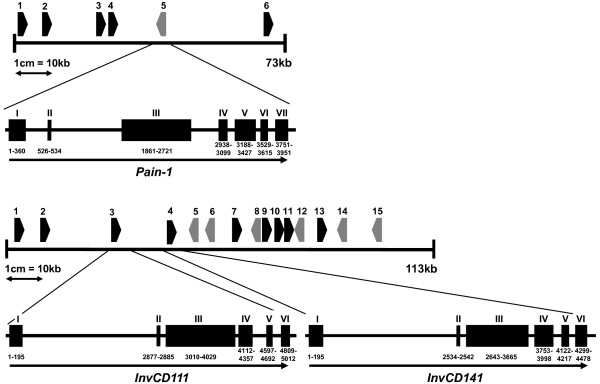
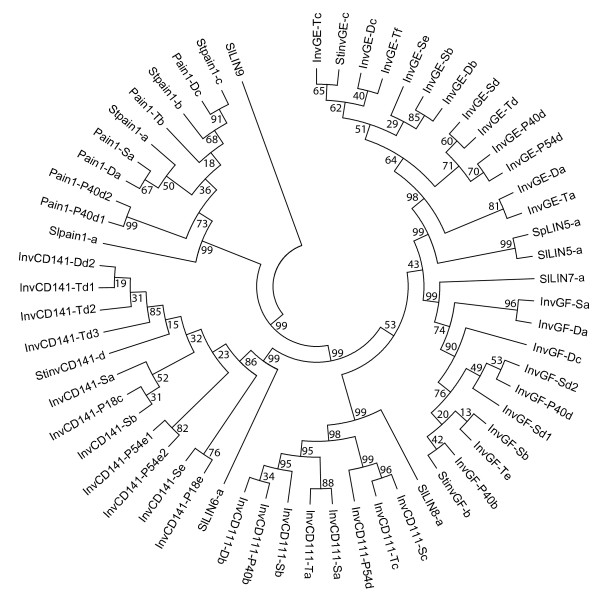
BACKGROUND: Invertases are ubiquitous enzymes that irreversibly cleave sucrose into fructose and glucose. Plant invertases play important roles in carbohydrate metabolism, plant development, and biotic and abiotic stress responses. In potato (Solanum tuberosum), invertases are involved in 'cold-induced sweetening' of tubers, an adaptive response to cold stress, which negatively affects the quality of potato chips and French fries. Linkage and association studies have identified quantitative trait loci (QTL) for tuber sugar content and chip quality that colocalize with three independent potato invertase loci, which together encode five invertase genes. The role of natural allelic variation of these genes in controlling the variation of tuber sugar content in different genotypes is unknown. RESULTS: For functional studies on natural variants of five potato invertase genes we cloned and sequenced 193 full-length cDNAs from six heterozygous individuals (three tetraploid and three diploid). Eleven, thirteen, ten, twelve and nine different cDNA alleles were obtained for the genes Pain-1, InvGE, InvGF, InvCD141 and InvCD111, respectively. Allelic cDNA sequences differed from each other by 4 to 9%, and most were genotype specific. Additional variation was identified by single nucleotide polymorphism (SNP) analysis in an association-mapping population of 219 tetraploid individuals. Haplotype modeling revealed two to three major haplotypes besides a larger number of minor frequency haplotypes. cDNA alleles associated with chip quality, tuber starch content and starch yield were identified. CONCLUSIONS: Very high natural allelic variation was uncovered in a set of five potato invertase genes. This variability is a consequence of the cultivated potato's reproductive biology. Some of the structural variation found might underlie functional variation that influences important agronomic traits such as tuber sugar content. The associations found between specific invertase alleles and chip quality, tuber starch content and starch yield will facilitate the selection of superior potato genotypes in breeding programs.
Overview
The claims and statistics of this paper haven’t been checked yet.
Run the check — free, no account needed. It reads the open-access text and checks the sources it cites.
Integrity signals
Registry
Cites
Statistics
Figures
Verification
Claims the paper makes
The claims and statistics of this paper haven’t been checked yet.
Run the check — free, no account needed. It reads the open-access text and checks the sources it cites.
Claims other papers make about this one
Each is checked against this paper’s own text: does it say what the citing paper says it does?
The cited source says what the claim attributes to it.
In the citing paper
“Previous studies also demonstrated that invertase might influence the starch content of storage organs (Tang et al., 1999; Draffehn et al., 2010; Li et al., 2013).”
From Comparative Transcriptome Analysis Reveals Critical Function of Sucrose Metabolism Related-Enzymes in Starch Accumulation in the Storage Root of Sweet Potato (2017) · cites this paper as Draffehn et al., 2010
Self-check
Percentages, sums and reported differences re-computed from the paper’s own numbers.
The self-check needs the paper’s full text.
Citations
Cites
Molecular Cloning: A Laboratory Manual
Sambrook, J., Fritsch, E., & Maniatis, T. (1989) · UCLA - Biblioteca de Ciencias de la Salud · Cited by 133,589
DNA sequencing with chain-terminating inhibitors
Sanger, F., Nicklen, S., & Coulson, A. R. (1977) · Proceedings of the National Academy of Sciences · doi:10.1073/pnas.74.12.5463 · Cited by 68,572
Clustal W and Clustal X version 2.0
Larkin, M., Blackshields, G., Brown, N. P., Chenna, R., McGettigan, P., McWilliam, H., Valentin, F., Wallace, I. M., Wilm, A., López, R., et al. (2007) · Bioinformatics · doi:10.1093/bioinformatics/btm404 · Cited by 28,742
MEGA4: Molecular Evolutionary Genetics Analysis (MEGA) Software Version 4.0
Tamura, K., Dudley, J. T., Nei, M., & Kumar, S. (2007) · Molecular Biology and Evolution · doi:10.1093/molbev/msm092 · Cited by 28,734
Studies on transformation of Escherichia coli with plasmids
Hanahan, D. (1983) · Journal of Molecular Biology · doi:10.1016/s0022-2836(83)80284-8 · Cited by 11,194
Genome sequencing in microfabricated high-density picolitre reactors
Margulies, M., Egholm, M., Altman, W. E., Attiya, S., Bader, J. S., Bemben, L. A., Berka, J., Braverman, M. S., Chen, Y.-J., Chen, Z., et al. (2005) · Nature · doi:10.1038/nature03959 · Cited by 7,693
Ashburner, M. (1989) · Cold Spring Harbor Laboratory eBooks · Cited by 6,756
Orita, M., Suzuki, Y., Sekiya, T., & Hayashi, K. (1989) · Genomics · doi:10.1016/0888-7543(89)90129-8 · Cited by 3,419
Genome-wide association studies for common diseases and complex traits
Hirschhorn, J. N., & Daly, M. J. (2005) · Nature Reviews Genetics · doi:10.1038/nrg1521 · Cited by 2,933
Real-Time DNA Sequencing Using Detection of Pyrophosphate Release
Ronaghi, M., Karamohamed, S., Pettersson, B., Uhlén, M., & Nyrén, P. (1996) · Analytical Biochemistry · doi:10.1006/abio.1996.0432 · Cited by 1,173
Research works printed but not linked: 2
- Müller-Thurgau H: Über Zuckeranhäufung in Pflanzentheilen in Folge niederer Temperatur. Landwirtsch Jahrb 11. 1882, 751-828.
- Habib A, Brown HD: The role of reducing sugars and amino acids in browning of potato chips. Food Technol. 1957, 11: 85-89.
Cited by
Improving cold storage and processing traits in potato through targeted gene knockout
Clasen, B. M., Stoddard, T., Luo, S. J., Demorest, Z. L., Li, J., Cédrone, F., Tibebu, R., Davison, S., Ray, E. E., Daulhac, A., et al. (2015) · Plant Biotechnology Journal · doi:10.1111/pbi.12370 · Cited by 414
A review on invertase: Its potentials and applications
Manoochehri, H., Hosseini, N. F., Saidijam, M., Taheri, M., Rezaee, H., & Nouri, F. (2020) · Biocatalysis and Agricultural Biotechnology · doi:10.1016/j.bcab.2020.101599 · Cited by 129
McKenzie, M. J., Chen, R., Harris, J. C., Ashworth, M., & Brummell, D. A. (2012) · Plant Cell & Environment · doi:10.1111/j.1365-3040.2012.02565.x · Cited by 97
Zhang, K., Wu, Z., Tang, D., Luo, K., Lu, H., Liu, Y., Dong, J., Wang, X., Lv, C., Wang, J., et al. (2017) · Frontiers in Plant Science · doi:10.3389/fpls.2017.00914 · Cited by 88
Li, L., Tacke, E., Hofferbert, H.-R., Lübeck, J., Strahwald, J., Draffehn, A. M., Walkemeier, B., & Gebhardt, C. (2013) · Theoretical and Applied Genetics · doi:10.1007/s00122-012-2035-z · Cited by 83
Self-citation
Metadata
- Authors
- Draffehn, A. M., Meller, S., Li, L., & Gebhardt, C.
- Affiliations
- Max Planck Institute for Plant Breeding Research (DE)
- Corresponding author
- Gebhardt, Christiane
- Venue
- BMC Plant Biology
- Published
- 2010-12
- Volume
- 10
- Issue
- 1
- Pages
- 271-271
- ISSN
- 1471-2229 (ISSN-L)
- PMC
- PMC3012049
- OpenAlex
- W2084920272
- Cited by
- 63
- References
- 55
- Citations by year
- 2025: 3 · 2024: 4 · 2023: 3 · 2022: 5 · 2021: 4 · 2020: 5 · 2019: 6 · 2018: 4 · 2017: 5 · 2016: 1 · 2015: 5 · 2014: 5 · 2013: 8 · 2012: 2
- FWCI
- 2.34
- Type
- journal article
- Language
- en
- Open access
- gold
- doi.org
- Locations
- BMC Plant Biology (publishedVersion, cc-by)
- PubMed Central (publishedVersion, cc-by)
- PubMed (publishedVersion)
- DOAJ (DOAJ: Directory of Open Access Journals) (submittedVersion)
- Max Planck Institute for Plasma Physics (submittedVersion)
- Max Planck Digital Library (submittedVersion, other-oa)
- MPG.PuRe (Max Planck Society) (submittedVersion, other-oa)
- Topics
- Life Sciences › Biochemistry, Genetics and Molecular Biology › Genetics › Genetic Mapping and Diversity in Plants and Animals
- Life Sciences › Agricultural and Biological Sciences › Food Science › Potato Plant Research
- Life Sciences › Agricultural and Biological Sciences › Plant Science › Genetics and Plant Breeding
- Keywords
- potato, cold-induced sweetening, chip quality, starch yield, haplotype structure, single nucleotide polymorphisms, tetraploid potato, quantitative trait loci, carbohydrate metabolism
- MeSH terms
- Alleles, Amino Acid Sequence, Chromosome Mapping, Multigene Family, Genotype, Haplotypes, Isoenzymes, Molecular Sequence Data, Phenotype, Phylogeny, Plant Proteins, Solanum tuberosum, Genetic Variation, Genomic Library, Sequence Homology, Amino Acid, Sequence Analysis, DNA, Polymorphism, Single Nucleotide, Chromosomes, Plant, beta-Fructofuranosidase
About these checks
Registry, retraction, Cites and statistics results are computed, not judged, with one exception: a printed reference that no index lists is read once by a model before it counts as a citation error. Claims are extracted by a model and kept only when their quote appears verbatim in the text; each cited source is then checked, with a model’s help, for whether it says what the claim relies on. Those verdicts can be wrong — read the claim’s quote and the cited source before relying on one.
Statistics and arithmetic are recomputed, not judged.
Confidence bands are shown only for fields calibrated on our annotated test set. None is calibrated yet, so no band is shown.
What counts as a claim ›How we measure confidence ›How we check this ›
Are you an author, or do you see a problem with this page? Request a review
Data sources
Bibliographic data: Semantic Scholar, OpenAlex, Crossref.
Contains information from the Semantic Scholar Academic Graph Datasets, made available under the ODC Attribution License (ODC-BY 1.0).
Semantic Scholar’s data is described in: Kinney, R., et al. (2023). The Semantic Scholar Open Data Platform. arXiv:2301.10140.
