

Does an additional structured information program during the intensive care unit stay reduce anxiety in ICU patients?: A multicenter randomized controlled trial.
Open accessThe DOI matches its Crossref record; 60 of the 61 references it cites were found in a registry or an index.
Abstract
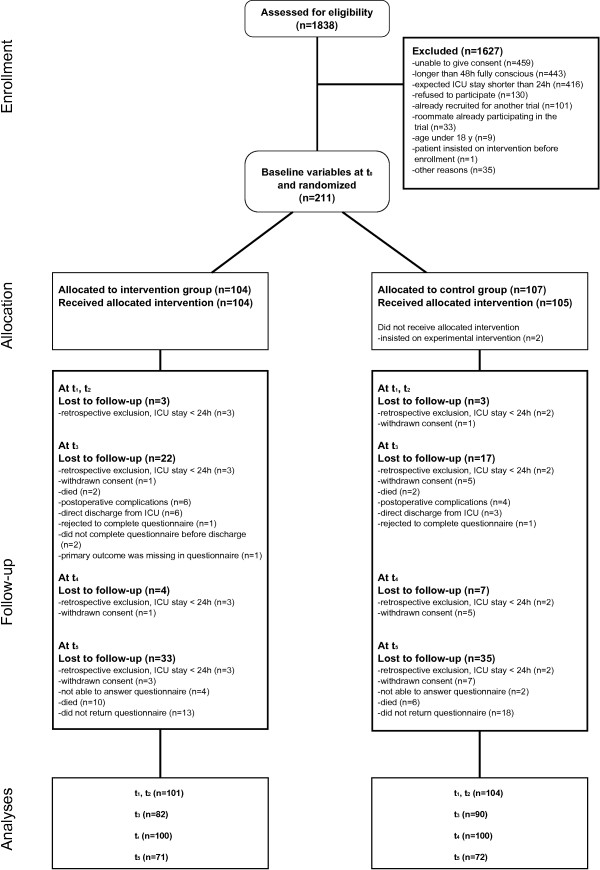
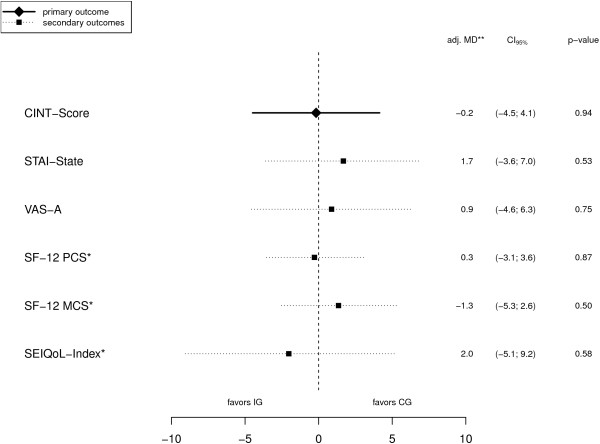
BACKGROUND: Communication and information in order to reduce anxiety in the intensive care unit (ICU) has been described as area needing improvement. Therefore, the aim of this trial was to evaluate whether a structured information program that intensifies information given in standard care process reduces anxiety in ICU patients. METHODS: Multicenter, two-armed, non-blinded, parallel-group randomized controlled trial in hospitals in the cities of Marburg, Halle, and Stuttgart (Germany). The trial was performed in cardiac surgery, general surgery, and internal medicine ICUs. Two-hundred and eleven elective and non-elective ICU patients were enrolled in the study (intervention group, n = 104; control group, n = 107). The experimental intervention comprised a single episode of structured oral information that was given in addition to standard care and covered two main parts: (1) A more standardized part about predefined ICU specific aspects - mainly procedural, sensory and coping information, and (2) an individualized part about fears and questions of the patient. The control group received a non-specific episodic conversation of similar length additional to standard care. Both conversations took place at the beginning of the ICU stay and lasted 10-15 minutes. Study nurses administered both interventions. The primary outcome ICU-related anxiety (CINT-Score, 0-100 pts., higher scores indicate higher anxiety) was assessed after admission to a regular ward. RESULTS: The primary outcome could be measured in 82 intervention group participants and 90 control group participants resulting in mean values of 20.4 (SD 14.4) compared to 20.8 (SD 14.7) and a mean difference of -0.2 (CI 95% -4.5 to 4.1). CONCLUSIONS: A structured information intervention additional to standard care during ICU stay had no demonstrated additional benefit compared to an unspecific communication of similar duration. Reduction of anxiety in ICU patients will probably require more continuous approaches to information giving and communication. TRIAL REGISTRATION: ClinicalTrials.gov NCT00764933.
Overview
The claims and statistics of this paper haven’t been checked yet.
Free: it reads the open-access text and checks the first 5 claims that cite a source we can check. Create a free account to check every claim.
Integrity signals
Registry
Cites
Statistics
Figures
Verification
Claims the paper makes
The claims and statistics of this paper haven’t been checked yet.
Free: it reads the open-access text and checks the first 5 claims that cite a source we can check. Create a free account to check every claim.
Claims other papers make about this one
Each is checked against this paper’s own text: does it say what the citing paper says it does?
The source backs part of the claim, not all of it — or backs it for a different population, condition or comparison.
In the citing paper
“ICU education did not appear to impact patients’ anxiety and depression [584, 586, 588], but did improve families’ satisfaction with care [583].”
From Surviving sepsis campaign: international guidelines for management of sepsis and septic shock 2021 (2021) · cites this paper as [586]
Experimental — accuracy not yet measuredThe cited source says what the claim attributes to it.
In the citing paper
“We identified six RCTs that evaluated educational interventions for critically ill patients and their families (583-588).”
From Surviving Sepsis Campaign: International Guidelines for Management of Sepsis and Septic Shock 2021. (2021) · cites this paper as [583]
The cited source says what the claim attributes to it.
In the citing paper
“We identified six RCTs that evaluated educational interventions for critically ill patients and their families [583–588].”
From Surviving sepsis campaign: international guidelines for management of sepsis and septic shock 2021 (2021) · cites this paper as [586]
The check wasn’t confident either way, so it gives no verdict — never disputed.
In the citing paper
“The incidence of DVT acquired in the ICU may be as high as 10% (497), the incidence of acquired PE may be 2%-4% (498, 499).”
From Surviving Sepsis Campaign: International Guidelines for Management of Sepsis and Septic Shock 2021. (2021) · cites this paper as [497]
Experimental — accuracy not yet measuredThe check wasn’t confident either way, so it gives no verdict — never disputed.
In the citing paper
“ICU education did not appear to impact patients' anxiety and depression (584, 586, 588), but did improve families' satisfaction with care (583).”
From Surviving Sepsis Campaign: International Guidelines for Management of Sepsis and Septic Shock 2021. (2021) · cites this paper as [583]
Experimental — accuracy not yet measured
Self-check
Percentages, sums and reported differences re-computed from the paper’s own numbers.
The self-check needs the paper’s full text.
Citations
Cites
R: A Language and Environment for Statistical Computing
R Core Team (2025) · doi:10.32614/r.manuals · Cited by 352,181
WARE, J. E., KOSINSKI, M., & KELLER, S. D. (1996) · Medical Care · doi:10.1097/00005650-199603000-00003 · Cited by 17,392
Moher, D., Hopewell, S., Schulz, K. F., Montori, V., Gotzsche, P. C., Devereaux, P. J., Elbourne, D., Egger, M., & Altman, D. G. (2010) · BMJ · doi:10.1136/bmj.c869 · Cited by 8,883
Le Gall, J.-R. (1993) · JAMA: The Journal of the American Medical Association · doi:10.1001/jama.270.24.2957 · Cited by 7,773 · cited 1×
“The measurement of the Therapeutic Intervention Scoring System (TISS 28) [55] and Simplified Acute Physiology Score (SAPS II) [56] at baseline indicate that our study population compares well to ICU patients in other studies.”
ResultNorman, G. R., Sloan, J. A., & Wyrwich, K. W. (2003) · Medical Care · doi:10.1097/01.mlr.0000062554.74615.4c · Cited by 4,700 · cited 1×
“On the notion that in QoL measures the differences within the scope of half a standard deviation are considered as noticeable [48] we determined a difference of 8.”
BackgroundSessler, C. N., Gosnell, M. S., Grap, M. J., Brophy, G. M., O'Neal, P. V., Keane, K. A., Tesoro, E. P., & Elswick, R. K. (2002) · American Journal of Respiratory and Critical Care Medicine · doi:10.1164/rccm.2107138 · Cited by 3,695 · cited 5×
“Abbreviations ANCOVA: Analysis of covariance; CAM-ICU: Confusion assessment method for the intensive care unit; CG: Control group; CINT: Fragebogen chirurgische intensivstation (questionnaire for surgical ICU patients); CINT-Score: Anxiety-related part of the CINT; FAS: Faces anxiety scale; ICU: Intensive care unit; I…”
MethodInfluentialStress and emotion: a new synthesis
(1999) · Choice Reviews Online · doi:10.5860/choice.37-1229 · Cited by 3,662
Ely, E. W., Inouye, S. K., Bernard, G. R., Gordon, S., Francis, J., May, L., Truman, B., Speroff, T., Gautam, S., Margolin, R., et al. (2001) · JAMA · doi:10.1001/jama.286.21.2703 · Cited by 3,210 · cited 10×
“In regard to the prevalence of acute confusion in the ICU assessed with the CAM-ICU (t0 through t2) a mixed effects logistic regression model (Generalized Linear Mixed Model with Penalized Quasi-Likelihood Estimation) using our basic model did not converge.”
MethodInfluentialEly, E. W., Margolin, R., Francis, J., May, L., Truman, B., Dittus, R., Speroff, T., Gautam, S., Bernard, G. R., & Inouye, S. K. (2001) · Critical Care Medicine · doi:10.1097/00003246-200107000-00012 · Cited by 2,422
Applied Mixed Models in Medicine
Brown, H., & Presco, R. (2000) · Technometrics · doi:10.1080/00401706.2000.10485742 · Cited by 1,262
Corticosteroid insufficiency in acutely ill patients
Cooper, M. S., & Stewart, P. M. (2003) · New England Journal of Medicine · doi:10.1056/nejmra020529 · Cited by 1,033
Das State-Trait-Angstinventar (STAI) : theoretische Grundlagen und Handanweisung
Laux, L. (1981) · Beltz eBooks · Cited by 750
Reis Miranda, D., de Rijk, A., & Schaufeli, W. (1996) · Critical Care Medicine · doi:10.1097/00003246-199601000-00012 · Cited by 666
Applied Mixed Models in Medicine
Brown, H., & Prescott, R. (2006) · Wiley eBooks · doi:10.1002/0470023589 · Cited by 560
Hickey, A. M., Bury, G., O'Boyle, C. A., Bradley, F., O'Kelly, F. D., & Shannon, W. (1996) · BMJ · doi:10.1136/bmj.313.7048.29 · Cited by 421
Patients' experiences of being in an intensive care unit: a select literature review
Stein-Parbury, J., & McKinley, S. (2000) · American Journal of Critical Care · doi:10.4037/ajcc2000.9.1.20 · Cited by 220
Disturbed memory and amnesia related to intensive care
Jones, C., Griffiths, R. D., & Humphris, G. (2000) · Memory · doi:10.1080/096582100387632 · Cited by 202
Communication with critically ill patients
Alshraideh, J. A., & Ahmad, M. M. (2005) · Journal of Advanced Nursing · doi:10.1111/j.1365-2648.2005.03400.x · Cited by 196
Experiences of critically ill patients in the ICU
Hofhuis, J. G. M., Spronk, P. E., van Stel, H. F., Schrijvers, A. J. P., Rommes, J. H., & Bakker, J. (2008) · Intensive and Critical Care Nursing · doi:10.1016/j.iccn.2008.03.004 · Cited by 187
Vileikytė, L. (2007) · Clinics in Dermatology · doi:10.1016/j.clindermatol.2006.09.005 · Cited by 177
Vulnerability and security in seriously ill patients in intensive care
McKinley, S., Nagy, S. A., Stein‐Parbury, J., Bramwell, M., & Hudson, J. (2002) · Intensive and Critical Care Nursing · doi:10.1054/iccn.2002.1611 · Cited by 154
Development and testing of a Faces Scale for the assessment of anxiety in critically ill patients
McKinley, S., Coote, K., & Stein‐Parbury, J. (2003) · Journal of Advanced Nursing · doi:10.1046/j.1365-2648.2003.02508.x · Cited by 153
Communication interaction in ICU—Patient and staff experiences and perceptions
Magnus, V. S., & Turkington, L. (2005) · Intensive and Critical Care Nursing · doi:10.1016/j.iccn.2005.09.009 · Cited by 147
The Measurement of Delirium: Review of Scales
Schuurmans, M. J., Deschamps, P. I., Markham, S. W., Shortridge‐Baggett, L. M., & Duursma, S. A. (2003) · Research and theory for nursing practice · doi:10.1891/rtnp.17.3.207.53186 · Cited by 131
Monika Bullinger und Inge Kirchberger “SF-36. Fragebogen zum Gesundheitszustand. Handanweisung.”
Franke, G. H. (1998) · Zeitschrift für Medizinische Psychologie · doi:10.3233/zmp-1998-7_4_08 · Cited by 130
Experiences of intensive care unit diaries: ‘touching a tender wound’
Engström, Å. H., Grip, K., & Hamrén, M. (2009) · Nursing in Critical Care · doi:10.1111/j.1478-5153.2008.00312.x · Cited by 118
Shuldham, C. (2002) · European Heart Journal · doi:10.1053/euhj.2001.2897 · Cited by 117
Managing anxiety in ICU patients: the role of pre‐operative information provision
Scott, A. (2004) · Nursing in Critical Care · doi:10.1111/j.1478-5153.2004.00053.x · Cited by 116
Nestel, D., & Kidd, J. M. (2006) · BMC Nursing · doi:10.1186/1472-6955-5-1 · Cited by 116
Assessment of Anxiety in Intensive Care Patients By Using the Faces Anxiety Scale
McKinley, S., Stein-Parbury, J., Chehelnabi, A., & Lovas, J. (2004) · American Journal of Critical Care · doi:10.4037/ajcc2004.13.2.146 · Cited by 113
Delirium in the intensive care unit: a review
Arend, E., & Christensen, M. (2009) · Nursing in Critical Care · doi:10.1111/j.1478-5153.2008.00324.x · Cited by 110
No short-cut in assessing trial quality: a case study
Hirji, K. F. (2009) · Trials · doi:10.1186/1745-6215-10-1 · Cited by 109
Research priorities of adult intensive care nurses in 20 European countries: a Delphi study
Blackwood, B., Albarran, J. W., & Latour, J. M. (2010) · Journal of Advanced Nursing · doi:10.1111/j.1365-2648.2010.05512.x · Cited by 86
Wojnicki-Johansson, G. (2001) · Intensive and Critical Care Nursing · doi:10.1054/iccn.2000.1547 · Cited by 83
Single-Item Graphic Representational Scales
Patrician, P. A. (2004) · Nursing Research · doi:10.1097/00006199-200409000-00011 · Cited by 80
Relationship between two anxiety instruments in patients receiving mechanical ventilatory support
Chlan, L. L. (2004) · Journal of Advanced Nursing · doi:10.1111/j.1365-2648.2004.03231.x · Cited by 79
McKinley, S., & Madronio, C. (2008) · Journal of Psychosomatic Research · doi:10.1016/j.jpsychores.2008.02.002 · Cited by 75
Evaluation of an interdisciplinary data set for national intensive care unit assessment
Metnitz, P., Vesely, H., Valentin, A., Popow, C., Hiesmayr, M., Lenz, K., Krenn, C. G., & Steltzer, H. (1999) · Critical Care Medicine · doi:10.1097/00003246-199908000-00014 · Cited by 73
Qualitative analysis of patients’ intensive care experience during mechanical ventilation
Wang, K., Zhang, B., Li, C., & Wang, C. (2008) · Journal of Clinical Nursing · doi:10.1111/j.1365-2702.2008.02518.x · Cited by 72
Löf, L., Berggren, L., & Ahlström, G. (2007) · Intensive and Critical Care Nursing · doi:10.1016/j.iccn.2007.08.001 · Cited by 68
Schuster, H.-P., Schuster, F. P., Ritschel, P., Wilts, S., & Bodmann, K. ‐. (1997) · Intensive Care Medicine · doi:10.1007/s001340050456 · Cited by 56
Samuelson, K. A. M., LUNDBERG, D., & Fridlund, B. (2008) · Acta Anaesthesiologica Scandinavica · doi:10.1111/j.1399-6576.2008.01702.x · Cited by 53
Nurse-patient interaction in the intensive care unit.
Salyer, J. W., & Stuart, B. (1985) · PubMed · Cited by 50
McCauley, K. M., & Irwin, R. S. (2006) · American Journal of Critical Care · doi:10.4037/ajcc2006.15.6.541 · Cited by 46
Nurse-patient communication in the intensive care unit: a review of the literature
Llenore, E., & Ogle, K. R. (1999) · Australian Critical Care · doi:10.1016/s1036-7314(99)70599-0 · Cited by 44
Performance of the faces anxiety scale in patients transferred from the ICU
Gustad, L. T., Chaboyer, W. P., & Wallis, M. C. (2005) · Intensive and Critical Care Nursing · doi:10.1016/j.iccn.2005.06.006 · Cited by 37
Impaired Verbal Communication During Short‐Term Oral Intubation
Fowler, S. A. (1997) · International Journal of Nursing Terminologies and Classifications · doi:10.1111/j.1744-618x.1997.tb00317.x · Cited by 31
Hubert, W., Möller, M., & Nieschlag, E. (2008) · Hormone Research · doi:10.1159/000181289 · Cited by 28
The impact of pre-operative education on recovery following coronary artery bypass surgery.
Shuldham, C. (2000) · Europe PMC (PubMed Central) · Cited by 28
Communicating with patients in ICU
Turnock, C. (1991) · Nursing Standard · doi:10.7748/ns.5.16.38.s37 · Cited by 25
Nurse—patient communication in intensive care: a low priority?
Hagland, M. R. (1995) · Intensive and Critical Care Nursing · doi:10.1016/s0964-3397(95)82022-1 · Cited by 23
Berg, A., Fleischer, S., Koller, M. T., & Neubert, T. R. (2006) · BMC Nursing · doi:10.1186/1472-6955-5-4 · Cited by 22
Self-citationMagnus, V. S., & Turkington, L. (2008) · Intensive and Critical Care Nursing · doi:10.1016/j.iccn.2008.03.003 · Cited by 20
A study of nurse-patient interaction in a high dependency unit
Rundell, S. (1991) · Intensive Care Nursing · doi:10.1016/0266-612x(91)90006-d · Cited by 19
Hwang, S.-L., Chang, Y., Ko, W., & Lee, M. (1998) · PubMed · Cited by 18
Bohrer, T., Koller, M. T., Neubert, T., Moldzio, A., Beaujean, O., Hellinger, A., Lorenz, W., & Rothmund, Μ. (2002) · Der Chirurg · doi:10.1007/s00104-002-0471-z · Cited by 14
Self-citationAgha, A., Bein, T., Fröhlich, D., Höfler, S., Krenz, D., & Jauch, K. ‐. (2002) · Der Chirurg · doi:10.1007/s00104-001-0374-4 · Cited by 12
Fleischer, S., Berg, A., Neubert, T. R., Koller, M. T., Behrens, J., Becker, R., Horbach, A., Radke, J., Rothmund, M., & Kuß, O. (2009) · Trials · doi:10.1186/1745-6215-10-84 · Cited by 9
Self-citationIncidence and prevalence of acute confusion following CAVB or replacement of a heart valve
Osterbrink, J., Mayer, Fiedler, Ewers, Haslbeck, J. W., Wirth, Wordel, Hannich, McDonough, Krian, et al. (2002) · Pflege · doi:10.1024/1012-5302.15.4.178 · Cited by 5
Wie erleben Patienten den Aufenthalt auf einer chirurgischen Intensivstation?
Neubert, T. R., Bohrer, T., & Koller, M. T. (2004) · intensiv · doi:10.1055/s-2004-813067 · Cited by 5
Self-citation
Research works printed but not linked: 6
- National Institute for Health and Care Excellence Acutely Ill Patients in Hospital. Recognition of and Response to Acute Illness in Adults in Hospital CG50 2007 London: National Institute for Health and Care Excellence 6
- Ely EW Truman B The Confusion Assessment Method for the ICU (CAM-ICU). Training Manual 2002 Nashville, TN: MPH and Vanderbilt University 1 12
- Berg A Fleischer S Neubert TR Koller M Entwicklung und Pretest eines Programms mit spezifischen Informationen zum Intensivstationsaufenthalt Hallesche Beiträge zu den Gesundheits- und Pflegewissenschaften 2004 3 3 18 20
- Bullinger M Kirchberger I SF-36: Fragebogen zum Gesundheitszustand: Handanweisung 1998 Göttingen: Hogrefe 65 73
- Becker R Berg A Fleischer S Neubert TR Messung patientengenerierter Lebensqualität mittels schriftlicher Befragung. Entwicklung und erste Ergebnisse in der schriftlichen Anwendung des SEIQoL Hallesche Beiträge zu den Gesundheits- und Pflegewissenschaften 2009 8 4 1 15
- Lauritsen JM EpiData Data Entry, Data Management and Basic Statistical Analysis System 2008 Odense: EpiData Association
Cited by
Surviving sepsis campaign: international guidelines for management of sepsis and septic shock 2021
Evans, L., Rhodes, A., Alhazzani, W., Antonelli, M., Coopersmith, C. M., French, C., Machado, F. R., Mcintyre, L., Ostermann, M., Prescott, H. C., et al. (2021) · Intensive Care Medicine · doi:10.1007/s00134-021-06506-y · Cited by 5,082
Surviving Sepsis Campaign: International Guidelines for Management of Sepsis and Septic Shock 2021.
Evans, L., Rhodes, A., Alhazzani, W., Antonelli, M., Coopersmith, C. M., French, C., Machado, F. R., Mcintyre, L., Ostermann, M., Prescott, H. C., et al. (2021) · Critical Care Medicine · doi:10.1097/ccm.0000000000005337 · Cited by 2,935
Post-intensive care syndrome (PICS): recent updates
Hiser, S. L., Fatima, A., Ali, M., & Needham, D. M. (2023) · Journal of Intensive Care · doi:10.1186/s40560-023-00670-7 · Cited by 275
Geense, W. W., van den Boogaard, M., van der Hoeven, J. G., Vermeulen, H., Hannink, G., & Zegers, M. (2019) · Critical Care Medicine · doi:10.1097/ccm.0000000000003974 · Cited by 133
Information or education interventions for adult intensive care unit (ICU) patients and their carers
Lewis, S. R., Pritchard, M., Schofield-Robinson, O. J., Evans, D. J., Alderson, P., & Smith, A. F. (2018) · Cochrane Database of Systematic Reviews · doi:10.1002/14651858.cd012471.pub2 · Cited by 50
Metadata
- Authors
- Fleischer, S., Berg, A., Behrens, J., Kuss, O., Becker, R., Horbach, A., & Neubert, T. R.
- Affiliations
- Martin Luther University Halle-Wittenberg (DE)
- München Klinik (DE)
- Frankfurt University of Applied Sciences (DE)
- Universitätsklinikum Gießen und Marburg (DE)
- Corresponding author
- Fleischer, Steffen
- Venue
- BMC Anesthesiology
- Published
- 2014-06-28
- Volume
- 14
- Issue
- 1
- Pages
- 48-48
- ISSN
- 1471-2253 (ISSN-L)
- PMC
- PMC4113490
- OpenAlex
- W2157832096
- Semantic Scholar
- 33b0d4bfa5f99fac058c7ae47da0758798b3de1d
- Cited by
- 30
- References
- 61
- Citations by year
- 2026: 4 · 2025: 4 · 2024: 4 · 2023: 3 · 2022: 1 · 2021: 3 · 2020: 2 · 2019: 1 · 2018: 4 · 2017: 1 · 2016: 2 · 2015: 1
- FWCI
- 2.82
- Type
- journal article
- Language
- en
- Open access
- gold
- doi.org
- Licence
- Locations
- BMC Anesthesiology (publishedVersion, cc-by)
- Europe PMC (PubMed Central) (publishedVersion, cc-by)
- PubMed Central (publishedVersion, cc-by)
- PubMed (publishedVersion)
- Funders
- Bundesministerium für Bildung und Forschung (01GT0603, 01GT0601)
- Topics
- Health Sciences › Medicine › Critical Care and Intensive Care Medicine › Family and Patient Care in Intensive Care Units
- Health Sciences › Medicine › Critical Care and Intensive Care Medicine › Intensive Care Unit Cognitive Disorders
- Social Sciences › Psychology › Social Psychology › Music Therapy and Health
- Keywords
- intensive care unit patients, patient information, nurse-patient communication, procedural information, sensory input
- MeSH terms
- Aged, Anxiety, Communication, Critical Care, Female, Follow-Up Studies, Germany, Humans, Intensive Care Units, Male, Middle Aged, Patient Education as Topic, Prospective Studies
About these checks
Registry, retraction, Cites and statistics results are computed, not judged, with one exception: a printed reference that no index lists is read once by a model before it counts as a citation error. Claims are extracted by a model and kept only when their quote appears verbatim in the text; each cited source is then checked, with a model’s help, for whether it says what the claim relies on. Those verdicts can be wrong — read the claim’s quote and the cited source before relying on one.
Statistics and arithmetic are recomputed, not judged.
Confidence bands are shown only for fields calibrated on our annotated test set. None is calibrated yet, so no band is shown.
What counts as a claim ›How we measure confidence ›How we check this ›
Are you an author, or do you see a problem with this page? Request a review
Data sources
Bibliographic data: Semantic Scholar, OpenAlex, Crossref.
Contains information from the Semantic Scholar Academic Graph Datasets, made available under the ODC Attribution License (ODC-BY 1.0).
Semantic Scholar’s data is described in: Kinney, R., et al. (2023). The Semantic Scholar Open Data Platform. arXiv:2301.10140.
