

The DOI matches its Crossref record; 75 of the 75 references it cites were found in a registry or an index.
“Best fit” framework synthesis: refining the method
Open accessAbstract
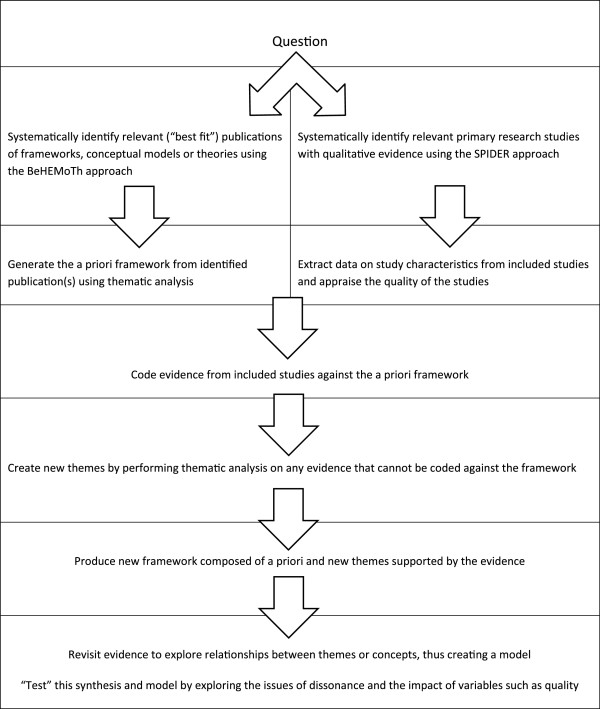
BACKGROUND: Following publication of the first worked example of the "best fit" method of evidence synthesis for the systematic review of qualitative evidence in this journal, the originators of the method identified a need to specify more fully some aspects of this particular derivative of framework synthesis. METHODS AND RESULTS: We therefore present a second such worked example in which all techniques are defined and explained, and their appropriateness is assessed. Specified features of the method include the development of new techniques to identify theories in a systematic manner; the creation of an a priori framework for the synthesis; and the "testing" of the synthesis. An innovative combination of existing methods of quality assessment, analysis and synthesis is used to complete the process. This second worked example was a qualitative evidence synthesis of employees' views of workplace smoking cessation interventions, in which the "best fit" method was found to be practical and fit for purpose. CONCLUSIONS: The method is suited to producing context-specific conceptual models for describing or explaining the decision-making and health behaviours of patients and other groups. It offers a pragmatic means of conducting rapid qualitative evidence synthesis and generating programme theories relating to intervention effectiveness, which might be of relevance both to researchers and policy-makers.
Overview
The claims and statistics of this paper haven’t been checked yet.
Run the check — free, no account needed. It reads the open-access text and checks the sources it cites.
Integrity signals
Registry
Cites
Statistics
Figures
Verification
Claims the paper makes
The claims and statistics of this paper haven’t been checked yet.
Run the check — free, no account needed. It reads the open-access text and checks the sources it cites.
Claims other papers make about this one
Each is checked against this paper’s own text: does it say what the citing paper says it does?
In the citing paper
“While the analysis utilized a priori concepts and their definitions, new themes were also created inductively where data were not accommodated by the framework to avoid forcing data into prescribed categories [21].”
From Towards defining quality in home care for persons living with dementia (2022) · cites this paper as [21]
Self-check
Percentages, sums and reported differences re-computed from the paper’s own numbers.
The self-check needs the paper’s full text.
Citations
Cites
The theory of planned behavior
Ajzen, I. (1991) · Organizational Behavior and Human Decision Processes · doi:10.1016/0749-5978(91)90020-t · Cited by 90,587
Qualitative Data Analysis: An Expanded Sourcebook
(1994) · Journal of Environmental Psychology · doi:10.1016/s0272-4944(05)80231-2 · Cited by 48,420
Methods for the thematic synthesis of qualitative research in systematic reviews
Thomas, J., & Harden, A. (2008) · BMC Medical Research Methodology · doi:10.1186/1471-2288-8-45 · Cited by 9,312
The Transtheoretical Model of Health Behavior Change.
Prochaska, J. O., & Velicer, W. F. (1997) · American Journal of Health Promotion · doi:10.4278/0890-1171-12.1.38 · Cited by 7,782
Health behavior and health education
(1990) · Choice Reviews Online · doi:10.5860/choice.28-2173 · Cited by 2,919
The Significance of Saturation
Morse, J. M. (1995) · Qualitative Health Research · doi:10.1177/104973239500500201 · Cited by 2,663
Beyond PICO: The SPIDER Tool for Qualitative Evidence Synthesis
Cooke, A., Smith, D., & Booth, A. (2012) · Qualitative Health Research · doi:10.1177/1049732312452938 · Cited by 2,608
Self-citationMethods for the synthesis of qualitative research: a critical review
Barnett-Page, E., & Thomas, J. (2009) · BMC Medical Research Methodology · doi:10.1186/1471-2288-9-59 · Cited by 2,386
Why People Use Health Services
Rosenstock, I. M. (2005) · Milbank Quarterly · doi:10.1111/j.1468-0009.2005.00425.x · Cited by 2,329
Why People Use Health Services
Rosenstock, I. M. (1966) · The Milbank Memorial Fund Quarterly · doi:10.2307/3348967 · Cited by 2,305
Research works printed but not linked: 3
- Garside R, Pearson M, Moxham T, Anderson R: Providing Public Information to Prevent Skin Cancer. Review 2. Barriers and Facilitators to Conveying Information to Prevent First Occurrence of Skin Cancer: a Systematic Review of Qualitative Research. 2009, London: National Institute for Health and Clinical Excellence
- Fishwick D, McGregor M, Drury M, Webster J, Rick J, Carroll C: BOHRF smoking cessation review. HuSU/12/17. Health & Safety Laboratory. 2012, Available at: http://www.bohrf.org.uk/downloads/BOHRF_Smoking_Cessation_Review-April%202012.pdf
- Grayson L, Gomersall A: A Difficult Business: Finding the Evidence for Social Science Reviews. Working Paper 19. 2003, London: Economic and Social Research Council, UK Centre for Evidence Based Policy and Practice
Cited by
Sorted by citations
Guidance on Conducting a Systematic Literature Review
Xiao, Y., & Watson, M. (2019) · Journal of Planning Education and Research · doi:10.1177/0739456x17723971 · Cited by 3,467
Houghton, C., Meskell, P., Delaney, H., Smalle, M., Glenton, C., Booth, A., Chan, X. H. S., Devane, D., & Biesty, L. (2020) · Cochrane Database of Systematic Reviews · doi:10.1002/14651858.cd013582 · Cited by 737
Meeting the review family: exploring review types and associated information retrieval requirements
Sutton, A., Clowes, M., Preston, L., & Booth, A. (2019) · Health Information & Libraries Journal · doi:10.1111/hir.12276 · Cited by 570
Noyes, J., Booth, A., Flemming, K., Garside, R., Harden, A., Lewin, S., Pantoja, T., Hannes, K., Cargo, M., & Thomas, J. (2018) · Journal of Clinical Epidemiology · doi:10.1016/j.jclinepi.2017.06.020 · Cited by 480
Noyes, J., Booth, A., Moore, G., Flemming, K., Tunçalp, Ö., & Shakibazadeh, E. (2019) · BMJ Global Health · doi:10.1136/bmjgh-2018-000893 · Cited by 497
Metadata
- Authors
- Carroll, C., Booth, A., Leaviss, J., & Rick, J.
- Affiliations
- University of Sheffield (GB)
- University of Manchester (GB)
- Corresponding author
- Carroll, Christopher
- Venue
- BMC Medical Research Methodology
- Published
- 2013-03-13
- Volume
- 13
- Issue
- 1
- Pages
- 37-37
- ISSN
- 1471-2288 (ISSN-L)
- PMC
- PMC3618126
- OpenAlex
- W2168814190
- Cited by
- 649
- References
- 74
- Citations by year
- 2026: 100 · 2025: 63 · 2024: 81 · 2023: 93 · 2022: 60 · 2021: 83 · 2020: 57 · 2019: 25 · 2018: 24 · 2017: 28 · 2016: 22 · 2015: 9 · 2014: 3 · 2013: 1
- FWCI
- 2.39
- Type
- journal article
- Language
- en
- Open access
- gold
- doi.org
- Licence
- Locations
- BMC Medical Research Methodology (publishedVersion, cc-by)
- Europe PMC (PubMed Central) (publishedVersion, cc-by)
- PubMed Central (publishedVersion, cc-by)
- PubMed (publishedVersion)
- White Rose Research Online (University of Leeds, The University of Sheffield, University of York) (acceptedVersion)
- Research Explorer (The University of Manchester) (submittedVersion)
- Funders
- British Occupational Health Research Foundation
- Topics
- Social Sciences › Decision Sciences › Statistics, Probability and Uncertainty › Meta-analysis and systematic reviews
- Social Sciences › Education › Qualitative Research Methods and Applications
- Health Sciences › Health Professions › General Health Professions › Health Policy Implementation Science
- Keywords
- framework synthesis, qualitative evidence synthesis, program theory, intervention effectiveness, conceptual model, health behavior
- MeSH terms
- Decision Making, Health Promotion, Humans, Models, Theoretical, Research Design, Health Behavior, Evidence-Based Medicine, Benchmarking, Qualitative Research
About these checks
Registry, retraction, Cites and statistics results are computed, not judged, with one exception: a printed reference that no index lists is read once by a model before it counts as a citation error. Claims are extracted by a model and kept only when their quote appears verbatim in the text; each cited source is then checked, with a model’s help, for whether it says what the claim relies on. Those verdicts can be wrong — read the claim’s quote and the cited source before relying on one.
Statistics and arithmetic are recomputed, not judged.
Confidence bands are shown only for fields calibrated on our annotated test set. None is calibrated yet, so no band is shown.
What counts as a claim ›How we measure confidence ›How we check this ›
Are you an author, or do you see a problem with this page? Request a review
