

Methods for the thematic synthesis of qualitative research in systematic reviews
Open accessThe DOI matches its Crossref record; 60 of the 64 references it cites were found in a registry or an index; 3 of the 48 sources its claims cite were checked for support.
Abstract
BACKGROUND: There is a growing recognition of the value of synthesising qualitative research in the evidence base in order to facilitate effective and appropriate health care. In response to this, methods for undertaking these syntheses are currently being developed. Thematic analysis is a method that is often used to analyse data in primary qualitative research. This paper reports on the use of this type of analysis in systematic reviews to bring together and integrate the findings of multiple qualitative studies. METHODS: We describe thematic synthesis, outline several steps for its conduct and illustrate the process and outcome of this approach using a completed review of health promotion research. Thematic synthesis has three stages: the coding of text 'line-by-line'; the development of 'descriptive themes'; and the generation of 'analytical themes'. While the development of descriptive themes remains 'close' to the primary studies, the analytical themes represent a stage of interpretation whereby the reviewers 'go beyond' the primary studies and generate new interpretive constructs, explanations or hypotheses. The use of computer software can facilitate this method of synthesis; detailed guidance is given on how this can be achieved. RESULTS: We used thematic synthesis to combine the studies of children's views and identified key themes to explore in the intervention studies. Most interventions were based in school and often combined learning about health benefits with 'hands-on' experience. The studies of children's views suggested that fruit and vegetables should be treated in different ways, and that messages should not focus on health warnings. Interventions that were in line with these suggestions tended to be more effective. Thematic synthesis enabled us to stay 'close' to the results of the primary studies, synthesising them in a transparent way, and facilitating the explicit production of new concepts and hypotheses. CONCLUSION: We compare thematic synthesis to other methods for the synthesis of qualitative research, discussing issues of context and rigour. Thematic synthesis is presented as a tried and tested method that preserves an explicit and transparent link between conclusions and the text of primary studies; as such it preserves principles that have traditionally been important to systematic reviewing.
Overview
CoChat Summary
TL;DR
This paper describes thematic synthesis, a three-stage method for integrating qualitative findings in systematic reviews: line-by-line coding, descriptive themes, and analytical themes. It illustrates the method with a review of children’s views on healthy eating and argues it preserves transparency while enabling new interpretive constructs.
Key findings
- Thematic synthesis has three overlapping stages: free line-by-line coding, development of descriptive themes, and generation of analytical themes; descriptive themes remain close to primary studies, while analytical themes go beyond them.
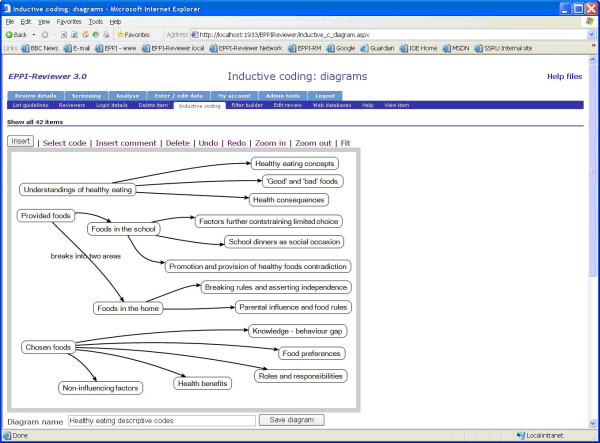
- In the example review, eight relevant qualitative studies yielded 36 initial codes, 12 descriptive themes, six analytical themes, and ten intervention recommendations.
- Six main issues emerged from children’s views: children do not see it as their role to be interested in health; future-health messages are not personally relevant or credible; fruit, vegetables and confectionery have different meanings; children seek food choices; eating is valued as a social occasion; and children see contradictions between promoted theory and adult practice.
- Most interventions were school-based and combined health-benefit learning with hands-on experience; interventions aligned with children’s views tended to be more effective, while multi-component physical activity plus healthy eating interventions worked less well than healthy-eating-only ones.
Methods
- Methodological paper describing thematic synthesis, illustrated with a completed systematic review of barriers to and facilitators of healthy eating among children aged four to 10 years.
- Searching involved extensive grey literature, author contact, and manual journal screening; quality was assessed using 12 criteria covering reporting, validity/reliability strategies, and appropriateness for children’s perspectives.
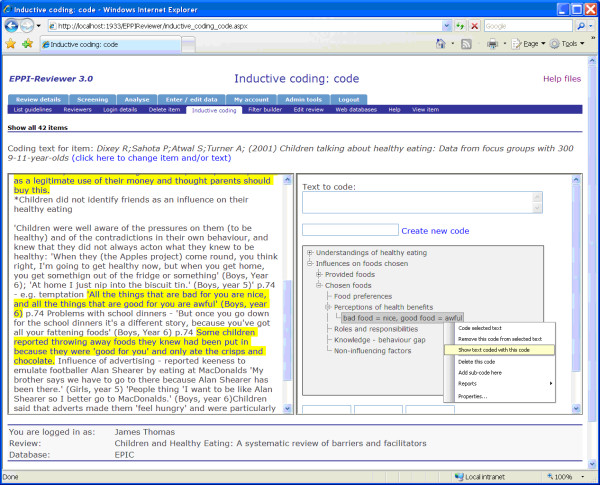
- Findings text labelled results/findings was entered verbatim into NVivo/EPPI-Reviewer; three reviewers independently coded line-by-line, grouped codes into descriptive themes, then generated analytical themes through group discussion and review questions.
Limitations
- Stated: contextual information in primary reports was very restricted, making it difficult to use context fully; there is little consensus on assessing qualitative quality and no accepted or empirically tested methods for excluding studies on quality, so all studies were included regardless of quality.
- Stated: the analytical-theme stage depends on reviewers’ judgement and insights and is potentially controversial; sensitivity analysis was done after synthesis by examining relative contributions of studies, finding poorer-quality studies contributed comparatively little and contained few unique themes.
- Evident: the method is illustrated with a single example review rather than compared empirically with other synthesis methods; the paper does not report a formal validation or inter-rater reliability for the synthesis.
Model-written summary. Check it against the paper before relying on it.
Integrity signals
Registry
Cites
Statistics
Figures
Verification
Claims the paper makes
3 Valid · 1 Not valid · 20 Not checked · 63 Own results and interpretations
A result the paper reports from its own data — it cites no other source for it, so there is none to check. The quote shows it is in the paper.
In the paper
“we found that there was very little difference in the methods we had to use to find qualitative studies compared to the methods we use when searching for studies for inclusion in a meta-analysis.”
§ Methods for the thematic synthesis of qualitative research in systematic reviews > Methods > Searching
plain- Asserted: passes — The authors put it forward as true.
- Checkable: passes — It can be checked against evidence.
- Load-bearing: unclear — It is unclear whether the paper’s conclusions depend on it.
- Based: passes — The paper gives a reason why it holds.
A result the paper states — it cites no source for it, so there is none to check. The quote shows it is in the paper.
In the paper
“Interventions that were in line with these suggestions tended to be more effective.”
§ Methods for the thematic synthesis of qualitative research in systematic reviews > Abstract > Results
hedgedstates an association- Asserted: passes — The authors put it forward as true.
- Checkable: passes — It can be checked against evidence.
- Load-bearing: passes — The paper’s conclusions depend on it.
- Based: passes — The paper gives a reason why it holds.
A result the paper states — it cites no source for it, so there is none to check. The quote shows it is in the paper.
In the paper
“In our review, it was not possible to rely on simple electronic searches of databases.”
§ Methods for the thematic synthesis of qualitative research in systematic reviews > Methods > Searching
plain- Asserted: passes — The authors put it forward as true.
- Checkable: passes — It can be checked against evidence.
- Load-bearing: unclear — It is unclear whether the paper’s conclusions depend on it.
- Based: passes — The paper gives a reason why it holds.
A result the paper reports from its own data — it cites no other source for it, so there is none to check. The quote shows it is in the paper.
In the paper
“In the event, we did not find any themes that belonged to a specific group, but another outcome of this process was a realisation that the contextual information given in the reports of studies was very restricted indeed.”
§ Methods for the thematic synthesis of qualitative research in systematic reviews > Discussion > Context and rigour in thematic synthesis
plain- Asserted: passes — The authors put it forward as true.
- Checkable: passes — It can be checked against evidence.
- Load-bearing: unclear — It is unclear whether the paper’s conclusions depend on it.
- Based: passes — The paper gives a reason why it holds.
A result the paper states — it cites no source for it, so there is none to check. The quote shows it is in the paper.
In the paper
“Interventions targeted at people with particular risk factors worked better than others, and multi-component interventions that combined the promotion of physical activity with healthy eating did not work as well as those that only concentrated on healthy eating.”
§ Methods for the thematic synthesis of qualitative research in systematic reviews > Results
plainstates a cause- Asserted: passes — The authors put it forward as true.
- Checkable: passes — It can be checked against evidence.
- Load-bearing: passes — The paper’s conclusions depend on it.
- Based: passes — The paper gives a reason why it holds.
25 more claims
Create a free account to see all 87 claims and to verify the 9 references still open.
- It may state two separate claims as one. 26
- Probably not a substantial claim. 45
Claims other papers make about this one
Each is checked against this paper’s own text: does it say what the citing paper says it does?
The source backs part of the claim, not all of it — or backs it for a different population, condition or comparison.
In the citing paper
“A thematic synthesis approach was used to integrate findings from studies with diverse methodological designs, following three key stages (Thomas & Harden, 2008).”
From Mind the gap: a systematic review of barriers, facilitators, and experiences of care transitions for people living with dementia and their informal caregivers. (2026) · cites this paper as Thomas & Harden, 2008
Experimental — accuracy not yet measuredThe source backs part of the claim, not all of it — or backs it for a different population, condition or comparison.
In the citing paper
“The thematic coding frame in Table 2 was applied to all included studies and reviewed for consistency of interpretation. This process, known as “axial coding,” ensured coded themes remained connected to and understood within the context of the source studies [13].”
From Patient-Perceived Factors Influencing Physical Activity Sensor Use in Stroke Prevention and Rehabilitation: Systematic Review of Qualitative Studies Using Thematic Synthesis (2026) · cites this paper as [13]
Experimental — accuracy not yet measuredThe source backs part of the claim, not all of it — or backs it for a different population, condition or comparison.
In the citing paper
“These data will be analysed following a three-step process. First, study data will be coded line by line by the first reviewer and checked by a second reviewer with a coding frame developed from codes derived from the data.”
From Effectiveness and acceptability of cognitive-behavioural therapy based interventions for maternal peripartum depression: A systematic review, meta-analysis and thematic synthesis protocol (2019) · cites this paper as [104]
Experimental — accuracy not yet measuredThe cited source says what the claim attributes to it.
In the citing paper
“The data coding, extraction and synthesis process was an iterative process, aligned with the thematic synthesis process outlined by Thomas 2008.”
From Health workers' perceptions and experiences of using mHealth technologies to deliver primary healthcare services: a qualitative evidence synthesis (2020) · cites this paper as Thomas 2008
The cited source says what the claim attributes to it.
In the citing paper
“To ensure the scientific reliability and trustworthiness of the findings, the qualitative analysis followed a thematic synthesis approach [25].”
From Sustainable Value Creation in Nonprofit Organizations: Processes, Determinants, and Strategic Dimensions (2026) · cites this paper as [25]
31 more claims about this paper
Create a free account to see every claim other papers make about this one.
Citations
Cites
Using thematic analysis in psychology
Braun, V., & Clarke, V. (2006) · Qualitative Research in Psychology · doi:10.1191/1478088706qp063oa · Cited by 194,414
(1997) · Cited by 4,204
Systematic reviews in the social sciences: a practical guide
(2006) · Choice Reviews Online · doi:10.5860/choice.43-5664 · Cited by 4,089
The Handbook of Research Synthesis.
Howel, D., Cooper, H., & Hedges, L. V. (1995) · Biometrics · doi:10.2307/2533295 · Cited by 3,642
Systematic Reviews in the Social Sciences: A Practical Guide
Petticrew, M., & Roberts, H. (2006) · doi:10.1002/9780470754887 · Cited by 3,586
Assessing the quality of controlled clinical trials
Jüni, P., Altman, D. G., & Egger, M. (2001) · BMJ · doi:10.1136/bmj.323.7303.42 · Cited by 3,309
Noblit, G., & Hare, R. (1988) · doi:10.4135/9781412985000 · Cited by 2,723
Qualitative Research: Rigour and qualitative research
Mays, N., & Pope, C. (1995) · BMJ · doi:10.1136/bmj.311.6997.109 · Cited by 2,715
Systematic Reviews in Health Care : Meta-Analysis in Context
Egger, M., Smith, G. D., & Altman, D. G. (2000) · Cited by 2,417
Dixon-Woods, M., Cavers, D., Agarwal, S., Annandale, E., Arthur, A., Harvey, J., Hsu, R., Katbamna, S., Olsen, R., Smith, L., et al. (2006) · BMC Medical Research Methodology · doi:10.1186/1471-2288-6-35 · Cited by 2,289
Research works printed but not linked: 9
- EPPI-Centre EPPI-Centre Methods for Conducting Systematic Reviews 2006 London: EPPI-Centre, Social Science Research Unit, Institute of Education, University of London
- Higgins J Green S (Eds) Cochrane Handbook for Systematic Reviews of Interventions 426 2006 Updated September 2006. Accessed 24th January 2007
- Sandelowski M Barroso J Handbook for Synthesising Qualitative Research 2007 New York: Springer
- Oakley A Experiments in Knowing: Gender and methods in the social sciences 2000 Cambridge: Polity Press
- Shepherd J Harden A Rees R Brunton G Oliver S Oakley A Young People and Healthy Eating: A systematic review of barriers and facilitators 2001 London: EPPI-Centre, Social Science Research Unit, Institute of Education, University of London
- Popay J Moving Beyond Effectiveness in Evidence Synthesis 2006 London: National Institute for Health and Clinical Excellence
- Boyatzis RE Transforming Qualitative Information 1998 Sage: Cleveland
- Medical Sociology Group Criteria for the evaluation of qualitative research papers Med Sociol News 1996 22 68 71
- Thomas J Brunton J EPPI-Reviewer 30: Analysis and management of data for research synthesis EPPI-Centre software 2006 London: EPPI-Centre, Social Science Research Unit, Institute of Education
Cited by
Items 2,501–2,600 of 9,166
Mansour, R., Naal, H., Kishawi, T., Achi, N. E., Hneiny, L., & Saleh, S. S. (2021) · Health Research Policy and Systems · doi:10.1186/s12961-021-00725-x · Cited by 28
Li, Y., Zhang, X., Su, J.-P., Li, H., Meng, X., Zhang, S., Fang, S., Wang, W., Bao, L., & Sun, J. (2021) · International Journal of Nursing Studies · doi:10.1016/j.ijnurstu.2021.104046 · Cited by 27
Miller, E. M., Porter, J. E., & Barbagallo, M. S. (2021) · HERD Health Environments Research & Design Journal · doi:10.1177/19375867211032931 · Cited by 33
Herrler, A., Kukla, H., Vennedey, V., & Stock, S. (2021) · European Journal of Ageing · doi:10.1007/s10433-021-00633-7 · Cited by 25
Rapid reviews as an emerging approach to evidence synthesis in education
Wollscheid, S., & Tripney, J. (2021) · London Review of Education · doi:10.14324/lre.19.1.32 · Cited by 37
Alhendyani, F., Jolly, K. B., & Jones, L. L. (2022) · PLoS ONE · doi:10.1371/journal.pone.0263234 · Cited by 27
Community views on mass drug administration for filariasis: a qualitative evidence synthesis
Taylor, M., Thomas, R., Oliver, S. R., & Garner, P. (2022) · Cochrane Database of Systematic Reviews · doi:10.1002/14651858.cd013638.pub2 · Cited by 35
Teaching Data Journalism: A Systematic Review
Bhaskaran, H., Kashyap, G., & Mishra, H. (2022) · Journalism Practice · doi:10.1080/17512786.2022.2044888 · Cited by 40
Naylor, J., Killingback, C., & Green, A. (2022) · Disability and Rehabilitation · doi:10.1080/09638288.2022.2055165 · Cited by 38
Zeng, Q., Ling, D., Chen, W., Liao, Y., An, R., & He, L. (2022) · Cancer Nursing · doi:10.1097/ncc.0000000000001096 · Cited by 32
Fear of relapse in schizophrenia: a mixed-methods systematic review
Zukowska, Z., Allan, S., Eisner, E., Ling, L., & Gumley, A. I. (2022) · Social Psychiatry and Psychiatric Epidemiology · doi:10.1007/s00127-022-02220-2 · Cited by 40
Project-Based Learning Methodology as a Promoter of Learning Math Concepts: A Scoping Review
Cruz, S., Viseu, F., & Lencastre, J. A. (2022) · Frontiers in Education · doi:10.3389/feduc.2022.953390 · Cited by 55
Brooke, J. M., Biernat, K., Shamaris, N., & Skerrett, V. (2022) · The Prison Journal · doi:10.1177/00328855221121097 · Cited by 32
Brown, S., Carter, G. J., Halliwell, G., Brown, K., Caswell, R. J., Howarth, E., Feder, G. S., & O’Doherty, L. (2022) · Cochrane Database of Systematic Reviews · doi:10.1002/14651858.cd013648.pub2 · Cited by 34
Patient experiences of codesigned rehabilitation interventions in hospitals: a rapid review
McKercher, J. P., Slade, S. C., Jazayeri, J. A., Hodge, A., Knight, M., Green, J., Woods, J. T., Thwaites, C. K., & Morris, M. E. (2022) · BMJ Open · doi:10.1136/bmjopen-2022-068241 · Cited by 30
Stigma towards leprosy across seven life domains in Indonesia: a qualitative systematic review
Marpaung, Y. M., Ernawati, E., & Dwivania, A. T. (2022) · BMJ Open · doi:10.1136/bmjopen-2022-062372 · Cited by 68
Napier-Raman, S., Hossain, S. Z., Lee, M., Mpofu, E., Liamputtong, P., & Dune, T. M. (2022) · Sexual Health · doi:10.1071/sh22081 · Cited by 26
In pursuit of mutual benefits in school-based citizen science: who wins what in a win-win situation?
Atias, O., Baram‐Tsabari, A., Kali, Y., & Shavit, A. (2023) · Instructional Science · doi:10.1007/s11251-022-09608-2 · Cited by 26
Mitchell, F., Walker, T., Hill, K., & Browne, J. (2023) · BMC Public Health · doi:10.1186/s12889-022-14709-1 · Cited by 29
Family grief during the COVID-19 pandemic: a meta-synthesis of qualitative studies
Sola, P. P. B., de Souza, C., Rodrigues, E. C. G., dos Santos, M. A., & de Oliveira‐Cardoso, É. A. (2023) · Cadernos de Saúde Pública · doi:10.1590/0102-311xen058022 · Cited by 30
Lee, K. M. K., Page, A. T., Kim, S., Al‐Diery, T., Koeper, I., Singh, I., Hawthorne, D., & Johnson, J. L. (2023) · Exploratory Research in Clinical and Social Pharmacy · doi:10.1016/j.rcsop.2023.100264 · Cited by 44
Reliability in Software Engineering Qualitative Research Through Inter-Coder Agreement
González-Prieto, Á., Pérez, J., Díaz, J., & López-Fernández, D. (2022) · Journal of Systems and Software · doi:10.1016/j.jss.2023.111707 · Cited by 56
Moore, L., Larkin, F., & Foley, S. (2023) · Journal of Autism and Developmental Disorders · doi:10.1007/s10803-023-06006-6 · Cited by 41
Rosin, M., Mackay, S., Gerritsen, S., Morenga, L. T., Terry, G., & Mhurchú, C. N. (2023) · Nutrition Reviews · doi:10.1093/nutrit/nuad062 · Cited by 32
Correlates of eating behaviors in adolescence: a systematic review of qualitative studies
Vidal, R., Navarro, J. R., Gravina, L., Díez, J., & Franco, M. (2023) · Nutrition Reviews · doi:10.1093/nutrit/nuad088 · Cited by 41
Bondebjerg, A., Dalgaard, N. T., Filges, T., & Viinholt, B. C. A. (2023) · Campbell Systematic Reviews · doi:10.1002/cl2.1345 · Cited by 60
Weerakkody, A., White, J., Hill, C., Godecke, E., & Singer, B. (2023) · Journal of physiotherapy · doi:10.1016/j.jphys.2023.08.007 · Cited by 31
Sriraman, S., Sreejith, D., Andrew, E., Okello, I., & Willcox, M. L. (2023) · Complementary Therapies in Clinical Practice · doi:10.1016/j.ctcp.2023.101808 · Cited by 38
Dasgupta, T., Horgan, G., Peterson, L., Mistry, H. D., Balls, E., Wilson, M., Smith, V. A., Boulding, H., Sheen, K., Citters, A. D. V., et al. (2024) · Women and Birth · doi:10.1016/j.wombi.2024.02.004 · Cited by 23
Innovation grants to smallholder farmers: Revisiting the key assumptions in the impact pathways
Ton, G., Klerkx, L., de Grip, K., & Rau, M. (2014) · Food Policy · doi:10.1016/j.foodpol.2014.11.002 · Cited by 30
Pethrick, H., Nowell, L. S., Paolucci, E. O., Lorenzetti, L., Jacobsen, M., Clancy, T., & Lorenzetti, D. (2017) · Systematic Reviews · doi:10.1186/s13643-017-0571-y · Cited by 27
Early discharge in acute mental health: A rapid literature review
Clibbens, N., Harrop, D., & Blackett, S. (2018) · International Journal of Mental Health Nursing · doi:10.1111/inm.12515 · Cited by 27
Listening to the voice of patients with head and neck cancer: A systematic review and meta‐synthesis
Qualizza, M., Bressan, V., Rizzuto, A., Stevanin, S., Bulfone, G., Cadorin, L., & Ghirotto, L. (2018) · European Journal of Cancer Care · doi:10.1111/ecc.12939 · Cited by 27
Warwick, H., Mansell, W., Porter, C., & Tai, S. (2019) · Journal of Affective Disorders · doi:10.1016/j.jad.2019.01.024 · Cited by 40
Integrating Diverse Disciplines to Enhance Interprofessional Competency in Healthcare Delivery
Champagne‐Langabeer, T., Revere, L., Tankimovich, M., Yu, E., Spears, R. D., & Swails, J. L. (2019) · Healthcare · doi:10.3390/healthcare7020075 · Cited by 30
Scott, S., Elamin, W., Giles, E. L., Hillier-Brown, F. C., Sykes, K., Connor, N., Newbury‐Birch, D., & Ells, L. J. (2019) · Nutrients · doi:10.3390/nu11081914 · Cited by 29
Zych, M. M., Berta, W. B., & Gagliardi, A. R. (2019) · BMC Health Services Research · doi:10.1186/s12913-019-4573-4 · Cited by 32
Manias, E., Bucknall, T. K., Wickramasinghe, N. S., Gray, K. M., Schaffer, J. L., & Rosenfeld, E. (2019) · International Journal of Medical Informatics · doi:10.1016/j.ijmedinf.2019.104036 · Cited by 29
Campbell, K., Coleman-Haynes, T., Bowker, K., Cooper, S. E., Connelly, S., & Coleman, T. (2020) · Cochrane Database of Systematic Reviews · doi:10.1002/14651858.cd013629 · Cited by 36
Husk, K., Lovell, R., Cooper, C., & Garside, R. (2013) · Cochrane Database of Systematic Reviews · doi:10.1002/14651858.cd010351 · Cited by 26
Welshman, H., Dombrowski, S., Grant, A., Swanson, V., Goudreau, A., & Currie, S. (2023) · Preventive Medicine · doi:10.1016/j.ypmed.2023.107707 · Cited by 24
A qualitative meta-synthesis of patients with heart failure perceived needs
Kyriakou, M., Samara, A., Philippou, K., Lakatamitou, I., & Lambrinou, E. (2021) · Reviews in Cardiovascular Medicine · doi:10.31083/j.rcm2203091 · Cited by 23
Fernandes, L. G., Devan, H., Kamper, S. J., Williams, C. M., & Saragiotto, B. T. (2020) · Systematic Reviews · doi:10.1186/s13643-020-01390-x · Cited by 23
Nowell, L. S., Dhingra, S., Carless-Kane, S., McGuinness, C., Paolucci, A., Jacobsen, M., Lorenzetti, D., Lorenzetti, L., & Paolucci, E. O. (2022) · Medical Education Online · doi:10.1080/10872981.2022.2088049 · Cited by 30
Spencer, B. K. C., Wright, J. M., Flemming, K., Cottrell, D. J., & Pini, S. A. (2022) · Archives of Disease in Childhood · doi:10.1136/archdischild-2022-324874 · Cited by 29
Regenerative economics for planetary health: A scoping review
Shannon, G. D., Issa, R., Wood, C., & Kelman, I. (2022) · International Health Trends and Perspectives · doi:10.32920/ihtp.v2i3.1704 · Cited by 34
Heradstveit, S., Larsen, M. H., Solberg, M. T., & Steindal, S. A. (2023) · Journal of Clinical Nursing · doi:10.1111/jocn.16728 · Cited by 38
Meshkovska, B., Gebremariam, M. K., Atukunda, P., Iversen, P. O., Wandel, M., & Lien, N. (2023) · Implementation Science Communications · doi:10.1186/s43058-023-00454-y · Cited by 39
MacAskill, W., Chua, W. J., Woodall, H., & Pinidiyapathirage, J. M. (2023) · Perspectives on Medical Education · doi:10.5334/pme.914 · Cited by 36
Climent‐Sanz, C., Hamilton, K. R., Martínez-Navarro, O., Briones‐Vozmediano, E., Gracia-Lasheras, M., Fernández‐Lago, H., Valenzuela‐Pascual, F., & Finan, P. H. (2023) · Disability and Rehabilitation · doi:10.1080/09638288.2023.2280057 · Cited by 35
Keegan, S., Reis, K., Roiko, A. H., & Desha, C. (2023) · Food Security · doi:10.1007/s12571-023-01418-9 · Cited by 37
Framework for Promoting Women’s Career Development across Career Stages in the Construction Industry
Yan, D., Wang, C., & Sunindijo, R. Y. (2024) · Journal of Construction Engineering and Management · doi:10.1061/jcemd4.coeng-14644 · Cited by 34
Jingling, L., Ye, Q., & Liu, N. (2024) · International Journal of Nursing Studies Advances · doi:10.1016/j.ijnsa.2024.100210 · Cited by 26
Sluiter, A., Cazzolli, R., Jauré, A., Scholes-Robertson, N. J., Craig, J. C., Johnson, D. W., González, A. M., Sautenet, B., Smith, B. J., Manera, K., et al. (2024) · Clinical Journal of the American Society of Nephrology · doi:10.2215/cjn.0000000000000529 · Cited by 38
McGowan, M., Garad, R. M., Wadhwani, G., Torkel, S., Rao, V. S., Maunder, A., Osei‐Safo, E. K., Moran, L., & Cowan, S. (2024) · Obesity Reviews · doi:10.1111/obr.13854 · Cited by 44
Ambidextrous leadership: A systematic review and roadmap for future research
Gianzina-Kassotaki, O., & Paroutis, S. (2024) · Journal of Business Research · doi:10.1016/j.jbusres.2024.115151 · Cited by 30
Political enablers of ambitious climate policies: a framework and thematic review
Montfort, S., Fesenfeld, L., Ingold, K. M., Lamb, W. F., & Andrijevic, M. (2025) · npj Climate Action · doi:10.1038/s44168-024-00206-1 · Cited by 26
Hardy, R., West, H., & Fisher, P. (2025) · BMC Public Health · doi:10.1186/s12889-025-22521-w · Cited by 37
Abbasi, E. (2025) · Journal of Insects as Food and Feed · doi:10.1163/23524588-bja10208 · Cited by 45
Parent–child shared book reading challenges and facilitators: a systematic review and meta synthesis
Nan, J., & Tian, Y. (2025) · Frontiers in Psychology · doi:10.3389/fpsyg.2025.1635956 · Cited by 61
Arab, R. A. E., Moosa, O. A. A., Albahrani, Z., Alkhalil, I., Somerville, J. G., & Abuadas, F. H. A. (2025) · Nursing Reports · doi:10.3390/nursrep15080281 · Cited by 43
Professionalisation of action sports in Australia
Ellmer, E. M. M., & Rynne, S. B. (2018) · Sport in Society · doi:10.1080/17430437.2018.1440700 · Cited by 27
Lazzerini, M., Ciuch, M., Rusconi, S., & Covi, B. (2018) · BMJ Open · doi:10.1136/bmjopen-2017-021281 · Cited by 27
An Evidence-based Approach to Measuring Affective Domain Development
Stephens, M., & Ormandy, P. (2018) · Journal of Professional Nursing · doi:10.1016/j.profnurs.2018.12.004 · Cited by 23
A scoping review of ‘think-family’ approaches in healthcare settings
Woodman, J., Simon, A., Hauari, H., & Gilbert, R. E. (2019) · Journal of Public Health · doi:10.1093/pubmed/fdy210 · Cited by 31
Sam, S., Sharma, R., Igwesi-Chidobe, C. N., & Babatunde, O. O. (2019) · International Health · doi:10.1093/inthealth/ihz077 · Cited by 26
Kelly, A., Niddrie, F., Tunnicliffe, D. J., González, A. M., Hanson, C. S., Jiang, I., Major, G. A. C., Singh‐Grewal, D., Tymms, K., & Tong, A. (2020) · Rheumatology · doi:10.1093/rheumatology/keaa168 · Cited by 26
Coaching: client factors & contextual dynamics in the change process
Erdös, T., de Haan, E., & Heusinkveld, S. (2020) · Coaching An International Journal of Theory Research and Practice · doi:10.1080/17521882.2020.1791195 · Cited by 39
Brodeur, M., Margo-Dermer, E., Chouinard, M., & Hudon, C. (2020) · BMJ Open · doi:10.1136/bmjopen-2019-033351 · Cited by 30
Sarigiovannis, P., Jowett, S. M., Saunders, B., & Bishop, A. (2020) · Physiotherapy · doi:10.1016/j.physio.2020.10.002 · Cited by 25
Darling, F., McCourt, C., & Cartwright, M. (2020) · Midwifery · doi:10.1016/j.midw.2020.102861 · Cited by 35
The role of teamwork in the implicit rationing of nursing care: A systematic mixed‐methods review
Zhao, Y., Jianping, S., Ma, D., Li, H., Li, Y., Zhang, X., Li, Z., & Sun, J. (2020) · Journal of Nursing Management · doi:10.1111/jonm.13231 · Cited by 40
Muir‐Cochrane, E., & Oster, C. (2021) · Nursing and Health Sciences · doi:10.1111/nhs.12822 · Cited by 29
Dawson, S., Bierce, A., Feder, G. S., Macleod, J., Turner, K. M., Zammit, S., & Lewis, N. V. (2021) · BMJ Open · doi:10.1136/bmjopen-2020-042112 · Cited by 29
Mackay, S., Smith, A., Kyle, R. G., & Beattie, M. (2021) · Rural and Remote Health · doi:10.22605/rrh6335 · Cited by 39
Schloemer, T., Bock, F. D., & Schröder‐Bäck, P. (2021) · Bundesgesundheitsblatt - Gesundheitsforschung - Gesundheitsschutz · doi:10.1007/s00103-021-03324-x · Cited by 31
Nunan, F., Menton, M., McDermott, C. L., Huxham, M., & Schreckenberg, K. (2021) · World Development · doi:10.1016/j.worlddev.2021.105595 · Cited by 27
Catapan, S. D. C., Nair, U., Gray, L., Calvo, M. C. M., Bird, D., Janda, M., Fatehi, F., Menon, A., & Russell, A. W. (2021) · Diabetic Medicine · doi:10.1111/dme.14625 · Cited by 32
Sadjadi, M., Blanchard, L., Brülle, R., & Bonell, C. P. (2021) · Health Education Research · doi:10.1093/her/cyab029 · Cited by 42
Jones, D. J., di Martino, E., Bradley, S. H., Essang, B., Hemphill, S., Wright, J. M., Renzi, C., Surr, C., Clegg, A. P., de Wit, N. J., et al. (2021) · British Journal of General Practice · doi:10.3399/bjgp.2021.0257 · Cited by 25
Analysing Gender Issues in the Australian Construction Industry through the Lens of Empowerment
Wang, C., Mussi, E., & Sunindijo, R. Y. (2021) · Buildings · doi:10.3390/buildings11110553 · Cited by 31
The Lived Experience of Motherhood after Prison: A Qualitative Systematic Review
Gobena, E. B., Hean, S. C. P. D., Heaslip, V., & Studsrød, I. (2022) · Women & Criminal Justice · doi:10.1080/08974454.2022.2030274 · Cited by 35
Emm-Collison, L., Cross, R., González, M. G., Watson, D. L., Foster, C. E., & Jago, R. (2022) · International Journal of Environmental Research and Public Health · doi:10.3390/ijerph19073993 · Cited by 37
Troup, J., Taylor, B. L., Rains, L. S., Broeckelmann, E., Russell, J., Jeynes, T., Cooper, C., Steare, T., Dedat, Z., McNicholas, S., et al. (2022) · PLoS ONE · doi:10.1371/journal.pone.0267787 · Cited by 24
Choo, P. Y., Shaik, M. A., Tan-Ho, G., Lee, J., & Ho, A. H. Y. (2022) · International Journal of Stroke · doi:10.1177/17474930221104908 · Cited by 24
Broadening the diversity of consumers engaged in guidelines: a scoping review
Synnot, A., Hill, S., Jauré, A., Merner, B., Hill, K. M., Bates, P., Liacos, A., & Turner, T. (2022) · BMJ Open · doi:10.1136/bmjopen-2021-058326 · Cited by 24
Language Use in Conversational Agent–Based Health Communication: Systematic Review
Shan, Y., Ji, M., Xie, W., Qian, X., Li, R., Zhang, X., & Hao, T. (2022) · Journal of Medical Internet Research · doi:10.2196/37403 · Cited by 30
Byrnes, E., Ross, A. I., & Murphy, M. F. (2022) · OMEGA - Journal of Death and Dying · doi:10.1177/00302228221116697 · Cited by 25
Instruments assessing nurse educator's competence: A scoping review
Lemetti, T., Pakarinen, A., Salminen, L., Virtanen, H., & Haapa, T. (2022) · Nursing Open · doi:10.1002/nop2.1479 · Cited by 34
Influence of spirituality on moral distress and resilience in critical care staff: A scoping review
Kubitza, J., Große, G., Schütte‐Nütgen, K., & Frick, E. (2022) · Intensive and Critical Care Nursing · doi:10.1016/j.iccn.2022.103377 · Cited by 31
Attitudes and beliefs regarding race‐targeted genetic testing of Black people: A systematic review
Iltis, A. S., Rolf, L., Yaeger, L., Goodman, M. S., & DuBois, J. M. (2023) · Journal of Genetic Counseling · doi:10.1002/jgc4.1653 · Cited by 24
Ackenbom, M. F., Carter-Brooks, C. M., Soyemi, S. A., Everstine, C. K., Butters, M. A., & Davis, E. M. (2023) · Urogynecology · doi:10.1097/spv.0000000000001302 · Cited by 25
Hayes, N., Bagley, K., Hewlett, N., Elliott, E. J., Pestell, C., Gullo, M. J., Munn, Z., Middleton, P., Walker, P., Till, H., et al. (2023) · Alcoholism Clinical and Experimental Research · doi:10.1111/acer.15097 · Cited by 25
Bélaïd, F., & Arora, A. (2023) · Studies in energy, resource and environmental economics · doi:10.1007/978-3-031-35664-3 · Cited by 23
Surviving depressive ill‐health: A qualitative systematic review of older persons' narratives
Holm, A. L., & Severinsson, E. (2013) · Nursing and Health Sciences · doi:10.1111/nhs.12071 · Cited by 25
Latchem-Hastings, J., & Greenhalgh, J. (2014) · Aging & Mental Health · doi:10.1080/13607863.2013.875125 · Cited by 31
Park, K., Caine, V., & Wimmer, R. (2014) · Journal of Advanced Academics · doi:10.1177/1932202x14532258 · Cited by 34
A Novel Iterative-Learner Simulation Model: Fellows as Teachers
Tofil, N. M., Peterson, D. T., Harrington, K., et al. (2014) · Journal of Graduate Medical Education · doi:10.4300/jgme-d-13-00067.1 · Cited by 23
Cronin, T., Sheppard, J., & de Wildt, G. (2013) · Pan African Medical Journal · doi:10.11604/pamj.2013.16.130.3078 · Cited by 27
Why Marry? The Role of Tradition in Women's Marital Aspirations
Carter, J. (2017) · Sociological Research Online · doi:10.5153/sro.4125 · Cited by 34
Metadata
- Authors
- Thomas, J., & Harden, A.
- Affiliations
- University of London (GB)
- Corresponding author
- Thomas, James
- Venue
- BMC Medical Research Methodology
- Published
- 2008-07-10
- Volume
- 8
- Issue
- 1
- Pages
- 45-45
- ISSN
- 1471-2288 (ISSN-L)
- PMC
- PMC2478656
- OpenAlex
- W2109305774
- Cited by
- 9,312
- References
- 64
- Citations by year
- 2026: 1606 · 2025: 1253 · 2024: 1082 · 2023: 899 · 2022: 903 · 2021: 852 · 2020: 606 · 2019: 472 · 2018: 404 · 2017: 318 · 2016: 275 · 2015: 179 · 2014: 141 · 2013: 122 · 2012: 91
- FWCI
- 38.28
- Type
- journal article
- Language
- en
- Open access
- gold
- doi.org
- Licence
- cc-by
- creativecommons.org/licenses/by/2.0 (tdm)
- Locations
- BMC Medical Research Methodology (publishedVersion, cc-by)
- PubMed Central (publishedVersion, cc-by)
- PubMed (publishedVersion)
- UEL Research Repository (University of East London) (acceptedVersion)
- City Research Online (City University London) (acceptedVersion)
- IOE EPrints (submittedVersion)
- UEL Research Repository (University of East London) (submittedVersion, cc-by-nd)
- DOAJ (DOAJ: Directory of Open Access Journals) (submittedVersion, cc-by-sa)
- UCL Discovery (University College London) (submittedVersion)
- Funders
- National Institute for Health and Care Research
- Economic and Social Research Council (RES-576-25-5008)
- Topics
- Social Sciences › Education › Qualitative Research Methods and Applications
- Social Sciences › Decision Sciences › Statistics, Probability and Uncertainty › Meta-analysis and systematic reviews
- Social Sciences › Sociology and Political Science › Delphi Technique in Research
- Keywords
- thematic synthesis, thematic analysis, health promotion interventions, children's perspectives, school-based intervention, fruit and vegetable intake, health messaging
- MeSH terms
- Humans, Methods, Review Literature as Topic, Statistics as Topic, Qualitative Research
About these checks
Registry, retraction, Cites and statistics results are computed, not judged, with one exception: a printed reference that no index lists is read once by a model before it counts as a citation error. Claims are extracted by a model and kept only when their quote appears verbatim in the text; each cited source is then checked, with a model’s help, for whether it says what the claim relies on. Those verdicts can be wrong — read the claim’s quote and the cited source before relying on one.
The claim verdicts this report counts are experimental: their accuracy is not yet measured.
A language model drew the claims from the paper on 2026-10-04, under version 3 of the claim definition (model deepseek-v4.1-flash, prompt extract-v3).
A second model labelled each claim on 2026-10-04 (model jev-1.13-20260917, definition revision gold-guideline-v0.2).
Statistics and arithmetic are recomputed, not judged.
Confidence bands are shown only for fields calibrated on our annotated test set. None is calibrated yet, so no band is shown.
What counts as a claim ›How we measure confidence ›How we check this ›
Are you an author, or do you see a problem with this page? Request a review
Data sources
Bibliographic data: Semantic Scholar, OpenAlex, Crossref.
Contains information from the Semantic Scholar Academic Graph Datasets, made available under the ODC Attribution License (ODC-BY 1.0).
Semantic Scholar’s data is described in: Kinney, R., et al. (2023). The Semantic Scholar Open Data Platform. arXiv:2301.10140.
