

Methods for the thematic synthesis of qualitative research in systematic reviews
Open accessThe DOI matches its Crossref record; 60 of the 64 references it cites were found in a registry or an index; 3 of the 48 sources its claims cite were checked for support.
Abstract
BACKGROUND: There is a growing recognition of the value of synthesising qualitative research in the evidence base in order to facilitate effective and appropriate health care. In response to this, methods for undertaking these syntheses are currently being developed. Thematic analysis is a method that is often used to analyse data in primary qualitative research. This paper reports on the use of this type of analysis in systematic reviews to bring together and integrate the findings of multiple qualitative studies. METHODS: We describe thematic synthesis, outline several steps for its conduct and illustrate the process and outcome of this approach using a completed review of health promotion research. Thematic synthesis has three stages: the coding of text 'line-by-line'; the development of 'descriptive themes'; and the generation of 'analytical themes'. While the development of descriptive themes remains 'close' to the primary studies, the analytical themes represent a stage of interpretation whereby the reviewers 'go beyond' the primary studies and generate new interpretive constructs, explanations or hypotheses. The use of computer software can facilitate this method of synthesis; detailed guidance is given on how this can be achieved. RESULTS: We used thematic synthesis to combine the studies of children's views and identified key themes to explore in the intervention studies. Most interventions were based in school and often combined learning about health benefits with 'hands-on' experience. The studies of children's views suggested that fruit and vegetables should be treated in different ways, and that messages should not focus on health warnings. Interventions that were in line with these suggestions tended to be more effective. Thematic synthesis enabled us to stay 'close' to the results of the primary studies, synthesising them in a transparent way, and facilitating the explicit production of new concepts and hypotheses. CONCLUSION: We compare thematic synthesis to other methods for the synthesis of qualitative research, discussing issues of context and rigour. Thematic synthesis is presented as a tried and tested method that preserves an explicit and transparent link between conclusions and the text of primary studies; as such it preserves principles that have traditionally been important to systematic reviewing.
Overview
CoChat Summary
TL;DR
This paper describes thematic synthesis, a three-stage method for integrating qualitative findings in systematic reviews: line-by-line coding, descriptive themes, and analytical themes. It illustrates the method with a review of children’s views on healthy eating and argues it preserves transparency while enabling new interpretive constructs.
Key findings
- Thematic synthesis has three overlapping stages: free line-by-line coding, development of descriptive themes, and generation of analytical themes; descriptive themes remain close to primary studies, while analytical themes go beyond them.
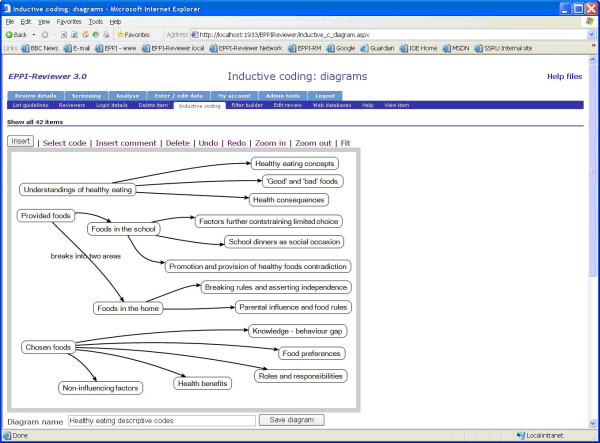
- In the example review, eight relevant qualitative studies yielded 36 initial codes, 12 descriptive themes, six analytical themes, and ten intervention recommendations.
- Six main issues emerged from children’s views: children do not see it as their role to be interested in health; future-health messages are not personally relevant or credible; fruit, vegetables and confectionery have different meanings; children seek food choices; eating is valued as a social occasion; and children see contradictions between promoted theory and adult practice.
- Most interventions were school-based and combined health-benefit learning with hands-on experience; interventions aligned with children’s views tended to be more effective, while multi-component physical activity plus healthy eating interventions worked less well than healthy-eating-only ones.
Methods
- Methodological paper describing thematic synthesis, illustrated with a completed systematic review of barriers to and facilitators of healthy eating among children aged four to 10 years.
- Searching involved extensive grey literature, author contact, and manual journal screening; quality was assessed using 12 criteria covering reporting, validity/reliability strategies, and appropriateness for children’s perspectives.
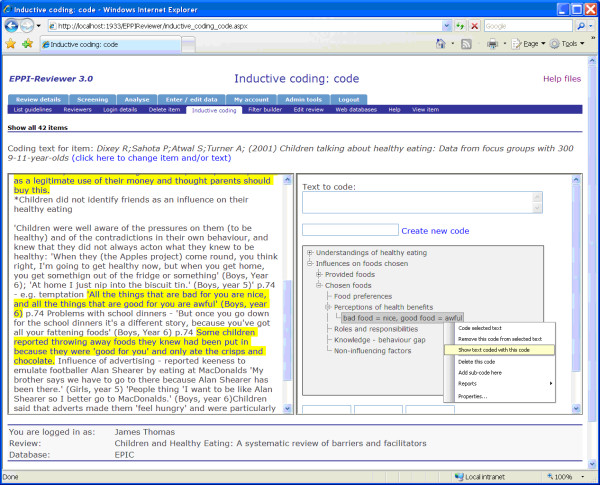
- Findings text labelled results/findings was entered verbatim into NVivo/EPPI-Reviewer; three reviewers independently coded line-by-line, grouped codes into descriptive themes, then generated analytical themes through group discussion and review questions.
Limitations
- Stated: contextual information in primary reports was very restricted, making it difficult to use context fully; there is little consensus on assessing qualitative quality and no accepted or empirically tested methods for excluding studies on quality, so all studies were included regardless of quality.
- Stated: the analytical-theme stage depends on reviewers’ judgement and insights and is potentially controversial; sensitivity analysis was done after synthesis by examining relative contributions of studies, finding poorer-quality studies contributed comparatively little and contained few unique themes.
- Evident: the method is illustrated with a single example review rather than compared empirically with other synthesis methods; the paper does not report a formal validation or inter-rater reliability for the synthesis.
Model-written summary. Check it against the paper before relying on it.
Integrity signals
Registry
Cites
Statistics
Figures
Verification
Claims the paper makes
3 Valid · 1 Not valid · 20 Not checked · 63 Own results and interpretations
A result the paper reports from its own data — it cites no other source for it, so there is none to check. The quote shows it is in the paper.
In the paper
“we found that there was very little difference in the methods we had to use to find qualitative studies compared to the methods we use when searching for studies for inclusion in a meta-analysis.”
§ Methods for the thematic synthesis of qualitative research in systematic reviews > Methods > Searching
plain- Asserted: passes — The authors put it forward as true.
- Checkable: passes — It can be checked against evidence.
- Load-bearing: unclear — It is unclear whether the paper’s conclusions depend on it.
- Based: passes — The paper gives a reason why it holds.
A result the paper states — it cites no source for it, so there is none to check. The quote shows it is in the paper.
In the paper
“Interventions that were in line with these suggestions tended to be more effective.”
§ Methods for the thematic synthesis of qualitative research in systematic reviews > Abstract > Results
hedgedstates an association- Asserted: passes — The authors put it forward as true.
- Checkable: passes — It can be checked against evidence.
- Load-bearing: passes — The paper’s conclusions depend on it.
- Based: passes — The paper gives a reason why it holds.
A result the paper states — it cites no source for it, so there is none to check. The quote shows it is in the paper.
In the paper
“In our review, it was not possible to rely on simple electronic searches of databases.”
§ Methods for the thematic synthesis of qualitative research in systematic reviews > Methods > Searching
plain- Asserted: passes — The authors put it forward as true.
- Checkable: passes — It can be checked against evidence.
- Load-bearing: unclear — It is unclear whether the paper’s conclusions depend on it.
- Based: passes — The paper gives a reason why it holds.
A result the paper reports from its own data — it cites no other source for it, so there is none to check. The quote shows it is in the paper.
In the paper
“In the event, we did not find any themes that belonged to a specific group, but another outcome of this process was a realisation that the contextual information given in the reports of studies was very restricted indeed.”
§ Methods for the thematic synthesis of qualitative research in systematic reviews > Discussion > Context and rigour in thematic synthesis
plain- Asserted: passes — The authors put it forward as true.
- Checkable: passes — It can be checked against evidence.
- Load-bearing: unclear — It is unclear whether the paper’s conclusions depend on it.
- Based: passes — The paper gives a reason why it holds.
A result the paper states — it cites no source for it, so there is none to check. The quote shows it is in the paper.
In the paper
“Interventions targeted at people with particular risk factors worked better than others, and multi-component interventions that combined the promotion of physical activity with healthy eating did not work as well as those that only concentrated on healthy eating.”
§ Methods for the thematic synthesis of qualitative research in systematic reviews > Results
plainstates a cause- Asserted: passes — The authors put it forward as true.
- Checkable: passes — It can be checked against evidence.
- Load-bearing: passes — The paper’s conclusions depend on it.
- Based: passes — The paper gives a reason why it holds.
25 more claims
Create a free account to see all 87 claims and to verify the 9 references still open.
- It may state two separate claims as one. 26
- Probably not a substantial claim. 45
Claims other papers make about this one
Each is checked against this paper’s own text: does it say what the citing paper says it does?
The source backs part of the claim, not all of it — or backs it for a different population, condition or comparison.
In the citing paper
“A thematic synthesis approach was used to integrate findings from studies with diverse methodological designs, following three key stages (Thomas & Harden, 2008).”
From Mind the gap: a systematic review of barriers, facilitators, and experiences of care transitions for people living with dementia and their informal caregivers. (2026) · cites this paper as Thomas & Harden, 2008
Experimental — accuracy not yet measuredThe source backs part of the claim, not all of it — or backs it for a different population, condition or comparison.
In the citing paper
“The thematic coding frame in Table 2 was applied to all included studies and reviewed for consistency of interpretation. This process, known as “axial coding,” ensured coded themes remained connected to and understood within the context of the source studies [13].”
From Patient-Perceived Factors Influencing Physical Activity Sensor Use in Stroke Prevention and Rehabilitation: Systematic Review of Qualitative Studies Using Thematic Synthesis (2026) · cites this paper as [13]
Experimental — accuracy not yet measuredThe source backs part of the claim, not all of it — or backs it for a different population, condition or comparison.
In the citing paper
“These data will be analysed following a three-step process. First, study data will be coded line by line by the first reviewer and checked by a second reviewer with a coding frame developed from codes derived from the data.”
From Effectiveness and acceptability of cognitive-behavioural therapy based interventions for maternal peripartum depression: A systematic review, meta-analysis and thematic synthesis protocol (2019) · cites this paper as [104]
Experimental — accuracy not yet measuredThe cited source says what the claim attributes to it.
In the citing paper
“The data coding, extraction and synthesis process was an iterative process, aligned with the thematic synthesis process outlined by Thomas 2008.”
From Health workers' perceptions and experiences of using mHealth technologies to deliver primary healthcare services: a qualitative evidence synthesis (2020) · cites this paper as Thomas 2008
The cited source says what the claim attributes to it.
In the citing paper
“To ensure the scientific reliability and trustworthiness of the findings, the qualitative analysis followed a thematic synthesis approach [25].”
From Sustainable Value Creation in Nonprofit Organizations: Processes, Determinants, and Strategic Dimensions (2026) · cites this paper as [25]
31 more claims about this paper
Create a free account to see every claim other papers make about this one.
Citations
Cites
Using thematic analysis in psychology
Braun, V., & Clarke, V. (2006) · Qualitative Research in Psychology · doi:10.1191/1478088706qp063oa · Cited by 194,414
(1997) · Cited by 4,204
Systematic reviews in the social sciences: a practical guide
(2006) · Choice Reviews Online · doi:10.5860/choice.43-5664 · Cited by 4,089
The Handbook of Research Synthesis.
Howel, D., Cooper, H., & Hedges, L. V. (1995) · Biometrics · doi:10.2307/2533295 · Cited by 3,642
Systematic Reviews in the Social Sciences: A Practical Guide
Petticrew, M., & Roberts, H. (2006) · doi:10.1002/9780470754887 · Cited by 3,586
Assessing the quality of controlled clinical trials
Jüni, P., Altman, D. G., & Egger, M. (2001) · BMJ · doi:10.1136/bmj.323.7303.42 · Cited by 3,309
Noblit, G., & Hare, R. (1988) · doi:10.4135/9781412985000 · Cited by 2,723
Qualitative Research: Rigour and qualitative research
Mays, N., & Pope, C. (1995) · BMJ · doi:10.1136/bmj.311.6997.109 · Cited by 2,715
Systematic Reviews in Health Care : Meta-Analysis in Context
Egger, M., Smith, G. D., & Altman, D. G. (2000) · Cited by 2,417
Dixon-Woods, M., Cavers, D., Agarwal, S., Annandale, E., Arthur, A., Harvey, J., Hsu, R., Katbamna, S., Olsen, R., Smith, L., et al. (2006) · BMC Medical Research Methodology · doi:10.1186/1471-2288-6-35 · Cited by 2,289
Research works printed but not linked: 9
- EPPI-Centre EPPI-Centre Methods for Conducting Systematic Reviews 2006 London: EPPI-Centre, Social Science Research Unit, Institute of Education, University of London
- Higgins J Green S (Eds) Cochrane Handbook for Systematic Reviews of Interventions 426 2006 Updated September 2006. Accessed 24th January 2007
- Sandelowski M Barroso J Handbook for Synthesising Qualitative Research 2007 New York: Springer
- Oakley A Experiments in Knowing: Gender and methods in the social sciences 2000 Cambridge: Polity Press
- Shepherd J Harden A Rees R Brunton G Oliver S Oakley A Young People and Healthy Eating: A systematic review of barriers and facilitators 2001 London: EPPI-Centre, Social Science Research Unit, Institute of Education, University of London
- Popay J Moving Beyond Effectiveness in Evidence Synthesis 2006 London: National Institute for Health and Clinical Excellence
- Boyatzis RE Transforming Qualitative Information 1998 Sage: Cleveland
- Medical Sociology Group Criteria for the evaluation of qualitative research papers Med Sociol News 1996 22 68 71
- Thomas J Brunton J EPPI-Reviewer 30: Analysis and management of data for research synthesis EPPI-Centre software 2006 London: EPPI-Centre, Social Science Research Unit, Institute of Education
Cited by
Items 7,501–7,600 of 9,166
Sezgin, M. G., & Bektaş, H. (2025) · Seminars in Oncology Nursing · doi:10.1016/j.soncn.2025.151961 · Cited by 1
Tunstall, L., Molyneux, P., & Alexander, T. (2025) · Journal of Clinical Nursing · doi:10.1111/jocn.70073 · Cited by 2
Babovič, M. (2025) · Criminal Behaviour and Mental Health · doi:10.1002/cbm.70007 · Cited by 2
Powell, L., Ellis, J., Kipling, K., Longster, H., Roden, A., & Azevedo, L. B. (2025) · Physical Therapy Reviews · doi:10.1080/10833196.2025.2543159 · Cited by 2
Dakshit, K. (2025) · SSRN Electronic Journal · doi:10.2139/ssrn.5375209
Zhai, S., Goodman, A., Smith, A. C., Diminic, S., & Zhou, X. (2025) · doi:10.2196/preprints.80386
Juneja, D., Jena, A., Gupta, M., & Sharman, R. (2025) · IGI Global eBooks · doi:10.4018/979-8-3373-3078-5.ch005
Lee, A. Y. S., Zembrzuska, H. D., Franke, K. B., Gordon, R. A., Franke, E. F., Kumble, L., Boderman, B., Pelkas, C., Hitchcock, M., Cornec, D., et al. (2025) · SSRN Electronic Journal · doi:10.2139/ssrn.5394386
Virgen, F. J. M., López, A. R., Palomar, M. D. R. L., & Cueva, S. A. G. (2025) · Ciencia Latina Revista Científica Multidisciplinar · doi:10.37811/cl_rcm.v9i3.18893
Hidayat, B., & Kasih, E. (2025) · SSRN Electronic Journal · doi:10.2139/ssrn.5392958
Hidayat, B., & Kasih, E. (2025) · SSRN Electronic Journal · doi:10.2139/ssrn.5392952
Behavioral Antecedents of Green Skincare Purchases in the Zillennial Cohort: A Literature Review
Kusbianto, N., Utami, S. Y. R., Hasesda, S. W. S. A. P., & Rihidima, L. V. C. (2025) · EKOMA Jurnal Ekonomi Manajemen Akuntansi · doi:10.56799/ekoma.v4i5.10345
SPORT IN CONTEMPORARY SOCIETY: A CRITICAL REVIEW OF SOCIAL THEORIES AND CULTURAL PRACTICES
Li, Y. (2025) · Journal of Current Social Issues Studies · doi:10.71113/jcsis.v2i7.376
Experience of Conjugality Among Older People in Long-Term Care Facilities: A Scoping Review
Bia, F., Charepe, Z. B., & Marques-Vieira, C. M. A. (2025) · Journal of Applied Gerontology · doi:10.1177/07334648251369264 · Cited by 1
The Transformative Power of Pedagogical Love as Transcultural Resource
Vanderheiden, E. (2025) · Springer eBooks · doi:10.1007/978-3-031-76665-7_89-1
Restorative Justice Approaches in the Workplace: A Systematic Review Protocol
Neves, K. B., Traguetto, J., Neves, J. B., Torres, M. M., & Sousa, M. D. M. (2025) · International Journal of Qualitative Methods · doi:10.1177/16094069251369297 · Cited by 1
Ades, R., Evans, J., & Heath, J. (2025) · Journal of Health Psychology · doi:10.1177/13591053251362032 · Cited by 1
Nurdiansyah, M. I., & Nurwati, D. (2025) · Priviet Social Sciences Journal · doi:10.55942/pssj.v5i8.524
Contextualising Sustainable Communities in Sub-sahara Africa: A Systematic Review Protocol
Afful, D. S., Poku‐Boansi, M., Doe, B., & Asibey, M. O. (2025) · Frontiers. · doi:10.11648/j.frontiers.20250503.14
McClenaghan, M., Gillespie, K. M., Baird, K. M., & Branjerdporn, G. (2025) · Trauma Violence & Abuse · doi:10.1177/15248380251362166
Bennett, R., & Atkinson, C. (2025) · Pastoral Care in Education · doi:10.1080/02643944.2025.2554601
FATORES RELACIONADOS À VIOLÊNCIA A MULHERES IDOSAS NOS ÚLTIMOS 10 ANOS: UMA REVISÃO INTEGRATIVA
de Oliveira, A. A., Teixeira, A. S., & Gianvecchio, V. A. P. (2025) · Revista Contemporânea · doi:10.56083/rcv5n9-046 · Cited by 1
Alsalami, A. I. (2025) · Saudi Journal of Language Studies · doi:10.1108/sjls-02-2025-0015 · Cited by 10
Artificial Intelligence (AI) and Media Convergence in the 21st Century: A Critical Review
Ajisafe, I. O., & Doyinsola Dada, M. S. (2025) · International Journal of Latest Technology in Engineering Management & Applied Science · doi:10.51583/ijltemas.2025.1408000080
Faija, C., Bee, P., Pedley, R., Bennion, M., Susanti, H., Fausiah, F., Idaiani, S., Susilo, D., Hussen, M., & Brooks, H. L. (2025) · Cambridge Prisms Global Mental Health · doi:10.1017/gmh.2025.10059 · Cited by 2
Compulsory guests of Türkiye: A meta-synthesis study on teachers’ experiences with refugee students
Yağan, E., Özgenel, M., & Taktak, M. (2025) · South African Journal of Education · doi:10.15700/saje.v45n3a2427
Kumar, P., Caggiano, H., Shwom, R., Felder, F. A., & Andrews, C. J. (2025) · Environmental Policy and Governance · doi:10.1002/eet.70022 · Cited by 1
Corticosteroid use in pediatric neuro-oncology symptom management: A rapid review
Manoharan, N., Armitage, N., & Virdun, C. (2025) · Neuro-Oncology Practice · doi:10.1093/nop/npaf097
Velapi, L., Cooper, S., Kredo, T., & Schmidt, B. (2025) · Clinical and Public Health Guidelines · doi:10.1002/gin2.70044
Velandia, J. C., & Elvira-Zorzo, M. N. (2025) · VISUAL REVIEW International Visual Culture Review / Revista Internacional de Cultura Visual · doi:10.62161/revvisual.v17.5939
Alchokr, R., Sunilkumar, A., Saake, G., Leich, T., & Krüger, J. (2025) · Lecture notes in computer science · doi:10.1007/978-3-032-05409-8_23 · Cited by 1
Shankar, R., Ali, J., & Qian, X. (2025) · medRxiv · doi:10.1101/2025.09.21.25336300
von-Zeschau, J. F., & Sánchez-Mosquera, M. (2025) · Revista Internacional del Trabajo · doi:10.16995/ilrs.18857
Lee, N. P. M., Chan, A. M. L., & Wong, F. M. F. (2025) · Frontiers of Nursing · doi:10.2478/fon-2025-0036
Responsible AI in Action: Navigating the Ethical Landscape of ChatGPT
Tiwari, A., & Kumar, P. (2025) · IGI Global eBooks · doi:10.4018/979-8-3373-0877-7.ch008
Aon, M., Brasholt, M., Khabsa, J., & Borschmann, R. (2025) · Systematic Reviews · doi:10.1186/s13643-025-02880-6 · Cited by 3
The Evolution of Gender Quota Research on Corporate Boards: A Thematic Literature Review
Kavalieraki-Foka, D., Asonitou, S., Tourna, E., Krambia‐Kapardis, M., & Kottara, C. (2025) · WSEAS TRANSACTIONS ON BUSINESS AND ECONOMICS · doi:10.37394/23207.2025.22.166
Effectiveness of E‐Learning in Undergraduate ENT Education: A Mixed‐Methods Systematic Review
Mughal, Z., Gupta, K. K., Traglia, R. D., & Fruhstorfer, B. H. (2025) · The Laryngoscope · doi:10.1002/lary.70164 · Cited by 3
Lane, C., McCrabb, S., Turon, H., Bialek, C., Couper, L., Wilczynska, M., Gray, S. M., Barnes, C., Fee, M., Kuchenmüller, T., et al. (2025) · medRxiv · doi:10.1101/2025.09.24.25336590
Microbial Adaptation and Host Signaling: Bacteroides - Bile Acid Interactions in Gut HealthPreprint
Silva, C. M. G., Ferreira, R. B. R., & Lobo, L. A. (2025) · SSRN Electronic Journal · doi:10.2139/ssrn.5549718
O'Connor, J. B., George, S. S., Klein, M. R., Herbst, N. R., Hoffman, L. A., Lydston, M., Kelly, J. F., & Hennessy, E. A. (2025) · Campbell Systematic Reviews · doi:10.1002/cl2.70068
Exploring Studies on the Use of Artificial Intelligence in Education: A Meta-Synthesis Study
Koç, H., & Uzun, A. M. (2025) · Erzincan Üniversitesi Eğitim Fakültesi Dergisi · doi:10.17556/erziefd.1680480
Responses to listening difficulty in in-person conversation: a scoping review of primary evidence
Robertson, L., & Naylor, G. (2025) · International Journal of Audiology · doi:10.1080/14992027.2025.2558692
A Qualitative Analysis of High Point Experiences Among Young People Living in Rural Appalachia
Yuan, N. P., Ellsworth-Kopkowski, A., Brooks, N. A.-Z. K., Patel, N., & Hamby, S. L. (2025) · Adversity and Resilience Science · doi:10.1007/s42844-025-00184-1
Sahana, P. G., Dongre, A. R., Gandhi, A. P., & Deshmukh, P. R. (2025) · The Evidence · doi:10.61505/evidence.2025.3.1.131
Shankar, R., Devi, F., & Qian, X. (2025) · medRxiv · doi:10.1101/2025.09.30.25337030
Zhunissova, D., Topping, D. O., & Evans, J. (2025) · Frontiers in Sustainable Cities · doi:10.3389/frsc.2025.1433488
Jain, A., & Singhal, A. (2025) · Lecture notes in networks and systems · doi:10.1007/978-3-032-03751-0_2
Sanders, M., Fiscella, K. A., Chang, J., LeBlanc, A., & Veazie, P. J. (2025) · PLOS Digital Health · doi:10.1371/journal.pdig.0001014 · Cited by 1
Exploring Oral Health Promotion Among Palliative Care Providers: An Integrative Review
Jain, V. K., Sanchez, P., Christian, B., Ajwani, S., Malik, Z., Pais, R., Harlum, J., Frost, J. S., & George, A. (2025) · Journal of Advanced Nursing · doi:10.1111/jan.70263 · Cited by 2
Lopes, L. P. N., Boeira, L. D. S., Modesto, A. C. F., Silva, A. R. O., Menin, V. P., Abe, F. C., & Lopes, L. C. (2025) · BMJ Open · doi:10.1136/bmjopen-2025-107543 · Cited by 2
Moss, S. J., Chacon, C. Z., Hekmati, F. B., Siddiqui, S. A., Stelfox, M., Ahmed, S. B., Birnie, K. A., Halperin, B. A., Halperin, S. A., Tutelman, P. R., et al. (2025) · BMJ Open · doi:10.1136/bmjopen-2023-083285
Evaluating the human factor in cybersecurity threats (a Systematic Literature Review)Preprint
Abuiteiwi, A., & Escobar, S. (2025) · SSRN Electronic Journal · doi:10.2139/ssrn.5576064 · Cited by 3
Nam, H. J., Park, H. N., Lee, S., Kang, G., Shin, J. H., Kim, B. H., & Yoon, J. Y. (2025) · Disability and health journal · doi:10.1016/j.dhjo.2025.101972 · Cited by 2
Addressing Treatment Disparities for Black Children with Neurodevelopmental Disorders
Clark, A. (2025) · American Journal of Qualitative Research · doi:10.29333/ajqr/17189 · Cited by 2
von-Zeschau, J. F., & Sánchez-Mosquera, M. (2025) · International Labour Review · doi:10.16995/ilr.18857
McGrory, S., Slater, P. F., & O’Neill, M. (2025) · Aging & Mental Health · doi:10.1080/13607863.2025.2569653
del Río, M., Bauta, A. A. L., Salgado, E., & Bennett, A. F. (2025) · International Journal of Sexual Health · doi:10.1080/19317611.2025.2573695
Klock, K. S., & Vettore, S. V. (2025) · Journal of integrative nursing and palliative care · doi:10.51847/adrrozafgr
Wen, R., Wang, S., Yang, K., & Xu, H. (2025) · Frontiers in Public Health · doi:10.3389/fpubh.2025.1678360
Meroz, M. R., Rivas, C. A., & McCourt, C. (2025) · medRxiv · doi:10.1101/2025.10.12.25337836
Older Korean Americans’ Experiences in an Adult Medical Daycare Center
Park, H.-J., Lee, J. W., & Wenzel, J. A. (2025) · Journal of Transcultural Nursing · doi:10.1177/10436596251380255
Conceptualizing the Local Governance Performance: A Systematic Review and Thematic Analysis
Duan, W., Liao, Y., & Wang, Y. (2025) · International perspectives on social policy, administration, and practice · doi:10.1007/978-3-032-00395-9_15
Evain, J., Giffard, M., Picard, J., Tanoubi, I., Pili‐Floury, S., Besch, G., & Ferreira, D. (2025) · Systematic Reviews · doi:10.1186/s13643-025-02937-6 · Cited by 1
Belleza, M. J. A., Billones-Franco, M. X. D., Ballara, N. B., Genodia, A. M. P., Bibit, C. D., Bandojo, H. I. G., & Billones, S. (2025) · Psychology and Education A Multidisciplinary Journal · doi:10.70838/pemj.480108 · Cited by 2
Research Methodology and Materials
Rosa, A. (2025) · Future of business and finance · doi:10.1007/978-3-032-04091-6_5
Litchfield, H. D., Gill, B., Irwin, J. D., Tucker, P., Fenesi, B., & Burke, S. M. (2025) · Review of Educational Research · doi:10.3102/00346543251367772
Kelly, M., & James, P. (2025) · Mental Health Practice · doi:10.7748/mhp.2025.e1751
Alghathayan, A., Smith, Z., & Smith, M. (2025) · Journal of Advanced Nursing · doi:10.1111/jan.70273
Cyborg-Technologie im Alltag: Implantate, Interoperabilität und User Experience
Lutz, A. M. (2025) · Springer eBooks · doi:10.1007/978-3-658-49529-9_2
Sitshange, M. (2025) · SOUTHERN AFRICAN JOURNAL OF SOCIAL WORK AND SOCIAL DEVELOPMENT · doi:10.25159/2708-9355/17245
Küçükkaya, M., Dolkun, B., & Kaya, H. D. (2025) · Sexual & Reproductive Healthcare · doi:10.1016/j.srhc.2025.101157 · Cited by 3
Shankar, R., Joshua, J. W., & Qian, X. (2025) · medRxiv · doi:10.1101/2025.10.14.25338031
Acero, Á. E., García, J. G., Lobato, J. M. P., & Sumaza, C. R. (2025) · Lecture notes in bioengineering · doi:10.1007/978-3-031-77282-5_19
Harney, O., Cardon, G., Ch, J., Finnegan, E. A., Smyth, S., Quinn, M., Hennessy, M., O'Reilly, C., Quinn, E., & Houghton, C. (2025) · HRB Open Research · doi:10.12688/hrbopenres.14242.1
Xu, Y., Zheng, Y., Long, Z., & Chang, L. (2025) · Journal of Renal Care · doi:10.1111/jorc.70033 · Cited by 1
Shankar, R., Joshua, J. W., & Xu, Q. (2025) · medRxiv · doi:10.1101/2025.10.14.25338032
A Review on Collaborative Approaches and Dynamics Between Traditional Handicrafts and Design
Saikia, B. A., & Das, S. (2025) · Lecture notes in mechanical engineering · doi:10.1007/978-981-96-6414-6_44
Khan, A., Tierney, S., & Wanat, M. (2025) · Health & Social Care in the Community · doi:10.1155/hsc/1517298
Ahsan, M., Javaid, M. U., Nawaz, A., Hassan, M. H. U. H., Iqbal, J., Hayyat, O., Hussain, A., & Sathian, B. (2025) · Mental Health Science · doi:10.1002/mhs2.70033 · Cited by 1
Roxburgh, E., Taylor, B. L., Rammou, A., & Hodgekins, J. (2025) · International Journal of Bipolar Disorders · doi:10.1186/s40345-025-00391-w · Cited by 4
Dir, A. L., Batch, B. L., & Aalsma, M. C. (2025) · Drug and Alcohol Dependence Reports · doi:10.1016/j.dadr.2025.100386 · Cited by 1
Ziaesaeidi, P., Cushing, D. F., Washington, T. L., & Buys, L. R. (2025) · Children s Geographies · doi:10.1080/14733285.2025.2578281 · Cited by 2
Law and Theology in Dialogue: Historical Roots, Jurisprudential Influence, and Global Perspectives
Purwanto, E. (2025) · Dunamis Jurnal Teologi dan Pendidikan Kristiani · doi:10.30648/dun.v10i1.1733
Oduro, P., Khan, A., & Asamoah, B. K. (2025) · Open Journal of Social Sciences · doi:10.4236/jss.2025.1310038
Bioética, pedagogía infantil y la formación del profesor de preescolar
Izquierdo, G. M., Cárdenas, L. V. U., & Silva, J. M. C. (2025) · Revista Colombiana de Bioética · doi:10.18270/rcb.4845
Bai, Z., Xie, J., Wei, J., Liu, E., Xiong, Y., Jiang, H., Liu, F., & Zhou, J. (2025) · Cure & Care · doi:10.1016/j.ccwv.2025.100007
Sahin, B., & Wade‐Jaimes, K. (2025) · Technology Knowledge and Learning · doi:10.1007/s10758-025-09909-8
Fachon, K. D., Narayan, S., Greenwald, M., & Goodman, A. (2025) · Open Journal of Obstetrics and Gynecology · doi:10.4236/ojog.2025.1510149
Wedema, D., Hovenkamp-Hermelink, J., Korevaar, E. L., Wardenaar, K. J., & Schoevers, R. A. (2025) · Psychotherapy and Psychosomatics · doi:10.1159/000548808 · Cited by 3
Yeni Atanan Öğretmenlerin Oryantasyon Etkinliklerine Yönelik Görüşleri
Güzel, S., & Gözler, A. (2025) · Erciyes journal of education/Erciyes journal of education : · doi:10.32433/eje.1607590
Influence of personal beliefs on adherence to medicines in older people with multimorbidity
Akinwale, O. T., & Powell, J. (2025) · Nursing Older People · doi:10.7748/nop.2025.e1531
Li, C., Gu, Y., Ding, K., et al. (2025) · Disability and Rehabilitation · doi:10.1080/09638288.2025.2570856
Kowalski, S., Rahman, A. S., & Bergström, L. (2025) · medRxiv · doi:10.1101/2025.10.30.25339147 · Cited by 2
Walsh, E. H., Hemming, L., Herring, M. P., & McMahon, J. (2025) · Child and Adolescent Mental Health · doi:10.1111/camh.70043
de Moraes, R. B., dos Santos, M. A., Ferracioli, N. G. M., et al. (2025) · Psico-USF · doi:10.1590/1413-8271202530e281109
Tang, Y., Liu, Q., Liu, S., et al. (2025) · Patient Education and Counseling · doi:10.1016/j.pec.2025.109411
Investigating community cricket coaches attempts to make net practice sessions more game-like
SueSee, B., & Pill, S. (2025) · Sports Coaching Review · doi:10.1080/21640629.2025.2585753
Kerrigan, O., Murray, C., & Ferguson, J. (2025) · Trauma Violence & Abuse · doi:10.1177/15248380251366267
Chowdhury, N. A., Erman, D., Marshall, Z., Raihan, M. M. H., Datta, R. K., Aghajafari, F., Shankar, J., Sehgal, K., Rashid, R., & Turin, T. C. (2025) · Trauma Violence & Abuse · doi:10.1177/15248380251381871
Metadata
- Authors
- Thomas, J., & Harden, A.
- Affiliations
- University of London (GB)
- Corresponding author
- Thomas, James
- Venue
- BMC Medical Research Methodology
- Published
- 2008-07-10
- Volume
- 8
- Issue
- 1
- Pages
- 45-45
- ISSN
- 1471-2288 (ISSN-L)
- PMC
- PMC2478656
- OpenAlex
- W2109305774
- Cited by
- 9,312
- References
- 64
- Citations by year
- 2026: 1606 · 2025: 1253 · 2024: 1082 · 2023: 899 · 2022: 903 · 2021: 852 · 2020: 606 · 2019: 472 · 2018: 404 · 2017: 318 · 2016: 275 · 2015: 179 · 2014: 141 · 2013: 122 · 2012: 91
- FWCI
- 38.28
- Type
- journal article
- Language
- en
- Open access
- gold
- doi.org
- Licence
- cc-by
- creativecommons.org/licenses/by/2.0 (tdm)
- Locations
- BMC Medical Research Methodology (publishedVersion, cc-by)
- PubMed Central (publishedVersion, cc-by)
- PubMed (publishedVersion)
- UEL Research Repository (University of East London) (acceptedVersion)
- City Research Online (City University London) (acceptedVersion)
- IOE EPrints (submittedVersion)
- UEL Research Repository (University of East London) (submittedVersion, cc-by-nd)
- DOAJ (DOAJ: Directory of Open Access Journals) (submittedVersion, cc-by-sa)
- UCL Discovery (University College London) (submittedVersion)
- Funders
- National Institute for Health and Care Research
- Economic and Social Research Council (RES-576-25-5008)
- Topics
- Social Sciences › Education › Qualitative Research Methods and Applications
- Social Sciences › Decision Sciences › Statistics, Probability and Uncertainty › Meta-analysis and systematic reviews
- Social Sciences › Sociology and Political Science › Delphi Technique in Research
- Keywords
- thematic synthesis, thematic analysis, health promotion interventions, children's perspectives, school-based intervention, fruit and vegetable intake, health messaging
- MeSH terms
- Humans, Methods, Review Literature as Topic, Statistics as Topic, Qualitative Research
About these checks
Registry, retraction, Cites and statistics results are computed, not judged, with one exception: a printed reference that no index lists is read once by a model before it counts as a citation error. Claims are extracted by a model and kept only when their quote appears verbatim in the text; each cited source is then checked, with a model’s help, for whether it says what the claim relies on. Those verdicts can be wrong — read the claim’s quote and the cited source before relying on one.
The claim verdicts this report counts are experimental: their accuracy is not yet measured.
A language model drew the claims from the paper on 2026-10-04, under version 3 of the claim definition (model deepseek-v4.1-flash, prompt extract-v3).
A second model labelled each claim on 2026-10-04 (model jev-1.13-20260917, definition revision gold-guideline-v0.2).
Statistics and arithmetic are recomputed, not judged.
Confidence bands are shown only for fields calibrated on our annotated test set. None is calibrated yet, so no band is shown.
What counts as a claim ›How we measure confidence ›How we check this ›
Are you an author, or do you see a problem with this page? Request a review
Data sources
Bibliographic data: Semantic Scholar, OpenAlex, Crossref.
Contains information from the Semantic Scholar Academic Graph Datasets, made available under the ODC Attribution License (ODC-BY 1.0).
Semantic Scholar’s data is described in: Kinney, R., et al. (2023). The Semantic Scholar Open Data Platform. arXiv:2301.10140.
