

The attitudes, beliefs and behaviours of GPs regarding exercise for chronic knee pain: a systematic review
Open accessThe DOI matches its Crossref record; 48 of the 48 references it cites were found in a registry or an index.
Abstract
BACKGROUND: Joint pain, specifically chronic knee pain (CKP), is a frequent cause of chronic pain and limitation of function and mobility among older adults. Multiple evidence-based guidelines recommend exercise as a first-line treatment for all patients with CKP or knee osteoarthritis (KOA), yet healthcare practitioners' attitudes and beliefs may limit their implementation. This systematic review aims to identify the attitudes, beliefs and behaviours of General Practitioners (GPs) regarding the use of exercise for CKP/KOA. METHODS: We searched four electronic databases between inception and January 2008, using subject headings to identify studies examining the attitudes, beliefs or behaviours of GPs regarding the use of exercise for the treatment of CKP/KOA in adults aged over 45 years in primary care. Studies referring to patellofemoral pain syndrome or CKP secondary to other causes or that occurring in a prosthetic joint were excluded. Once inclusion and exclusion criteria were applied, study data were extracted and summarised. Study quality was independently reviewed using two assessment tools. RESULTS: From 2135 potentially relevant articles, 20 were suitable for inclusion. A variety of study methodologies and approaches to measuring attitudes beliefs and behaviours were used among the studies. Quality assessment revealed good reporting of study objective, type, outcome factors and, generally, the sampling frame. However, criticisms included use of small sample sizes, low response rates and under-reporting of non-responder factors. Although 99% of GPs agreed that exercise should be used for CKP/KOA and reported ever providing advice or referring to a physiotherapist, up to 29% believed that rest was the optimum management approach. The frequency of actual provision of exercise advice or physiotherapy referral was lower. Estimates of provision of exercise advice and physiotherapy referral were generally higher for vignette-based studies (exercise advice 9%-89%; physiotherapy referral 44%-77%) than reviews of actual practice (exercise advice 5%-52%; physiotherapy referral 13-63%). Advice to exercise and exercise prescription were not clearly differentiated. CONCLUSIONS: Attitudes and beliefs of GPs towards exercise for CKP/KOA vary widely and exercise appears to be underused in the management of CKP/KOA. Limitations of the evidence base include the paucity of studies directly examining attitudes of GPs, poor methodological quality, limited generalisability of results and ambiguity concerning GPs' expected roles. Further investigation is required of the roles of GPs in using exercise as first-line management of CKP/KOA.
Overview
The claims and statistics of this paper haven’t been checked yet.
Free: it reads the open-access text and checks the first 5 claims that cite a source we can check. Create a free account to check every claim.
Integrity signals
Registry
Cites
Statistics
Figures
Verification
Claims the paper makes
The claims and statistics of this paper haven’t been checked yet.
Free: it reads the open-access text and checks the first 5 claims that cite a source we can check. Create a free account to check every claim.
Claims other papers make about this one
Each is checked against this paper’s own text: does it say what the citing paper says it does?
In the citing paper
“Feelings of being ill prepared to manage OA are consistent with other studies [7,18,22,30,31].”
Self-check
Percentages, sums and reported differences re-computed from the paper’s own numbers.
The self-check needs the paper’s full text.
Citations
Cites
Jordan, K. M., Arden, N. K., Doherty, M., Bannwarth, B., Bijlsma, J. W. J., Dieppe, P., Gunther, K., Hauselmann, H., Herrero-Beaumont, G., Kaklamanis, P., et al. (2003) · Annals of the Rheumatic Diseases · doi:10.1136/ard.2003.011742 · Cited by 2,048 · cited 2×
“These, and a Cochrane review [14], conclude that exercise is beneficial and should be a first-line management strategy for CKP/KOA [5,6, 12 ,15,16].”
Recommendations for the medical management of osteoarthritis of the hip and knee: 2000 update
(2000) · Arthritis & Rheumatism · doi:10.1002/1529-0131(200009)43:9<1905::aid-anr1>3.0.co;2-p · Cited by 1,875
Zhang, W., Doherty, M., Leeb, B. F., Alekseeva, L., Arden, N. K., Bijlsma, J. W., Dinçer, F., Dziedzic, K., Häuselmann, H. J., Herrero-Beaumont, G., et al. (2007) · Annals of the Rheumatic Diseases · doi:10.1136/ard.2006.062091 · Cited by 1,338
Peat, G., McCarney, R., & Croft, P. (2001) · Annals of the Rheumatic Diseases · doi:10.1136/ard.60.2.91 · Cited by 1,335 · cited 1×
“Approximately 25% of adults aged over 45 years have previously experienced knee pain lasting over a month or had an episode of knee pain in the last year and prevalence increases with age [1-3].”
Felson, D. T., & McAlindon, T. (2002) · Annals of Internal Medicine · doi:10.7326/0003-4819-136-1-200201010-00019 · Cited by 1,122
Bedson, J., & Croft, P. R. (2008) · BMC Musculoskeletal Disorders · doi:10.1186/1471-2474-9-116 · Cited by 951 · cited 1×
“to the discordance between pain and OA-related radiographic changes [21].”
Exercise for osteoarthritis of the knee
Fransen, M., McConnell, S., Harmer, A. R., Van der Esch, M., Simic, M., & Bennell, K. L. (2015) · Cochrane Database of Systematic Reviews · doi:10.1002/14651858.cd004376.pub3 · Cited by 800
Exercise for osteoarthritis of the knee
Fransen, M., & McConnell, S. (2008) · Cochrane Database of Systematic Reviews · doi:10.1002/14651858.cd004376.pub2 · Cited by 751
(1934) · Notes and Queries · doi:10.1093/nq/clxvii.nov17.360a · Cited by 725
Is There Time for Management of Patients With Chronic Diseases in Primary Care?
Ostbye, T. (2005) · The Annals of Family Medicine · doi:10.1370/afm.310 · Cited by 698 · cited 1×
“Østbye et al [51] reinforced the latter issue by identifying that provision of comprehensive management for ten common chronic diseases, including arthritis, exceeds the total time GPs have for all patient care [51].”
Pendleton, A., Arden, N., Dougados, M., Doherty, M., Bannwarth, B., Bijlsma, J. W. J., Cluzeau, F., Cooper, C., Dieppe, P. A., Günther, K.-P., et al. (2000) · Annals of the Rheumatic Diseases · doi:10.1136/ard.59.12.936 · Cited by 575 · cited 1×
“These, and a Cochrane review [14], conclude that exercise is beneficial and should be a first-line management strategy for CKP/KOA [5,6,12,15,16].”
Roddy, E. (2005) · Rheumatology · doi:10.1093/rheumatology/keh399 · Cited by 554 · cited 3×
“These, and a Cochrane review [14], conclude that exercise is beneficial and should be a first-line management strategy for CKP/KOA [5,6,12,15,16].”
Self-citationOsteoarthritis: New Insights. Part 2: Treatment Approaches
Felson, D. T., Lawrence, R. C., Hochberg, M. C., McAlindon, T., Dieppe, P. A., Minor, M. A., Blair, S. N., Berman, B. M., Fries, J. F., Weinberger, M., et al. (2000) · Annals of Internal Medicine · doi:10.7326/0003-4819-133-9-200011070-00015 · Cited by 506 · cited 1×
“Multiple generic, secondary and primary care guidelines recommend management for CKP and/or knee osteoarthritis (KOA) [6,8-13].”
KNEE PAIN AND DISABILITY IN THE COMMUNITY
McALINDON, T. E., COOPER, C., KIRWAN, J. R., & DIEPPE, P. A. (1992) · Rheumatology · doi:10.1093/rheumatology/31.3.189 · Cited by 243 · cited 1×
“Approximately 25% of adults aged over 45 years have previously experienced knee pain lasting over a month or had an episode of knee pain in the last year and prevalence increases with age [1-3].”
Hendry, M. (2006) · Family Practice · doi:10.1093/fampra/cml022 · Cited by 174 · cited 6×
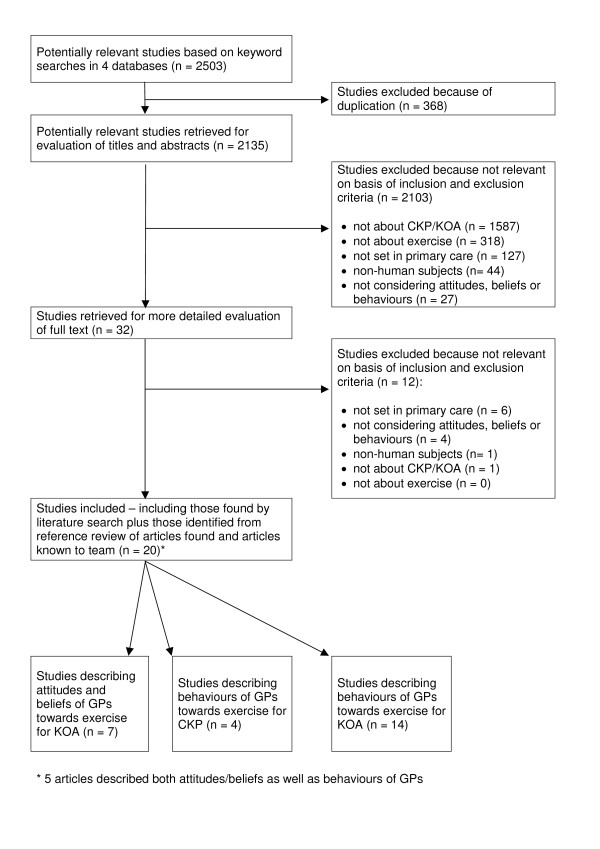
“Five articles described both attitudes and beliefs as well as behaviours of GPs, therefore of the 20 relevant articles, seven described attitudes and beliefs of GPs towards exercise for KOA [23-29] [Additional File 1] and eighteen described behaviours of GPs regarding exercise for CKP/KOA [4,23,27,30-42] [Additional F…”
InfluentialScreening for pain in knee osteoarthritis: which question?
O’Reilly, S., Muir, K. R., & Doherty, M. (1996) · Annals of the Rheumatic Diseases · doi:10.1136/ard.55.12.931 · Cited by 164
Management of osteoarthritis in the primary-care setting: An evidence-based approach to treatment
Lane, N. E., & Thompson, J. M. (1997) · The American Journal of Medicine · doi:10.1016/s0002-9343(97)90005-x · Cited by 126 · cited 1×
“Multiple generic, secondary and primary care guidelines recommend management for CKP and/or knee osteoarthritis (KOA) [6, 8-13 ].”
BackgroundExercise for knee osteoarthritis
Baker, K., & McAlindon, T. (2000) · Current Opinion in Rheumatology · doi:10.1097/00002281-200009000-00020 · Cited by 125
Management of common musculoskeletal problems: a survey of Ontario primary care physicians.
Glazier, R. H., Dalby, D. M., Badley, E. M., HAWKER, G. A., Bell, M. J., Buchbinder, R., & Lineker, S. C. (1998) · Europe PMC (PubMed Central) · Cited by 125
The use of conventional and complementary treatments for knee osteoarthritis in the community
Jordan, K. M. (2003) · British journal of rheumatology · doi:10.1093/rheumatology/keh045 · Cited by 124 · cited 3×
“The remaining 10 studies detailed “actual” behaviour using; patient questionnaires (n = 3) [34,38,39], patient interviews (n = 3) [32,37,40], casenote review (n = 3) [23,35,41] and patient questionnaires and interviews (n = 1) [36].”
Primary care treatment of knee pain a survey in older adults
Porcheret, M., Jordan, K., Jinks, C., & P. Croft in collaboration with the Primary Care Rheumatology Society (2007) · Rheumatology · doi:10.1093/rheumatology/kem232 · Cited by 123 · cited 6×
“The four studies that related specifically to CKP [30,35,38, 40 ] were UK studies.”
BackgroundInfluentialDenoeud‐Ndam, L., Mazières, B., Payen-Champenois, C., & Ravaud, P. (2004) · Annals of the Rheumatic Diseases · doi:10.1136/ard.2003.015263 · Cited by 104 · cited 9×
“The frequency with which GPs exhibited implied negative attitudes and beliefs about exercise for CKP was low, therefore, by eliminating the studies from which implied attitudes and beliefs were extracted, there is still a spectrum of opinion ranging from the more negative and/or ambivalent approaches such as that exer…”
InfluentialPorcheret, M., Jordan, K. P., & Croft, P. R. (2006) · Rheumatology · doi:10.1093/rheumatology/kel340 · Cited by 84 · cited 4×
“These, and a Cochrane review [14], conclude that exercise is beneficial and should be a first-line management strategy for CKP/KOA [5,6,12,15,16].”
InfluentialCoyte, P. C., HAWKER, G. A., Croxford, R., Attard, C., & Wright, J. G. (1996) · PubMed · Cited by 78
Mazzuca, S. A., Brandt, K. D., Katz, B. P., Dittus, R. S., Freund, D. A., Lubitz, R., Hawker, G., & Eckert, G. (1997) · Arthritis & Rheumatism · doi:10.1002/art.1790100503 · Cited by 72 · cited 4×
“These include, uncertainty about the role of GPs in relation to exercise for CKP [47,48] and/or appropriate types [36] of exercise, uncertainty of the correct exercise “prescription” [14,47]; lack of awareness about the guidelines [26]; the belief that patients will not exercise [49]; the presence of comorbidities [48…”
InfluentialUse of mainstream nonpharmacologic treatment by patients with arthritis
LI, L. C., Maetzel, A., Pencharz, J. N., Maguire, L., Bombardier, C., & The Community Hypertension and Arthritis Project (CHAP) Team (2004) · Arthritis Care & Research · doi:10.1002/art.20244 · Cited by 65 · cited 1×
“Patients may undertake exercise independently from GPs or other healthcare practitioners’ advice [17].”
Management of Osteoarthritis of the Knee by Primary Care Physicians
Mamlin, L. A. (1998) · Archives of Family Medicine · doi:10.1001/archfami.7.6.563 · Cited by 61 · cited 4×
“Behaviour Concerning Exercise Within the 18 studies investigating behaviour of GPs regarding exercise for CKP/KOA, eight presented information on “reported behaviours” of GPs [ 4 ,24-27,30,31,33].”
InfluentialMcHugh, G. A., Luker, K. A., Campbell, M., Kay, P., & Silman, A. J. (2006) · Lara D. Veeken · doi:10.1093/rheumatology/kel355 · Cited by 52 · cited 1×
“CKP/KOA [4],[23]-[27],[30-42]”
Mitchell, H. L., Carr, A. J., & Scott, D. L. (2006) · Rheumatology · doi:10.1093/rheumatology/kei214 · Cited by 48 · cited 5×
“Five articles described both attitudes and beliefs as well as behaviours of GPs, therefore of the 20 relevant articles, seven described attitudes and beliefs of GPs towards exercise for KOA [23-29] [Additional File 1] and eighteen described behaviours of GPs regarding exercise for CKP/KOA [4,23,27,30-42] [Additional F…”
InfluentialDexter, P. A. (1992) · Arthritis & Rheumatism · doi:10.1002/art.1790050109 · Cited by 47 · cited 1×
“Without instruction, motivated patients may exercise with little or no benefit [18].”
Do Physicians Treat Symptomatic Osteoarthritis Patients Properly? Results of the AMICA Experience
Sarzi‐Puttini, P., Cimmino, M. A., Scarpa, R., Caporali, R. F., Parazzini, F., Zaninelli, A., Atzeni, F., & Marcolongo, R. (2005) · Seminars in Arthritis and Rheumatism · doi:10.1016/j.semarthrit.2005.02.005 · Cited by 47 · cited 3×
“The remaining 10 studies detailed “actual” behaviour using; patient questionnaires (n = 3) [34,38,39], patient interviews (n = 3) [32,37,40], casenote review (n = 3) [23,35,41] and patient questionnaires and interviews (n = 1) [36].”
How do GPs use x rays to manage chronic knee pain in the elderly? A case study
Bedson, J., Jordan, K., & Croft, P. (2003) · Annals of the Rheumatic Diseases · doi:10.1136/ard.62.5.450 · Cited by 46
Exercise for Osteoarthritis of the Knee
Lin, C. C., Taylor, D., Bierma‐Zeinstra, S., & Maher, C. G. (2010) · Physical Therapy · doi:10.2522/ptj.20100084 · Cited by 44
Iversen, M. D., Eaton, H. M., & Daltroy, L. H. (2004) · Arthritis Care & Research · doi:10.1002/art.20168 · Cited by 43 · cited 1×
“These include, uncertainty about the role of GPs in relation to exercise for CKP [47,48] and/or appropriate types [36] of exercise, uncertainty of the correct exercise “prescription” [14,47]; lack of awareness about the guidelines [26]; the belief that patients will not exercise [ 49 ]; the presence of comorbidities […”
BackgroundChevalier, X., Marre, J.-P., de Butler, J., & Hercek, A. (2004) · PubMed · Cited by 42
Glazier, R. H., Badley, E. M., Wright, J. G., Coyte, P. C., Williams, J., Harvey, B. J., Wilkins, A. L., & HAWKER, G. A. (2003) · PubMed · Cited by 39
Mazzuca, S. A., Brandt, K. D., Katz, B. P., Li, W., & Stewart, K. (1993) · PubMed · Cited by 39
Linsell, L., Dawson, J., Zondervan, K., Randall, T., Rose, P., Carr, A., & Fitzpatrick, R. (2004) · Family Practice · doi:10.1093/fampra/cmh609 · Cited by 34 · cited 5×
“Five articles described both attitudes and beliefs as well as behaviours of GPs, therefore of the 20 relevant articles, seven described attitudes and beliefs of GPs towards exercise for KOA [23-29] [Additional File 1] and eighteen described behaviours of GPs regarding exercise for CKP/KOA [4,23,27,30-42] [Additional F…”
InfluentialPractice guidelines in the management of osteoarthritis
Altman, R. D., & Lozada, C. J. (1998) · Osteoarthritis and Cartilage · doi:10.1016/s1063-4584(98)80007-1 · Cited by 32 · cited 1×
“Multiple generic, secondary and primary care guidelines recommend management for CKP and/or knee osteoarthritis (KOA) [6,8-13].”
Chard, J., Dickson, J., Tallon, D., & Dieppe, P. (2002) · British journal of rheumatology · doi:10.1093/rheumatology/41.10.1208-a · Cited by 31 · cited 6×
“referring patients with CKP/KOA to physiotherapy [31].”
InfluentialMazières, B., Scmidely, N., Häuselmann, H., Martin-Mola, E., Serni, U., Verbruggen, A. A., & Bars, M. L. (2005) · Annals of the Rheumatic Diseases · doi:10.1136/ard.2003.009431 · Cited by 29 · cited 4×
“Of the seven studies reporting attitudes of physicians towards exercise for KOA five used physician-completed questionnaires [24-27,29], one used patient interviews [28] and the other physician interviews [23].”
InfluentialRelationships between social background and medical care in osteoarthritis.
Dexter, P. R., & Brandt, K. D. (1993) · PubMed · Cited by 20
Scarpa, R., Sarzi‐Puttini, P., Cimmino, M. A., Caporali, R. F., Parazzini, F., Zaninelli, A., & Canesi, B. (2005) · Seminars in Arthritis and Rheumatism · doi:10.1016/j.semarthrit.2005.02.001 · Cited by 16
Davis, P. J., & Suarez-Almazor, M. E. (1995) · PubMed · Cited by 13
Dutch General Practitioners' Management of Patients with Distal Osteoarthritic Symptoms
de Bock, G. H., Kaptein, A. A., & Mulder, J. D. (1992) · Scandinavian Journal of Primary Health Care · doi:10.3109/02813439209014034 · Cited by 12 · cited 8×
“de Bock et al [23] detailed GP’s positive attitudes about physiotherapy compared to pharmacological therapy.”
InfluentialDoes a structured exercise program benefit elderly people with knee osteoarthritis?
Rao, A., & Evans, M. F. (1998) · PubMed · Cited by 5
Günaydın, İ., Maleitzke, R., Göttl, K. H., & Tschirdewahn, B. (1997) · Zeitschrift für Rheumatologie · doi:10.1007/s003930050024 · Cited by 1
Research works printed but not linked: 4
- NICE Osteoarthritis: the care and management of osteoarthritis in adults NICE Guideline 2008 London: NICE
- Pavelka K Olejárová M Stehlíkova M Dvoráková T Šmeralová V Epidemiological study of treatment of osteoarthritis of the knee joints in the Czech Republic Ceska Revmatologie 1995 3 3 115 21
- Arthritis Research Campaign Exercise 'needs to be prescribed for chronic back pain' 2009 http://www.arc.org.uk/news/DirectNews/Article.asp?ID=19032975&Year=2009&Mo
- Mazieres B Hauselmann H Martin-Mola E Serni U Verbruggen A Schmidely N A European survey among 4,204 physicians Part 2. The management of knee osteoarthritis treatment Ann Rheum Dis 2002 61 suppl 1 119
Cited by
CDC Clinical Practice Guideline for Prescribing Opioids for Pain — United States, 2022
Dowell, D., Ragan, K. R., Jones, C. M., Baldwin, G. T., & Chou, R. (2022) · MMWR. Recommendations and Reports · doi:10.15585/mmwr.rr7103a1 · Cited by 1,886
Hiligsmann, M., Cooper, C., Arden, N., Boers, M., Branco, J. C., Luisa Brandi, M., Bruyère, O., Guillemin, F., Hochberg, M. C., Hunter, D. J., et al. (2013) · Seminars in Arthritis and Rheumatism · doi:10.1016/j.semarthrit.2013.07.003 · Cited by 327
“In part, this is because the percentage of GPs who actually advise their OA patients to exercise or refer them for physical therapy can be very low, with rates varying between 6% and 63% [65].”
BackgroundNissen, N., Holm, P. M., Bricca, A., Dideriksen, M., Tang, L. H., & Skou, S. T. (2022) · Osteoarthritis and Cartilage · doi:10.1016/j.joca.2021.11.008 · Cited by 277
Update on the Role of Muscle in the Genesis and Management of Knee Osteoarthritis
Bennell, K. L., Wrigley, T. V., Hunt, M. A., Lim, B.-W., & Hinman, R. S. (2013) · Rheumatic Disease Clinics of North America · doi:10.1016/j.rdc.2012.11.003 · Cited by 254
Nijs, J., Roussel, N., Paul van Wilgen, C., Köke, A., & Smeets, R. (2013) · Manual Therapy · doi:10.1016/j.math.2012.11.001 · Cited by 246
“Likewise, the attitudes and beliefs of general practitioners toward chronic knee pain and knee osteoarthritis are related to the underuse of exercise in the management of these patients, including the low physiotherapy referral (Cottrell et al., 2010).”
Background
Metadata
- Authors
- Cottrell, E., Roddy, E., & Foster, N. E.
- Affiliations
- Keele University (GB)
- Corresponding author
- Cottrell, Elizabeth
- Venue
- BMC Family Practice
- Published
- 2010-01-18
- Volume
- 11
- Issue
- 1
- Pages
- 4-4
- ISSN
- 1471-2296 (ISSN-L)
- PMC
- PMC2826301
- OpenAlex
- W2106928200
- Cited by
- 90
- References
- 48
- Citations by year
- 2026: 1 · 2024: 9 · 2023: 2 · 2022: 10 · 2021: 8 · 2020: 11 · 2019: 3 · 2018: 9 · 2017: 5 · 2016: 4 · 2015: 5 · 2014: 5 · 2013: 7 · 2012: 10
- FWCI
- 0.65
- Type
- journal article
- Language
- en
- Open access
- gold
- doi.org
- Licence
- cc-by
- creativecommons.org/licenses/by/2.0 (tdm)
- Locations
- BMC Family Practice (publishedVersion, cc-by)
- PubMed Central (publishedVersion, cc-by)
- PubMed (publishedVersion)
- Keele Research Repository (Keele University) (submittedVersion, cc-by)
- DOAJ (DOAJ: Directory of Open Access Journals) (submittedVersion, cc-by-sa)
- Funders
- National Institute for Health and Care Research (ACF-2008-10-001, RP-PG-0407-10386)
- Versus Arthritis (18139)
- Topics
- Health Sciences › Health Professions › Physical Therapy, Sports Therapy and Rehabilitation › Musculoskeletal pain and rehabilitation
- Health Sciences › Medicine › Public Health, Environmental and Occupational Health › Clinical practice guidelines implementation
- Health Sciences › Medicine › Public Health, Environmental and Occupational Health › Physical Activity and Health
- Keywords
- chronic knee pain, knee osteoarthritis, general practitioners, exercise prescription, physiotherapy referral, primary care, older adults, guideline implementation
- MeSH terms
- Adult, Attitude of Health Personnel, Chronic Disease, Exercise Therapy, Family Practice, Female, Humans, Male, Practice Patterns, Physicians', Physicians, Family, Quality Assurance, Health Care, Osteoarthritis, Knee, Pain Management
About these checks
Registry, retraction, Cites and statistics results are computed, not judged, with one exception: a printed reference that no index lists is read once by a model before it counts as a citation error. Claims are extracted by a model and kept only when their quote appears verbatim in the text; each cited source is then checked, with a model’s help, for whether it says what the claim relies on. Those verdicts can be wrong — read the claim’s quote and the cited source before relying on one.
Statistics and arithmetic are recomputed, not judged.
Confidence bands are shown only for fields calibrated on our annotated test set. None is calibrated yet, so no band is shown.
What counts as a claim ›How we measure confidence ›How we check this ›
Are you an author, or do you see a problem with this page? Request a review
Data sources
Bibliographic data: Semantic Scholar, OpenAlex, Crossref.
Contains information from the Semantic Scholar Academic Graph Datasets, made available under the ODC Attribution License (ODC-BY 1.0).
Semantic Scholar’s data is described in: Kinney, R., et al. (2023). The Semantic Scholar Open Data Platform. arXiv:2301.10140.
