

The DOI matches its Crossref record; 29 of the 30 references it cites were found in a registry or an index.
The effectiveness of the Austrian disease management programme for type 2 diabetes: a cluster-randomised controlled trial
Open accessAbstract
BACKGROUND: Disease management programmes (DMPs) are costly and impose additional work load on general practitioners (GPs). Data on their effectiveness are inconclusive. We therefore conducted a cluster-randomised controlled trial to evaluate the effectiveness of the Austrian DMP for diabetes mellitus type 2 on HbA1c and quality of care for adult patients in primary care. METHODS: All GPs of Salzburg-province were invited to participate. After cluster-randomisation by district, all patients with diabetes type 2 were recruited consecutively from 7-11/2007. The DMP, consisting mainly of physician and patient education, standardised documentation and agreement on therapeutic goals, was implemented in the intervention group while the control group received usual care. We aimed to show superiority of the intervention regarding metabolic control and process quality. The primary outcome measure was a change in HbA1c after one year. Secondary outcomes were days in the hospital, blood pressure, lipids, body mass index (BMI), enrolment in patient education and regular guideline-adherent examination. Blinding was not possible. RESULTS: 92 physicians recruited 1489 patients (649 intervention, 840 control). After 401 ± 47 days, 590 intervention-patients and 754 controls had complete data. In the intention to treat analysis (ITT) of all 1489 patients, HbA1c decreased 0.41% in the intervention group and 0.28% in controls. The difference of -0.13% (95% CI -0.24; -0.02) was significant at p = 0.026. Significance was lost in mixed models adjusted for baseline value and cluster-effects (adjusted mean difference -0.03 (95% CI -0.15; 0.09, p = 0.607). Of the secondary outcome measures, BMI and cholesterol were significantly reduced in the intervention group compared to controls in ITT after adjustments (-0.53 kg/m²; 95% CI -1.03;-0.02; p = 0.014 and -0.10 mmol/l; 95% CI -0.21; -0.003; p = 0.043). Additionally, more patients received patient education (49.5% vs. 20.1%, p < 0.0001), eye- (71.0% vs. 51.2%, p < 0.0001), foot examinations (73.8% vs. 45.1%, p < 0.0001), and regular HbA1c checks (44.1% vs. 36.0%, p < 0.01) in the intervention group. CONCLUSION: The Austrian DMP implemented by statutory health insurance improves process quality and enhances weight reduction, but does not significantly improve metabolic control for patients with type 2 diabetes mellitus. Whether the small benefit seen in secondary outcome measures leads to better patient outcomes, remains unclear. TRIAL REGISTRATION: Current Controlled trials Ltd., ISRCTN27414162.
Overview
The claims and statistics of this paper haven’t been checked yet.
Run the check — free, no account needed. It reads the open-access text and checks the sources it cites.
Integrity signals
Registry
Cites
Statistics
Figures
Verification
Claims the paper makes
The claims and statistics of this paper haven’t been checked yet.
Run the check — free, no account needed. It reads the open-access text and checks the sources it cites.
Self-check
Percentages, sums and reported differences re-computed from the paper’s own numbers.
The self-check needs the paper’s full text.
Citations
Cites
Wild, S., Roglic, G., Green, A., Sicree, R., & King, H. (2004) · Diabetes Care · doi:10.2337/diacare.27.5.1047 · Cited by 15,297 · cited 1×
“Background The prevalence of type 2 diabetes is rising worldwide for all age groups due to population growth, ageing, urbanisation, increasing prevalence of obesity and physical inactivity [1,2].”
10-year follow-up of intensive glucose control in type 2 diabetes
Holman, R. R., Paul, S. K., Bethel, M. A., Matthews, D. R., & Neil, H. A. W. (2008) · New England Journal of Medicine · doi:10.1056/nejmoa0806470 · Cited by 7,751 · cited 1×
“However, the United Kingdom Prospective Diabetes Study (UKPDS) demonstrated that even small differences in HbA1c may translate into benefits regarding acute and chronic diabetic complications as well as hospital admissions in the long run [30].”
Global Burden of Diabetes, 1995–2025: Prevalence, numerical estimates, and projections
King, H. O. M., Aubert, R. E., & Herman, W. H. (1998) · Diabetes Care · doi:10.2337/diacare.21.9.1414 · Cited by 6,294 · cited 1×
“Background The prevalence of type 2 diabetes is rising worldwide for all age groups due to population growth, ageing, urbanisation, increasing prevalence of obesity and physical inactivity [1,2].”
Consort 2010 statement: extension to cluster randomised trials
Campbell, M. K., Piaggio, G., Elbourne, D. R., Altman, D. G., & for the CONSORT Group (2012) · BMJ · doi:10.1136/bmj.e5661 · Cited by 3,510
Improving Primary Care for Patients With Chronic Illness
Bodenheimer, T. (2002) · JAMA · doi:10.1001/jama.288.14.1775 · Cited by 2,961 · cited 1×
“The chronic care model (CCM) has been developed to improve the care for patients with chronic conditions like diabetes mellitus type 2 [6].”
CONSORT statement: extension to cluster randomised trials
Campbell, M. K., Elbourne, D. R., & Altman, D. G. (2004) · BMJ · doi:10.1136/bmj.328.7441.702 · Cited by 2,557 · cited 1×
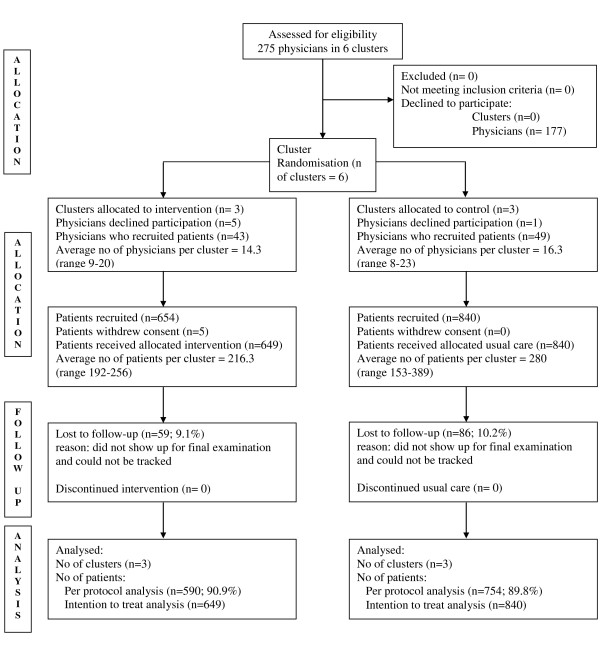
“Details of the flow of clusters, physicians and patients through the study are shown in figure 1 as suggested by the consort statement for cluster randomised trials [17].”
Improving the reporting of pragmatic trials: An extension of the CONSORT statement
Zwarenstein, M., Treweek, S., Gagnier, J. J., Altman, D. G., Tunis, S., Haynes, B., Oxman, A. D., Moher, D., & groups, F. T. C. A. P. T. I. H. (. (2008) · BMJ · doi:10.1136/bmj.a2390 · Cited by 1,813 · cited 1×
“According to the extension of the CONSORT statement for pragmatic trials, special emphasis should be put on the generalisability (external validity) of the results [27]: Our trial is characterised by a high level of internal validity.”
Design and Analysis of Cluster Randomization Trials in Health Research
DONNER, A. P., & Klar, N. S. (2000) · Cited by 1,236
Criteria for evaluating evidence on public health interventions
Rychetnik, L., Frommer, M., Hawe, P., & Shiell, A. (2002) · Journal of Epidemiology and Community Health · doi:10.1136/jech.56.2.119 · Cited by 1,042 · cited 1×
“Randomised controlled trials have been described as the best method for appraising a causal relationship between a complex intervention and clinical outcomes [12].”
Weingarten, S. R. (2002) · BMJ · doi:10.1136/bmj.325.7370.925 · Cited by 735 · cited 2×
“One showed that overall DMPs have positive pooled effect sizes regarding improvement in care [21].”
Research works printed but not linked: 3
- Berger M, Grüßer M: Behandlungs- und Schulungsprogramm fürTyp 2 Diabetiker, die nicht Insulin spritzen. Deutscher Ärzteverlag, Köln. 1997
- Weitgasser R, Aistleitner M, König C, Rakovac I, Habacher W: Diabetesschulung "Neu" für Patienten mit Typ-2-Diabetes im Land Salzburg. Diabetes, Stoffwechsel und Herz. 2009, 18: 25-27.
- Österreichische Diabetes Gesellschaft: [Diabetes mellitus--guidelines for general practice. Revised and expanded 2007 edition]. Wien Klin Wochenschr. 2007, 119: 5-64.
Cited by
Sorted by citations
Rieckert, A., Reeves, D., Altiner, A., Drewelow, E., Esmail, A., Flamm, M., Hann, M., Johansson, T., Klaaßen‐Mielke, R., Kunnamo, I., et al. (2020) · BMJ · doi:10.1136/bmj.m1822 · Cited by 148
“We powered the study to detect a relative risk reduction of 20% in the decision support group at 80% power and an α level of 5%, assuming an intracluster correlation coefficient of 0.01 (based on an earlier cluster trial 32 ) and a 10% attrition rate in both patients and practices.”
MethodInfluentialSelf-citationOvercoming fragmentation in health care: chronic care in Austria, Germany and the Netherlands
Nolte, E., Knai, C., Hofmarcher, M. M., Conklin, A., Erler, A., Elissen, A., Flamm, M., Fullerton, B., Sönnichsen, A. C., & Vrijhoef, H. J. (2012) · Health Economics Policy and Law · doi:10.1017/s1744133111000338 · Cited by 139
“The evidence was mixed, however, with non-significant improvements in metabolic control, the main clinical outcome, although other measures (weight and cholesterol) improved significantly (Sönnichsen et al., 2010).”
ResultSelf-citationPatient-mediated interventions to improve professional practice
Fønhus, M. S., Dalsbø, T. K., Johansen, M., Fretheim, A., Skirbekk, H., & Flottorp, S. A. (2018) · Cochrane Database of Systematic Reviews · doi:10.1002/14651858.cd012472.pub2 · Cited by 107
Sönnichsen, A. C., Trampisch, U. S., Rieckert, A., Piccoliori, G., Vögele, A., Flamm, M., Johansson, T., Esmail, A., Reeves, D., Löffler, C., et al. (2016) · Trials · doi:10.1186/s13063-016-1177-8 · Cited by 108
“01 (derived from an earlier cluster-randomized trial involving GP practices as clusters [45]).”
BackgroundSelf-citationInterventions to increase attendance for diabetic retinopathy screening
Lawrenson, J. G., Graham-Rowe, E., Lorencatto, F., Burr, J. M., Bunce, C., Francis, J., Aluko, P., Rice, S. J. C., Vale, L. D., Pető, T., et al. (2018) · Cochrane Database of Systematic Reviews · doi:10.1002/14651858.cd012054.pub2 · Cited by 94
Metadata
- Authors
- Sönnichsen, A. C., Winkler, H., Flamm, M., Panisch, S., Kowatsch, P., Klima, G., Fürthauer, B., & Weitgasser, R.
- Affiliations
- Paracelsus Medical University (AT)
- Private Pädagogische Hochschule Augustinum (AT)
- Corresponding author
- Sönnichsen, Andreas C
- Venue
- BMC Family Practice
- Published
- 2010-11-05
- Volume
- 11
- Issue
- 1
- Pages
- 86-86
- ISSN
- 1471-2296 (ISSN-L)
- PMC
- PMC2989935
- OpenAlex
- W2057504267
- Cited by
- 141
- References
- 30
- Citations by year
- 2026: 1 · 2025: 1 · 2024: 1 · 2023: 13 · 2022: 4 · 2021: 2 · 2020: 5 · 2019: 1 · 2018: 6 · 2017: 2 · 2016: 3 · 2015: 6 · 2014: 4 · 2013: 5 · 2012: 41
- FWCI
- 22.20
- Type
- journal article
- Language
- en
- Open access
- gold
- doi.org
- Licence
- Locations
- BMC Family Practice (publishedVersion, cc-by)
- PubMed Central (publishedVersion, cc-by)
- PubMed (publishedVersion)
- DOAJ (DOAJ: Directory of Open Access Journals) (submittedVersion)
- Funders
- Universität Heidelberg
- Paracelsus Medizinische Privatuniversität
- Topics
- Health Sciences › Medicine › Endocrinology, Diabetes and Metabolism › Diabetes Management and Education
- Health Sciences › Medicine › Epidemiology › Chronic Disease Management Strategies
- Health Sciences › Medicine › Family Practice › Primary Care and Health Outcomes
- Keywords
- type 2 diabetes, disease management programs, primary care, HbA1c, glycemic control, quality of care, patient education, physician training, treatment goals, body mass index, cholesterol, hospitalization, guideline adherence, cost-effectiveness, general practitioners, diabetes self-management education
- MeSH terms
- Adult, Austria, Diabetes Mellitus, Type 2, Female, Health Plan Implementation, Glycated Hemoglobin, Humans, Male, Program Development, Disease Management
About these checks
Registry, retraction, Cites and statistics results are computed, not judged, with one exception: a printed reference that no index lists is read once by a model before it counts as a citation error. Claims are extracted by a model and kept only when their quote appears verbatim in the text; each cited source is then checked, with a model’s help, for whether it says what the claim relies on. Those verdicts can be wrong — read the claim’s quote and the cited source before relying on one.
Statistics and arithmetic are recomputed, not judged.
Confidence bands are shown only for fields calibrated on our annotated test set. None is calibrated yet, so no band is shown.
What counts as a claim ›How we measure confidence ›How we check this ›
Are you an author, or do you see a problem with this page? Request a review
