

Drug prescription by telephone consultation in Danish out-of-hours primary care: a population-based study of frequency and associations with clinical severity and diagnosis
Open accessThe DOI matches its Crossref record; 18 of the 19 references it cites were found in a registry or an index.
Abstract
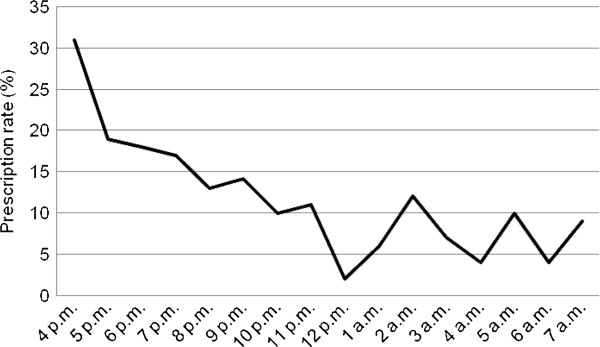
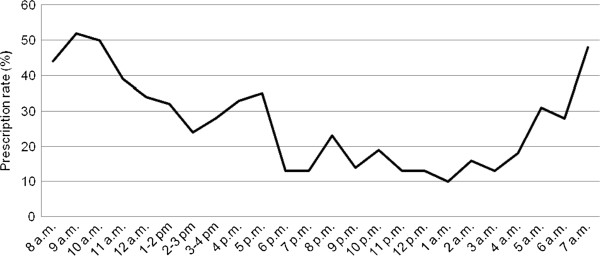
BACKGROUND: Danish general practitioners (GPs) answer all calls to the out-of-hours primary care service. About 60% of the calls are terminated on the telephone through provision of medical advice and prescription of medication. Nevertheless, little is known about the prescription patterns of telephone consultations, such as prescription frequency and indications for drug use. Our aim was to examine the characteristics of patients and GPs in telephone consultations resulting in drug prescription. METHODS: The study was based on a 12-month survey on reasons for encounter in the Danish out-of-hours primary care service. A total of 385 GPs (55.5% of all GPs from Central Denmark Region on duty during a year) participated in answering electronic pop-up questionnaires integrated in the electronic patient administration system. The questionnaires contained items on reasons for encounter (e.g. existing chronic disease or new health problem), diagnoses, and GP-assessed severity of the health problem. Data on time of contact, patient gender and age, and prescribed medication (Anatomic Therapeutic Chemical classifications) for telephone consultations were obtained from the patient administration system. Differences in characteristics of patients, general practitioners, and contacts were examined, and associations with prescribed medication were analysed using a multivariate analysis with prevalence ratios. RESULTS: Medication was prescribed in 19.9% of the included 4,173 telephone consultations; antibiotics and analgesics were prescribed most frequently (10.8% and 2.5%, respectively). GPs tended to assess contacts resulting in antibiotic prescription as more severe than other contacts. For high-severity contacts, there was a lower likelihood for prescription (prevalence ratio = 0.28 (0.16-0.47)). Children aged 0-4 years had lower probability of receiving a prescription compared with patients aged 18-40 years. The prescription rate was highest during the first four hours of the opening hours of the out-of-hours primary care service. CONCLUSION: One in five of all telephone consultations involved drug prescription; antibiotics constituted half of these prescriptions. Drug prescription by telephone was less likely to be offered in cases involving 'severe' reason for encounter or children. This study calls for further studies of drug prescriptions issued via out-of-hours primary care telephone consultations.
Overview
The claims and statistics of this paper haven’t been checked yet.
Free: it reads the open-access text and checks the first 5 claims that cite a source we can check. Create a free account to check every claim.
Integrity signals
Registry
Cites
Statistics
Figures
Verification
Claims the paper makes
The claims and statistics of this paper haven’t been checked yet.
Free: it reads the open-access text and checks the first 5 claims that cite a source we can check. Create a free account to check every claim.
Claims other papers make about this one
Each is checked against this paper’s own text: does it say what the citing paper says it does?
The source backs part of the claim, not all of it — or backs it for a different population, condition or comparison.
In the citing paper
“The respondents reported that 19.9% of the telephone consultations resulted in a prescription.”
From The Empirical Foundations of Telemedicine Interventions in Primary Care (2016) · cites this paper as [109]
Experimental — accuracy not yet measuredThe source backs part of the claim, not all of it — or backs it for a different population, condition or comparison.
In the citing paper
“The prescription rate seemed to decline over time during the off-hours.It tended to be highest during the first 4 h of the off-hours.”
From The Empirical Foundations of Telemedicine Interventions in Primary Care (2016) · cites this paper as [109]
Experimental — accuracy not yet measuredThe cited source says what the claim attributes to it.
In the citing paper
“Consultations resulting in antibiotic prescriptions were reported to be ''more severe'' compared with other contacts.”
From The Empirical Foundations of Telemedicine Interventions in Primary Care (2016) · cites this paper as [109]
The cited source says what the claim attributes to it.
In the citing paper
“consultations for children had a lower likelihood of receiving a prescription compared with consultations for adults.”
From The Empirical Foundations of Telemedicine Interventions in Primary Care (2016) · cites this paper as [109]
The cited source says what the claim attributes to it.
In the citing paper
“However, for high-severity contacts, there was a lower likelihood for prescription (prevalence ratio = 0.28)”
From The Empirical Foundations of Telemedicine Interventions in Primary Care (2016) · cites this paper as [109]
3 more claims about this paper
Create a free account to see every claim other papers make about this one.
Self-check
Percentages, sums and reported differences re-computed from the paper’s own numbers.
The self-check needs the paper’s full text.
Citations
Cites
Kirkwood, B. R., & Sterne, J. A. C. (2014) · Bristol Research (University of Bristol) · Cited by 2,820
International Classification of Primary Care
Bentsen, B. G. (1986) · Scandinavian Journal of Primary Health Care · doi:10.3109/02813438609013970 · Cited by 898
Telephone consultation and triage: effects on health care use and patient satisfaction
Bunn, F., Byrne, G., & Kendall, S. (2004) · Cochrane Database of Systematic Reviews · doi:10.1002/14651858.cd004180.pub2 · Cited by 241 · cited 1×
“Telephone triage in OOH-PC is used as a tool to manage patient flows efficiently and safely [8,9].”
Bradley, C. (1992) · Europe PMC (PubMed Central) · Cited by 210
Safety of telephone triage in out-of-hours care: A systematic review
Huibers, L., Smits, M., Renaud, V., Giesen, P., & Wensing, M. (2011) · Scandinavian Journal of Primary Health Care · doi:10.3109/02813432.2011.629150 · Cited by 194
Self-citationQuality of After-Hours Primary Care in the Netherlands: A Narrative Review
Giesen, P., Smits, M., Huibers, L., Grol, R., & Wensing, M. (2011) · Annals of Internal Medicine · doi:10.7326/0003-4819-155-2-201107190-00006 · Cited by 165 · cited 1×
“Growing patient demands [1-3] in combination with increasing needs of diagnosis and treat-ment outside normal working hours place heavy demands on the modern healthcare system; these challenges have created a constant need for further development of the organisation of OOH-PC [4-6].”
Self-citationOut of hours service in Denmark: evaluation five years after reform
Christensen, M. B., & Olesen, F. (1998) · BMJ · doi:10.1136/bmj.316.7143.1502 · Cited by 147
Self-citationAfter-Hours Care In The United Kingdom, Denmark, And The Netherlands: New Models
Grol, R. P. T. M., Giesen, P. H. J., & van Uden, C. J. T. (2006) · Health Affairs · doi:10.1377/hlthaff.25.6.1733 · Cited by 145 · cited 1×
“Growing patient demands [1-3] in combination with increasing needs of diagnosis and treatment outside normal working hours place heavy demands on the modern healthcare system; these challenges have created a constant need for further development of the organisation of OOH-PC [4-6].”
Wonca (2005) · doi:10.1093/oso/9780198568575.001.0001 · Cited by 95
Giesen, P. H. J. (2006) · Emergency Medicine Journal · doi:10.1136/emj.2005.032359 · Cited by 90
Research works printed but not linked: 1
- Moth G Flarup L Christensen M Olesen F Vedsted P Reasons for Encounter and Disease Patterns in the Danish Out-of-Hours Primary Care Service. LV-KOS (In Danish) 2012 1 Aarhus: The Research Unit for General Practice, Aarhus University
Cited by
The Empirical Foundations of Telemedicine Interventions in Primary Care
Bashshur, R. L., Howell, J. D., Krupinski, E. A., Harms, K. M., Bashshur, N., & Doarn, C. R. (2016) · Telemedicine and e-Health · doi:10.1089/tmj.2016.0045 · Cited by 370
“Moth et al.(109) 2014 Denmark Survey 385 Telephone Off-hours service 12 months Medication prescribed in 19.”
The organisation of out-of-hours primary care in OECD countries
Berchet, C., & Nader, C. (2016) · OECD health working papers · doi:10.1787/5jlr3czbqw23-en · Cited by 88
Teleconsulta: uma Revisão Integrativa da Interação Médico-Paciente Mediada pela Tecnologia
Catapan, S. D. C., & Calvo, M. C. M. (2020) · Revista Brasileira de Educação Médica · doi:10.1590/1981-5271v44.1-20190224.ing · Cited by 108
ATA Practice Guidelines for Live, On-Demand Primary and Urgent Care
Gough, F., Budhrani, S., Cohn, E. R., Dappen, A., Leenknecht, C., Lewis, B., Mulligan, D. A., Randall, D., Rheuban, K. S., Roberts, L., et al. (2015) · Telemedicine Journal and e-Health · doi:10.1089/tmj.2015.0008 · Cited by 49
“…who had access to the patient’s medical record were conservative in the encounters, being less likely to offer prescriptions when cases are severe or involve children, 32 with no differences in prescription rates between contacts due to new episodes and exacerbation of chronic disease.”
Kludacz-Alessandri, M., Walczak, R., Hawrysz, L., & Korneta, P. (2021) · Journal of Clinical Medicine · doi:10.3390/jcm10163502 · Cited by 33
Metadata
- Authors
- Moth, G., Huibers, L., Christensen, M. B., & Vedsted, P.
- Affiliations
- Aarhus University (DK)
- Corresponding author
- Moth, Grete
- Venue
- BMC Family Practice
- Published
- 2014-08-20
- Volume
- 15
- Issue
- 1
- Pages
- 142-142
- ISSN
- 1471-2296 (ISSN-L)
- PMC
- PMC4236596
- OpenAlex
- W2108831977
- Semantic Scholar
- c3818ac4a4d15c673647851dada9400033e6a2dc
- Cited by
- 15
- References
- 19
- Citations by year
- 2025: 2 · 2022: 4 · 2021: 1 · 2020: 2 · 2019: 1 · 2018: 1 · 2016: 3 · 2015: 1
- FWCI
- 2.41
- Type
- journal article
- Language
- en
- Open access
- gold
- doi.org
- Licence
- Locations
- BMC Family Practice (publishedVersion, cc-by)
- PubMed Central (publishedVersion, cc-by)
- PubMed (publishedVersion)
- Radboud Repository (Radboud University) (submittedVersion)
- Radboud Repository (Radboud University) (submittedVersion, other-oa)
- Topics
- Health Sciences › Medicine › Family Practice › Primary Care and Health Outcomes
- Health Sciences › Medicine › Emergency Medicine › Emergency and Acute Care Studies
- Health Sciences › Medicine › Geriatrics and Gerontology › Pharmaceutical Practices and Patient Outcomes
- Keywords
- telephone consultation, out-of-hours primary care, drug prescribing, antibiotic prescribing, analgesic prescribing, clinical severity, general practitioners, prescribing patterns, children, timing of consultation
- MeSH terms
- Adolescent, Adult, Age Factors, Child, Child, Preschool, Denmark, Drug Therapy, Female, Humans, Infant, Infant, Newborn, Male, Middle Aged, Practice Patterns, Physicians', Primary Health Care, Surveys and Questionnaires, Severity of Illness Index, Telephone, Remote Consultation, After-Hours Care, Young Adult, General Practice
About these checks
Registry, retraction, Cites and statistics results are computed, not judged, with one exception: a printed reference that no index lists is read once by a model before it counts as a citation error. Claims are extracted by a model and kept only when their quote appears verbatim in the text; each cited source is then checked, with a model’s help, for whether it says what the claim relies on. Those verdicts can be wrong — read the claim’s quote and the cited source before relying on one.
Statistics and arithmetic are recomputed, not judged.
Confidence bands are shown only for fields calibrated on our annotated test set. None is calibrated yet, so no band is shown.
What counts as a claim ›How we measure confidence ›How we check this ›
Are you an author, or do you see a problem with this page? Request a review
How to cite
Cite CoChat for the checks on this page, and the paper for its own findings.
- This page
- CoChat. (2026). Citation check: Drug prescription by telephone consultation in Danish out-of-hours primary care: a population-based study of frequency and associations with clinical severity and diagnosis. https://app.cochat.ai/papers/10.1186/1471-2296-15-142
- The paper
- Moth, G., Huibers, L., Christensen, M. B., & Vedsted, P. (2014). Drug prescription by telephone consultation in Danish out-of-hours primary care: a population-based study of frequency and associations with clinical severity and diagnosis. BMC Family Practice. https://doi.org/10.1186/1471-2296-15-142
Data sources
Bibliographic data: Semantic Scholar, OpenAlex, Crossref.
Contains information from the Semantic Scholar Academic Graph Datasets, made available under the ODC Attribution License (ODC-BY 1.0).
Semantic Scholar’s data is described in: Kinney, R., et al. (2023). The Semantic Scholar Open Data Platform. arXiv:2301.10140.
