

The DOI matches its Crossref record; 22 of the 22 references it cites were found in a registry or an index.
Evaluation of an early step-down strategy from intravenous anidulafungin to oral azole therapy for the treatment of candidemia and other forms of invasive candidiasis: results from an open-label trial.
Open accessAbstract
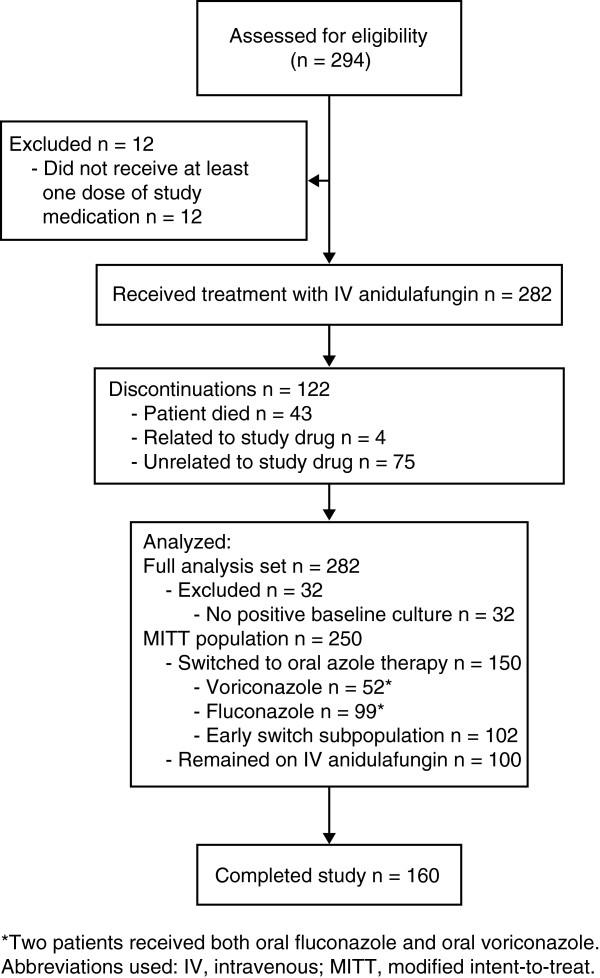
BACKGROUND: Hospitalized patients are at increased risk for candidemia and invasive candidiasis (C/IC). Improved therapeutic regimens with enhanced clinical and pharmacoeconomic outcomes utilizing existing antifungal agents are still needed. METHODS: An open-label, non-comparative study evaluated an intravenous (i.v.) to oral step-down strategy. Patients with C/IC were treated with i.v. anidulafungin and after 5 days of i.v. therapy had the option to step-down to oral azole therapy (fluconazole or voriconazole) if they met prespecified criteria. The primary endpoint was the global response rate (clinical + microbiological) at end of treatment (EOT) in the modified intent-to-treat (MITT) population (at least one dose of anidulafungin plus positive Candida within 96 hours of study entry). Secondary endpoints included efficacy at other time points and in predefined patient subpopulations. Patients who stepped down early (≤ 7 days' anidulafungin) were identified as the "early switch" subpopulation. RESULTS: In total, 282 patients were enrolled, of whom 250 were included in the MITT population. The MITT global response rate at EOT was 83.7% (95% confidence interval, 78.7-88.8). Global response rates at all time points were generally similar in the early switch subpopulation compared with the MITT population. Global response rates were also similar across multiple Candida species, including C. albicans, C. glabrata, and C. parapsilosis. The most common treatment-related adverse events were nausea and vomiting (four patients each). CONCLUSIONS: A short course of i.v. anidulafungin, followed by early step-down to oral azole therapy, is an effective and well-tolerated approach for the treatment of C/IC. TRIAL REGISTRATION: ClinicalTrials.gov: NCT00496197.
Overview
The claims and statistics of this paper haven’t been checked yet.
Run the check — free, no account needed. It reads the open-access text and checks the sources it cites.
Integrity signals
Registry
Cites
Statistics
Figures
Verification
Claims the paper makes
The claims and statistics of this paper haven’t been checked yet.
Run the check — free, no account needed. It reads the open-access text and checks the sources it cites.
Claims other papers make about this one
Each is checked against this paper’s own text: does it say what the citing paper says it does?
In the citing paper
“This strategy was shown to be safe and feasible for multiple Candida species, including C. glabrata [94].”
From Treatment of Invasive Candidiasis: A Narrative Review (2018) · cites this paper as [94]
In the citing paper
“Various PCR formats focussing specifically on the detection of mutations in C. glabrata have been developed (50;51).”
From Echinocandin resistance: an emerging clinical problem? (2014) · cites this paper as [51]
Self-check
Percentages, sums and reported differences re-computed from the paper’s own numbers.
The self-check needs the paper’s full text.
Citations
Cites
Epidemiology of Invasive Candidiasis: a Persistent Public Health Problem
Pfaller, M. A., & Diekema, D. J. (2007) · Clinical Microbiology Reviews · doi:10.1128/cmr.00029-06 · Cited by 4,174 · cited 2×
“; licensee BioMed Centra Commons Attribution License (http://creativec reproduction in any medium, provided the or The incidence of candidemia appears to be considerably higher in the United States (US) compared with Canada and Europe, with the exception of Denmark [1,2].”
BackgroundInternational Study of the Prevalence and Outcomes of Infection in Intensive Care Units
Vincent, J. (2009) · JAMA · doi:10.1001/jama.2009.1754 · Cited by 3,639
Pappas, P. G., Kauffman, C. A., Andes, D., Benjamin, D. K., Calandra, T. F., Edwards, J. E., Filler, S. G., Fisher, J. F., Kullberg, B.-J., Zeichner, L. O., et al. (2009) · Clinical Infectious Diseases · doi:10.1086/596757 · Cited by 3,191
Self-citationComparison of Caspofungin and Amphotericin B for Invasive Candidiasis
Mora-Duarte, J., Betts, R., Rotstein, C., Colombo, A. L., Thompson-Moya, L., Smietana, J., Lupinacci, R., Sable, C., Kartsonis, N., & Perfect, J. (2002) · New England Journal of Medicine · doi:10.1056/nejmoa021585 · Cited by 1,380
Cornely, O. A., Bassetti, M., Calandra, T., Garbino, J., Kullberg, B. J., Lortholary, O., Meersseman, W., Akova, M., Arendrup, M. C., Arikan-Akdagli, S., et al. (2012) · Clinical Microbiology and Infection · doi:10.1111/1469-0691.12039 · Cited by 1,217
Attributable Mortality of Nosocomial Candidemia, Revisited
Gudlaugsson, O., Gillespie, S., Lee, K., Berg, J. V., Hu, J., Messer, S., Herwaldt, L., Pfaller, M., & Diekema, D. (2003) · Clinical Infectious Diseases · doi:10.1086/378745 · Cited by 1,140
Denning, D. W. (2003) · The Lancet · doi:10.1016/s0140-6736(03)14472-8 · Cited by 1,131
Anidulafungin versus Fluconazole for Invasive Candidiasis
Reboli, A. C., Rotstein, C., Pappas, P. G., Chapman, S. W., Kett, D. H., Kumar, D., Betts, R., Wible, M., Goldstein, B. P., Schranz, J., et al. (2007) · New England Journal of Medicine · doi:10.1056/nejmoa066906 · Cited by 894
Self-citationParczewska, O. K., Posaconazol, przeciwgrzybicze, L., Anidulafungina, Micafungina, & wrażliwość, O. (2009) · Cited by 656
Morgan, J., Meltzer, M. I., Plikaytis, B. D., Sofair, A. N., Huie-White, S., Wilcox, S., Harrison, L. H., Seaberg, E. C., Hajjeh, R. A., & Teutsch, S. M. (2005) · Infection Control & Hospital Epidemiology · doi:10.1086/502581 · Cited by 437
Cited by
Sorted by citations
Items 101–101 of 101
Puyana, J. D. P., Rico, D., Iregui, A., & GUEVARA, F. (2026) · Journal of Fungi · doi:10.3390/jof12100770
Metadata
- Authors
- Vazquez, J., Reboli, A. C., Pappas, P. G., Patterson, T. F., Reinhardt, J., Chin-Hong, P., Tobin, E., Kett, D. H., Biswas, P., & Swanson, R.
- Affiliations
- Cooper Medical School of Rowan University (US)
- University of Alabama at Birmingham (US)
- South Texas Veterans Health Care System (US)
- University of California, San Francisco (US)
- Albany Medical Center Hospital (US)
- University of Miami (US)
- Pfizer (United States) (US)
- Corresponding author
- Swanson, Robert
- Venue
- BMC Infectious Diseases
- Published
- 2014-02-21
- Volume
- 14
- Issue
- 1
- Pages
- 97-97
- ISSN
- 1471-2334 (ISSN-L)
- PMC
- PMC3944438
- OpenAlex
- W2043992568
- Cited by
- 101
- References
- 22
- Citations by year
- 2026: 9 · 2025: 4 · 2024: 6 · 2023: 8 · 2022: 3 · 2021: 10 · 2020: 10 · 2019: 10 · 2018: 8 · 2017: 10 · 2016: 10 · 2015: 9 · 2014: 4
- FWCI
- 7.73
- Type
- journal article
- Language
- en
- Open access
- gold
- doi.org
- Licence
- Locations
- BMC Infectious Diseases (publishedVersion, cc-by)
- Europe PMC (PubMed Central) (publishedVersion, cc-by)
- PubMed Central (publishedVersion, cc-by)
- PubMed (publishedVersion)
- eScholarship (California Digital Library) (submittedVersion)
- Funders
- Pfizer
- Topics
- Health Sciences › Medicine › Infectious Diseases › Antifungal resistance and susceptibility
- Health Sciences › Medicine › Infectious Diseases › Fungal Infections and Studies
- Health Sciences › Medicine › Ophthalmology › Ocular Infections and Treatments
- Keywords
- candidemia, invasive candidiasis, anidulafungin, step-down therapy, fluconazole, voriconazole, antifungal therapy, Candida albicans, Candida glabrata, Candida parapsilosis, treatment-related adverse events
- MeSH terms
- Anidulafungin, Administration, Oral, Adult, Aged, Aged, 80 and over, Antifungal Agents, Candida, Candidiasis, Female, Humans, Male, Middle Aged, Research Design, Risk, United States, Fluconazole, Treatment Outcome, Echinocandins, Young Adult, Republic of Korea, Candidiasis, Invasive, Candidemia, Administration, Intravenous, Voriconazole
About these checks
Registry, retraction, Cites and statistics results are computed, not judged, with one exception: a printed reference that no index lists is read once by a model before it counts as a citation error. Claims are extracted by a model and kept only when their quote appears verbatim in the text; each cited source is then checked, with a model’s help, for whether it says what the claim relies on. Those verdicts can be wrong — read the claim’s quote and the cited source before relying on one.
Statistics and arithmetic are recomputed, not judged.
Confidence bands are shown only for fields calibrated on our annotated test set. None is calibrated yet, so no band is shown.
What counts as a claim ›How we measure confidence ›How we check this ›
Are you an author, or do you see a problem with this page? Request a review
