

Visual fixation in the vegetative state: an observational case series PET study
Open accessThe DOI matches its Crossref record; 17 of the 19 references it cites were found in a registry or an index.
Abstract
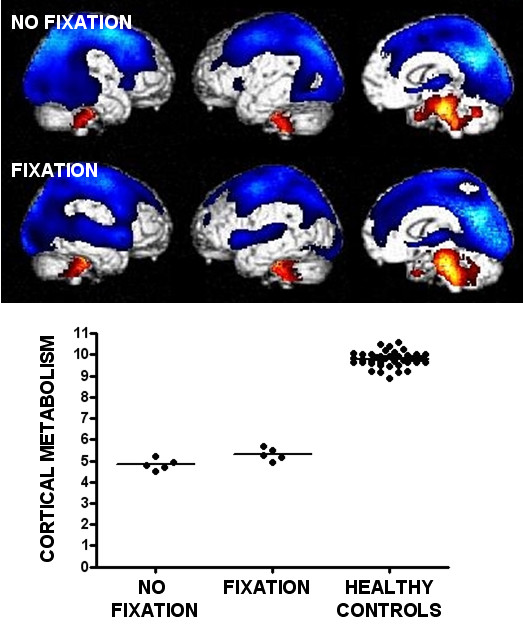
Background: Assessment of visual fixation is commonly used in the clinical examination of patients with disorders of consciousness. However, different international guidelines seem to disagree whether fixation is compatible with the diagnosis of the vegetative state (i.e., represents "automatic" subcortical processing) or is a sufficient sign of consciousness and higher order cortical processing. Methods: We here studied cerebral metabolism in ten patients with chronic post-anoxic encephalopathy and 39 age-matched healthy controls. Five patients were in a vegetative state (without fixation) and five presented visual fixation but otherwise showed all criteria typical of the vegetative state. Patients were matched for age, etiology and time since insult and were followed by repeated Coma Recovery Scale-Revised (CRS-R) assessments for at least 1 year. Sustained visual fixation was considered as present when the eyes refixated a moving target for more than 2 seconds as defined by CRS-R criteria. Results: Patients without fixation showed metabolic dysfunction in a widespread fronto-parietal cortical network (with only sparing of the brainstem and cerebellum) which was not different from the brain function seen in patients with visual fixation. Cortico-cortical functional connectivity with visual cortex showed no difference between both patient groups. Recovery rates did not differ between patients without or with fixation (none of the patients showed good outcome). Conclusions: Our findings suggest that sustained visual fixation in (non-traumatic) disorders of consciousness does not necessarily reflect consciousness and higher order cortical brain function.
Overview
The claims and statistics of this paper haven’t been checked yet.
Free: it reads the open-access text and checks the first 5 claims that cite a source we can check. Create a free account to check every claim.
Integrity signals
Registry
Cites
Statistics
Figures
Verification
Claims the paper makes
The claims and statistics of this paper haven’t been checked yet.
Free: it reads the open-access text and checks the first 5 claims that cite a source we can check. Create a free account to check every claim.
Claims other papers make about this one
Each is checked against this paper’s own text: does it say what the citing paper says it does?
The cited source doesn’t support the claim as written.
In the citing paper
“relative regional variations in metabolism correlate with the preservation of specific behavioral or perceptual functions in MCS patients [7, 8]”
From The Minimal Energetic Requirement of Sustained Awareness after Brain Injury (2016) · cites this paper as [8]
Checked by a reasoning model — may be wrong.
Experimental — accuracy not yet measured
Self-check
Percentages, sums and reported differences re-computed from the paper’s own numbers.
The self-check needs the paper’s full text.
Citations
Cites
The minimally conscious state: Definition and diagnostic criteria
Giacino, J. T., Ashwal, S., Childs, N., Cranford, R., Jennett, B., Katz, D. I., Kelly, J. P., Rosenberg, J. H., Whyte, J., Zafonte, R. D., et al. (2002) · Neurology · doi:10.1212/wnl.58.3.349 · Cited by 2,422
Giacino, J. T., Kalmar, K., & Whyte, J. (2004) · Archives of Physical Medicine and Rehabilitation · doi:10.1016/j.apmr.2004.02.033 · Cited by 1,874
Medical Aspects of the Persistent Vegetative State
(1994) · New England Journal of Medicine · doi:10.1056/nejm199405263302107 · Cited by 1,538
Schnakers, C., Vanhaudenhuyse, A., Giacino, J., Ventura, M., Boly, M., Majerus, S., Moonen, G., & Laureys, S. (2009) · BMC Neurology · doi:10.1186/1471-2377-9-35 · Cited by 1,348 · cited 1×
“Future studies should employ this methodology to increase our understanding of remaining ambiguous signs of consciousness such as for example the presence of orientation response to auditory stimuli or grimaces, abduction, flexion or orientation responses to noxious stimulation [14].”
Self-citationThe role of fixational eye movements in visual perception
Martinez-Conde, S., Macknik, S. L., & Hubel, D. H. (2004) · Nature Reviews Neuroscience · doi:10.1038/nrn1348 · Cited by 1,255 · cited 1×
“, see [10,11]], shown to be dysfunctional in our reported patients with visual fixation.”
BackgroundBrodmann's Areas 17 and 18 Brought into Stereotaxic Space—Where and How Variable?
Amunts, K., Malikovic, A., Mohlberg, H., Schormann, T., & Zilles, K. (2000) · NeuroImage · doi:10.1006/nimg.1999.0516 · Cited by 638 · cited 1×
“Seed region of interest (Brodmann area's 17 and 18) was taken from previously published probabilistic standardized 3D structural volumes of V1 and V2 [7]).”
MethodKincade, J. M., Abrams, R. A., Astafiev, S. V., Shulman, G. L., & Corbetta, M. (2005) · The Journal of Neuroscience · doi:10.1523/jneurosci.0236-05.2005 · Cited by 561 · cited 1×
“, see [10,11]], shown to be dysfunctional in our reported patients with visual fixation.”
BackgroundBeyond Phrenology: What Can Neuroimaging Tell Us About Distributed Circuitry?
Friston, K. (2002) · Annual Review of Neuroscience · doi:10.1146/annurev.neuro.25.112701.142846 · Cited by 465
Impaired Effective Cortical Connectivity in Vegetative State: Preliminary Investigation Using PET
Laureys, S., Goldman, S., Phillips, C., Van Bogaert, P., Aerts, J., Luxen, A., Franck, G., & Maquet, P. (1999) · NeuroImage · doi:10.1006/nimg.1998.0414 · Cited by 382 · cited 3×
“Methods Cerebral metabolic rates for glucose (CMRGlu) [4] were studied by means of [18F]-fluorodeoxyglucose-PET (FDG-PET) in ten patients with chronic (>4 weeks) post* Correspondence: steven.”
MethodSelf-citationTrans Fatty Acids in Margarine
(1995) · New England Journal of Medicine · doi:10.1056/nejm199507133330217 · Cited by 320
Cited by
Disorders of consciousness after acquired brain injury: the state of the science
Giacino, J. T., Fins, J. J., Laureys, S., & Schiff, N. D. (2014) · Nature Reviews Neurology · doi:10.1038/nrneurol.2013.279 · Cited by 883
Self-citationBruno, M.-A., Vanhaudenhuyse, A., Thibaut, A., Moonen, G., & Laureys, S. (2011) · Journal of Neurology · doi:10.1007/s00415-011-6114-x · Cited by 669
“a Denotes a minimally conscious state b Denotes a minimally conscious state except for anoxic aetiology [70] c Denotes emergence from the minimally conscious state J Neurol (2011) 258:1373–1384 1379”
BackgroundSelf-citationComa and consciousness: paradigms (re)framed by neuroimaging
Laureys, S., & Schiff, N. D. (2012) · NeuroImage · doi:10.1016/j.neuroimage.2011.12.041 · Cited by 397
Self-citationDi Perri, C., Bahri, M. A., Amico, E., Thibaut, A., Heine, L., Antonopoulos, G., Charland-Verville, V., Wannez, S., Gomez, F., Hustinx, R., et al. (2016) · The Lancet Neurology · doi:10.1016/s1474-4422(16)00111-3 · Cited by 259
Self-citationBruno, M.-A., Majerus, S., Boly, M., Vanhaudenhuyse, A., Schnakers, C., Gosseries, O., Boveroux, P., Kirsch, M., Demertzi, A., Bernard, C., et al. (2012) · Journal of Neurology · doi:10.1007/s00415-011-6303-7 · Cited by 239
“Phylogenetically, the midbrain is capable of driving the eyes to track objects [19, 20], and the human phenomenon of blindsight in the absence of occipital lobe function suggests that tracking could be coordinated in the optic tectum [21].”
BackgroundSelf-citationResting brain activity in disorders of consciousness: A systematic review and meta-analysis
Hannawi, Y., Lindquist, M. A., Caffo, B. S., Sair, H. I., & Stevens, R. D. (2015) · Neurology · doi:10.1212/wnl.0000000000001404 · Cited by 173
“These studies showed widespread reductions in activity in parietal, occipital, frontal, insular and cingulate cortices, and in the thalamus (findings of each study are listed in detail in table e-3).(26,29,31,32,35,36,38,41,42) In several studies, when compared with subjects in the MCS, patients in VS had proportional…”
ResultMinimally conscious state or cortically mediated state?
Naccache, L. (2018) · Brain · doi:10.1093/brain/awx324 · Cited by 181
“Bruno and colleagues compared the cerebral metabolism of five VS patients (therefore without visual fixation) and of five MCS patients in whom the single MCS item was preserved visual fixation (Bruno et al., 2010).”
BackgroundMeasuring Consciousness in Severely Damaged Brains
Gosseries, O., Di, H., Laureys, S., & Boly, M. (2014) · Annual Review of Neuroscience · doi:10.1146/annurev-neuro-062012-170339 · Cited by 152
“…communication and object use (Giacino et al. 2002) • Reflex behaviors: auditory startle, blinking to threat, flexion withdrawal/stereotyped to pain, yawning, oral reflexes (Giacino et al. 2002) • Debated behavior: visual fixation (Bruno et al. 2010), localization to sound (Cheng et al. 2013) 2.”
BackgroundSelf-citationMetabolic activity in external and internal awareness networks in severely brain-damaged patients
Thibaut, A., Bruno, M., Chatelle, C., Gosseries, O., Vanhaudenhuyse, A., Demertzi, A., Schnakers, C., Thonnard, M., Charland-Verville, V, Bernard, C., et al. (2012) · Journal of Rehabilitation Medicine · doi:10.2340/16501977-0940 · Cited by 151
Self-citationThe Nature of Consciousness in the Visually Deprived Brain
Kupers, R., Pietrini, P., Ricciardi, E., & Ptito, M. (2011) · Frontiers in Psychology · doi:10.3389/fpsyg.2011.00019 · Cited by 139
Recent advances in disorders of consciousness: Focus on the diagnosis
Gosseries, O., Zasler, N. D., & Laureys, S. (2014) · Brain Injury · doi:10.3109/02699052.2014.920522 · Cited by 150
“Visual fixation cannot be definitively determined as a sign of consciousness, at least in patients with anoxia [27], whereas resistance to eye opening seems to be related to consciousness [28].”
Self-citationThe Minimal Energetic Requirement of Sustained Awareness after Brain Injury
Stender, J., Mortensen, K. N., Thibaut, A., Darkner, S., Laureys, S., Gjedde, A., & Kupers, R. (2016) · Current Biology · doi:10.1016/j.cub.2016.04.024 · Cited by 131
“Notwithstanding, relative regional variations in metabolism correlate with the preservation of specific behavioral or perceptual functions in MCS patients [7, 8], supporting the claim that network activations cause local increases in energy metabolism even in disorders of consciousness (DOCs) [9].”
Self-citationGodet, T., Chabanne, R., Marin, J., Kauffmann, S., Futier, E., Pereira, B., & Constantin, J. (2016) · Anesthesiology · doi:10.1097/aln.0000000000001379 · Cited by 148
Disorders of consciousness: What's in a name?
Gosseries, O., Bruno, M., Chatelle, C., Vanhaudenhuyse, A., Schnakers, C., Soddu, A., & Laureys, S. (2011) · Neurorehabilitation · doi:10.3233/nre-2011-0625 · Cited by 123
“, 2010 [20] 10 VS/UWS NTBI 3 m FP hypometabolism (VS/UWS without fixation =”
BackgroundResultInfluentialSelf-citationComa recovery scale-r: variability in the disorder of consciousness
Cortese, M., Riganello, F., Arcuri, F., Pugliese, M., Lucca, L., Dolce, G., & Sannita, W. (2015) · BMC Neurology · doi:10.1186/s12883-015-0455-5 · Cited by 101
“The within/between subject (spontaneous) variability of the signs in use to evaluate brain responsiveness in VS/ UWS and MCS is a possible critical issue adding to the existing controversy on their pathophysiological meaning [17, 20].”
BackgroundOn the Cerebral Origin of EEG Responses to TMS: Insights From Severe Cortical Lesions
Gosseries, O., Sarasso, S., Casarotto, S., Boly, M., Schnakers, C., Napolitani, M., Bruno, M., Ledoux, D., Tshibanda, J., Massimini, M., et al. (2014) · Brain stimulation · doi:10.1016/j.brs.2014.10.008 · Cited by 98
Self-citationVisual Pursuit: Within-Day Variability in the Severe Disorder of Consciousness
Candelieri, A., Cortese, M. D., Dolce, G., Riganello, F., & Sannita, W. G. (2011) · Journal of Neurotrauma · doi:10.1089/neu.2011.1885 · Cited by 98
“A visual pursuit response was elicited more frequently in MCS than in VS subjects, in percentages (62% versus 33%) that are consistent with previous observations (Bruno et al., 2010; Dolce and Sazbon, 2002; Giacino et al., 1997,2004; Gusnard et al., 2001; Jennett, 2002; Laureys, 2005; Multi-Society Task Force on PVS,…”
InfluentialHermann, B., Stender, J., Habert, M., Kas, A., Denis-Valente, M., Raimondo, F., Pérez, P., Rohaut, B., Sitt, J. D., & Naccache, L. (2021) · NeuroImage Clinical · doi:10.1016/j.nicl.2021.102601 · Cited by 85
“Indeed, the absence of metabolic differences between MCS patients with fixation only and VS/UWS patients cast doubt on the relevance of this sign as an MCS item (Bruno et al., 2010).”
BackgroundMagee, W. L., Siegert, R. J., Daveson, B. A., Lenton-Smith, G., & Taylor, S. M. (2013) · Neuropsychological Rehabilitation · doi:10.1080/09602011.2013.844174 · Cited by 78
“…pursuit in VS patients is a reflexive or conscious behaviour (Chatelle, Laureys, Majerus, & Schnakers, 2010) as the research with VS patients suggests that visual fixation does not necessarily indicate conscious interaction between the patient and his or her surroundings (Bruno et al., 2010).”
BackgroundConsciousness and the fallacy of misplaced objectivity
Ellia, F., Hendren, J., Grasso, M., Kozma, C., Mindt, G., P. Lang, J., M. Haun, A., Albantakis, L., Boly, M., & Tononi, G. (2021) · Neuroscience of Consciousness · doi:10.1093/nc/niab032 · Cited by 57
“Conversely, behaviors such as tracking a target with the eyesmay occur in the absence of experience (Bruno et al. 2010).”
Self-citationComa and Disorders of Consciousness: Scientific Advances and Practical Considerations for Clinicians
Bodart, O., Gosseries, O., & Laureys, S. (2013) · Seminars in Neurology · doi:10.1055/s-0033-1348965 · Cited by 60
Self-citationQuantitative assessment of visual behavior in disorders of consciousness
Trojano, L., Moretta, P., Loreto, V., Cozzolino, A., Santoro, L., & Estraneo, A. (2012) · Journal of Neurology · doi:10.1007/s00415-012-6435-4 · Cited by 58
“, [2 s) visual fixation of stationary stimuli [19].”
BackgroundAssessment of visual fixation in vegetative and minimally conscious states
Di, H., Nie, Y., Hu, X., Tong, Y., Heine, L., Wannez, S., Huang, W., Yu, D., He, M., Thibaut, A., et al. (2014) · BMC Neurology · doi:10.1186/1471-2377-14-147 · Cited by 55
Self-citationSattin, D., Giovannetti, A. M., Ciaraffa, F., Covelli, V., Bersano, A., Nigri, A., Ferraro, S., Minati, L., Sebastiano, D. R., Duran, D., et al. (2014) · Journal of Neurology · doi:10.1007/s00415-014-7478-5 · Cited by 48
Measures of CNS-Autonomic Interaction and Responsiveness in Disorder of Consciousness
Riganello, F., Larroque, S. K., Perri, C. D., Prada, V., Sannita, W. G., & Laureys, S. (2019) · Frontiers in Neuroscience · doi:10.3389/fnins.2019.00530 · Cited by 49
Self-citationAssessment of consciousness with electrophysiological and neurological imaging techniques
Bruno, M., Gosseries, O., Ledoux, D., Hustinx, R., & Laureys, S. (2011) · Current Opinion in Critical Care · doi:10.1097/mcc.0b013e328343476d · Cited by 50
Self-citationEye Movement Measurement in Diagnostic Assessment of Disorders of Consciousness
Ting, W. K., Velázquez, J. L. P., & Cusimano, M. D. (2014) · Frontiers in Neurology · doi:10.3389/fneur.2014.00137 · Cited by 47
Bonfiglio, L., Olcese, U., Rossi, B., Frisoli, A., Arrighi, P., Greco, G., Carozzo, S., André, P., Bergamasco, M., & Carboncini, M. C. (2012) · Human Brain Mapping · doi:10.1002/hbm.22056 · Cited by 46
“The VS group was composed of three subjects with CRS-R score ¼ 6/23, plus one subject with a CRS-R score of 9/23 [assigned, however, only for the presence of visual fixation and, hence, according to Bruno et al., 2010, classified as VS].”
BackgroundSpinal Cord Injury: How Could Acupuncture Help?
Fan, Q., Cavus, O., Xiong, L., & Xia, Y. (2018) · Journal of Acupuncture and Meridian Studies · doi:10.1016/j.jams.2018.05.002 · Cited by 43
Carrière, M., Cassol, H., Aubinet, C., Panda, R., Thibaut, A., Larroque, S. K., Simon, J., Martial, C., Bahri, M. A., Chatelle, C., et al. (2020) · Brain Communications · doi:10.1093/braincomms/fcaa195 · Cited by 45
“We also hypothesize that compared to UWS NO-LOCA patients, UWS LOCA patients have greater brain metabolism (as shown with visual fixation) (Bruno et al. , 2010), and higher connectivity in brain areas linked to auditory processing and awareness.”
Self-citationVolitional electromyographic responses in disorders of consciousness
Habbal, D., Gosseries, O., Noirhomme, Q., Renaux, J., Lesenfants, D., Bekinschtein, T. A., Majerus, S., Laureys, S., & Schnakers, C. (2014) · Brain Injury · doi:10.3109/02699052.2014.920519 · Cited by 44
“oriented eye movements; see the debate around visual fixation) [2], the conscious aspect of volitional responses is difficult to dispute (a patient has to be conscious in order to wilfully respond to stimulation).”
BackgroundSelf-citationWhich behaviours are first to emerge during recovery of consciousness after severe brain injury?
Martens, G., Bodien, Y. G., Sheau, K. E., Christoforou, A., & Giacino, J. T. (2019) · Annals of Physical and Rehabilitation Medicine · doi:10.1016/j.rehab.2019.10.004 · Cited by 42
“cortex on FDG-PET or in recovery rates between patients who demonstrated fixation and those who did not [19].”
BackgroundMindsight: Diagnostics in Disorders of Consciousness
Guldenmund, P., Stender, J., Heine, L., & Laureys, S. (2012) · Critical Care Research and Practice · doi:10.1155/2012/624724 · Cited by 44
“, aphasia, apraxia or deafness [29, 30]), language comprehension, restraining and immobilizing techniques, and pain [26].”
BackgroundSelf-citationBonfiglio, L., Piarulli, A., Olcese, U., André, P., Arrighi, P., Frisoli, A., Rossi, B., Bergamasco, M., & Carboncini, M. C. (2014) · PLoS ONE · doi:10.1371/journal.pone.0093252 · Cited by 39
“The VS/UWS group was composed of 3 subjects with CRS-R score #6/23, plus 1 subject with a CRS-R score of 9/23 classified as VS/UWS according to Bruno and collegues [27].”
MethodVisual Pursuit in the Severe Disorder of Consciousness
Dolce, G., Lucca, L. F., Candelieri, A., Rogano, S., Pignolo, L., & Sannita, W. G. (2010) · Journal of Neurotrauma · doi:10.1089/neu.2010.1405 · Cited by 40
New Behavioral Signs of Consciousness in Patients with Severe Brain Injuries
Mat, B., Sanz, L. R. D., Arzi, A., Boly, M., Laureys, S., & Gosseries, O. (2022) · Seminars in Neurology · doi:10.1055/a-1883-0861 · Cited by 40
Self-citationRiganello, F., Cortese, M. D., Dolce, G., & Sannita, W. G. (2013) · BMC Neurology · doi:10.1186/1471-2377-13-164 · Cited by 35
“The HRV descriptors of the VS/UWS and MCS subgroups were compared in baseline to exclude differences depending on the clinical condition already at rest (Mann–Whitney U test).”
BackgroundInfluentialBack to the bedside? Making clinical decisions in patients with prolonged unconsciousness
Wade, D. T. (2016) · Journal of Medical Ethics · doi:10.1136/medethics-2015-103140 · Cited by 32
Liberati, G., Hünefeldt, T., & Belardinelli, M. O. (2014) · Frontiers in Human Neuroscience · doi:10.3389/fnhum.2014.00865 · Cited by 35
“Whereas fixation of a stationary visual target is considered compatible with the diagnosis of VS (PVS, 1994; Royal College of Physicians, 2003; Bruno et al., 2010), the visual pursuit of moving stimuli is considered sufficient for the diagnosis of MCS (Giacino et al., 2002, 2004; Majerus et al.,…”
MethodGantner, I. S., Bodart, O., Laureys, S., & Demertzi, A. (2012) · Future Neurology · doi:10.2217/fnl.12.77 · Cited by 33
“In any case, in order to minimize false positives and to enhance our understanding of the interaction between brain and behavior, we suggest that future investigations take the correlation between behavioral scores and neuroimaging data into account, which has been previously suggested [57] and performed [20,58].”
Self-citationMirror efficiency in the assessment of visual pursuit in patients in minimally conscious state
Wannez, S., Vanhaudenhuyse, A., Laureys, S., & Brédart, S. (2017) · Brain Injury · doi:10.1080/02699052.2017.1376755 · Cited by 28
“Indeed, in the literature, it has been evoked that patients who show a visual fixation to a brightly coloured object as the only sign of consciousness have a cerebral metabolism comparable to patients who are in UWS/VS (18).”
BackgroundSelf-citationOne-Year Demographical and Clinical Indices of Patients with Chronic Disorders of Consciousness
Nekrasova, J. Y., Kanarskii, M. M., Borisov, I. V., Pradhan, P., Shunenkov, D. A., Vorobiev, A., Smirnova, M. A., Pasko, V., Petrova, M. V., Luginina, E. V., et al. (2021) · Brain Sciences · doi:10.3390/brainsci11050651 · Cited by 25
“The lack of communication or dubious communication by all available methods, bearing in mind the level of consciousness at discharge, made it possible to include patients that were presumably in VS/UWS and MCS− in the category of “noncommunicating” participants.”
MethodInfluentialWijnen, V. J. M., Eilander, H. J., de Gelder, B., & Boxtel, G. J. M. V. (2014) · Neurophysiologie Clinique · doi:10.1016/j.neucli.2014.08.008 · Cited by 25
“[8] investigated brain responses related to visual xation in a vegetative state, and did not demonstrate any ifference in the brain areas related to consciousness in atients with or without fixation capabilities.”
Naro, A., Leo, A., Buda, A., Manuli, A., Bramanti, A., Bramanti, P., & Calabrò, R. S. (2016) · Brain Research · doi:10.1016/j.brainres.2016.10.015 · Cited by 26
Altered States of Consciousness after Brain Injury
Stender, J., Laureys, S., & Gosseries, O. (2017) · Wiley eBooks · doi:10.1002/9781119132363.ch47 · Cited by 23
Self-citationXiao, J., Pan, J., He, Y., Xie, Q., Yu, T., Huang, H., Lv, W., Zhang, J., Yu, R., & Li, Y. (2018) · Neuroscience Bulletin · doi:10.1007/s12264-018-0257-z · Cited by 27
Carrière, M., Lloréns, R., Navarro, M. D., Olaya, J., Ferri, J., & Noé, E. (2021) · Annals of Physical and Rehabilitation Medicine · doi:10.1016/j.rehab.2021.101534 · Cited by 22
Mencarelli, L., Biagi, M. C., Salvador, R., Romanella, S. M., Ruffini, G., Rossi, S., & Santarnecchi, E. (2020) · Journal of Clinical Medicine · doi:10.3390/jcm9030828 · Cited by 23
“, 2010 [58] 10 UWS cronic post-anoxic enephalopathy 2 44.”
Stokes, V., Gunn, S., Schouwenaars, K., & Badwan, D. (2016) · Neuropsychological Rehabilitation · doi:10.1080/09602011.2016.1214604 · Cited by 22
Demertzi, A., Sitt, J. D., Sarasso, S., & Pinxten, W. (2017) · Neuroscience of Consciousness · doi:10.1093/nc/nix010 · Cited by 25
“Importantly, some of the diagnostic criteria for VS/UWS and MCS do not share international consensus, such is the case with visual fixation, which is considered as a sign of consciousness for some whereas others provide evidence for the opposite (Bruno et al. 2010; Naro et al. 2016).”
BackgroundUnresponsive wakefulness syndrome.
Laureys, S., & Boly, M. (2012) · PubMed · doi:10.4449/aib.v150i2.1407 · Cited by 19
Self-citationNoé, E., Ferri, J., Olaya, J., Navarro, M. D., O’Valle, M., Colomer, C., Moliner, B., Ippoliti, C., Maza, A., & Lloréns, R. (2021) · Brain Sciences · doi:10.3390/brainsci11010126 · Cited by 15
“However, the reliability of visual fixation to reflect consciousness and higher order cortical brain function is controversial [60].”
BackgroundRiganello, F., Macrì, S., Alleva, E., Petrini, C., Soddu, A., León‐Carrión, J., & Dolce, G. (2016) · Frontiers in Neurology · doi:10.3389/fneur.2016.00202 · Cited by 17
Naro, A., Leo, A., Filoni, S., Bramanti, P., & Calabrò, R. S. (2015) · Restorative Neurology and Neuroscience · doi:10.3233/rnn-150525 · Cited by 15
“Nevertheless, since both some patients with UWS and MCS showed a stable visual fixation at the CRS-R (a score of 2 at visuomotor domain), the visual fixation could not be per se considered as a marker of MCS, as also suggested by functional neuroimaging studies (e.g. Bruno et al., 2010).”
BackgroundResultEvaluation of consciousness rehabilitation via neuroimaging methods
Wang, J., Gao, X., Xiang, Z., Sun, F., & Yang, Y. (2023) · Frontiers in Human Neuroscience · doi:10.3389/fnhum.2023.1233499 · Cited by 15
Neurology of consciousness impairments
Rohaut, B., Faugeras, F., & Naccache, L. (2013) · Cambridge University Press eBooks · doi:10.1017/cbo9781139248822.010 · Cited by 16
Observed Recovery Sequence in Neurobehavioral Function After Severe Traumatic Brain Injury
Lannin, N. A., Cusick, A., McLachlan, R., & Allaous, J. (2013) · American Journal of Occupational Therapy · doi:10.5014/ajot.2013.008094 · Cited by 12
“For decades, observation of visual performance has been a critical clinical marker regarding DOC informing diagnostic, prognostic, and classification decisions (Ansell, 1993, 1995; Bruno et al., 2010; Dolce et al., 2011, p. 1152).”
Arbour, C., Baril, A., Westwick, H. J., Potvin, M.-J., Gilbert, D., Giguère, J., Lavigne, G. J., Désautels, A., Bernard, F., Laureys, S., et al. (2016) · Critical Care Medicine · doi:10.1097/ccm.0000000000001960 · Cited by 12
“Cerebrospinal fluid drainage, n (%) 54 (51) 31 (41) NS 22 (34) 27 (34) NS”
InfluentialSelf-citationSattin, D., Sebastiano, D. R., Magnani, F. G., D’Incerti, L., Marotta, G., Benti, R., Tirelli, S., Bersano, A., Duran, D., Visani, E., et al. (2021) · Physiology & Behavior · doi:10.1016/j.physbeh.2021.113310 · Cited by 11
Resting brain activity in disorders of consciousness: A systematic review and meta-analysis
Shen, D., Cui, L., Shen, Z., Garbarino, S., Sannita, W. G., Hannawi, Y., & Stevens, R. D. (2016) · Neurology · doi:10.1212/wnl.0000000000002274 · Cited by 12
Khorev, V. S., Kurkin, S., Николаевна, П. Е., Radutnaya, M., Bondar, E., Mayorova, L. A., & Hramov, A. E. (2025) · The European Physical Journal Special Topics · doi:10.1140/epjs/s11734-024-01454-2 · Cited by 11
“The clinical assessment of the level of consciousness is also influenced by the level of wakefulness and attention, the state of the motor and sensory spheres, the functions of perception and speech, the presence of pain syndrome, as well as the patient’s immobilization [16, 17].”
Care and Neurorehabilitation in the Disorder of Consciousness: A Model in Progress
Dolce, G., Arcuri, F., Carozzo, S., Cortese, M. D., Greco, P., Lucca, L. F., Pignolo, L., Pugliese, M. E., & Riganello, F. (2015) · The Scientific World JOURNAL · doi:10.1155/2015/463829 · Cited by 9
“The visual pursuit response is a major CRS-r item observed in 70–80% of subjects in MCS [34–36] and a key marker of evolution from VS/UWS [37, 38]; it has been reported with lower incidence (∼20–30%) also in subjects otherwise unambiguously diagnosed as VS/UWS [10, 29, 39, 40].”
BackgroundNaro, A., Chillura, A., Portaro, S., Bramanti, A., Luca, R. D., Bramanti, P., & Calabrò, R. S. (2018) · Frontiers in Neurology · doi:10.3389/fneur.2018.00047 · Cited by 11
Liu, D., Wang, N., Song, M., Chai, X., He, Q., Cao, T., Kong, D.-W., Song, Z., Zhang, G., Liu, L., et al. (2025) · Frontiers in Neurology · doi:10.3389/fneur.2024.1425271 · Cited by 8
Responsiveness in DoC and individual variability
Sannita, W. G. (2015) · Frontiers in Human Neuroscience · doi:10.3389/fnhum.2015.00270 · Cited by 7
“…cognition were reported in a small number of subjects (Monti et al., 2010a); whether these activations should be considered equivalent to consciousness or compatible with, but atypical for VS/UWS is a matter of debate (Bruno et al., 2010; Monti et al., 2010b; Bardin et al., 2011; Celesia, 2013).”
BackgroundDondi, F., Latronico, N., Bellini, P., Lucchini, S., Camoni, L., Cossandi, M., Viganò, G. L., Santo, G., & Bertagna, F. (2025) · Diagnostics · doi:10.3390/diagnostics15111406 · Cited by 5
“An interesting research performed by Snyman et al. [33] aimed to assess the efficacy of zolpidem (a positive modulator of GABAA receptors) in increasing the level of consciousness in three children with PVS by using [ 18 F]FDG PET imaging to assess the effect of the therapy; however, no significant…”
Czyżewski, A., Kurowski, A., Odya, P., & Szczuko, P. (2020) · BioMedical Engineering OnLine · doi:10.1186/s12938-019-0746-y · Cited by 5
Sattin, D., Lovaglio, P. G., Brenna, G., Covelli, V., Sebastiano, D. R., Duran, D., Minati, L., Giovannetti, A. M., Rosazza, C., Bersano, A., et al. (2017) · Clinical Rehabilitation · doi:10.1177/0269215517694225 · Cited by 5
Functional Imaging and Impaired Consciousness
Vanhaudenhuyse, A., Boly, M., Bruno, M., Gosseries, O., Demertzi, A., Kirsch, M., Tshibanda, J., Thonnard, M., Charland‐Verville, V., Chatelle, C., et al. (2012) · Springer eBooks · doi:10.1007/978-1-4471-2440-5_3 · Cited by 4
Self-citationEye gaze and conscious processing in severely brain-injured patients
Chatelle, C., Laureys, S., Majerus, S., & Schnakers, C. (2010) · Behavioral and Brain Sciences · doi:10.1017/s0140525x10001494 · Cited by 6
Self-citationDetection of Consciousness in the Severely Injured Brain
Stender, J., GJEDDE, A. H., & Laureys, S. (2015) · Annual update in intensive care and emergency medicine · doi:10.1007/978-3-319-13761-2_36 · Cited by 6
Self-citationCharland‐Verville, V., Habbal, D., Laureys, S., & Gosseries, O. (2013) · Schweizer Archiv für Neurologie und Psychiatrie · doi:10.4414/sanp.2012.00131 · Cited by 3
Self-citationComa Prognostication: Looks That Count*
Stevens, R. D., & Hannawi, Y. (2016) · Critical Care Medicine · doi:10.1097/ccm.0000000000002039 · Cited by 3
“Also, it is notable that a recent study of patients with chronic disorders of consciousness found no difference in metabolic impairment or corticocortical functional connectivity when comparing patients with or without visual fixation (12).”
BackgroundKing, J.-R. (2014) · theses.fr (ABES) · doi:10.70675/31b246a3zc187z492dzaa19z94f6a03ee265 · Cited by 5
Rossato, E., Avesani, R., Bonadiman, S., Olivari, L., Silva, R., Zanatta, P., Lupi, A., & Salgarello, M. (2022) · Minerva Anestesiologica · doi:10.23736/s0375-9393.22.16104-3 · Cited by 2
PET Imaging in Altered States of Consciousness: Coma, Sleep, and Hypnosis
Bonin, E., Martens, G., Cassol, H., Chatelle, C., Laureys, S., & Thibaut, A. (2020) · Springer eBooks · doi:10.1007/978-3-030-53168-3_45 · Cited by 4
Self-citationEstraneo, A., Magliacano, A., Bellis, F. D., Amantini, A., Lavezzi, S., Grippo, A., On behalf of the CaPIADoC study group, Aloisi, M., Formisano, R., Anzalone, N., et al. (2024) · Neurological Sciences · doi:10.1007/s10072-024-07875-0 · Cited by 1
“A longitudinal study on 10 post-anoxic patients in VS/UWS [49] evaluated possible predictive value of an intentional behaviour (i.e., visual fixation) as assessed by CRS-R on recovery of command following at 12 months after brain injury.”
The Diagnostic Value of Visual Evoked Potentials in Chronic Disorders of Consciousness
Clementi, L., Magnani, F. G., Barbadoro, F., Ippoliti, C., Cacciatore, M., Sattin, D., Pingue, V., Cazzulani, B., Navarro, J., Schiaffi, E., et al. (2025) · Annals of Clinical and Translational Neurology · doi:10.1002/acn3.70102 · Cited by 1
“Conversely, a study [66] showed that some VS/UWS patients exhibiting visual fixation did not differ from non-fixating VS/ UWS patients in cerebral metabolism or cortico-cortical connectivity.”
Magnani, F. G., Cacciatore, M., Clementi, L., Barbadoro, F., Ippoliti, C., Sebastiano, D. R., Stanziano, M., Nigri, A., Medina, J. P., Rosazza, C., et al. (2026) · Neuroscience & Biobehavioral Reviews · doi:10.1016/j.neubiorev.2026.106837 · Cited by 1
Behavioral Neurology in the ICU
Stevens, R. D., Sharshar, T., & Ely, E. W. (2013) · Cambridge University Press eBooks · doi:10.1017/cbo9781139248822.009 · Cited by 1
PET Imaging in Altered States of Consciousness: Coma, Sleep, and Hypnosis
Thibaut, A., Chatelle, C., Stender, J., Demertzi, A., Bernard, C., Hustinx, R., Laureys, S., & Bruno, M. (2014) · Springer eBooks · doi:10.1007/978-3-642-54307-4_47 · Cited by 2
Self-citationCalabrò, R. S., & Naro, A. (2018) · Clinical Neurophysiology · doi:10.1016/j.clinph.2018.01.067 · Cited by 1
Multimodal meta-analysis of brain integrity in disorders of consciousnessPreprint
Sala, A., Meys, M., Alnagger, N., Beliy, N., Abagnale, S., Szirmai, D., Ok, B. K., Wang, Z., Bardiau, M., Beaudart, C., et al. (2026) · Research Square · doi:10.21203/rs.3.rs-8480413/v1 · Cited by 2
Self-citationCharland‐Verville, V. (2012) · ORBi (University of Liège)
Charland‐Verville, V., Laureys, S., Gosseries, O., Thibaut, A., & Bruno, M. (2014) · Springer eBooks · doi:10.1007/978-3-7091-1634-0_8
Self-citationDecoding Mental States after Severe Brain Injury
Gibson, R. M. (2017) · Scholarship@Western (Western University)
Gobert, F. (2019) · theses.fr (ABES) · doi:10.70675/29636c4az674bz41c9za515zf657704de2c7 · Cited by 1
Imagerie fonctionnelle et états de conscience altérée
Vanhaudenhuyse, A., Boly, M., Bruno, M., Gosseries, O., Demertzi, A., Laureys, S., & Soddu, A. (2011) · Springer eBooks · doi:10.1007/978-2-8178-0127-8_4
Self-citationAméliorer le diagnostic des patients en état de conscience altérée: une approche comportementale
Wannez, S. (2017) · ORBi (University of Liège)
Ocular motor and vestibular examination in the unconscious patient—standard of care
Tarnutzer, A. A., Shaikh, A. G., & Zee, D. S. (2026) · Frontiers in Neurology · doi:10.3389/fneur.2026.1790158
“Disorders of consciousness are classically divided into coma, unresponsive wakefulness syndrome (UWS, previously referred to as vegetative state) and minimally conscious state (MCS), depending on the patient’s response to internal and external stimuli (1).”
InfluentialBagnato, S., Boccagni, C., & Bonavita, J. (2026) · Neurological Sciences · doi:10.1007/s10072-026-08932-6
“Bruno et al. [ 15 ] compared 18 F-fluorodeoxyglucose posi - tron emission tomography (FDG-PET) in ten patients with prolonged DoC—five with sustained visual fixation (consistent with MCS) and five without fixation.”
Faugeras, F. (2014) · theses.fr (ABES) · doi:10.70675/64eb79d1zbd6fz49cazbb22zf041e6b0c105
“La première (Bruno et al., 2010) s’est attachée à comparer des sujets végétatifs, sans ou avec fixation oculaire.”
Novel diagnostic and therapeutic approaches for patients suffering from disorders of consciousness
Hermann, B. (2019) · theses.fr (ABES) · doi:10.70675/e8620819z412fz4bd4z8475z998a979bfe82
Valdés, L. D. F. I., & Foyaca-Sibat, H. (2026) · International Journal of Drug Delivery Technology · doi:10.25258/ijddt.16.17s.22
What eye-movements tell us about Disorders of Consciousness?
Clerc, A., Tilikete, C., Gobert, F., Luauté, J., & Beaudoin‐Gobert, M. (2026) · Neuroscience & Biobehavioral Reviews · doi:10.1016/j.neubiorev.2026.106835
Boltzmann, M., Jenner, S. B., Krauss, J. K., Tegtbur, U., Haghikia, A., Weimar, C., & Rollnik, J. D. (2026) · BMC Neurology · doi:10.1186/s12883-026-05566-1
“…the CRS-R classifies fixation as indicative of MCS, Bruno et al. (2010) found no meaningful differences in cerebral metabolism between five UWS patients without fixation and five patients whose only sign of MCS was visual fixation; moreover, none showed a favorable outcome after one year [39].”
Metadata
- Authors
- Bruno, M.-A., Vanhaudenhuyse, A., Schnakers, C., Boly, M., Gosseries, O., Demertzi, A., Majerus, S., Moonen, G., Hustinx, R., & Laureys, S.
- Affiliations
- University of Liège (BE)
- Centre Hospitalier Universitaire de Liège (BE)
- Corresponding author
- Laureys, Steven
- ORCID
- Venue
- BMC Neurology
- Published
- 2010-05-26
- Volume
- 10
- Issue
- 1
- Pages
- 35-35
- ISSN
- 1471-2377 (ISSN-L)
- PMC
- PMC2895583
- OpenAlex
- W2157058742
- Cited by
- 92
- References
- 19
- Citations by year
- 2026: 6 · 2025: 4 · 2024: 1 · 2023: 1 · 2022: 3 · 2021: 6 · 2020: 4 · 2019: 3 · 2018: 4 · 2017: 5 · 2016: 9 · 2015: 7 · 2014: 13 · 2013: 7 · 2012: 8
- FWCI
- 6.07
- Type
- journal article
- Language
- en
- Open access
- gold
- doi.org
- Licence
- Locations
- BMC Neurology (publishedVersion, cc-by)
- PubMed Central (publishedVersion, cc-by)
- PubMed (publishedVersion)
- Open Repository and Bibliography (University of Liège) (submittedVersion, other-oa)
- DOAJ (DOAJ: Directory of Open Access Journals) (submittedVersion, cc-by-sa)
- Funders
- James S. McDonnell Foundation (ARC 06/11-340)
- Mind Science Foundation
- European Commission
- Fonds De La Recherche Scientifique - FNRS
- Topics
- Health Sciences › Medicine › Clinical Neurology › Traumatic Brain Injury Research
- Social Sciences › Arts and Humanities › Philosophy › Philosophy and Theoretical Science
- Social Sciences › Psychology › Experimental and Cognitive Psychology › Cognitive Functions and Memory
- Keywords
- visual fixation, vegetative state, disorders of consciousness, brain metabolism, postanoxic encephalopathy, Coma Recovery Scale-Revised, visual cortex connectivity
- MeSH terms
- Adult, Hypoxia, Brain, Brain Diseases, Brain Mapping, Chronic Disease, Consciousness, Female, Fixation, Ocular, Follow-Up Studies, Glucose, Humans, Male, Middle Aged, Neurologic Examination, Time Factors, Case-Control Studies, Persistent Vegetative State, Recovery of Function, Positron-Emission Tomography
About these checks
Registry, retraction, Cites and statistics results are computed, not judged, with one exception: a printed reference that no index lists is read once by a model before it counts as a citation error. Claims are extracted by a model and kept only when their quote appears verbatim in the text; each cited source is then checked, with a model’s help, for whether it says what the claim relies on. Those verdicts can be wrong — read the claim’s quote and the cited source before relying on one.
Statistics and arithmetic are recomputed, not judged.
Confidence bands are shown only for fields calibrated on our annotated test set. None is calibrated yet, so no band is shown.
What counts as a claim ›How we measure confidence ›How we check this ›
Are you an author, or do you see a problem with this page? Request a review
Data sources
Bibliographic data: Semantic Scholar, OpenAlex, Crossref.
Contains information from the Semantic Scholar Academic Graph Datasets, made available under the ODC Attribution License (ODC-BY 1.0).
Semantic Scholar’s data is described in: Kinney, R., et al. (2023). The Semantic Scholar Open Data Platform. arXiv:2301.10140.
