

Suboptimal care and maternal mortality among foreign-born women in Sweden: maternal death audit with application of the ‘migration three delays’ model
Open accessThe DOI matches its Crossref record; 47 of the 48 references it cites were found in a registry or an index.
Abstract
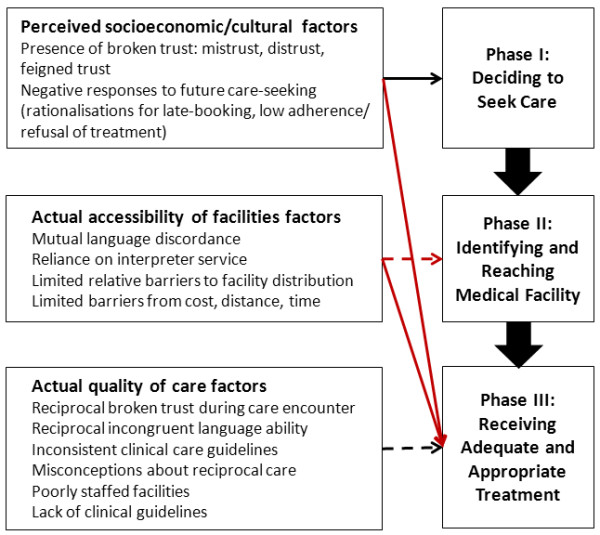
BACKGROUND: Several European countries report differences in risk of maternal mortality between immigrants from low- and middle-income countries and host country women. The present study identified suboptimal factors related to care-seeking, accessibility, and quality of care for maternal deaths that occurred in Sweden from 1988-2010. METHODS: A subset of maternal death records (n = 75) among foreign-born women from low- and middle-income countries and Swedish-born women were audited using structured implicit review. One case of foreign-born maternal death was matched with two native born Swedish cases of maternal death. An assessment protocol was developed that applied both the 'migration three delays' framework and a modified version of the Confidential Enquiry from the United Kingdom. The main outcomes were major and minor suboptimal factors associated with maternal death in this high-income, low-maternal mortality context. RESULTS: Major and minor suboptimal factors were associated with a majority of maternal deaths and significantly more often to foreign-born women (p = 0.01). The main delays to care-seeking were non-compliance among foreign-born women and communication barriers, such as incongruent language and suboptimal interpreter system or usage. Inadequate care occurred more often among the foreign-born (p = 0.04), whereas delays in consultation/referral and miscommunication between health care providers where equally common between the two groups. CONCLUSIONS: Suboptimal care factors, major and minor, were present in more than 2/3 of maternal deaths in this high-income setting. Those related to migration were associated to miscommunication, lack of professional interpreters, and limited knowledge about rare diseases and pregnancy complications. Increased insight into a migration perspective is advocated for maternity clinicians who provide care to foreign-born women.
Overview
The claims and statistics of this paper haven’t been checked yet.
Free: it reads the open-access text and checks the first 5 claims that cite a source we can check. Create a free account to check every claim.
Integrity signals
Registry
Cites
Statistics
Figures
Verification
Claims the paper makes
The claims and statistics of this paper haven’t been checked yet.
Free: it reads the open-access text and checks the first 5 claims that cite a source we can check. Create a free account to check every claim.
Claims other papers make about this one
Each is checked against this paper’s own text: does it say what the citing paper says it does?
The cited source says what the claim attributes to it.
In the citing paper
“The extent to which language barriers lead to delays both inside and outside of the camps has not been studied, however language barriers have been shown to cause delays in other contexts.64–66”
From Mortality in Rohingya refugee camps in Bangladesh: historical, social, and political context (2019) · cites this paper as [65]
Self-check
Percentages, sums and reported differences re-computed from the paper’s own numbers.
The self-check needs the paper’s full text.
Citations
Cites
Too far to walk: Maternal mortality in context
Thaddeus, S., & Maine, D. (1994) · Social Science & Medicine · doi:10.1016/0277-9536(94)90226-7 · Cited by 3,240 · cited 1×
“This protocol applied a modified version of the ‘three delays’ model [25], referred to as the ‘migration three delays’ model of Binder et al.”
MethodSaving Mothers’ Lives: Reviewing maternal deaths to make motherhood safer: 2006–2008
(2011) · BJOG: An International Journal of Obstetrics & Gynaecology · doi:10.1111/j.1471-0528.2010.02847.x · Cited by 2,994
Deakin, C. D., Nolan, J. P., Soar, J., Sunde, K., Koster, R. W., Smith, G. B., & Perkins, G. D. (2010) · Resuscitation · doi:10.1016/j.resuscitation.2010.08.017 · Cited by 2,700
Strategies for reducing maternal mortality: getting on with what works
Campbell, O. M., & Graham, W. J. (2006) · The Lancet · doi:10.1016/s0140-6736(06)69381-1 · Cited by 1,785 · cited 1×
“Averting maternal mortality may thus be dependent upon provision of optimal emergency care [12] that is provided in a timely way [13].”
BackgroundThe Importance of Cognitive Errors in Diagnosis and Strategies to Minimize Them
Croskerry, P. (2003) · Academic Medicine · doi:10.1097/00001888-200308000-00003 · Cited by 1,675 · cited 1×
“Several of these cases strongly suggest errors from premature satisfaction of the search, which is when the care provider becomes satisfied with an investigation once a single diagnosis is identified, even if it is not the root cause of the problem [28].”
BackgroundMyrdal, G. (1962) · New Tribalisms · doi:10.1007/978-1-349-26403-2_5 · Cited by 1,469
European Resuscitation Council Guidelines for Resuscitation 2005
Soar, J., Deakin, C. D., Nolan, J. P., Abbas, G., Alfonzo, A., Handley, A. J., Lockey, D., Perkins, G. D., & Thies, K. (2005) · Resuscitation · doi:10.1016/j.resuscitation.2005.10.004 · Cited by 832
Antenatal care : routine care for the healthy pregnant woman
Excellence, C. (2008) · RCOG Press eBooks · Cited by 624
Huusom, L., Secher, N., Pryds, O., Whitfield, K., Gluud, C., & Brok, J. (2011) · BJOG: An International Journal of Obstetrics & Gynaecology · doi:10.1111/j.1471-0528.2010.02782.x · Cited by 532
Purssell, E. (2013) · Cited by 284
Rationing critical care beds: A systematic review*
Sinuff, T., Kahnamoui, K., Cook, D. J., Luce, J. M., & Levy, M. M. (2004) · Critical Care Medicine · doi:10.1097/01.ccm.0000130175.38521.9f · Cited by 270 · cited 1×
“if it was a matter of de facto insufficient resources or insufficient communication between specialists, overview and triage of critically ill patients at a hospital level [34].”
BackgroundRise in maternal mortality in the Netherlands
Schutte, J., Steegers, E., Schuitemaker, N., Santema, J., de Boer, K., Pel, M., Vermeulen, G., Visser, W., van Roosmalen, J., & the Netherlands Maternal Mortality Committee (2010) · BJOG: An International Journal of Obstetrics & Gynaecology · doi:10.1111/j.1471-0528.2009.02382.x · Cited by 263
Somali women and their pregnancy outcomes postmigration: data from six receiving countries
Small, R., Gagnon, A., Gissler, M., Zeitlin, J., Bennis, M., Glazier, R., Haelterman, E., Martens, G., McDermott, S., Urquia, M., et al. (2008) · BJOG: An International Journal of Obstetrics & Gynaecology · doi:10.1111/j.1471-0528.2008.01942.x · Cited by 207 · cited 1×
“Our findings are consistent with communication related problems for pregnant immigrant women in other western settings who experienced adverse birth outcomes [7,8,37-39].”
ResultAre some perinatal deaths in immigrant groups linked to suboptimal perinatal care services?
Essén, B. (2002) · BJOG: An International Journal of Obstetrics and Gynaecology · doi:10.1016/s1470-0328(02)01077-7 · Cited by 195 · cited 3×
“However, maternity care provided to foreign-born women is frequently reported as substandard, especially when it comes to availability of medical translation services and culturally competent care providers, and for underestimation of an existing condition due to communication barriers [1,2,8,10,11].”
BackgroundSelf-citationPractical lessons from global safe motherhood initiatives: time for a new focus on implementation
Freedman, L. P., Graham, W. J., Brazier, E., Smith, J. M., Ensor, T., Fauveau, V., Themmen, E., Currie, S., & Agarwal, K. (2007) · The Lancet · doi:10.1016/s0140-6736(07)61581-5 · Cited by 184 · cited 1×
“Averting maternal mortality may thus be dependent upon provision of optimal emergency care [12] that is provided in a timely way [13].”
BackgroundQualitative study of pregnancy and childbirth experiences in Somalian women resident in Sweden
Essén, B., Johnsdotter, S., Hovelius, B., Gudmundsson, S., Sjöberg, N. ‐., Friedman, J., & Östergren, P. ‐. (2000) · BJOG: An International Journal of Obstetrics & Gynaecology · doi:10.1111/j.1471-0528.2000.tb11676.x · Cited by 161 · cited 1×
“Our findings are consistent with communication related problems for pregnant immigrant women in other western settings who experienced adverse birth outcomes [7,8,37-39].”
ResultSelf-citationSubstandard care in maternal mortality due to hypertensive disease in pregnancy in the Netherlands
Schutte, J., Schuitemaker, N., Van Roosmalen, J., Steegers, E., & Dutch Maternal Mortality Committee (2008) · BJOG: An International Journal of Obstetrics & Gynaecology · doi:10.1111/j.1471-0528.2008.01702.x · Cited by 129 · cited 1×
“This finding is consistent with substandard care reported from other European countries [8,29].”
ResultCritical incident audit and feedback to improve perinatal and maternal mortality and morbidity
Pattinson, R. C., Say, L., Makin, J., & Bastos, M. H. (2005) · Cochrane Database of Systematic Reviews · doi:10.1002/14651858.cd002961.pub2 · Cited by 124 · cited 1×
“The necessity of recording the number and causes of death is not in question [14].”
BackgroundShared Language Is Essential: Communication in a Multiethnic Obstetric Care Setting
Binder, P., Borné, Y., Johnsdotter, S., & Essén, B. (2012) · Journal of Health Communication · doi:10.1080/10810730.2012.665421 · Cited by 122 · cited 4×
“However, maternity care provided to foreign-born women is frequently reported as substandard, especially when it comes to availability of medical translation services and culturally competent care providers, and for underestimation of an existing condition due to communication barriers [1,2,8,10,11].”
BackgroundInfluentialSelf-citationMaternal Mortality in Sweden, 1980???1988
HOGBERG, U., INNALA, E., & SANDSTROM, A. (1995) · Survey of Anesthesiology · doi:10.1097/00132586-199504000-00027 · Cited by 108 · cited 12×
“The most frequent causes of direct maternal death among the foreign-born women are comparable to those reported for maternal deaths across Europe [1,3,7,8,33,42].”
BackgroundInfluentialSelf-citationPhilibert, M., Deneux‐Tharaux, C., & Bouvier‐Colle, M. (2008) · BJOG: An International Journal of Obstetrics & Gynaecology · doi:10.1111/j.1471-0528.2008.01860.x · Cited by 106 · cited 11×
“Background Differences in maternal mortality between immigrants and host country women are observed in several European countries, often with elevated risk for women coming from low-income countries (LIC) or middle-income countries (MIC) [1-4].”
BackgroundInfluentialConfidential enquiry into maternal deaths in The Netherlands 1983–1992
Schuitemaker, N., van Roosmalen, J., Dekker, G. A., van Dongen, P. W. J., van Geijn, H. P., & Gravenhorst, J. B. (1998) · European Journal of Obstetrics & Gynecology and Reproductive Biology · doi:10.1016/s0301-2115(98)00053-0 · Cited by 100 · cited 23×
“women cannot be easily explained by well-known obstetric and socioeconomic risk factors [1,8,9].”
BackgroundInfluentialCornthwaite, K., Edwards, S. E., & Siassakos, D. M. (2013) · Best Practice & Research Clinical Obstetrics & Gynaecology · doi:10.1016/j.bpobgyn.2013.04.004 · Cited by 99 · cited 1×
“Enquiry into adverse maternal outcomes and patient safety has also shown that failures in teamwork can contribute to maternal death [7,8,31].”
BackgroundMore to teamwork than knowledge, skill and attitude
Siassakos, D., Draycott, T., Crofts, J., Hunt, L., Winter, C., & Fox, R. (2010) · BJOG: An International Journal of Obstetrics & Gynaecology · doi:10.1111/j.1471-0528.2010.02654.x · Cited by 82 · cited 1×
“Furthermore, much focus has been on developing teamwork skills within a specific emergency situation, as in the delivery room [32].”
BackgroundTruhlář, A., Deakin, C. D., Soar, J., Khalifa, G. E. A., Alfonzo, A. V. M., Bierens, J. J. L. M., Brattebø, G., Brugger, H., Dunning, J., Hunyadi-Antičević, S., et al. (2015) · Notfall + Rettungsmedizin · doi:10.1007/s10049-015-0096-7 · Cited by 73
Tuberculosis in pregnancy in the UK
Knight, M., Kurinczuk, J. J., Nelson‐Piercy, C., Spark, P., & Brocklehurst, P. (2009) · BJOG An International Journal of Obstetrics & Gynaecology · doi:10.1111/j.1471-0528.2008.02097.x · Cited by 70
Ashton, C. M., Kuykendall, D. H., Johnson, M. L., & Wray, N. P. (1999) · Medical Care · doi:10.1097/00005650-199908000-00009 · Cited by 69 · cited 2×
“The structured implicit review [24], which identified major and minor factors of suboptimal care, began with the development of a coded audit protocol.”
BackgroundEssén, B., Binder, P., & Johnsdotter, S. (2011) · Journal of Psychosomatic Obstetrics & Gynecology · doi:10.3109/0167482x.2010.547966 · Cited by 67 · cited 1×
“Other probable factors include mutual broken trust during the care encounter, which is also exhibited as women’s non-compliance/limited adherence to treatment advice and refusal of care as well as care provider frustration at not being able to impart quality care as a matter of course [26,40].”
BackgroundSelf-citationHuisman, C. M., Zwart, J. J., Roos-Hesselink, J. W., Duvekot, J. J., & van Roosmalen, J. (2013) · PLoS ONE · doi:10.1371/journal.pone.0056494 · Cited by 66 · cited 1×
“The association of limited professional insight into to those diseases illustrates the importance of improving knowledge about rare diseases complicating pregnancies, such as tuberculosis, rheumatic heart disease and severe anaemia, which have lately returned to European obstetrics [43-45].”
BackgroundMaternal deaths in Denmark 2002–2006
Bødker, B., Hvidman, L. E., Weber, T., Møller, M., AARRE, A., Nielsen, K. M., & Sørensen, J. L. (2009) · Acta Obstetricia Et Gynecologica Scandinavica · doi:10.1080/00016340902897992 · Cited by 65 · cited 17×
“The most frequent causes of direct maternal death among the foreign-born women are comparable to those reported for maternal deaths across Europe [1,3,7,8,33,42].”
BackgroundResultInfluentialSelf-citationBinder, P., Johnsdotter, S., & Essén, B. (2012) · Social Science & Medicine · doi:10.1016/j.socscimed.2012.08.010 · Cited by 61 · cited 3×
“The implicit problem with lack of optimal interpretation services is that the language barriers between a woman and her care provider limit her ability to access and understand biomedical knowledge and similarly for the care provider to impart it [26].”
BackgroundSelf-citationStrategies to reduce maternal mortality worldwide
Liljestrand, J. (2000) · Current Opinion in Obstetrics and Gynecology · doi:10.1097/00001703-200012000-00010 · Cited by 59 · cited 1×
“However, in HIC maternal mortality is rare, and it can take years to approach a clear understanding about risks and how to improve health care conditions in a single, particular setting [7,15].”
BackgroundCompliance as strategy: the importance of personalised relations in obstetric practice
Tanassi, L. M. (2004) · Social Science & Medicine · doi:10.1016/j.socscimed.2004.03.009 · Cited by 55 · cited 1×
“Mutual trust therefore requires that a woman’s care-seeking strategies are synonymous with the provision of trustworthy care [41].”
BackgroundMaternal mortality in England and Wales 1970–1985: an analysis by country of birth
Ibison, J. M., Swerdlow, A. J., Head, J. A., & Marmot, M. (1996) · BJOG: An International Journal of Obstetrics & Gynaecology · doi:10.1111/j.1471-0528.1996.tb09546.x · Cited by 50 · cited 1×
“women cannot be easily explained by well-known obstetric and socioeconomic risk factors [1,8,9].”
BackgroundEsscher, A., Haglund, B., Högberg, U., & Essén, B. (2012) · European Journal of Public Health · doi:10.1093/eurpub/cks101 · Cited by 47 · cited 11×
“Background Differences in maternal mortality between immigrants and host country women are observed in several European countries, often with elevated risk for women coming from low-income countries (LIC) or middle-income countries (MIC) [1-4].”
BackgroundInfluentialSelf-citationMaternal mortality in S weden 1988–2007: more deaths than officially reported
Esscher, A., Högberg, U., Haglund, B., & Essén, B. (2012) · Acta Obstetricia Et Gynecologica Scandinavica · doi:10.1111/aogs.12037 · Cited by 46 · cited 2×
“A major strength of the study design is that the majority of cases were linked to three sources of register data: the Swedish cause of death register, the medical birth register, and the national patient register [5].”
BackgroundMethodSelf-citationUnderstanding regional differences in maternal mortality: a national case–control study in France
Saucedo, M., Deneux‐Tharaux, C., & Bouvier‐Colle, M. (2011) · BJOG An International Journal of Obstetrics & Gynaecology · doi:10.1111/j.1471-0528.2011.03220.x · Cited by 34 · cited 1×
“Scrutinising the road to death may therefore clarify why the incidence is higher for different groups of women [4,16,17] and why women representing high risk groups face barriers to care-seeking or regular utilisation of available maternity care services [8,18,19].”
BackgroundThe AMDD program: history, focus and structure
Maine, D., & Rosenfield, A. G. (2001) · International Journal of Gynecology & Obstetrics · doi:10.1016/s0020-7292(01)00428-3 · Cited by 33 · cited 1×
“Scrutinising the road to death may therefore clarify why the incidence is higher for different groups of women [4,16,17] and why women representing high risk groups face barriers to care-seeking or regular utilisation of available maternity care services [8,18,19].”
BackgroundEssén, B. (2001) · Lund University Publications (Lund University) · Cited by 33
Self-citationRise in Maternal Mortality in the Netherlands
Schutte, J. M., Steegers, E., Schuitemaker, N., Santema, J. G., de Boer, K., Pel, M., Vermeulen, G., Visser, W. E., & van Roosmalen, J. (2011) · Obstetric Anesthesia Digest · doi:10.1097/01.aoa.0000397098.03945.44 · Cited by 31
Bray, J., Gorman, D., Dundas, K. C., & Sim, J. (2010) · Scottish Medical Journal · doi:10.1258/rsmsmj.55.3.26 · Cited by 22 · cited 1×
“Our findings are consistent with communication related problems for pregnant immigrant women in other western settings who experienced adverse birth outcomes [7,8,37-39].”
ResultMore to Teamwork Than Knowledge, Skill, and Attitude
Siassakos, D. M., Draycott, T., Crofts, J. F., Hunt, L. P., Winter, C., & Fox, R. (2011) · Obstetric Anesthesia Digest · doi:10.1097/01.aoa.0000406690.19068.78 · Cited by 21
Tuberculosis in Norway by country of birth, 1986-1999.
Farah, M. G., Tverdal, A., Selmer, R. M., Heldal, E., & Bjune, G. A. (2003) · PubMed · Cited by 17
Misclassified Maternal Deaths among East African Immigrants in Sweden
Elebro, K., Rööst, M., Moussa, K. M., Johnsdotter, S., & Essén, B. (2007) · Reproductive Health Matters · doi:10.1016/s0968-8080(07)30322-4 · Cited by 14 · cited 1×
“Scrutinising the road to death may therefore clarify why the incidence is higher for different groups of women [4,16,17] and why women representing high risk groups face barriers to care-seeking or regular utilisation of available maternity care services [8,18,19].”
BackgroundSelf-citationBinder, P. (2012) · Uppsala University Publications (Uppsala University) · Cited by 11
An ``American dilemma'' in Scandinavian childbirth: unmet needs in healthcare?
Högberg, U. (2004) · Scandinavian Journal of Public Health · doi:10.1080/14034950310022205 · Cited by 10 · cited 9×
“Differences in maternal mortality between immigrants and host country women are observed in several European countries, often with elevated risk for women coming from low-income countries (LIC) or middle-income countries (MIC) [1-4].”
BackgroundInfluentialSelf-citationMaternal Mortality in Sweden : Classification, Country of Birth, and Quality of Care
Esscher, A. (2014) · Uppsala University Publications (Uppsala University) · Cited by 7
Self-citation
Research works printed but not linked: 7
- Confidential Enquiry into Maternal and Child Health (CEMACH) Lewis G Saving mothers’ lives: Reviewing maternal deaths to make motherhood safer, 2003–2005. The Seventh Report on Confidential Enquiries into Maternal Deaths in the United Kingdom 2007 London: CEMACH
- World Health Organization ICD-10: International statistical classification of diseases and related health problems: tenth revision. Volume 2. Instruction manual, Volume 2 2004 2 Geneva: World Health Organization
- Swedish Ministry of Social Welfare Health Care Act 1982:763 1982 Stockholm: Hälso- och sjukvårdslagen
- Swedish Ministry of Justice Administrative Act 1986:223, Volume vol. § 8 1986 Stockholm: [Förvaltningslagen]
- Swedish National Board of Health and Welfare National Board of Health and Welfare National Board of Health and Welfare's regulations and general advice on clinical autopsies [Socialstyrelsens föreskrifter och allmänna råd om kliniska obduktioner m.m. SOSFS 1996:28 SOSFS 1996:28 1996 Stockholm: Swedish National Board of Health and Welfare
- Swedish National Board of Health and Welfare National Board of Health and Welfare National Board of Health and Welfares regulations and general advice on death in health care settings [Socialstyrelsens föreskrifter och allmänna råd om vissa åtgärder inom hälso- och sjukvården vid dödsfall SOSFS 1996:29] 1996 Stockholm: Swedish National Board of Health and Welfare
- Essén B Johnsdotter S Binder P Maternal mortality in Sweden–comprehending the incomprehensible refusal to accept acute caesarean section Women’s Health to Gender Medicine, Volume 75 2011 Stockholm: The Swedish Council for Working Life and Social Research (FAS)
Cited by
Handbook of Healthcare in the Arab World
(2020) · Springer eBooks · doi:10.1007/978-3-319-74365-3 · Cited by 451
Byrskog, U., Olsson, P., Essén, B., & Allvin, M.-K. (2015) · BMC Pregnancy and Childbirth · doi:10.1186/s12884-015-0429-z · Cited by 164
Self-citationA systematic review of the use of health services by immigrants and native populations
Sarría-Santamera, A., Hijas-Gómez, A. I., Carmona, R., & Gimeno-Feliú, L. A. (2016) · Public Health Reviews · doi:10.1186/s40985-016-0042-3 · Cited by 159
Culture and religious beliefs in relation to reproductive health
Arousell, J., & Carlbom, A. (2015) · Best Practice & Research Clinical Obstetrics & Gynaecology · doi:10.1016/j.bpobgyn.2015.08.011 · Cited by 205
Maternal mortality and severe morbidity in a migration perspective
van den Akker, T., & van Roosmalen, J. (2015) · Best Practice & Research Clinical Obstetrics & Gynaecology · doi:10.1016/j.bpobgyn.2015.08.016 · Cited by 129
Metadata
- Authors
- Esscher, A., Binder-Finnema, P., Bødker, B., Högberg, U., Mulic-Lutvica, A., & Essén, B.
- Affiliations
- Uppsala University (SE)
- Corresponding author
- Esscher, Annika
- Venue
- BMC Pregnancy and Childbirth
- Published
- 2014-04-12
- Volume
- 14
- Issue
- 1
- Pages
- 141-141
- ISSN
- 1471-2393 (ISSN-L)
- PMC
- PMC3998732
- OpenAlex
- W2123561782
- Cited by
- 117
- References
- 48
- Citations by year
- 2026: 2 · 2025: 7 · 2024: 11 · 2023: 17 · 2022: 8 · 2021: 11 · 2020: 12 · 2019: 20 · 2018: 3 · 2017: 6 · 2016: 5 · 2015: 13 · 2014: 1
- FWCI
- 7.84
- Type
- journal article
- Language
- en
- Open access
- gold
- doi.org
- Licence
- Locations
- BMC Pregnancy and Childbirth (publishedVersion, cc-by)
- Europe PMC (PubMed Central) (publishedVersion, cc-by)
- PubMed Central (publishedVersion, cc-by)
- PubMed (publishedVersion)
- KTH Publication Database DiVA (KTH Royal Institute of Technology) (submittedVersion, other-oa)
- Funders
- Forskningsrådet för Arbetsliv och Socialvetenskap
- Uppsala Universitet
- Topics
- Health Sciences › Medicine › Pediatrics, Perinatology and Child Health › Global Maternal and Child Health
- Health Sciences › Medicine › Pediatrics, Perinatology and Child Health › Maternal and fetal healthcare
- Social Sciences › Psychology › Clinical Psychology › Migration, Health and Trauma
- Keywords
- maternal mortality, foreign-born women, suboptimal care, treatment-seeking delay, language barriers, professional interpreters, communication barriers, quality of care, obstetric care
- MeSH terms
- Adult, Death Certificates, Female, Humans, Maternal Health Services, Maternal Mortality, Middle Aged, Pregnancy, Pregnancy Complications, Retrospective Studies, Risk Factors, Socioeconomic Factors, Sweden, Models, Statistical, Emigrants and Immigrants, Young Adult, Maternal Death
About these checks
Registry, retraction, Cites and statistics results are computed, not judged, with one exception: a printed reference that no index lists is read once by a model before it counts as a citation error. Claims are extracted by a model and kept only when their quote appears verbatim in the text; each cited source is then checked, with a model’s help, for whether it says what the claim relies on. Those verdicts can be wrong — read the claim’s quote and the cited source before relying on one.
Statistics and arithmetic are recomputed, not judged.
Confidence bands are shown only for fields calibrated on our annotated test set. None is calibrated yet, so no band is shown.
What counts as a claim ›How we measure confidence ›How we check this ›
Are you an author, or do you see a problem with this page? Request a review
Data sources
Bibliographic data: Semantic Scholar, OpenAlex, Crossref.
Contains information from the Semantic Scholar Academic Graph Datasets, made available under the ODC Attribution License (ODC-BY 1.0).
Semantic Scholar’s data is described in: Kinney, R., et al. (2023). The Semantic Scholar Open Data Platform. arXiv:2301.10140.
