

Experiences of and responses to disrespectful maternity care and abuse during childbirth; a qualitative study with women and men in Morogoro Region, Tanzania
Open accessThe DOI matches its Crossref record; 42 of the 43 references it cites were found in a registry or an index.
Abstract
BACKGROUND: Interventions to reduce maternal mortality have focused on delivery in facilities, yet in many low-resource settings rates of facility-based birth have remained persistently low. In Tanzania, rates of facility delivery have remained static for more than 20 years. With an aim to advance research and inform policy changes, this paper builds on a growing body of work that explores dimensions of and responses to disrespectful maternity care and abuse during childbirth in facilities across Morogoro Region, Tanzania. METHODS: This research drew on in-depth interviews with 112 respondents including women who delivered in the preceding 14 months, their male partners, public opinion leaders and community health workers to understand experiences with and responses to abuse during childbirth. All interviews were recorded, transcribed, translated and coded using Atlas.ti. Analysis drew on the principles of Grounded Theory. RESULTS: When initially describing birth experiences, women portrayed encounters with providers in a neutral or satisfactory light. Upon probing, women recounted events or circumstances that are described as abusive in maternal health literature: feeling ignored or neglected; monetary demands or discriminatory treatment; verbal abuse; and in rare instances physical abuse. Findings were consistent across respondent groups and districts. As a response to abuse, women described acquiescence or non-confrontational strategies: resigning oneself to abuse, returning home, or bypassing certain facilities or providers. Male respondents described more assertive approaches: requesting better care, paying a bribe, lodging a complaint and in one case assaulting a provider. CONCLUSIONS: Many Tanzanian women included in this study experienced unfavorable conditions when delivering in facilities. Providers, women and their families must be made aware of women's rights to respectful care. Recommendations for further research include investigations of the prevalence and dimensions of disrespectful care and abuse, on mechanisms for women and their families to effectively report and redress such events and on interventions that could mitigate neglect or isolation among delivering women. Respectful care is a critical component to improve maternal health.
Overview
The claims and statistics of this paper haven’t been checked yet.
Free: it reads the open-access text and checks the first 5 claims that cite a source we can check. Create a free account to check every claim.
Integrity signals
Registry
Cites
Statistics
Figures
Verification
Claims the paper makes
The claims and statistics of this paper haven’t been checked yet.
Free: it reads the open-access text and checks the first 5 claims that cite a source we can check. Create a free account to check every claim.
Claims other papers make about this one
Each is checked against this paper’s own text: does it say what the citing paper says it does?
The cited source doesn’t support the claim as written.
In the citing paper
“Pinching, hitting, and slapping, either with an open hand or an instrument, were the most commonly reported specific acts of physical violence.”
From The Mistreatment of Women during Childbirth in Health Facilities Globally: A Mixed-Methods Systematic Review (2015) · cites this paper as [9]
Checked by a reasoning model — may be wrong.
Experimental — accuracy not yet measuredThe cited source doesn’t support the claim as written.
In the citing paper
“In several settings, women reported the need to pay bribes to different workers throughout health facilities, including to doctors, nurses, midwives, receptionists, and guards.”
From The Mistreatment of Women during Childbirth in Health Facilities Globally: A Mixed-Methods Systematic Review (2015) · cites this paper as [9]
Checked by a reasoning model — may be wrong.
Experimental — accuracy not yet measuredThe source backs part of the claim, not all of it — or backs it for a different population, condition or comparison.
In the citing paper
“A recent qualitative evidence synthesis [4] and several recent studies [6–11] and reports [12,13] clearly indicate that many women globally experience poor treatment during childbirth, including abusive, neglectful, or disrespectful care.”
From The Mistreatment of Women during Childbirth in Health Facilities Globally: A Mixed-Methods Systematic Review (2015) · cites this paper as [9]
Experimental — accuracy not yet measuredThe source backs part of the claim, not all of it — or backs it for a different population, condition or comparison.
In the citing paper
“Across high-, middle-, and low-income countries, verbal abuse of women by health providers during childbirth was a commonly reported event, particularly the use of harsh or rude language.”
From The Mistreatment of Women during Childbirth in Health Facilities Globally: A Mixed-Methods Systematic Review (2015) · cites this paper as [9]
Experimental — accuracy not yet measuredThe source backs part of the claim, not all of it — or backs it for a different population, condition or comparison.
In the citing paper
“Women across the world reported experiencing physical force by health providers during childbirth.”
From The Mistreatment of Women during Childbirth in Health Facilities Globally: A Mixed-Methods Systematic Review (2015) · cites this paper as [9]
Experimental — accuracy not yet measured
19 more claims about this paper
Create a free account to see every claim other papers make about this one.
Self-check
Percentages, sums and reported differences re-computed from the paper’s own numbers.
The self-check needs the paper’s full text.
Citations
Cites
Too far to walk: Maternal mortality in context
Thaddeus, S., & Maine, D. (1994) · Social Science & Medicine · doi:10.1016/0277-9536(94)90226-7 · Cited by 3,240
Qualitative Interviewing and Grounded Theory Analysis
Charmaz, K., & Belgrave, L. L. (2012) · The SAGE Handbook of Interview Research: The Complexity of the Craft · doi:10.4135/9781452218403.n25 · Cited by 1,997
The SAGE Handbook of Interview Research: The Complexity of the Craft
Gubrium, J., Holstein, J., Marvasti, A., & McKinney, K. (2012) · Sage eBooks · doi:10.4135/9781452218403 · Cited by 824 · cited 3×
“Analysis drew on the principles of Grounded Theory.”
MethodInfluentialTanzania Demographic and Health Survey 2010
Macro, I. (2011) · Unspecified eBooks · Cited by 780
Why do nurses abuse patients? Reflections from South African obstetric services
Jewkes, R., Abrahams, N., & Mvo, Z. (1998) · Social Science & Medicine · doi:10.1016/s0277-9536(98)00240-8 · Cited by 541 · cited 2×
“As recently as 10 years ago, nearly no literature addressed the topic [11]; and abuse during childbirth was described as an “emerging problem” [9].”
BackgroundMaternal health in poor countries: the broader context and a call for action
Filippi, V., Ronsmans, C., Campbell, O. M., Graham, W. J., Mills, A., Borghi, J., Koblinsky, M., & Osrin, D. (2006) · The Lancet · doi:10.1016/s0140-6736(06)69384-7 · Cited by 537 · cited 1×
“Efforts to reduce maternal morbidity and mortality emphasize facility-based childbirth and skilled attendance at birth with timely referral for emergency obstetric care if complications occur [4].”
BackgroundMATERNAL MORTALITY-A NEGLECTED TRAGEDY
Rosenfield, A., & Maine, D. (1985) · The Lancet · doi:10.1016/s0140-6736(85)90188-6 · Cited by 438
Violence against women in health-care institutions: an emerging problem
d'Oliveira, A. F. P. L., Diniz, S. G., & Schraiber, L. B. (2002) · The Lancet · doi:10.1016/s0140-6736(02)08592-6 · Cited by 382
The SAGE handbook of interview research: the complexity of the craft
(2012) · Choice Reviews Online · doi:10.5860/choice.49-6645 · Cited by 370
Factors affecting home delivery in rural Tanzania
Mrisho, M., Schellenberg, J. A., Mushi, A. K., Obrist, B., Mshinda, H., Tanner, M., & Schellenberg, D. (2007) · Tropical Medicine & International Health · doi:10.1111/j.1365-3156.2007.01855.x · Cited by 338 · cited 2×
“In Tanzania, several studies highlight the importance of quality of care during childbirth [19-25], however the experience of abuse, its manifestations and responses to it in non-complicated births has been less explored.”
BackgroundKruk, M. E., Paczkowski, M., Mbaruku, G., de Pinho, H., & Galea, S. (2009) · American Journal of Public Health · doi:10.2105/ajph.2008.146209 · Cited by 290 · cited 2×
“Kruk’s discrete choice experiment found that a provider’s attitude and the availability of drugs were the most important characteristics influencing choice of a facility delivery and that improving these characteristics would lead to a 43-88% increase in facility delivery [20].”
BackgroundD'Ambruoso, L., Abbey, M., & Hussein, J. (2005) · BMC Public Health · doi:10.1186/1471-2458-5-140 · Cited by 274 · cited 3×
“Moyer CA, Adongo PB, Aborigo RA, Hodgson A, Engmann CM: ‘They treat you like you are not a human being’: maltreatment during labour and delivery in rural northern Ghana.”
BackgroundMacLachlan, M. F., & Mannan, H. (2013) · SUNScholar (Stellenbosch University) · Cited by 248
Bypassing primary care facilities for childbirth: a population-based study in rural Tanzania
Kruk, M. E., Mbaruku, G., McCord, C. W., Moran, M., Rockers, P. C., & Galea, S. (2009) · Health Policy and Planning · doi:10.1093/heapol/czp011 · Cited by 243 · cited 1×
“In Tanzania, several studies highlight the importance of quality of care during childbirth [19-25], however the experience of abuse, its manifestations and responses to it in non-complicated births has been less explored.”
BackgroundKim, J., & Motsei, M. (2002) · Social Science & Medicine · doi:10.1016/s0277-9536(01)00093-4 · Cited by 237 · cited 1×
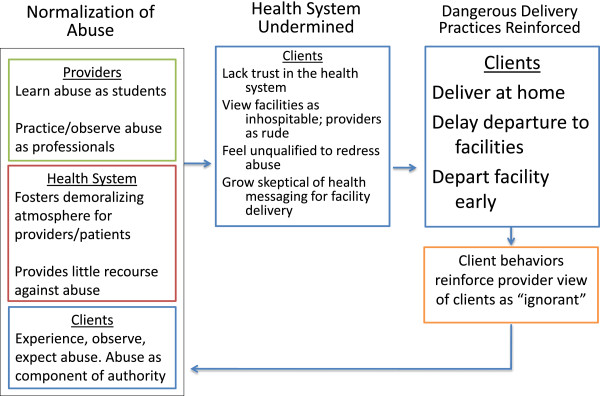
“Figure 1 Pathways from disrespectful care to dangerous delivery pra service training, because they are faced with severe human resource or supply limitations (and are contending with resultant poor motivation) or because they have “internalised dominant cultural values and beliefs regarding gender and gender-based vio…”
BackgroundMoyer, C. A., Adongo, P. B., Aborigo, R. A., Hodgson, A., & Engmann, C. M. (2014) · Midwifery · doi:10.1016/j.midw.2013.05.006 · Cited by 210 · cited 3×
“Moyer CA, Adongo PB, Aborigo RA, Hodgson A, Engmann CM: ‘They treat you like you are not a human being’: maltreatment during labour and delivery in rural northern Ghana.”
BackgroundKruk, M. E., Mbaruku, G., Rockers, P. C., & Galea, S. (2008) · Tropical Medicine & International Health · doi:10.1111/j.1365-3156.2008.02173.x · Cited by 204 · cited 1×
“Reports of being charged fees (also called “under-the-table”, or “asante” (thank you) charges) even in facilities that are officially exempt from payment, has also been detailed [25,34,35].”
BackgroundColvin, C. J., Smith, H. J., Swartz, A., Ahs, J. W., de Heer, J., Opiyo, N., Kim, J. C., Marraccini, T., & George, A. (2013) · Social Science & Medicine · doi:10.1016/j.socscimed.2013.02.031 · Cited by 178 · cited 1×
“Our findings correspond with other articles that emphasize that a woman’s or family’s “delay” in seeking care in facilities is not always an oversight borne of lack of knowledge or education, but an active decision made by her and in cooperation with others in her community based on previous experience and an effort t…”
ResultSelf-citationMselle, L. T., Moland, K. M., Mvungi, A., Evjen-Olsen, B., & Kohi, T. W. (2013) · BMC Health Services Research · doi:10.1186/1472-6963-13-174 · Cited by 175 · cited 2×
“In Tanzania, several studies highlight the importance of quality of care during childbirth [19-25], however the experience of abuse, its manifestations and responses to it in non-complicated births has been less explored.”
BackgroundMolyneux, S., Atela, M., Angwenyi, V., & Goodman, C. (2012) · Health Policy and Planning · doi:10.1093/heapol/czr083 · Cited by 174 · cited 1×
“For women and their husbands, we found that limitations related to reporting concerns in a private, safe and effective manner fostered a sense that providers were beyond redress [40-42].”
BackgroundSatisfaction with Childbirth: Theories and Methods of Measurement
Bramadat, I. J., & Driedger, M. (1993) · Birth · doi:10.1111/j.1523-536x.1993.tb00175.x · Cited by 173 · cited 5×
“Negative outcomes portend over-reporting of negative experiences (also termed “fulfillment theory” [31]), which highlights a need for data that draws on experiences in non-complicated, healthy, vaginal deliveries.”
BackgroundInfluentialToward a critical medical anthropology
Baer, H. A., Singer, M., & Johnsen, J. H. (1986) · Social Science & Medicine · doi:10.1016/0277-9536(86)90358-8 · Cited by 159 · cited 1×
“For every woman who dies of pregnancy-related causes, 20 to 30 others experience acute or chronic morbidity [2,3].”
BackgroundCleary, S. M., Molyneux, S., & Gilson, L. (2013) · BMC Health Services Research · doi:10.1186/1472-6963-13-320 · Cited by 141 · cited 1×
“For women and their husbands, we found that limitations related to reporting concerns in a private, safe and effective manner fostered a sense that providers were beyond redress [40-42].”
BackgroundPoor People's Experiences of Health Services in Tanzania: A Literature Review
Mamdani, M., & Bangser, M. (2004) · Reproductive Health Matters · doi:10.1016/s0968-8080(04)24135-0 · Cited by 130
Warren, C., Njuki, R., Abuya, T., Ndwiga, C., Maingi, G., Serwanga, J., Mbehero, F., Muteti, L., Njeru, A., Karanja, J., et al. (2013) · BMC Pregnancy and Childbirth · doi:10.1186/1471-2393-13-21 · Cited by 115 · cited 1×
“A more recent emphasis has centered on quality of care and, more specifically, women’s experience of disrespectful care and abuse related directly to provider actions [8-10].”
BackgroundKumbani, L. C., Chirwa, E., Malata, A., Odland, J. Ø., & Bjune, G. (2012) · Reproductive Health · doi:10.1186/1742-4755-9-30 · Cited by 112 · cited 3×
“A qualitative study on women’s perceptions of perinatal care at a district hospital in Malawi.”
BackgroundUsing Accountability to Improve Reproductive Health Care
George, A. S. (2003) · Reproductive Health Matters · doi:10.1016/s0968-8080(03)02164-5 · Cited by 105 · cited 1×
“For women and their husbands, we found that limitations related to reporting concerns in a private, safe and effective manner fostered a sense that providers were beyond redress [40-42].”
BackgroundSelf-citationThe other side of caring: abuse in a South African maternity ward
Kruger, L., & Schoombee, C. (2010) · Journal of Reproductive and Infant Psychology · doi:10.1080/02646830903294979 · Cited by 93
Encountering abuse in health care; lifetime experiences in postnatal women - a qualitative study
Schroll, A.-M., Kjærgaard, H., & Midtgaard, J. (2013) · BMC Pregnancy and Childbirth · doi:10.1186/1471-2393-13-74 · Cited by 83 · cited 1×
“Since then the topic has garnered broader attention with studies in South Africa [12], Ghana [13,14], Malawi [15], Nicaragua [16], Guatemala [17] and Denmark [18].”
BackgroundWho's Judging the Quality of Care? Indigenous Maya and the Problem of “Not Being Attended”
Berry, N. S. (2008) · Medical Anthropology · doi:10.1080/01459740802017413 · Cited by 76 · cited 1×
“Since then the topic has garnered broader attention with studies in South Africa [12], Ghana [13,14], Malawi [15], Nicaragua [16], Guatemala [17] and Denmark [18].”
BackgroundUse of biomedical obstetric care in rural Tanzania: The role of social and material inequalities
Spangler, S. A., & Bloom, S. S. (2010) · Social Science & Medicine · doi:10.1016/j.socscimed.2010.05.025 · Cited by 69 · cited 2×
“Several studies, in particular the work of Spangler, have highlighted how women recognize and internalize feelings of discrimination because they are under-dressed, rural, cannot afford a bribe or lack political or social influence [21,25,34].”
BackgroundResultReichenheim, M. E., Zylbersztajn, F., de Moraes, C. L., & Lobato, G. (2008) · Archives of Gynecology and Obstetrics · doi:10.1007/s00404-008-0891-1 · Cited by 66 · cited 1×
“For every woman who dies of pregnancy-related causes, 20 to 30 others experience acute or chronic morbidity [2,3].”
BackgroundPromoting childbirth companions in South Africa: a randomised pilot study
Brown, H., Hofmeyr, G. J., Nikodem, V. C., Smith, H., & Garner, P. (2007) · BMC Medicine · doi:10.1186/1741-7015-5-7 · Cited by 66 · cited 1×
“Promoting birth companions is not without challenges and further studies on how to do this in a manner that is feasible, acceptable and appropriate are necessary [44].”
BackgroundSpangler, S. A. (2011) · Medical Anthropology Quarterly · doi:10.1111/j.1548-1387.2011.01181.x · Cited by 59 · cited 5×
“Several studies, in particular the work of Spangler, have highlighted how women recognize and internalize feelings of discrimination because they are under-dressed, rural, cannot afford a bribe or lack political or social influence [21,25,34].”
BackgroundResultInfluentialPitchforth, E., Lilford, R. J., Kebede, Y., Asres, G., Stanford, C., & Frost, J. H. (2010) · Social Science & Medicine · doi:10.1016/j.socscimed.2010.08.001 · Cited by 53 · cited 2×
“general infrastructure improvements, addressing human resource shortages and remedying deficiencies in supervision and skills training [43].”
BackgroundNurses' Workplace Distress and Ethical Dilemmas in Tanzanian Health Care
Häggström, E., Mbusa, E., & Wadensten, B. (2008) · Nursing Ethics · doi:10.1177/0969733008090519 · Cited by 50 · cited 1×
“Providers in this context experience severe professional and personal constraints themselves, which can affect whether and how they interact with patients [45].”
BackgroundState of the World's Mothers: New Report From Save the Children
Hellwig, J. P. (2013) · Nursing for Women s Health · doi:10.1111/1751-486x.12055 · Cited by 47
Tanzania Service Provision Assessment Survey 2014-2015
Zanzibar (2016) · Cited by 46
Women's Perceptions of Childbirth Experience at a Hospital in Rural Tanzania
Shimpuku, Y., Patil, C. L., Norr, K. F., & Hill, P. D. (2013) · Health Care For Women International · doi:10.1080/07399332.2012.708374 · Cited by 45 · cited 2×
“However, Shimpuku’s qualitative study concluded that in the midst of crowded facilities staffed by overworked nurses, families play a critical role in advocating for “invisible” laboring women [24].”
BackgroundImplementing health system change: What are the lessons from the African Health Initiative?
Gilson, L. (2013) · BMC Health Services Research · doi:10.1186/1472-6963-13-s2-s14 · Cited by 24
Radoff, K. A., Levi, A. J., & Thompson, L. M. (2012) · International Journal of Childbirth · doi:10.1891/2156-5287.2.1.40 · Cited by 11 · cited 2×
“Radoff KA, Levi A, Thompson LM: From home to hospital: mistreatment of childbearing women and barriers to facility-based birth in Nicaragua.”
BackgroundSchroll, A., Kjærgaard, H. W., & Midtgaard, J. (2015) · Cited by 1
Research works printed but not linked: 9
- UNICEF The State of the World’s Children 2013 2013 New York, NY United Nations Publications
- United Nations General Assembly:: United Nations millennium declaration: resolution by the General Assembly.. United Nations; 2000, 55:2
- Bowser D Hill K Exploring evidence for disrespect and abuse in facility-based childbirth USAID-TRAction Project, Harvard School of Public Health 2010
- White Ribbon Alliance Respectful Maternity Care: The Universal Rights of Childbearing Women 2011 Washington, DC White Ribbon Alliance
- Save the Children State of the World’s Mothers 2013 2013 Westport, Connecticut; London, United Kingdom Save the Children
- Ngallaba S Kapiga SH Ruyobya I Boerma JT Tanzania Demographic and Health Survey Bureau of Statistics, Planning Commission, Dar es Salaam, Tanzania and Macro International Inc, Columbia, MD, USA 1993
- NBS NBoSNTaMII Tanzania Service Provision Assessment Survey 2006 2007 Dar es Salaam, Tanzania National Bureau of Statistics and Macro International Inc
- Muhr T Atlas. ti (Version 6.2. 16)[computer software] 2011 Berlin Atlas ti GmbH
- Fonn S Xaba M Health Workers for Change: A manual to improve quality of care 1995 Geneva, Switzerland World Health Organization, Special Programme For Research and Training in Tropical Diseases
Cited by
Bohren, M. A., Vogel, J. P., Hunter, E. C., Lutsiv, O., Makh, S. K., Souza, J. P., Aguiar, C., Saraiva Coneglian, F., Diniz, A. L. A., Tunçalp, Ö., et al. (2015) · PLOS Medicine · doi:10.1371/journal.pmed.1001847 · Cited by 1,656
“[9] Low 1 study with minor methodological limitations.”
BackgroundInfluentialthe GVtM-US Steering Council, Vedam, S., Stoll, K., Taiwo, T. K., Rubashkin, N., Cheyney, M., Strauss, N., McLemore, M., Cadena, M., Nethery, E., et al. (2019) · Reproductive Health · doi:10.1186/s12978-019-0729-2 · Cited by 883
“To date, evaluations of respectful maternity care (RMC) have focused primarily on monitoring care during hospital births in low-resource settings [6, 13, 14].”
BackgroundImplementation research: new imperatives and opportunities in global health
Theobald, S., Brandes, N., Gyapong, M., El-Saharty, S., Proctor, E., Diaz, T., Wanji, S., Elloker, S., Raven, J., Elsey, H., et al. (2018) · The Lancet · doi:10.1016/s0140-6736(18)32205-0 · Cited by 514
Mannava, P., Durrant, K., Fisher, J., Chersich, M., & Luchters, S. (2015) · Globalization and Health · doi:10.1186/s12992-015-0117-9 · Cited by 485
Exploring the Prevalence of Disrespect and Abuse during Childbirth in Kenya
Abuya, T., Warren, C. E., Miller, N., Njuki, R., Ndwiga, C., Maranga, A., Mbehero, F., Njeru, A., & Bellows, B. (2015) · PLOS ONE · doi:10.1371/journal.pone.0123606 · Cited by 360
Metadata
- Authors
- McMahon, S. A., George, A. S., Chebet, J. J., Mosha, I. H., Mpembeni, R. N., & Winch, P. J.
- Affiliations
- Johns Hopkins University (US)
- Muhimbili University of Health and Allied Sciences (TZ)
- Corresponding author
- McMahon, Shannon A
- Venue
- BMC Pregnancy and Childbirth
- Published
- 2014-08-12
- Volume
- 14
- Issue
- 1
- Pages
- 268-268
- ISSN
- 1471-2393 (ISSN-L)
- PMC
- PMC4261577
- OpenAlex
- W2108858663
- Cited by
- 244
- References
- 43
- Citations by year
- 2026: 6 · 2025: 11 · 2024: 10 · 2023: 18 · 2022: 21 · 2021: 26 · 2020: 26 · 2019: 24 · 2018: 44 · 2017: 24 · 2016: 15 · 2015: 15 · 2014: 3
- FWCI
- 17.88
- Type
- journal article
- Language
- en
- Open access
- gold
- doi.org
- Licence
- Locations
- BMC Pregnancy and Childbirth (publishedVersion, cc-by)
- PubMed Central (publishedVersion, cc-by)
- PubMed (publishedVersion)
- IHI Repository (acceptedVersion)
- Funders
- United States Agency for International Development (GHSA-00-09-00004-00, GHS-A-00-09-00004)
- Health Research Charities Ireland
- Muhimbili University of Health and Allied Sciences
- National Institutes of Health
- National Institute of Mental Health (F31MH095653)
- Topics
- Health Sciences › Medicine › Pediatrics, Perinatology and Child Health › Global Maternal and Child Health
- Health Sciences › Medicine › Obstetrics and Gynecology › Maternal and Perinatal Health Interventions
- Health Sciences › Medicine › Pediatrics, Perinatology and Child Health › Maternal and fetal healthcare
- Keywords
- disrespect and abuse in childbirth, respectful maternity care, facility-based birth, maternal health, male partners, community health workers, opinion leaders, verbal abuse, physical abuse, money demand, discriminatory treatment, institutional delivery
- MeSH terms
- Attitude of Health Personnel, Community Health Workers, Cross-Sectional Studies, Fees and Charges, Female, Patient Care, Health Facilities, Humans, Interviews as Topic, Male, Prejudice, Professional-Patient Relations, Quality of Health Care, Tanzania, Women's Rights, Organizational Culture, Qualitative Research, Parturition, Delivery, Obstetric
About these checks
Registry, retraction, Cites and statistics results are computed, not judged, with one exception: a printed reference that no index lists is read once by a model before it counts as a citation error. Claims are extracted by a model and kept only when their quote appears verbatim in the text; each cited source is then checked, with a model’s help, for whether it says what the claim relies on. Those verdicts can be wrong — read the claim’s quote and the cited source before relying on one.
Statistics and arithmetic are recomputed, not judged.
Confidence bands are shown only for fields calibrated on our annotated test set. None is calibrated yet, so no band is shown.
What counts as a claim ›How we measure confidence ›How we check this ›
Are you an author, or do you see a problem with this page? Request a review
Data sources
Bibliographic data: Semantic Scholar, OpenAlex, Crossref.
Contains information from the Semantic Scholar Academic Graph Datasets, made available under the ODC Attribution License (ODC-BY 1.0).
Semantic Scholar’s data is described in: Kinney, R., et al. (2023). The Semantic Scholar Open Data Platform. arXiv:2301.10140.
