

The DOI matches its Crossref record; 36 of the 36 references it cites were found in a registry or an index.
Mobile phones improve antenatal care attendance in Zanzibar: a cluster randomized controlled trial
Open accessAbstract
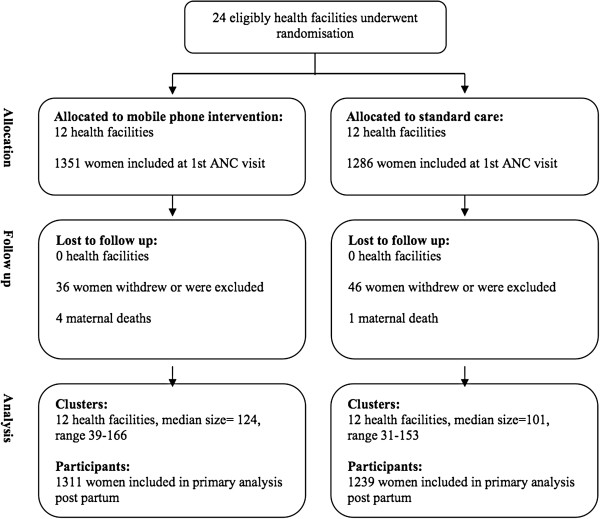
BACKGROUND: Applying mobile phones in healthcare is increasingly prioritized to strengthen healthcare systems. Antenatal care has the potential to reduce maternal morbidity and improve newborns' survival but this benefit may not be realized in sub-Saharan Africa where the attendance and quality of care is declining. We evaluated the association between a mobile phone intervention and antenatal care in a resource-limited setting. We aimed to assess antenatal care in a comprehensive way taking into consideration utilisation of antenatal care as well as content and timing of interventions during pregnancy. METHODS: This study was an open label pragmatic cluster-randomised controlled trial with primary healthcare facilities in Zanzibar as the unit of randomisation. 2550 pregnant women (1311 interventions and 1239 controls) who attended antenatal care at selected primary healthcare facilities were included at their first antenatal care visit and followed until 42 days after delivery. 24 primary health care facilities in six districts were randomized to either mobile phone intervention or standard care. The intervention consisted of a mobile phone text-message and voucher component. Primary outcome measure was four or more antenatal care visits during pregnancy. Secondary outcome measures were tetanus vaccination, preventive treatment for malaria, gestational age at last antenatal care visit, and antepartum referral. RESULTS: The mobile phone intervention was associated with an increase in antenatal care attendance. In the intervention group 44% of the women received four or more antenatal care visits versus 31% in the control group (OR, 2.39; 95% CI, 1.03-5.55). There was a trend towards improved timing and quality of antenatal care services across all secondary outcome measures although not statistically significant. CONCLUSIONS: The wired mothers' mobile phone intervention significantly increased the proportion of women receiving the recommended four antenatal care visits during pregnancy and there was a trend towards improved quality of care with more women receiving preventive health services, more women attending antenatal care late in pregnancy and more women with antepartum complications identified and referred. Mobile phone applications may contribute towards improved maternal and newborn health and should be considered by policy makers in resource-limited settings.
Overview
The claims and statistics of this paper haven’t been checked yet.
Run the check — free, no account needed. It reads the open-access text and checks the sources it cites.
Integrity signals
Registry
Cites
Statistics
Figures
Verification
Claims the paper makes
The claims and statistics of this paper haven’t been checked yet.
Run the check — free, no account needed. It reads the open-access text and checks the sources it cites.
Claims other papers make about this one
Each is checked against this paper’s own text: does it say what the citing paper says it does?
The cited source doesn’t support the claim as written.
In the citing paper
“The use of SMS only was mentioned in 16 of 26 interventions (62%) [28-31,35,37,38,40-43,45-47,50,52].”
From Barriers to the Use of Mobile Health in Improving Health Outcomes in Developing Countries: Systematic Review (2019) · cites this paper as [31]
Checked by a reasoning model — may be wrong.
Experimental — accuracy not yet measuredThe source backs part of the claim, not all of it — or backs it for a different population, condition or comparison.
In the citing paper
“most SMS based interventions are pilot tested (stage 3) [31,34,37,38,42,71] or at large scale implementation stage (stage 4) [28 -30,32,35].”
From Current evidence on the use of mHealth approaches in Sub-Saharan Africa: A scoping review (2023) · cites this paper as [29]
Experimental — accuracy not yet measuredIn the citing paper
“Among the articles analyzed, maternal health was the most prevalent health outcome with a frequency of 9 out of the 30 articles (30%) [27-35].”
From Barriers to the Use of Mobile Health in Improving Health Outcomes in Developing Countries: Systematic Review (2019) · cites this paper as [31]
In the citing paper
“Antenatal care improved with 44% of the intervention arm receiving the recommended four antenatal visits compared to 31% in the control group (38).”
From Assessing the impact of mHealth interventions in low- and middle-income countries – what has been shown to work? (2014) · cites this paper as [38]
In the citing paper
“Less evidence is available regarding end users’ and decision makers’ acceptance of and engagement with digital health technology.”
In the citing paper
“recent evidence has largely focused on app development, dashboards, or the before-and-after effects on awareness or coverage [6,7,10,12,21-25].”
In the citing paper
“In LMICS, mHealth apps are increasingly used for immunizations and other public health concerns”
Self-check
Percentages, sums and reported differences re-computed from the paper’s own numbers.
The self-check needs the paper’s full text.
Citations
Cites
Liu, L., Johnson, H. L., Cousens, S., Perin, J., Scott, S., Lawn, J. E., Rudan, I., Campbell, H., Cibulskis, R., Li, M., et al. (2012) · The Lancet · doi:10.1016/s0140-6736(12)60560-1 · Cited by 3,934
Strategies for reducing maternal mortality: getting on with what works
Campbell, O. M., & Graham, W. J. (2006) · The Lancet · doi:10.1016/s0140-6736(06)69381-1 · Cited by 1,785
Free, C., Phillips, G., Galli, L., Watson, L., Felix, L., Edwards, P., Patel, V., & Haines, A. (2013) · PLoS Medicine · doi:10.1371/journal.pmed.1001362 · Cited by 1,766
Lozano, R., Wang, H., Foreman, K. J., Rajaratnam, J. K., Naghavi, M., Marcus, J. R., Dwyer-Lindgren, L., Lofgren, K. T., Phillips, D., Atkinson, C., et al. (2011) · The Lancet · doi:10.1016/s0140-6736(11)61337-8 · Cited by 880
Countdown to 2015 decade report (2000–10): taking stock of maternal, newborn, and child survival
Bhutta, Z. A., Chopra, M., Axelson, H., Berman, P., Boerma, T., Bryce, J., Bustreo, F., Cavagnero, E., Cometto, G., Daelmans, B. M. E. G., et al. (2010) · The Lancet · doi:10.1016/s0140-6736(10)60678-2 · Cited by 816
Stillbirths: Where? When? Why? How to make the data count?
Lawn, J. E., Blencowe, H., Pattinson, R., Cousens, S., Kumar, R., Ibiebele, I., Gardosi, J., Day, L. T., & Stanton, C. (2011) · The Lancet · doi:10.1016/s0140-6736(10)62187-3 · Cited by 785
WHO antenatal care randomised trial for the evaluation of a new model of routine antenatal care
Villar, J., Ba'aqeel, H., Piaggio, G., Lumbiganon, P., Belizán, J. M., Farnot, U., Al-Mazrou, Y., Carroli, G., Pinol, A., Donner, A., et al. (2001) · The Lancet · doi:10.1016/s0140-6736(00)04722-x · Cited by 627
Mobile phone messaging reminders for attendance at healthcare appointments
Gurol‐Urganci, I., de Jongh, T. E., Vodopivec‐Jamšek, V., Atun, R. A., & Car, J. (2013) · Cochrane Database of Systematic Reviews · doi:10.1002/14651858.cd007458.pub3 · Cited by 623
Carroli, G., Rooney, C., & Villar, J. (2001) · Paediatric and Perinatal Epidemiology · doi:10.1046/j.1365-3016.2001.0150s1001.x · Cited by 622
Mpembeni, R. N., Killewo, J. Z., Leshabari, M. T., Massawe, S. N., Jahn, A., Mushi, D., & Mwakipa, H. (2007) · BMC Pregnancy and Childbirth · doi:10.1186/1471-2393-7-29 · Cited by 414
Technologies for global health
Howitt, P. J., Darzi, A. W., Yang, G., Ashrafian, H., Atun, R. A., Barlow, J. G., Blakemore, A. I. F., Bull, A. M. J., Car, J., Conteh, L., et al. (2012) · The Lancet · doi:10.1016/s0140-6736(12)61127-1 · Cited by 405
Mocroft, A., Lundgren, J. D., Sabin, M. L., Monforte, A. D., Brockmeyer, N. H., Casabona, J., Castagna, A., Costagliola, D. G., Dabis, F., Wit, S. D., et al. (2013) · PLoS Medicine · doi:10.1371/journal.pmed.1001510 · Cited by 360
Guy, R., Hocking, J. S., Wand, H. C., Stott, S., Ali, H., & Kaldor, J. M. (2011) · Health Services Research · doi:10.1111/j.1475-6773.2011.01342.x · Cited by 332
Under-attending free antenatal care is associated with adverse pregnancy outcomes
Raatikainen, K., Heiskanen, N., & Heinonen, S. (2007) · BMC Public Health · doi:10.1186/1471-2458-7-268 · Cited by 326
Tamrat, T., & Kachnowski, S. (2012) · Maternal and Child Health Journal · doi:10.1007/s10995-011-0836-3 · Cited by 312
SMS for disease control in developing countries: a systematic review of mobile health applications
Déglise, C., Suggs, L. S., & Odermatt, P. (2012) · Journal of Telemedicine and Telecare · doi:10.1258/jtt.2012.110810 · Cited by 240 · cited 2×
“The 2012 Lancet report of technologies for global health identified only nine randomised controlled trials for mHealth in low-income countries and the evidence for effectiveness remains weak [2,23,24].”
BackgroundMobile phone messaging reminders for attendance at healthcare appointments
Car, J., Gurol‐Urganci, I., de Jongh, T. E., Vodopivec‐Jamšek, V., & Atun, R. A. (2012) · Cochrane Database of Systematic Reviews · doi:10.1002/14651858.cd007458.pub2 · Cited by 230
Lund, S., Hemed, M., Nielsen, B., Said, A., Said, K., Makungu, M., & Rasch, V (2012) · BJOG: An International Journal of Obstetrics & Gynaecology · doi:10.1111/j.1471-0528.2012.03413.x · Cited by 228
Self-citationHeterogeneous Mobile Phone Ownership and Usage Patterns in Kenya
Wesolowski, A., Eagle, N., Noor, A. M., Snow, R. W., & Buckee, C. O. (2012) · PLoS ONE · doi:10.1371/journal.pone.0035319 · Cited by 216
Short Message Service (SMS) Applications for Disease Prevention in Developing Countries
Déglise, C., Suggs, L. S., & Odermatt, P. (2012) · Journal of Medical Internet Research · doi:10.2196/jmir.1823 · Cited by 206
Progress Toward Millennium Development Goals 4 and 5 on Maternal and Child Mortality
Lozano, R., Wang, H., Foreman, K. J., Rajaratnam, J. K., Naghavi, M., Marcus, J. R., Dwyer‐Lindgren, L., Lofgren, K. T., Phillips, D. E., Atkinson, C., et al. (2012) · Obstetric Anesthesia Digest · doi:10.1097/01.aoa.0000417580.43834.c6 · Cited by 185
Improvement of maternal health services through the use of mobile phones
Noordam, A. C., Kuepper, B. M., Stekelenburg, J., & Milen, A. (2011) · Tropical Medicine & International Health · doi:10.1111/j.1365-3156.2011.02747.x · Cited by 174
Quality of antenatal care in Zambia: a national assessment
Kyei, N. N. A., Chansa, C., & Gabrysch, S. (2012) · BMC Pregnancy and Childbirth · doi:10.1186/1471-2393-12-151 · Cited by 173
Jareethum, R., Titapant, V., Chantra, T., Sommai, V., Chuenwattana, P., & Jirawan, C. (2008) · PubMed · Cited by 130
Cormick, G., Kim, N. A., Rodgers, A., Gibbons, L., Buekens, P. M., Belizán, J. M., & Althabe, F. (2012) · Reproductive Health · doi:10.1186/1742-4755-9-9 · Cited by 118
L’Engle, K. L., Vahdat, H. L., Ndakidemi, E., Lasway, C., & Zan, T. (2012) · Contraception · doi:10.1016/j.contraception.2012.07.009 · Cited by 115
Mobile phone messaging reminders for attendance at scheduled healthcare appointments
Car, J., Gurol‐Urganci, I., de Jongh, T. E., Vodopivec‐Jamšek, V., & Atun, R. A. (2008) · Cochrane Database of Systematic Reviews · doi:10.1002/14651858.cd007458 · Cited by 95
Jones, C. O. H., Wasunna, B., Sudoi, R., Githinji, S., Snow, R. W., & Zurovac, D. (2012) · PLoS ONE · doi:10.1371/journal.pone.0038636 · Cited by 92 · cited 1×
“Most of the women in our study felt that the intervention influenced their health seeking behavior and satisfaction with the service which is in line with other studies finding mobile phone applications for reproductive health well accepted by women and health workers [28-30].”
ResultRequejo, J. H., & Bryce, J. (2010) · Cited by 92
Antenatal care in developing countries: The need for a tailored model
Zanconato, G., Msolomba, R., Guarenti, L., & Franchi, M. P. (2005) · Seminars in Fetal and Neonatal Medicine · doi:10.1016/j.siny.2005.10.002 · Cited by 88
The quality of antenatal care in rural Tanzania: what is behind the number of visits?
Nyamtema, A., Jong, A. B.-D., Urassa, D. P., Hagen, J. P., & van Roosmalen, J. (2012) · BMC Pregnancy and Childbirth · doi:10.1186/1471-2393-12-70 · Cited by 85
Conrad, P., Schmid, G., Tientrebeogo, J., Arinaitwe, M., Kirenga, S., Neuhann, F., Müller, O., & Sarker, M. (2011) · Tropical Medicine & International Health · doi:10.1111/j.1365-3156.2011.02923.x · Cited by 80
Gisore, P., Shipala, E., Otieno, K., Rono, B., Marete, I., Tenge, C., Mabeya, H., Bucher, S., Moore, J., Liechty, E., et al. (2012) · BMC Pregnancy and Childbirth · doi:10.1186/1471-2393-12-15 · Cited by 70
Beeckman, K., Louckx, F., Masuy‐Stroobant, G., Downe, S. M., & Putman, K. D. (2011) · BMC Health Services Research · doi:10.1186/1472-6963-11-213 · Cited by 63
MacLeod, B. B., Phillips, J., Stone, A., Walji, A., & Awoonor-Williams, J. K. (2012) · Online Journal of Public Health Informatics · doi:10.5210/ojphi.v4i1.3910 · Cited by 52
Randomised controlled trial of two antenatal care models in rural Zimbabwe
Majoko, F., Munjanja, S. P., Nyström, L., Mason, E. M., & Lindmark, G. (2007) · BJOG An International Journal of Obstetrics & Gynaecology · doi:10.1111/j.1471-0528.2007.01372.x · Cited by 33
Research works printed but not linked: 2
- GSMA: African Mobile Observatory 2011. 2011, London: Groupe Spéciale Mobile Association
- Ministry of Health: Zanzibar Reproductive and Child Health Strategy 2006-2010. 2006, Stonetown: Revolutionary Government of Zanzibar
Cited by
Sorted by citations
Lee, S. H., Nurmatov, U. B., Nwaru, B. I., Mukherjee, M., Grant, L., & Pagliari, C. (2016) · Journal of Global Health · doi:10.7189/jogh.06.010401 · Cited by 456
“Only two of the intervention studies were graded as being at low risk of bias [36,42], seven as moderate [29,30,32,34,37–39] and four at high [28,33,43,44] risk of bias (see Table s3 in Online Supplementary Document ).”
InfluentialSondaal, S. F. V., Browne, J. L., Amoakoh-Coleman, M., Borgstein, A., Miltenburg, A. S., Verwijs, M., & Klipstein-Grobusch, K. (2016) · PLOS ONE · doi:10.1371/journal.pone.0154664 · Cited by 441
Hall, C. S., Fottrell, E., Wilkinson, S., & Byass, P. (2014) · Global Health Action · doi:10.3402/gha.v7.25606 · Cited by 384
Kruse, C., Betancourt, J., Ortiz, S., Valdes Luna, S. M., Bamrah, I. K., & Segovia, N. (2019) · Journal of Medical Internet Research · doi:10.2196/13263 · Cited by 299
Mobile Health (mHealth) in Low- and Middle-Income Countries
McCool, J., Dobson, R., Whittaker, R., & Paton, C. (2022) · Annual Review of Public Health · doi:10.1146/annurev-publhealth-052620-093850 · Cited by 269
Metadata
- Authors
- Lund, S., Nielsen, B. B., Hemed, M., Boas, I. M., Said, A., Said, K., Makungu, M. H., & Rasch, V.
- Affiliations
- University of Copenhagen (DK)
- Aarhus University Hospital (DK)
- Corresponding author
- Lund, Stine
- Venue
- BMC Pregnancy and Childbirth
- Published
- 2014-01-17
- Volume
- 14
- Issue
- 1
- Pages
- 29-29
- ISSN
- 1471-2393 (ISSN-L)
- PMC
- PMC3898378
- OpenAlex
- W2095109714
- Cited by
- 301
- References
- 36
- Citations by year
- 2026: 11 · 2025: 22 · 2024: 22 · 2023: 20 · 2022: 33 · 2021: 27 · 2020: 35 · 2019: 36 · 2018: 30 · 2017: 29 · 2016: 16 · 2015: 10 · 2014: 9
- FWCI
- 38.62
- Type
- journal article
- Language
- en
- Open access
- gold
- doi.org
- Licence
- Locations
- BMC Pregnancy and Childbirth (publishedVersion, cc-by)
- Europe PMC (PubMed Central) (publishedVersion, cc-by)
- PubMed Central (publishedVersion, cc-by)
- PubMed (publishedVersion)
- University of Southern Denmark Research Portal (University of Southern Denmark) (submittedVersion)
- Topics
- Health Sciences › Health Professions › General Health Professions › Mobile Health and mHealth Applications
- Health Sciences › Medicine › Pediatrics, Perinatology and Child Health › Global Maternal and Child Health
- Physical Sciences › Computer Science › Information Systems › ICT in Developing Communities
- Keywords
- mobile devices, antenatal care attendance, text messaging, voucher incentives, tetanus vaccination, malaria prevention, maternal health, newborn health, resource-limited settings, Zanzibar
- MeSH terms
- Adult, Developing Countries, Female, Gestational Age, Humans, Malaria, Patient Acceptance of Health Care, Patient Education as Topic, Pregnancy, Prenatal Care, Tanzania, Tetanus Toxoid, Reminder Systems, Young Adult, Text Messaging
About these checks
Registry, retraction, Cites and statistics results are computed, not judged, with one exception: a printed reference that no index lists is read once by a model before it counts as a citation error. Claims are extracted by a model and kept only when their quote appears verbatim in the text; each cited source is then checked, with a model’s help, for whether it says what the claim relies on. Those verdicts can be wrong — read the claim’s quote and the cited source before relying on one.
Statistics and arithmetic are recomputed, not judged.
Confidence bands are shown only for fields calibrated on our annotated test set. None is calibrated yet, so no band is shown.
What counts as a claim ›How we measure confidence ›How we check this ›
Are you an author, or do you see a problem with this page? Request a review
