

Sleep duration, vital exhaustion, and odds of spontaneous preterm birth: a case–control study
Open accessThe DOI matches its Crossref record; 46 of the 46 references it cites were found in a registry or an index; none of the 17 sources its claims cite is checked for support yet.
Abstract
BACKGROUND: Preterm birth is a leading cause of perinatal morbidity and mortality worldwide, resulting in a pressing need to identify risk factors leading to effective interventions. Limited evidence suggests potential relationships between maternal sleep or vital exhaustion and preterm birth, yet the literature is generally inconclusive. METHODS: We examined the relationship between maternal sleep duration and vital exhaustion in the first six months of pregnancy and spontaneous (non-medically indicated) preterm birth among 479 Peruvian women who delivered a preterm singleton infant (<37 weeks gestation) and 480 term controls who delivered a singleton infant at term (≥37 weeks gestation). Maternal nightly sleep and reports of vital exhaustion were ascertained through in-person interviews. Spontaneous preterm birth cases were further categorized as those following either spontaneous preterm labor or preterm premature rupture of membranes. In addition, cases were categorized as very (<32 weeks), moderate (32-33 weeks), and late (34- <37 weeks) preterm birth for additional analyses. Logistic regression was used to estimate adjusted odds ratios (aORs) and 95% confidence intervals (CIs). RESULTS: After adjusting for confounders, we found that short sleep duration (≤6 hours) was significantly associated with preterm birth (aOR = 1.56; 95% CI 1.11-2.19) compared to 7-8 hours of sleep. Vital exhaustion was also associated with increased odds of preterm birth (aOR = 2.41; 95% CI 1.79-3.23) compared to no exhaustion (Ptrend <0.001). These associations remained significant for spontaneous preterm labor and preterm premature rupture of membranes. We also found evidence of joint effects of sleep duration and vital exhaustion on the odds of spontaneous preterm birth. CONCLUSIONS: The results of this case-control study suggest maternal sleep duration, particularly short sleep duration, and vital exhaustion may be risk factors for spontaneous preterm birth. These findings call for increased clinical attention to maternal sleep and the study of potential intervention strategies to improve sleep in early pregnancy with the aim of decreasing risk of preterm birth.
Overview
CoChat Summary
## TL;DR
This case–control study of 479 Peruvian women with spontaneous preterm birth and 480 term controls found that short sleep duration and vital exhaustion in the first six months of pregnancy were associated with higher odds of spontaneous preterm birth. The associations were also seen for spontaneous preterm labor and preterm premature rupture of membranes, with exploratory evidence that sleep duration and vital exhaustion may have joint effects.
## Key findings
- Short sleep duration (≤6 hours/night) was associated with preterm birth versus 7–8 hours/night: adjusted OR 1.56 (95% CI 1.11–2.19).
- Vital exhaustion was associated with preterm birth versus no exhaustion: adjusted OR 2.41 (95% CI 1.79–3.23), with a significant trend by frequency of exhaustion (Ptrend <0.001).
- For subtypes, short sleep was associated with higher odds of spontaneous preterm labor (aOR 1.51) and PPROM (aOR 1.60); vital exhaustion was associated with spontaneous preterm labor (aOR 2.21; 95% CI 1.54–3.15) and PPROM (aOR 2.66; 95% CI 1.81–3.89).
- Joint exposure showed higher odds than either factor alone: short sleep plus exhaustion aOR 3.58 (95% CI 2.21–5.78), and long sleep plus exhaustion aOR 3.74 (95% CI 2.20–6.35), though interaction terms were not statistically significant.
## Methods
- Case–control study at three hospitals in Lima, Peru, enrolling 479 women with spontaneous singleton preterm birth (<37 weeks) and 480 term singleton controls (≥37 weeks); participation rates were 93% for cases and 88% for controls.
- Exposure data came from a 45-minute in-person Spanish-language interview covering sleep duration in the first 6 months of pregnancy and vital exhaustion; gestational age and clinical outcomes were confirmed from medical records and ultrasound before 20 weeks.
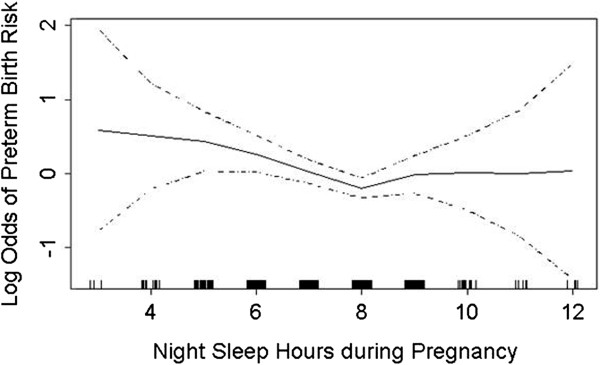
- Associations were estimated using logistic regression with adjustment for confounders; multinomial logistic regression assessed spontaneous preterm labor, PPROM, and very/moderate/late preterm birth, and GAM was used to examine nonlinearity.
## Limitations
- The paper states that sleep duration was self-reported retrospectively and categorized into integer hours to minimize recall error, so recall bias and misclassification are possible.
- The paper notes ambiguity in the accuracy of subjective sleep measures and suggests future studies use objective measures such as wrist actigraphy.
- The paper notes limited power for effect modification analyses; this is evident from the non-significant interaction terms despite exploratory joint effects.
Model-written summary. Check it against the paper before relying on it.
Integrity signals
Registry
Cites
Statistics
Figures
Verification
Claims the paper makes
0 Valid · 0 Not valid · 5 Not checked · 37 Own results and interpretations
A result the paper reports from its own data — it cites no other source for it, so there is none to check. The quote shows it is in the paper.
In the paper
“The odds of preterm birth were increased by 2.41-fold among women who reported feeling a sense of vital exhaustion in early pregnancy (unrelated to exercise) (aOR = 2.41; 95% CI 1.79-3.23) compared to women who did not report any symptoms (Table 2).”
§ Sleep duration, vital exhaustion, and odds of spontaneous preterm birth: a case–control study > Results
plainstates an association- Asserted: passes — The authors put it forward as true.
- Checkable: passes — It can be checked against evidence.
- Load-bearing: passes — The paper’s conclusions depend on it.
- Based: passes — The paper gives a reason why it holds.
- Rests on an assumption not shown here.
A result the paper reports from its own data — it cites no other source for it, so there is none to check. The quote shows it is in the paper.
In the paper
“The prevalence of short sleep duration (≤6 hours) was 22.3% among preterm cases and 16.5% among term controls (Table 2).”
§ Sleep duration, vital exhaustion, and odds of spontaneous preterm birth: a case–control study > Results
plain- Asserted: passes — The authors put it forward as true.
- Checkable: passes — It can be checked against evidence.
- Load-bearing: passes — The paper’s conclusions depend on it.
- Based: passes — The paper gives a reason why it holds.
A result the paper reports from its own data — it cites no other source for it, so there is none to check. The quote shows it is in the paper.
In the paper
“Though, weekly complaints of vital exhaustion were associated with greater odds of preterm birth than were daily complaints.”
§ Sleep duration, vital exhaustion, and odds of spontaneous preterm birth: a case–control study > Results
plainstates an association- Asserted: passes — The authors put it forward as true.
- Checkable: passes — It can be checked against evidence.
- Load-bearing: unclear — It is unclear whether the paper’s conclusions depend on it.
- Based: passes — The paper gives a reason why it holds.
- Rests on an assumption not shown here.
A result the paper reports from its own data — it cites no other source for it, so there is none to check. The quote shows it is in the paper.
In the paper
“Additionally, we found a statistically significant linear trend between frequency of complaint of vital exhaustion and odds of spontaneous preterm birth (Ptrend <0.001).”
§ Sleep duration, vital exhaustion, and odds of spontaneous preterm birth: a case–control study > Results
plainstates an association- Asserted: passes — The authors put it forward as true.
- Checkable: passes — It can be checked against evidence.
- Load-bearing: passes — The paper’s conclusions depend on it.
- Based: passes — The paper gives a reason why it holds.
- Rests on an assumption not shown here.
A result the paper reports from its own data — it cites no other source for it, so there is none to check. The quote shows it is in the paper.
In the paper
“Women who reported long sleep duration had increased odds of moderate preterm birth, compared with the referent group (aOR 1.98; 95% CI 1.08–3.65).”
§ Sleep duration, vital exhaustion, and odds of spontaneous preterm birth: a case–control study > Results
plainstates an association- Asserted: passes — The authors put it forward as true.
- Checkable: passes — It can be checked against evidence.
- Load-bearing: passes — The paper’s conclusions depend on it.
- Based: passes — The paper gives a reason why it holds.
- Rests on 2 assumptions not shown here.
14 more claims
Create a free account to see all 42 claims and to verify the 17 references still open.
- It may state two separate claims as one. 18
- Probably not a substantial claim. 7
Citations
Cites
Brown, R. A., Hastie, T. J., & Tibshirani, R. J. (1991) · Biometrics · doi:10.2307/2532174 · Cited by 8,176
Epidemiology and causes of preterm birth
Goldenberg, R. L., Culhane, J. F., Iams, J. D., & Romero, R. (2008) · The Lancet · doi:10.1016/s0140-6736(08)60074-4 · Cited by 7,801
Koyak, R. A., Hastie, T. J., & Tibshirani, R. J. (1991) · Journal of the American Statistical Association · doi:10.2307/2290538 · Cited by 7,596
Hastie, T., & Tibshirani, R. (2014) · Wiley StatsRef: Statistics Reference Online · doi:10.1002/9781118445112.stat03141 · Cited by 3,156
Modern Epidemiology 3rd edition
Rothman, K. J., Lash, T. L., & Greenland, S. (1986) · Cited by 3,103
Preterm Birth: Causes, Consequences, and Prevention
Outcomes, A. H., Behrman, R. E., & Butler, A. S. (2007) · Cited by 1,577
Self-Reported and Measured Sleep Duration: How Similar Are They?
Lauderdale, D. S., Knutson, K. L., Yan, L. L., Liu, K., & Rathouz, P. J. (2008) · Epidemiology · doi:10.1097/ede.0b013e318187a7b0 · Cited by 1,565 · cited 2×
“Additionally, because the accuracy of subjective sleep measures is ambiguous [20-23], it may be beneficial for future studies to use objective measures of sleep, such as wrist actigraphy, in combination with self-report to measure both perceived and actual sleep patterns.”
BackgroundKushida, C. A., Chang, A., Gadkary, C., Guilleminault, C., Carrillo, O., & Dement, W. C. (2001) · Sleep Medicine · doi:10.1016/s1389-9457(00)00098-8 · Cited by 997
Comparison between subjective and actigraphic measurement of sleep and sleep rhythms
Lockley, S. W., Skene, D. J., & Arendt, J. (1999) · Journal of Sleep Research · doi:10.1046/j.1365-2869.1999.00155.x · Cited by 622
Hillier, S. L., Witkin, S. S., Krohn, M. A., Watts, D. H., Kiviat, N. B., & Eschenbach, D. A. (1993) · PubMed · Cited by 581
Research works printed but not linked: 2
- World Health Organization Preterm birth: fact sheet 2014
- Rothman KJ Greenland S Modern Epidemiology 1998 2 Philadelphia Lippincott-Raven Publishers
Cited by
Lu, Q., Zhang, X., Wang, Y., Li, J., Xu, Y., Song, X., Su, S., Zhu, X., Vitiello, M. V., Shi, J., et al. (2021) · Sleep Medicine Reviews · doi:10.1016/j.smrv.2021.101436 · Cited by 311
Warland, J., Dorrian, J., Morrison, J. L., & O'Brien, L. M. (2018) · Sleep Medicine Reviews · doi:10.1016/j.smrv.2018.03.004 · Cited by 224
Sleep Disorder Diagnosis During Pregnancy and Risk of Preterm Birth
Felder, J. N., Baer, R. J., Rand, L., Jelliffe-Pawlowski, L. L., & Prather, A. A. (2017) · Obstetrics & Gynecology · doi:10.1097/aog.0000000000002132 · Cited by 139
Tsai, S., Lee, P., Lin, J., & Lee, C. (2016) · International Journal of Nursing Studies · doi:10.1016/j.ijnurstu.2016.01.001 · Cited by 106
Xu, Y.-H., Shi, L., Bao, Y.-P., Chen, S.-J., Shi, J., Zhang, R.-L., & Lu, L. (2018) · Sleep Medicine · doi:10.1016/j.sleep.2018.07.021 · Cited by 76
Wang, L., & Jin, F. (2020) · BMC Pregnancy and Childbirth · doi:10.1186/s12884-020-2814-5 · Cited by 73
Sedov, I. D., & Tomfohr‐Madsen, L. M. (2020) · Behavioral Sleep Medicine · doi:10.1080/15402002.2020.1771339 · Cited by 67
“Reports of sleep disruption are common during pregnancy (Fernández-Alonso et al., 2012; Kajeepeta et al., 2014; Mindell et al., 2015; Okun et al., 2013).”
BackgroundWang, R., Xu, M., Yang, W., Xie, G., Yang, L., Shang, L., Zhang, B., Guo, L., Yue, J., Zeng, L., et al. (2022) · Journal of Diabetes Investigation · doi:10.1111/jdi.13770 · Cited by 72
Du, M., Liu, J., Han, N., Zhao, Z., Yang, J., Xu, X., Luo, S., & Wang, H. (2021) · Sleep Medicine · doi:10.1016/j.sleep.2020.12.040 · Cited by 76
Sleep Trajectories Among Pregnant Women and the Impact on Outcomes: A Population-Based Cohort Study
Plancoulaine, S., Flori, S., Bat‐Pitault, F., Patural, H., Lin, J., & Franco, P. (2017) · Maternal and Child Health Journal · doi:10.1007/s10995-016-2212-9 · Cited by 63
“Recently, short and long sleep duration associated with exhaustion were linked to preterm birth (Kajeepeta et al., 2014).”
BackgroundPregnancy anxiety and preterm birth: The moderating role of sleep.
Tomfohr‐Madsen, L. M., Cameron, E. E., Schetter, C. D., Campbell, T. S., O’Beirne, M., Letourneau, N. L., & Giesbrecht, G. F. (2019) · Health Psychology · doi:10.1037/hea0000792 · Cited by 61
“One study of anxiety and salivary cortisol assessed at multiple times across the day throughout gestation found that higher average levels of anxiety predicted steeper increases in prenatal cortisol trajectories (Kane et al., 2014).”
BackgroundGelaye, B., Kajeepeta, S., Zhong, Q., Borba, C. P. C., Rondón, M. B., Sánchez, S. E., Henderson, D. C., & Williams, M. A. (2015) · Sleep Medicine · doi:10.1016/j.sleep.2015.07.004 · Cited by 52
“For example, investigators have reported that short sleep duration (six or fewer nightly hours) in early pregnancy is associated with elevated trimester-specific blood pressures [3], increased risks of preeclampsia [3], and spontaneous preterm birth [4].”
BackgroundSelf-citationMaternal night-time eating and sleep duration in relation to length of gestation and preterm birth
Loy, S. L., Cheung, Y. B., Cai, S., Colega, M., Godfrey, K. M., Chong, Y. S., Shek, L. P., Tan, K. H., Chong, M. F., Yap, F. K. P., et al. (2019) · Clinical Nutrition · doi:10.1016/j.clnu.2019.08.018 · Cited by 48
Maternal sleep practices and stillbirth: Findings from an international case‐control study
O'Brien, L. M., Warland, J., Stacey, T., Heazell, A. E. P., & Mitchell, E. A. (2019) · Birth · doi:10.1111/birt.12416 · Cited by 44
Sleep Disturbances and Symptoms of Depression and Daytime Sleepiness in Pregnant Women
Tsai, S., Lin, J., Wu, W., Lee, C., & Lee, P. (2016) · Birth · doi:10.1111/birt.12215 · Cited by 44
“Unlike most pregnancy outcome research primarily focusing on nighttime sleep (9,11,17), objective and self-reported measures of nighttime and daytime sleep were assessed concurrently in the present study.”
BackgroundLi, R., Zhang, J., Gao, Y., Zhang, Y., Lan, X., Dong, H., Wu, C., Yu, C., Peng, M., & Zeng, G. (2021) · International Journal of Gynecology & Obstetrics · doi:10.1002/ijgo.13584 · Cited by 30
Later sleep timing is associated with an increased risk of preterm birth in nulliparous women
Facco, F. L., Parker, C. B., Hunter, S., Reid, K. J., Zee, P. P., Silver, R. M., Pien, G., Chung, J. H., Louis, J. M., Haas, D. M., et al. (2019) · American Journal of Obstetrics & Gynecology MFM · doi:10.1016/j.ajogmf.2019.100040 · Cited by 26
Sleep patterns and the risk of adverse birth outcomes among Chinese women
Liu, B., Song, L., Zhang, L., Wang, L., Wu, M., Xu, S., & Wang, Y. (2019) · International Journal of Gynecology & Obstetrics · doi:10.1002/ijgo.12878 · Cited by 24
Deployment and Preterm Birth Among US Army Soldiers
Shaw, J. G., Nelson, D. A., Shaw, K. A., Woolaway-Bickel, K., Phibbs, C. S., & Kurina, L. M. (2018) · American Journal of Epidemiology · doi:10.1093/aje/kwy003 · Cited by 25
“In addition to (or instead of) direct stress effects, our results could indicate that other effects of deployment—for example, sleep deprivation (38, 39)—could have important short-term negative effects on pregnancy.”
ResultRubio, E., Levey, E. J., Rondón, M. B., Friedman, L. E., Sánchez, S. E., Williams, M. A., & Gelaye, B. (2022) · Maternal and Child Health Journal · doi:10.1007/s10995-022-03449-8 · Cited by 29
“While the evidence is limited, a few studies have also demonstrated a link between sleep disturbances during pregnancy and perinatal outcomes, including preterm birth (Blair et al., 2015; Kajeepeta et al., 2014), cesarean delivery (Li et al.”
BackgroundSelf-citationCronin, R. S., Wilson, J., Gordon, A., Li, M., Culling, V., Raynes‐Greenow, C. H., Heazell, A. E. P., Stacey, T., Askie, L. M., Mitchell, E. A., et al. (2020) · PLoS ONE · doi:10.1371/journal.pone.0230861 · Cited by 21
Shaw, J. G., Joyce, V. R., Schmitt, S. K., Frayne, S. M., Shaw, K. A., Danielsen, B. H., Kimerling, R. E., Asch, S. M., & Phibbs, C. S. (2018) · Health Services Research · doi:10.1111/1475-6773.13041 · Cited by 20
Christian, L. M. (2019) · Neuroscience & Biobehavioral Reviews · doi:10.1016/j.neubiorev.2019.04.009 · Cited by 24
“As detailed below, it has been proposed that sleep-induced inflammatory dysregulation may contribute to risk for shortened gestation (Blair et al., 2015; Kajeepeta et al., 2014; Okun et al., 2007, 2013).”
Are chronotype and subjective sleep quality associated with preeclampsia and preterm birth?
Takmaz, T., Unal, B., Özcan, P., Halıcı, B. N. A., Gorchiyeva, İ., Karasu, A. F. G., & Şahbaz, Ç. (2020) · Biological Rhythm Research · doi:10.1080/09291016.2020.1730617 · Cited by 20
“duration (≥9 h of nightly sleep) were associated with an increased risk of spontaneous preterm birth (Kajeepeta et al. 2014).”
BackgroundWowdzia, J. B., Hazell, T. J., & Davenport, M. H. (2022) · Physiological Reports · doi:10.14814/phy2.15454 · Cited by 22
“Short sleep duration (<6 h per night) has been associated with adverse pregnancy outcomes including prolonged labor (Lee & Gay, 2004), preterm delivery (Kajeepeta et al., 2014), and a 450% increase in the odds of”
BackgroundTang, Y., Zhang, J., Dai, F., Razali, N., Tagore, S., Chern, B. S., & Tan, K. H. (2020) · BJOG An International Journal of Obstetrics & Gynaecology · doi:10.1111/1471-0528.16591 · Cited by 24
Zhao, A., Zhao, K., Xia, Y., Yin, Y., Zhu, J., Hong, H., & Li, S. (2019) · Birth Defects Research · doi:10.1002/bdr2.1536 · Cited by 14
Weng, S., Lee, Y., & Chien, L. (2020) · Journal of Clinical Nursing · doi:10.1111/jocn.15388 · Cited by 15
Delgado, A., & Louis, J. M. (2022) · Clinics in Chest Medicine · doi:10.1016/j.ccm.2022.02.004 · Cited by 17
Delgado, A., & Louis, J. M. (2023) · Sleep Medicine Clinics · doi:10.1016/j.jsmc.2023.06.011 · Cited by 13
Association between sleep duration during pregnancy and preterm birth: a dose-response meta-analysis
Shi, F., Ji, C., Wu, Q., & Zhao, Y. (2021) · The Journal of Maternal-Fetal & Neonatal Medicine · doi:10.1080/14767058.2021.1957821 · Cited by 11
“A potential non-linear (U-shaped) correlation of sleep duration with preterm birth was indicated in one article [20].”
BackgroundInfluentialEffects of sleep quality in early pregnancy on pregnancy outcomes and mood state
Cai, Y., Ma, G., & Fan, J. (2023) · Sleep And Breathing · doi:10.1007/s11325-023-02968-0 · Cited by 12
“The effect of poor sleep quality on preterm births was found to be most significant during the first trimester, compared to the second and third trimesters [38, 39].”
Association between sleep during pregnancy and birth outcomes: a prospective cohort study
Chen, H., Lv, C., Yan, S., Caihong, Z., Hao, W., Lai, Y., Sun, Z., Lu, Q., Wang, R., Pan, X.-F., et al. (2025) · Reproductive Biology and Endocrinology · doi:10.1186/s12958-025-01350-x · Cited by 12
Influence of Fatigue, Depression and Anxiety on Quality of Life in Pregnant Women with Preterm Labor
Kang, H.-A., Nho, J., Kang, H., Lee, S.-J., Lee, H., & Choi, S. (2016) · Korean journal of women health nursing/Yeoseong geon'gang ganho hag'hoeji/Yeoseong geon-gang ganho hakoeji · doi:10.4069/kjwhn.2016.22.4.254 · Cited by 8
Zhu, H., Liu, X.-C., Wei, M., Gao, R., Liu, X., Li, X., Liu, X., & Chen, W. (2024) · Healthcare · doi:10.3390/healthcare12232400 · Cited by 9
The impact of air pollution on neurocognitive development: Adverse effects and health disparities
Pham, K.-C. T., & Chiew, K. S. (2023) · Developmental Psychobiology · doi:10.1002/dev.22440 · Cited by 12
Sleep and midwifery approach in the stages of women’s life
Santur, S. G., & Özşahin, Z. (2021) · The Journal of Turkish Family Physician · doi:10.15511/tjtfp.21.00494 · Cited by 6
Felder, J. N., & Lee, K. A. (2020) · Current clinical neurology · doi:10.1007/978-3-030-40842-8_17 · Cited by 7
Association between sleep disturbances during pregnancy and adverse perinatal outcomes
Chang, Y., Sun, Z., Ning, F., Dang, X., Zhang, G., & Tang, J. (2024) · American Journal of Translational Research · doi:10.62347/yxbm9408 · Cited by 5
Mental Health and Behavioral Disorders in Pregnancy
Wisner, K. L., Sit, D. K. Y., Bogen, D. L., Altemus, M. M., Pearlstein, T. B., Svikis, D. S., Misra, D. P., & Miller, E. S. (2017) · Elsevier eBooks · doi:10.1016/b978-0-323-32108-2.00055-x · Cited by 5
For the Japan Environment and Children’s Study Group, Konishi, M., Tomotaki, A., Yamamoto‐Hanada, K., Mezawa, H., Ayabe, T., Ishitsuka, K., Saito‐Abe, M., Saito, H., & Ohya, Y. (2018) · Sleep and Biological Rhythms · doi:10.1007/s41105-018-0195-1 · Cited by 5
O'Brien, L. M., & Dunietz, G. L. (2019) · Oxford University Press eBooks · doi:10.1093/oso/9780190930448.003.0003 · Cited by 3
Delgado, A., & Louis, J. M. (2024) · Sleep Medicine Clinics · doi:10.1016/j.jsmc.2024.08.001 · Cited by 1
邹丽, Jiang, Y., Ma, Y., Hu, Z., Ming, H., Xu, S., 翁树杰, Bao, M., Cao, H., Luo, A., et al. (2026) · Nature and Science of Sleep · doi:10.2147/nss.s573867 · Cited by 1
Brito, L. M. D. (2018) · Digital Library of Theses and Dissertations (Universidade de São Paulo) · doi:10.11606/d.17.2018.tde-23042018-121127 · Cited by 2
Kuslimawati, D., Wathan, F. M., & Anggraini, H. (2020) · Jurnal Ilmiah Universitas Batanghari Jambi · doi:10.33087/jiubj.v20i3.1048
Poor sleep is associated with higher blood pressure in pregnancy -- a prospective cohort studyPreprint
Tang, Y., Zhang, J., Dai, F., Razali, N. S., Tagore, S., Chern, B. S. M., & Tan, K. H. (2020) · doi:10.22541/au.159534875.55414983
Association between sleep during pregnancy and birth outcomes: A prospective cohort studyPreprint
Chen, H., Lv, C., Yan, S., Zhang, C., Hao, W., Lai, Y., Sun, Z., Lü, Q., Wang, R., Pan, X., et al. (2023) · doi:10.22541/au.169333968.89937436/v1
Association of sleep duration in pregnancy with preterm birth in China: a cross-sectional survey
Jiang, H., Yu, B., Liu, Y., Gao, H., Song, R., Tan, S., Han, S., & Zuo, H. (2025) · Frontiers in Pediatrics · doi:10.3389/fped.2025.1493248
The effect of healthy life behaviors in pregnancy on pregnant sleep quality
Karahan, N., Damsarsan, S., Döner, Ş. İ., & Sirkeci, İ. (2025) · Revista da Associação Médica Brasileira · doi:10.1590/1806-9282.20241821
“Sleep problems during pregnancy are associated with preterm labor, prolonged labor, increased risk of cesarean delivery, prenatal and postpartum depression, hypertensive disorders in pregnancy, glucose intolerance, and low APGAR score in newborns 5-7 .”
Marqueurs sommeil et émotionnels du risque de dépression chez les mères et leurs enfants
Bat‐Pitault, F. (2015) · theses.fr (ABES) · doi:10.70675/fa6c7b65z45fez4abeza467zb1158d3546d0
Metadata
- Authors
- Kajeepeta, S., Sanchez, S. E., Gelaye, B., Qiu, C., Barrios, Y. V., Enquobahrie, D. A., & Williams, M. A.
- Affiliations
- Harvard University (US)
- Swedish Medical Center (US)
- University of Washington (US)
- Corresponding author
- Kajeepeta, Sandhya
- Venue
- BMC Pregnancy and Childbirth
- Published
- 2014-09-27
- Volume
- 14
- Issue
- 1
- Pages
- 337-337
- ISSN
- 1471-2393 (ISSN-L)
- PMC
- PMC4190429
- OpenAlex
- W2117265863
- Cited by
- 51
- References
- 46
- Citations by year
- 2026: 1 · 2025: 3 · 2024: 3 · 2023: 4 · 2022: 4 · 2021: 5 · 2020: 9 · 2019: 8 · 2018: 6 · 2017: 3 · 2016: 3 · 2015: 2
- FWCI
- 2.02
- Type
- journal article
- Language
- en
- Open access
- gold
- doi.org
- Licence
- Locations
- BMC Pregnancy and Childbirth (publishedVersion, cc-by)
- Europe PMC (PubMed Central) (publishedVersion, cc-by)
- PubMed Central (publishedVersion, cc-by)
- PubMed (publishedVersion)
- LA Referencia (Red Federada de Repositorios Institucionales de Publicaciones Científicas) (submittedVersion, cc-by)
- Zenodo (CERN European Organization for Nuclear Research) (submittedVersion, cc-by)
- Digital Access to Scholarship at Harvard (DASH) (Harvard University) (submittedVersion, cc-by)
- Americanae (AECID Library) (submittedVersion, other-oa)
- Funders
- National Institutes of Health
- National Institute of Child Health and Human Development (R01-HD-059835)
- National Center on Minority Health and Health Disparities (T37-MD001449)
- National Institute on Minority Health and Health Disparities (T37MD001449)
- Eunice Kennedy Shriver National Institute of Child Health and Human Development (R01HD059835, R01HD059827)
- Topics
- Health Sciences › Medicine › Obstetrics and Gynecology › Preterm Birth and Chorioamnionitis
- Health Sciences › Medicine › Public Health, Environmental and Occupational Health › Maternal Mental Health During Pregnancy and Postpartum
- Health Sciences › Medicine › Pediatrics, Perinatology and Child Health › Infant Development and Preterm Care
- Keywords
- preterm birth, maternal sleep duration, vital exhaustion, short sleep duration, spontaneous preterm labor, preterm premature rupture of membranes, early pregnancy, maternal mental health, risk factors
- MeSH terms
- Developing Countries, Fatigue, Female, Gestational Age, Humans, Infant, Infant Mortality, Infant, Newborn, Obstetric Labor, Premature, Male, Maternal Welfare, Peru, Pregnancy, Pregnancy Outcome, Reference Values, Sleep, Sleep Deprivation, Time Factors, Comorbidity, Causality, Case-Control Studies, Risk Assessment, Premature Birth
About these checks
Registry, retraction, Cites and statistics results are computed, not judged, with one exception: a printed reference that no index lists is read once by a model before it counts as a citation error. Claims are extracted by a model and kept only when their quote appears verbatim in the text; each cited source is then checked, with a model’s help, for whether it says what the claim relies on. Those verdicts can be wrong — read the claim’s quote and the cited source before relying on one.
A language model drew the claims from the paper on 2026-10-11, under version 3 of the claim definition (model deepseek-v4.1-flash, prompt extract-v3).
A second model labelled each claim on 2026-10-11 (model jev-1.13-20260917, definition revision gold-guideline-v0.2).
Statistics and arithmetic are recomputed, not judged.
Confidence bands are shown only for fields calibrated on our annotated test set. None is calibrated yet, so no band is shown.
What counts as a claim ›How we measure confidence ›How we check this ›
Are you an author, or do you see a problem with this page? Request a review
Data sources
Bibliographic data: Semantic Scholar, OpenAlex, Crossref.
Contains information from the Semantic Scholar Academic Graph Datasets, made available under the ODC Attribution License (ODC-BY 1.0).
Semantic Scholar’s data is described in: Kinney, R., et al. (2023). The Semantic Scholar Open Data Platform. arXiv:2301.10140.
