

The DOI matches its Crossref record; 45 of the 46 references it cites were found in a registry or an index.
Characteristics of highly impaired children with severe chronic pain: a 5-year retrospective study on 2249 pediatric pain patients
Open accessAbstract
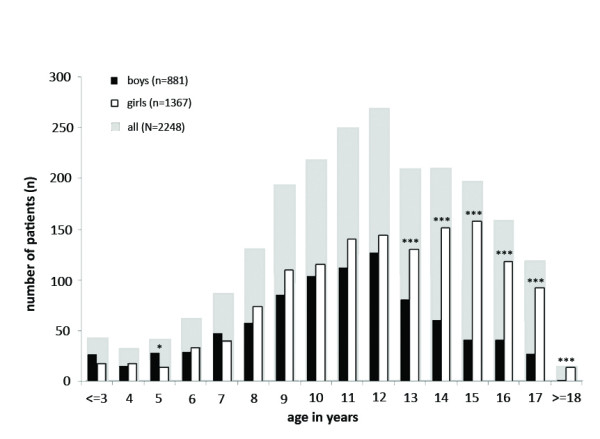
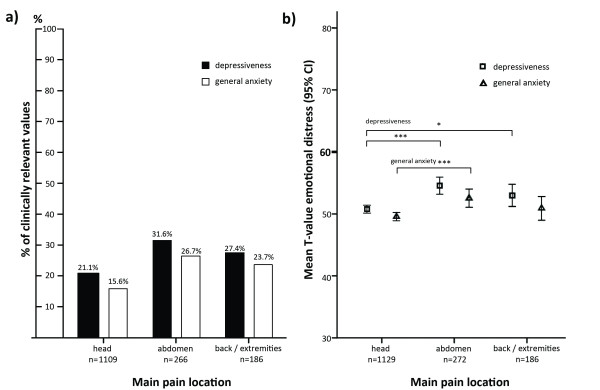
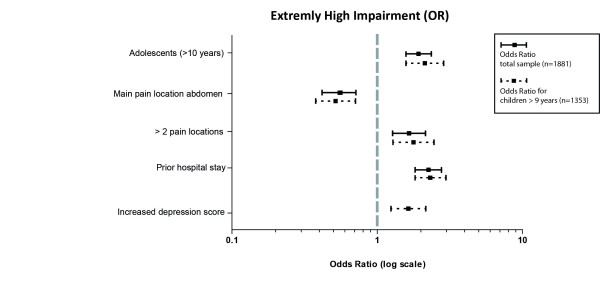
BACKGROUND: Prevalence of pain as a recurrent symptom in children is known to be high, but little is known about children with high impairment from chronic pain seeking specialized treatment. The purpose of this study was the precise description of children with high impairment from chronic pain referred to the German Paediatric Pain Centre over a 5-year period. METHODS: Demographic variables, pain characteristics and psychometric measures were assessed at the first evaluation. Subgroup analysis for sex, age and pain location was conducted and multivariate logistic regression applied to identify parameters associated with extremely high impairment. RESULTS: The retrospective study consisted of 2249 children assessed at the first evaluation. Tension type headache (48%), migraine (43%) and functional abdominal pain (11%) were the most common diagnoses with a high rate of co-occurrence; 18% had some form of musculoskeletal pain disease. Irrespective of pain location, chronic pain disorder with somatic and psychological factors was diagnosed frequently (43%). 55% of the children suffered from more than one distinct pain diagnosis. Clinically significant depression and general anxiety scores were expressed by 24% and 19% of the patients, respectively. Girls over the age of 13 were more likely to seek tertiary treatment compared to boys. Nearly half of children suffered from daily or constant pain with a mean pain value of 6/10. Extremely high pain-related impairment, operationalized as a comprehensive measure of pain duration, frequency, intensity, pain-related school absence and disability, was associated with older age, multiple locations of pain, increased depression and prior hospital stays. 43% of the children taking analgesics had no indication for pharmacological treatment. CONCLUSION: Children with chronic pain are a diagnostic and therapeutic challenge as they often have two or more different pain diagnoses, are prone to misuse of analgesics and are severely impaired. They are at increased risk for developmental stagnation. Adequate treatment and referral are essential to interrupt progression of the chronic pain process into adulthood.
Overview
The claims and statistics of this paper haven’t been checked yet.
Run the check — free, no account needed. It reads the open-access text and checks the sources it cites.
Integrity signals
Registry
Cites
Statistics
Figures
Verification
Claims the paper makes
The claims and statistics of this paper haven’t been checked yet.
Run the check — free, no account needed. It reads the open-access text and checks the sources it cites.
Claims other papers make about this one
Each is checked against this paper’s own text: does it say what the citing paper says it does?
The source backs part of the claim, not all of it — or backs it for a different population, condition or comparison.
In the citing paper
“Depression and functional disability commonly co-occur in chronic pain [40,41], and treatments that successfully target depressive symptoms are likely to have an important impact on overall pain-related functioning.”
From A clinical pilot study of individual and group treatment for adolescents with chronic pain and their parents: Effects of acceptance and commitment therapy on functioning (2016) · cites this paper as [40]
Experimental — accuracy not yet measured
Self-check
Percentages, sums and reported differences re-computed from the paper’s own numbers.
The self-check needs the paper’s full text.
Citations
Cites
Statistical Power Analysis for the Behavioral Sciences
Muller, K. E., & Cohen, J. (1989) · Technometrics · doi:10.2307/1270020 · Cited by 99,603
Statistical power analysis for the behavioral sciences
Cohen, J. (1990) · Computers Environment and Urban Systems · doi:10.1016/0198-9715(90)90050-4 · Cited by 65,417
Bundesgesundheitsblatt - Gesundheitsforschung - Gesundheitsschutz
(2013) · Bundesgesundheitsblatt - Gesundheitsforschung - Gesundheitsschutz · doi:10.1007/103.1437-1588 · Cited by 11,769
Pain in children and adolescents: a common experience
Perquin, C. W., Hazebroek-Kampschreur, A. A. J. M., Hunfeld, J. A. M., Bohnen, A. M., van Suijlekom-Smit, L. W. A., Passchier, J., & van der Wouden, J. C. (2000) · Pain · doi:10.1016/s0304-3959(00)00269-4 · Cited by 1,114
The severity of chronic pediatric pain: an epidemiological study
Huguet, A., & Miró, J. (2008) · The Journal of Pain · doi:10.1016/j.jpain.2007.10.015 · Cited by 600
The Epidemiology of Childhood Recurrent Abdominal Pain in Western Countries: A Systematic Review
Chitkara, D. K., Rawat, D. J., & Talley, N. J. (2005) · The American Journal of Gastroenterology · doi:10.1111/j.1572-0241.2005.41893.x · Cited by 359
School Impairment in Adolescents With Chronic Pain
Logan, D. E., Simons, L. E., Stein, M. J., & Chastain, L. (2008) · Journal of Pain · doi:10.1016/j.jpain.2007.12.003 · Cited by 288
Relationship of pain and symptoms to pubertal development in adolescents
LeResche, L., Mancl, L., Drangsholt, M. T., Saunders, K. W., & Korff, M. V. (2005) · Pain · doi:10.1016/j.pain.2005.08.011 · Cited by 287
Eccleston, C. (2003) · Archives of Disease in Childhood · doi:10.1136/adc.88.10.881 · Cited by 276
Headache in German Children and Adolescents: A Population-Based Epidemiological Study
Kröner‐Herwig, B., Heinrich, M., & Morris, L. (2007) · Cephalalgia · doi:10.1111/j.1468-2982.2007.01319.x · Cited by 223
Research works printed but not linked: 2
- Wieczerkowski W, Nickel H, Janowksi A, Fittkau B, Rauer W: Angstfragebogen für Schüler (AFS). 1981, Westermann, Göttingen
- Stiensmeier-Pelster J, Schürmann M, Duda K: Depressions-Inventar für Kinder und Jugendliche (DIKJ). 2000, Hogrefe, Göttingen
Cited by
Sorted by citations
Childhood Functional Gastrointestinal Disorders: Child/Adolescent
Hyams, J. S., Lorenzo, C. D., Saps, M., Shulman, R. J., Staiano, A., & van Tilburg, M. A. L. (2016) · Gastroenterology · doi:10.1053/j.gastro.2016.02.015 · Cited by 1,426
Pediatric Chronic Pain: Biopsychosocial Assessment and Formulation
Liossi, C., & Howard, R. F. (2016) · PEDIATRICS · doi:10.1542/peds.2016-0331 · Cited by 269
Prevalence of self‐reported chronic pain among adolescents: Evidence from 42 countries and regions
Gobiņa, I., Villberg, J. J., Välimaa, R. S., Tynjälä, J., Whitehead, R., Cosma, A. P., Brooks, F. M., Cavallo, F., Ng, K., de Matos, M. G., et al. (2018) · European Journal of Pain · doi:10.1002/ejp.1306 · Cited by 241
Systematic review on intensive interdisciplinary pain treatment of children with chronic pain
Hechler, T., Kanstrup, M., Holley, A. L., Simons, L. E., Wicksell, R., Hirschfeld, G., & Zernikow, B. (2015) · Pediatrics · doi:10.1542/peds.2014-3319 · Cited by 230
Self-citationMurray, C. B., Groenewald, C. B., de la Vega, R., & Palermo, T. M. (2019) · Pain · doi:10.1097/j.pain.0000000000001732 · Cited by 243
Metadata
- Authors
- Zernikow, B., Wager, J., Hechler, T., Hasan, C., Rohr, U., Dobe, M., Meyer, A., Hübner-Möhler, B., Wamsler, C., & Blankenburg, M.
- Affiliations
- Witten/Herdecke University (DE)
- Corresponding author
- Zernikow, Boris
- Venue
- BMC Pediatrics
- Published
- 2012-05-16
- Volume
- 12
- Issue
- 1
- Pages
- 54-54
- ISSN
- 1471-2431 (ISSN-L)
- PMC
- PMC3404028
- OpenAlex
- W2094181453
- Cited by
- 214
- References
- 46
- Citations by year
- 2026: 7 · 2025: 17 · 2024: 12 · 2023: 7 · 2022: 12 · 2021: 12 · 2020: 18 · 2019: 20 · 2018: 22 · 2017: 19 · 2016: 17 · 2015: 16 · 2014: 11 · 2013: 18 · 2012: 5
- FWCI
- 14.06
- Type
- journal article
- Language
- en
- Open access
- gold
- doi.org
- Licence
- Locations
- BMC Pediatrics (publishedVersion, cc-by)
- Europe PMC (PubMed Central) (publishedVersion, cc-by)
- PubMed Central (publishedVersion, cc-by)
- PubMed (publishedVersion)
- DOAJ (DOAJ: Directory of Open Access Journals) (submittedVersion, cc-by-sa)
- Topics
- Health Sciences › Medicine › Pediatrics, Perinatology and Child Health › Pediatric Pain Management Techniques
- Health Sciences › Health Professions › Physical Therapy, Sports Therapy and Rehabilitation › Musculoskeletal pain and rehabilitation
- Health Sciences › Medicine › Anesthesiology and Pain Medicine › Pain Management and Treatment
- Keywords
- pediatric chronic pain, pain-related impairment, tension-type headache, migraine, functional abdominal pain, musculoskeletal pain, depression, anxiety, analgesic misuse
- MeSH terms
- Absenteeism, Adolescent, Anxiety, Child, Child Health Services, Child, Preschool, Female, Germany, Headache, Hospitalization, Humans, Infant, Male, Pain Measurement, Psychometrics, Surveys and Questionnaires, Retrospective Studies, Risk Factors, Severity of Illness Index, Abdominal Pain, Logistic Models, Chronic Pain, Musculoskeletal Pain
About these checks
Registry, retraction, Cites and statistics results are computed, not judged, with one exception: a printed reference that no index lists is read once by a model before it counts as a citation error. Claims are extracted by a model and kept only when their quote appears verbatim in the text; each cited source is then checked, with a model’s help, for whether it says what the claim relies on. Those verdicts can be wrong — read the claim’s quote and the cited source before relying on one.
Statistics and arithmetic are recomputed, not judged.
Confidence bands are shown only for fields calibrated on our annotated test set. None is calibrated yet, so no band is shown.
What counts as a claim ›How we measure confidence ›How we check this ›
Are you an author, or do you see a problem with this page? Request a review
