

Bacterial and viral etiology of childhood diarrhea in Ouagadougou, Burkina Faso
Open accessThe DOI matches its Crossref record; 29 of the 29 references it cites were found in a registry or an index.
Abstract
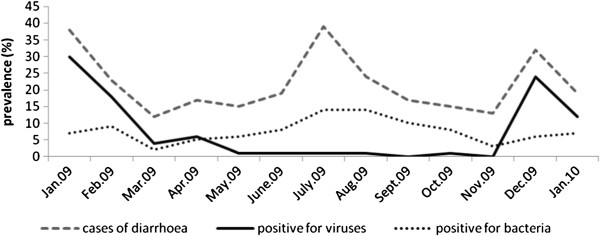
BACKGROUND: Diarrhea is the most frequent health problem among children in developing countries. This study investigated the bacterial and viral etiology and related clinical and epidemiological factors in children with acute diarrhea in Ouagadougou, Burkina Faso. METHODS: Stool specimens were collected from 283 children under 5 years of age visiting hospital due to acute diarrhea and from 60 healthy controls of similar age. Pathogens were investigated by using conventional culture techniques, PCR and immunochromatographic testing. Salmonella and Shigella strains were serotyped and their susceptibility to 23 antimicrobial agents was determined by the agar dilution method. RESULTS: At least one pathogen was detected in 64% of the 283 patients and in 8% of the 60 controls (p < 0.001). Rotavirus was found in 30% of the patients, followed by diarrheagenic Escherichia coli (24%), Salmonella enterica ssp. enterica (9%), Shigella spp. (6%), adenovirus (5%) and Campylobacter spp. (2%). Multiple pathogens were found in 11% of the patients and in 2% of the controls (p = 0.028). Viruses were found mainly in children of ≤ 2 years of age, whereas bacteria were equally prevalent among all the age groups. Viral infections occurred mostly during the cool dry season and the bacterial infections during the rainy season. Fever (64%) and vomiting (61%) were the most common symptoms associated with diarrhea. Only one Salmonella strain was resistant to nalidixic acid and ciprofloxacin. Of the Shigella strains, one was resistant to nalidixic acid but 81% to trimethoprim- sulfamethoxazole, 63% to streptomycin and 50% to ampicillin. Most of all the other Salmonella and Shigella strains were sensitive to all antimicrobials tested. CONCLUSION: Rotaviruses and diarrheal E. coli were the most predominant pathogens associated with acute diarrhea in Burkinabe children. Constant antimicrobial surveillance is warranted to observe for the emergence of enteric bacteria resistant to antimicrobials that are important in treatment also of severe infections.
Overview
The claims and statistics of this paper haven’t been checked yet.
Free: it reads the open-access text and checks the first 5 claims that cite a source we can check. Create a free account to check every claim.
Integrity signals
Registry
Cites
Statistics
Figures
Verification
Claims the paper makes
The claims and statistics of this paper haven’t been checked yet.
Free: it reads the open-access text and checks the first 5 claims that cite a source we can check. Create a free account to check every claim.
Claims other papers make about this one
Each is checked against this paper’s own text: does it say what the citing paper says it does?
The source backs part of the claim, not all of it — or backs it for a different population, condition or comparison.
In the citing paper
“Eight of these 16 serotypes were also reported in humans in this country (Bredeney, Derby, Enteritidis, Kentucky, Muenster, Poona, Tilene, and Tennessee) [34–36].”
From Contamination of street food with multidrug-resistant Salmonella, in Ouagadougou, Burkina Faso (2021) · cites this paper as [35]
Experimental — accuracy not yet measured
Self-check
Percentages, sums and reported differences re-computed from the paper’s own numbers.
The self-check needs the paper’s full text.
Citations
Cites
WHO estimates of the causes of death in children
Bryce, J., Boschi-Pinto, C., Shibuya, K., & Black, R. E. (2005) · The Lancet · doi:10.1016/s0140-6736(05)71877-8 · Cited by 2,096
Wayne, P. A. (2011) · Cited by 705
Typical and Atypical Enteropathogenic Escherichia coli
Trabulsi, L. R., Keller, R., & Gomes, T. A. T. (2002) · Emerging Infectious Diseases · doi:10.3201/eid0805.010385 · Cited by 692
Updated norovirus outbreak management and disease prevention guidelines.
Gregoricus, N., Hall, A. J., Lopman, B. A., et al. (2011) · PubMed · Cited by 531
A millennium update on pediatric diarrheal illness in the developing world.
O’Ryan, M., Prado, V., & Pickering, L. K. (2005) · Seminars in Pediatric Infectious Diseases · doi:10.1053/j.spid.2005.12.008 · Cited by 283 · cited 2×
“Moreover, parasites and other viral enteropathogens, such as norovirus and sapovirus, which were not included in our study, can cause enteric infections [14,26] and may be responsible for illness in some of the 36% of cases with no etiologic diagnosis.”
BackgroundUpdated norovirus outbreak management and disease prevention guidelines.
(2011) · PubMed · Cited by 199
Acute Infantile Gastroenteritis Associated with Human Enteric Viruses in Tunisia
Sdiri-Loulizi, K., Gharbi-Khélifi, H., de Rougemont, A., Chouchane, S., Sakly, N., Ambert-Balay, K., Hassine, M., Guédiche, M. N., Aouni, M., & Pothier, P. (2008) · Journal of Clinical Microbiology · doi:10.1128/jcm.02438-07 · Cited by 178 · cited 2×
“Sdiri-Loulizi K, Gharbi-Khélifi H, De Rougemont A, Chouchane S, Sakly N, Ambert-Balay K, Hassine M, Guédiche MN, Aouni M, Pothier P: Acute infantile gastroenteritis associated with human enteric viruses in Tunisia.”
BackgroundOkeke, I. N., Lamikanra, A., Steinrück, H., & Kaper, J. B. (2000) · Journal of Clinical Microbiology · doi:10.1128/jcm.38.1.7-12.2000 · Cited by 176 · cited 2×
“coli pathogroups can be considered as major bacterial causes of infantile diarrhea in developing countries [19,21,22].”
BackgroundResultEtiology of Diarrhea in Young Children in Denmark: a Case-Control Study
Olesen, B., Neimann, J., Böttiger, B., Ethelberg, S., Schiellerup, P., Jensen, C., Helms, M., Scheutz, F., Olsen, K. E. P., Krogfelt, K., et al. (2005) · Journal of Clinical Microbiology · doi:10.1128/jcm.43.8.3636-3641.2005 · Cited by 170 · cited 2×
“Similar results have also been reported from other countries [10,11], showing the importance of bacterial and viral infections as a cause of childhood diarrhea.”
ResultMANDOMANDO, I. M., MACETE, E. V., RUIZ, J., SANZ, S., ABACASSAMO, F., VALLÈS, X., SACARLAL, J., NAVIA, M. M., VILA, J., ALONSO, P. L., et al. (2007) · The American Journal of Tropical Medicine and Hygiene · doi:10.4269/ajtmh.2007.76.522 · Cited by 152 · cited 1×
“in Mozambique and Tanzania in which the prevalence was approximately 3% [23,24].”
BackgroundPrinciples and Practice of Clinical Bacteriology
(2006) · Wiley eBooks · doi:10.1002/9780470017968 · Cited by 150
Etiology and epidemiology of diarrhea in children in Hanoi, Vietnam
Vu Nguyen, T., Le Van, P., Le Huy, C., Nguyen Gia, K., & Weintraub, A. (2006) · International Journal of Infectious Diseases · doi:10.1016/j.ijid.2005.05.009 · Cited by 144 · cited 1×
“[27].”
Youssef, M. (2000) · FEMS Immunology and Medical Microbiology · doi:10.1016/s0928-8244(00)00165-6 · Cited by 144 · cited 3×
“Also, other symptoms were, in general, similar regardless of the detected pathogen, as has been reported before [25].”
ResultDiarrheagenic Escherichia coli in sub-Saharan Africa: Status, Uncertainties and Necessities
Okeke, I. N. (2009) · The Journal of Infection in Developing Countries · doi:10.3855/jidc.586 · Cited by 143 · cited 1×
“coli pathogroups can be considered as major bacterial causes of infantile diarrhea in developing countries [19,21,22].”
BackgroundMoyo, S. J., Gro, N., Matee, M. I., Kitundu, J., Myrmel, H., Mylvaganam, H., Maselle, S. Y., & Langeland, N. (2011) · BMC Pediatrics · doi:10.1186/1471-2431-11-19 · Cited by 139
Burden of rotavirus and other enteropathogens among children with diarrhea in Burkina Faso
Nitiema, L. W., Nordgren, J., Ouermi, D., Dianou, D., Traore, A. S., Svensson, L., & Simpore, J. (2011) · International Journal of Infectious Diseases · doi:10.1016/j.ijid.2011.05.009 · Cited by 123 · cited 5×
“This percentage is high compared to the previous studies carried out in Burkina Faso (2%) [5] and in southeastern and eastern Africa, e.”
BackgroundResultInfluentialEtiology of childhood diarrhea in the northeast of Brazil: significant emergent diarrheal pathogens
Moreno, A. C. R., Filho, A. F., Gomes, T. D. A. T., Ramos, S. T. S., Montemor, L. P. G., Tavares, V. C., Filho, L. S., Irino, K., & Martinez, M. B. (2008) · Diagnostic Microbiology and Infectious Disease · doi:10.1016/j.diagmicrobio.2008.03.017 · Cited by 122 · cited 2×
“Similar results have also been reported from other countries [10,11], showing the importance of bacterial and viral infections as a cause of childhood diarrhea.”
ResultOpintan, J. A., Newman, M. J., Ayeh-Kumi, P. F., Affrim, R., Gepi-Attee, R., Sevilleja, J. E. A. D., Roche, J. K., Nataro, J. P., Warren, C. A., & Guerrant, R. L. (2010) · The American Society of Tropical Medicine and Hygiene · doi:10.4269/ajtmh.2010.09-0792 · Cited by 114 · cited 1×
“Our results together with the results from previous studies conducted in Nigeria and Ghana suggest that EAEC is endemic in West Africa [4,19,20], but is not a primary cause of diarrhea.”
ResultPrinciples and Practice of Clinical Bacteriology
Gillespie, S. H., & Hawkey, P. M. (2021) · Cited by 93
Hiền, B. T. T., Scheutz, F., Cam, P. D., Serichantalergs, O., Hương, T. T., Thu, T. M., & Dalsgaard, A. (2008) · Journal of Clinical Microbiology · doi:10.1128/jcm.01219-07 · Cited by 89
Epidemiology of rotavirus infection among young children with acute diarrhoea in Burkina Faso
Bonkoungou, I. J. O., Sanou, I., Bon, F., Benon, B., Coulibaly, S. O., Haukka, K., Traore, A. S., & Barro, N. (2010) · BMC Pediatrics · doi:10.1186/1471-2431-10-94 · Cited by 62 · cited 2×
“In our previous reports, rotavirus and diarrheagenic Escherichia coli (DEC) were found to be common causes of childhood diarrhea [3,4].”
BackgroundResultSelf-citationMoyo, S. J., Njølstad, G., Vainio, K., Matee, M. I., Kitundu, J. A., Maselle, S. Y., Langeland, N., & Myrmel, H. (2007) · BMC Public Health · doi:10.1186/1471-2458-7-359 · Cited by 54 · cited 2×
“Sdiri-Loulizi K, Gharbi-Khélifi H, De Rougemont A, Chouchane S, Sakly N, Ambert-Balay K, Hassine M, Guédiche MN, Aouni M, Pothier P: Acute infantile gastroenteritis associated with human enteric viruses in Tunisia.”
BackgroundBonkoungou, I. J. O., Lienemann, T., Martikainen, O., Dembelé, R., Sanou, I., Traore, A. S., Siitonen, A., Barro, N., & Haukka, K. (2011) · Clinical Microbiology and Infection · doi:10.1111/j.1469-0691.2011.03675.x · Cited by 50 · cited 5×
“coli in general and in EPEC, ETEC, EIEC, STEC or EAEC specifically in a single PCR reaction, as described previously [4].”
ResultInfluentialSelf-citationKeskimäki, M., Mattila, L., Peltola, H., & Siitonen, A. (2000) · Journal of Clinical Microbiology · doi:10.1128/jcm.38.12.4425-4429.2000 · Cited by 48 · cited 1×
“Also other studies [17,18] have reported similar results, whereas some studies have concluded that EAEC are causes of diarrhea [10,11].”
ResultSelf-citationRodrigues, A., de Carvalho, M., Monteiro, S., Mikkelsen, C. S., Aaby, P., Mølbak, K., & Fischer, T. K. (2007) · The Pediatric Infectious Disease Journal · doi:10.1097/01.inf.0000254389.65667.8b · Cited by 41 · cited 1×
“Rotavirus was the most frequently detected enteropathogen, supporting the well-documented role of rotavirus in childhood diarrheal disease in Burkina Faso as in some other developing countries [3,5,12-14].”
BackgroundOkeke, C. N., Tsuboi, R., Kawai, M., & Ogawa, H. (2000) · Journal of Clinical Microbiology · doi:10.1128/jcm.38.2.489-491.2000 · Cited by 33
Simporè, J., Ouermi, D., Ilboudo, D. P., Kabre, A., Zeba, B., Pietra, V., Pignatelli, S., Nikiema, J. B., Kabre, G. B., Caligaris, S., et al. (2009) · Pakistan Journal of Biological Sciences · doi:10.3923/pjbs.2009.258.263 · Cited by 31
Benhafid, M., Youbi, M., Klena, J. D., Gentsch, J. R., Teleb, N. A., Widdowson, M., & Aouad, R. E. (2009) · The Journal of Infectious Diseases · doi:10.1086/605048 · Cited by 31
(2003) · Europe PMC (PubMed Central)
Research works printed but not linked: 1
- 7. WHO: Handbook-Integrated Management of Childhood Illness. Geneva: World Health Organization; 2000:18-22.
Cited by
Antimicrobial resistance in Africa: a systematic review
Tadesse, B. T., Ashley, E. A., Ongarello, S., Havumaki, J., Wijegoonewardena, M., González, I. J., & Dittrich, S. (2017) · BMC Infectious Diseases · doi:10.1186/s12879-017-2713-1 · Cited by 554
Majowicz, S. E., Scallan, E., Jones-Bitton, A., Sargeant, J. M., Stapleton, J., Angulo, F. J., Yeung, D. H., & Kirk, M. D. (2014) · Foodborne Pathogens and Disease · doi:10.1089/fpd.2013.1704 · Cited by 432
“In less developed countries, where childhood diarrheal diseases are highly endemic, studies typically focus solely on children, but have also identified STEC as a pathogen of concern in this age group (see, for example: Okeke, 2009; Al Jarousha et al., 2011; Llanos et al., 2012; López et al., 2012; Bonkoungou et al.,…”
Childhood diarrhoeal diseases in developing countries
Ugboko, H. U., Nwinyi, O. C., Oranusi, S. U., & Oyewale, J. O. (2020) · Heliyon · doi:10.1016/j.heliyon.2020.e03690 · Cited by 217
Kagambèga, A., Lienemann, T., Aulu, L., Traoré, A. S., Barro, N., Siitonen, A., & Haukka, K. (2013) · BMC Microbiology · doi:10.1186/1471-2180-13-253 · Cited by 144
Self-citationLangendorf, C., Le Hello, S., Moumouni, A., Gouali, M., Mamaty, A.-A., Grais, R. F., Weill, F.-X., & Page, A.-L. (2015) · PLOS ONE · doi:10.1371/journal.pone.0120275 · Cited by 88
“The few studies available from sub-Saharan Africa suggest that it is not yet the case in this area [9,52,53,60], which emphasizes the need for vaccines including both species.”
BackgroundResult
Metadata
- Authors
- Bonkoungou, I. J. O., Haukka, K., Österblad, M., Hakanen, A. J., Traoré, A. S., Barro, N., & Siitonen, A.
- Affiliations
- Finnish Institute for Health and Welfare (FI)
- University of Helsinki (FI)
- Université Joseph Ki-Zerbo (BF)
- Corresponding author
- Bonkoungou, Isidore Juste O
- Venue
- BMC Pediatrics
- Published
- 2013-03-19
- Volume
- 13
- Issue
- 1
- Pages
- 36-36
- ISSN
- 1471-2431 (ISSN-L)
- PMC
- PMC3616825
- OpenAlex
- W1988226877
- Semantic Scholar
- f641c4da47604028138e62242bfdbfec100099f8
- Cited by
- 166
- References
- 28
- Citations by year
- 2026: 7 · 2025: 5 · 2024: 13 · 2023: 16 · 2022: 11 · 2021: 18 · 2020: 13 · 2019: 13 · 2018: 10 · 2017: 20 · 2016: 9 · 2015: 17 · 2014: 10 · 2013: 3
- FWCI
- 9.44
- Type
- journal article
- Language
- en
- Open access
- gold
- doi.org
- Licence
- cc-by
- creativecommons.org/licenses/by/2.0 (tdm)
- Locations
- BMC Pediatrics (publishedVersion, cc-by)
- Europe PMC (PubMed Central) (publishedVersion, cc-by)
- PubMed Central (publishedVersion, cc-by)
- PubMed (publishedVersion)
- Työväentutkimus Vuosikirja (submittedVersion)
- STM:n Hallinnonalan avoin julkaisuarkisto (Julkari) (submittedVersion)
- Funders
- Academy of Finland (122600)
- Terveyden ja hyvinvoinnin laitos
- Topics
- Health Sciences › Medicine › Infectious Diseases › Viral gastroenteritis research and epidemiology
- Life Sciences › Agricultural and Biological Sciences › Food Science › Salmonella and Campylobacter epidemiology
- Health Sciences › Medicine › Surgery › Gastrointestinal disorders and treatments
- Keywords
- childhood diarrhea, acute diarrhea, enteric pathogens, rotavirus, diarrheagenic Escherichia coli, Salmonella, Shigella, antimicrobial resistance, seasonal variation, Ouagadougou
- MeSH terms
- Acute Disease, Adenoviridae Infections, Burkina Faso, Child, Preschool, Diarrhea, Feces, Female, Follow-Up Studies, Humans, Infant, Infant, Newborn, Male, Rotavirus Infections, Salmonella, Seasons, Serotyping, Shigella, Case-Control Studies, Gram-Negative Bacterial Infections, Drug Resistance, Bacterial
About these checks
Registry, retraction, Cites and statistics results are computed, not judged, with one exception: a printed reference that no index lists is read once by a model before it counts as a citation error. Claims are extracted by a model and kept only when their quote appears verbatim in the text; each cited source is then checked, with a model’s help, for whether it says what the claim relies on. Those verdicts can be wrong — read the claim’s quote and the cited source before relying on one.
Statistics and arithmetic are recomputed, not judged.
Confidence bands are shown only for fields calibrated on our annotated test set. None is calibrated yet, so no band is shown.
What counts as a claim ›How we measure confidence ›How we check this ›
Are you an author, or do you see a problem with this page? Request a review
Data sources
Bibliographic data: Semantic Scholar, OpenAlex, Crossref.
Contains information from the Semantic Scholar Academic Graph Datasets, made available under the ODC Attribution License (ODC-BY 1.0).
Semantic Scholar’s data is described in: Kinney, R., et al. (2023). The Semantic Scholar Open Data Platform. arXiv:2301.10140.
