

The DOI matches its Crossref record; 55 of the 57 references it cites were found in a registry or an index, and 2 are not checked yet.
Attention Deficit Hyperactivity Disorder (ADHD) among longer-term prison inmates is a prevalent, persistent and disabling disorder
Open accessAbstract
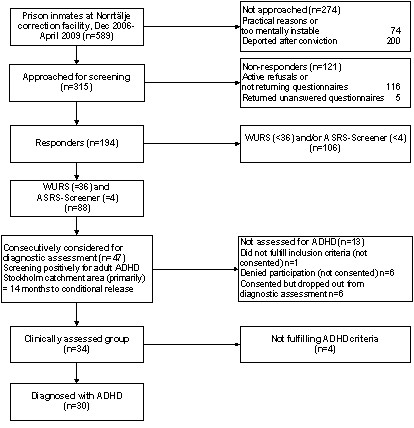
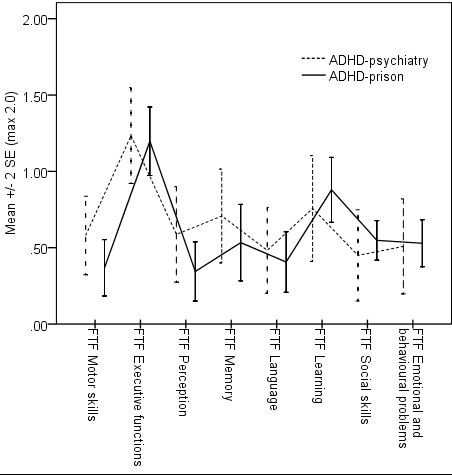
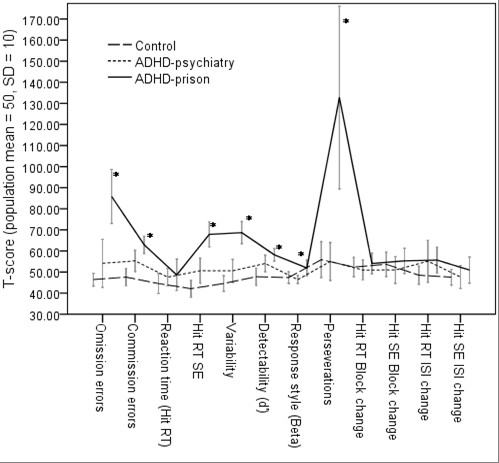
BACKGROUND: ADHD is a common and disabling disorder, with an increased risk for coexisting disorders, substance abuse and delinquency. In the present study, we aimed at exploring ADHD and criminality. We estimated the prevalence of ADHD among longer-term prison inmates, described symptoms and cognitive functioning, and compared findings with ADHD among psychiatric outpatients and healthy controls. METHODS: At Norrtälje Prison, we approached 315 male inmates for screening of childhood ADHD by the Wender Utah Rating Scale (WURS-25) and for present ADHD by the Adult ADHD Self-Report Screener (ASRS-Screener). The response rate was 62%. Further, we assessed 34 inmates for ADHD and coexisting disorders. Finally, we compared findings with 20 adult males with ADHD, assessed at a psychiatric outpatient clinic and 18 healthy controls. RESULTS: The estimated prevalence of adult ADHD among longer-term inmates was 40%. Only 2 out of 30 prison inmates confirmed with ADHD had received a diagnosis of ADHD during childhood, despite most needed health services and educational support. All subjects reported lifetime substance use disorder (SUD) where amphetamine was the most common drug. Mood and anxiety disorders were present among half of subjects; autism spectrum disorder (ASD) among one fourth and psychopathy among one tenth. Personality disorders were common; almost all inmates presented conduct disorder (CD) before antisocial personality disorder (APD). Prison inmates reported more ADHD symptoms during both childhood and adulthood, compared with ADHD psychiatric outpatients. Further, analysis of executive functions after controlling for IQ showed both ADHD groups performed poorer than controls on working memory tests. Besides, on a continuous performance test, the ADHD prison group displayed poorer results compared with both other groups. CONCLUSIONS: This study suggested ADHD to be present among 40% of adult male longer-term prison inmates. Further, ADHD and coexisting disorders, such as SUD, ASD, personality disorders, mood- and anxiety disorders, severely affected prison inmates with ADHD. Besides, inmates showed poorer executive functions also when controlling for estimated IQ compared with ADHD among psychiatric outpatients and controls. Our findings imply the need for considering these severities when designing treatment programmes for prison inmates with ADHD.
Overview
The claims and statistics of this paper haven’t been checked yet.
Run the check — free, no account needed. It reads the open-access text and checks the sources it cites.
Integrity signals
Registry
Cites
Statistics
Figures
Verification
Claims the paper makes
The claims and statistics of this paper haven’t been checked yet.
Run the check — free, no account needed. It reads the open-access text and checks the sources it cites.
Claims other papers make about this one
Each is checked against this paper’s own text: does it say what the citing paper says it does?
The cited source says what the claim attributes to it.
In the citing paper
“Another study estimated the prevalence of ADHD among long-term inmates of a prison at 40% [40].”
From Adult ADHD and comorbid disorders: clinical implications of a dimensional approach (2017) · cites this paper as [40]
Self-check
Percentages, sums and reported differences re-computed from the paper’s own numbers.
The self-check needs the paper’s full text.
Citations
Cites
Diagnostic and Statistical Manual of Mental Disorders
Williams, J. B. W., & First, M. B. (2013) · Oxford University Press eBooks · doi:10.1093/acrefore/9780199975839.013.104 · Cited by 109,845
An inventory for measuring depression
BECK, A. T. (1961) · Archives of General Psychiatry · doi:10.1001/archpsyc.1961.01710120031004 · Cited by 38,032
Diagnostic and Statistical Manual of Mental Disorders.
Widiger, T. A. (2000) · Oxford University Press eBooks · doi:10.1037/10518-009 · Cited by 19,766
An inventory for measuring clinical anxiety: Psychometric properties.
Beck, A. T., Epstein, N., Brown, G., & Steer, R. A. (1988) · Journal of Consulting and Clinical Psychology · doi:10.1037/0022-006x.56.6.893 · Cited by 14,407
Psychometric properties of the Beck Depression Inventory: Twenty-five years of evaluation
Beck, A. T., Steer, R. A., & Carbin, M. G. (1988) · Clinical Psychology Review · doi:10.1016/0272-7358(88)90050-5 · Cited by 11,696
Kessler, R. C., Adler, L., Barkley, R., Biederman, J., Conners, C. K., Demler, O., Faraone, S. V., Greenhill, L. L., Howes, M. J., Secnik, K., et al. (2006) · American Journal of Psychiatry · doi:10.1176/ajp.2006.163.4.716 · Cited by 3,886
Willcutt, E. G., Doyle, A. E., Nigg, J. T., Faraone, S. V., & Pennington, B. F. (2005) · Biological Psychiatry · doi:10.1016/j.biopsych.2005.02.006 · Cited by 3,568
KESSLER, R. C., ADLER, L., AMES, M., DEMLER, O., FARAONE, S., HIRIPI, E., HOWES, M. J., JIN, R., SECNIK, K., SPENCER, T., et al. (2005) · Psychological Medicine · doi:10.1017/s0033291704002892 · Cited by 3,452
FARAONE, S. V., BIEDERMAN, J., & MICK, E. (2006) · Psychological Medicine · doi:10.1017/s003329170500471x · Cited by 2,267
Lord, C., Rutter, M., Goode, S., Heemsbergen, J., Jordan, H., Mawhood, L., & Schopler, E. (1989) · Journal of Autism and Developmental Disorders · doi:10.1007/bf02211841 · Cited by 2,030
Research works printed but not linked: 3
- Wechsler D: . WAIS-III administration and scoring manual. 1997, San Antonio, TX: The Psychological Corporation
- Kaplan E, Fein D, Morris R, Delis D: . WAIS-R as a neuropsychological instrument. 1991, New York: The Psychological Corporation
- Conners CK: Manual for the Conners' Continuous Performance Test-II. 2002, Tonawanda, NY: Multi-Heath Systems
Cited by
Sorted by citations
Adult ADHD and comorbid disorders: clinical implications of a dimensional approach
Katzman, M. A., Bilkey, T. S., Chokka, P. R., Fallu, A., & Klassen, L. J. (2017) · BMC Psychiatry · doi:10.1186/s12888-017-1463-3 · Cited by 732
Updated European Consensus Statement on diagnosis and treatment of adult ADHD
Kooij, J. J. S., Bijlenga, D., Salerno, L., Jaeschke, R., Bitter, I., Balázs, J., Thome, J., Dom, G., Kasper, S., Nunes Filipe, C., et al. (2019) · European Psychiatry · doi:10.1016/j.eurpsy.2018.11.001 · Cited by 686
Self-citationDalsgaard, S., Østergaard, S. D., Leckman, J. F., Mortensen, P. B., & Pedersen, M. G. (2015) · The Lancet · doi:10.1016/s0140-6736(14)61684-6 · Cited by 681
Ginsberg, Y., Quintero, J., Anand, E., Casillas, M., & Upadhyaya, H. P. (2014) · The Primary Care Companion For CNS Disorders · doi:10.4088/pcc.13r01600 · Cited by 274
Self-citationKonstenius, M., Jayaram‐Lindström, N., Guterstam, J., Beck, O., Philips, B., & Franck, J. (2014) · Addiction · doi:10.1111/add.12369 · Cited by 188
Metadata
- Authors
- Ginsberg, Y., Hirvikoski, T., & Lindefors, N.
- Affiliations
- Karolinska Institutet (SE)
- Corresponding author
- Ginsberg, Ylva
- Venue
- BMC Psychiatry
- Published
- 2010-12
- Volume
- 10
- Issue
- 1
- Pages
- 112-112
- ISSN
- 1471-244X (ISSN-L)
- PMC
- PMC3016316
- OpenAlex
- W2049948820
- Cited by
- 191
- References
- 55
- Citations by year
- 2026: 3 · 2025: 9 · 2024: 12 · 2023: 5 · 2022: 5 · 2021: 10 · 2020: 14 · 2019: 10 · 2018: 11 · 2017: 14 · 2016: 18 · 2015: 19 · 2014: 20 · 2013: 19 · 2012: 16
- FWCI
- 8.96
- Type
- journal article
- Language
- en
- Open access
- gold
- doi.org
- Licence
- Locations
- BMC Psychiatry (publishedVersion, cc-by)
- PubMed Central (publishedVersion, cc-by)
- PubMed (publishedVersion)
- DOAJ (DOAJ: Directory of Open Access Journals) (submittedVersion)
- Funders
- Karolinska Institutet
- Stockholms Läns Landsting
- Socialdepartementet
- Topics
- Health Sciences › Medicine › Psychiatry and Mental health › Attention Deficit Hyperactivity Disorder
- Social Sciences › Psychology › Clinical Psychology › Psychopathy, Forensic Psychiatry, Sexual Offending
- Social Sciences › Sociology and Political Science › Criminal Justice and Corrections Analysis
- Keywords
- adult ADHD, prisoners, comorbidities, substance use disorders, amphetamine use, autism spectrum disorder, psychopathy, conduct disorder, antisocial personality disorder, personality disorders, mood and anxiety disorders, executive function, working memory, continuous performance test, childhood ADHD
- MeSH terms
- Adult, Attention Deficit Disorder with Hyperactivity, Mental Disorders, Cognition Disorders, Criminal Law, Humans, Male, Neuropsychological Tests, Prisoners, Psychiatric Status Rating Scales, Psychometrics, Surveys and Questionnaires, Sweden, Time Factors, Comorbidity, Prevalence, Diagnostic and Statistical Manual of Mental Disorders, Executive Function
About these checks
Registry, retraction, Cites and statistics results are computed, not judged, with one exception: a printed reference that no index lists is read once by a model before it counts as a citation error. Claims are extracted by a model and kept only when their quote appears verbatim in the text; each cited source is then checked, with a model’s help, for whether it says what the claim relies on. Those verdicts can be wrong — read the claim’s quote and the cited source before relying on one.
Statistics and arithmetic are recomputed, not judged.
Confidence bands are shown only for fields calibrated on our annotated test set. None is calibrated yet, so no band is shown.
What counts as a claim ›How we measure confidence ›How we check this ›
Are you an author, or do you see a problem with this page? Request a review
