

Trauma-focused treatment for posttraumatic stress disorder combined with CBT for severe substance use disorder: a randomized controlled trial
Open accessThe DOI matches its Crossref record; 56 of the 58 references it cites were found in a registry or an index.
Abstract
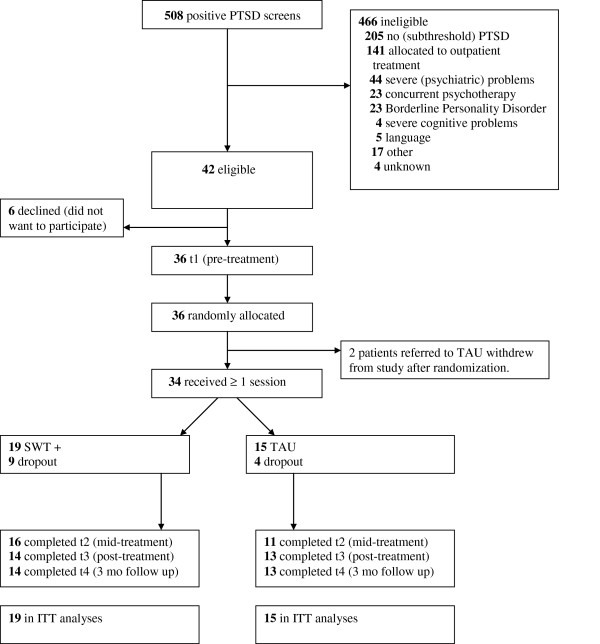
BACKGROUND: This randomized controlled trial (RCT) investigated the effectiveness of a combined treatment for co-morbid Posttraumatic Stress Disorder (PTSD) and severe Substance Use Disorder (SUD). METHODS: Structured Writing Therapy for PTSD (SWT), an evidence-based traumafocused intervention, was added on to Treatment As Usual (TAU), consisting of an intensive cognitive behavioral inpatient or day group treatment for SUD. The outcomes of the combined treatment (TAU + SWT) were compared to TAU alone in a sample of 34 patients. RESULTS: Results showed a general reduction of SUD symptoms for both TAU + SWT and TAU. Treatment superiority of TAU + SWT was neither confirmed by interaction effects (time x condition) for SUD or PTSD symptoms, nor by a group difference for SUD diagnostic status at post-treatment. However, planned contrasts revealed that improvements for PTSD severity over time were only significant within the TAU + SWT group. In addition, within the TAU + SWT group the remission of PTSD diagnoses after treatment was significant, which was not the case for TAU. Finally, at post-treatment a trend was noticed for between group differences for the number of PTSD diagnoses favoring TAU + SWT above TAU. CONCLUSIONS: In sum, the current study provides preliminary evidence that adding a trauma-focused treatment on to standard SUD treatment may be beneficial.
Overview
The claims and statistics of this paper haven’t been checked yet.
Free: it reads the open-access text and checks the first 5 claims that cite a source we can check. Create a free account to check every claim.
Integrity signals
Registry
Cites
Statistics
Figures
Verification
Claims the paper makes
The claims and statistics of this paper haven’t been checked yet.
Free: it reads the open-access text and checks the first 5 claims that cite a source we can check. Create a free account to check every claim.
Claims other papers make about this one
Each is checked against this paper’s own text: does it say what the citing paper says it does?
The source backs part of the claim, not all of it — or backs it for a different population, condition or comparison.
In the citing paper
“In most studies,18, 33, 35, 44, 52 significant improvement was noted in primary and secondary outcomes.32, 38, 44, 53”
From Psychosocial Interventions for Prisoners with Mental and Substance Use Disorders: A Systematic Review (2022) · cites this paper as [32]
Experimental — accuracy not yet measured
Self-check
Percentages, sums and reported differences re-computed from the paper’s own numbers.
The self-check needs the paper’s full text.
Citations
Cites
Missing data analysis: making it work in the real world
Graham, J. W. (2009) · Annual Review of Psychology · doi:10.1146/annurev.psych.58.110405.085530 · Cited by 6,163
Foa, E. B., Cashman, L., Jaycox, L., & Perry, K. (1997) · Psychological Assessment · doi:10.1037/1040-3590.9.4.445 · Cited by 2,709 · cited 10×
“Also, high sensitivities, and moderate specificities were found for the PDS within this population [3,46].”
MethodInfluentialThe self-medication hypothesis of addictive disorders: focus on heroin and cocaine dependence
(1985) · American Journal of Psychiatry · doi:10.1176/ajp.142.11.1259 · Cited by 2,538
Eye Movement Desensitization and Reprocessing: Basic Principles, Protocols, and Procedures
Shapiro, F. (1995) · Medical Entomology and Zoology · Cited by 1,529
Lobbestael, J., Leurgans, M., & Arntz, A. (2011) · Clinical Psychology & Psychotherapy · doi:10.1002/cpp.693 · Cited by 1,124
(2007) · Medical Entomology and Zoology · Cited by 1,118
Prolonged Exposure Therapy for PTSD: Therapist Guide: Emotional processing of traumatic experiences
Foa, E. B., Hembree, E., & Rothbaum, B. (2007) · doi:10.1093/med:psych/9780195308501.001.0001 · Cited by 1,050
The reliability of the Alcohol Timeline Followback when administered by telephone and by computer
Sobell, L. C., Brown, J., Leo, G. I., & Sobell, M. B. (1996) · Drug and Alcohol Dependence · doi:10.1016/0376-8716(96)01263-x · Cited by 750
Zanarini, M. C., Vujanovic, A. A., Parachini, E. A., Boulanger, J. L., Frankenburg, F. R., & Hennen, J. (2003) · Journal of Personality Disorders · doi:10.1521/pedi.17.6.568.25355 · Cited by 720 · cited 3×
“Zanarini MC, Vujanovic AA, Parachini EA, Boulanger JL, Frankenburg FR, Hennen J: A Screening Measure for BPD: The McLean Screening Instrument for Borderline Personality Disorder (MSI-BPD).”
MethodInfluentialFals-Stewart, W., O'Farrell, T. J., Freitas, T. T., McFarlin, S. K., & Rutigliano, P. (2000) · Journal of Consulting and Clinical Psychology · doi:10.1037//0022-006x.68.1.134 · Cited by 671
Research works printed but not linked: 3
- First MB, Spitzer RL, Gibbon M, Williams JBW: Structured clinical interview for axis I DSM-IV disorders-Patient edition (SCID-I/P, version 2.0). New York, USA: Biometrics Research Department; 1996.
- Van Groenestijn MAC, Akkerhuis GW, Kupka RW, Schneider N, Nolen WA: Gestructureerd klinisch interview voor de vaststelling van DSM-IV as-I stoornissen (SCID-I) [Structured Clinical Interview for DSM-IV Axis I disorders (SCID-I)]. Lisse, The Netherlands: Swets & Zeitlinger; 1999.
- Weertman A, Arntz A, Kerkhofs MLM: Gestructureerd diagnostisch interview voor DSM-IV persoonlijkheidsstoornissen (SCID II) [Structural and Clinical Interview for DSM-IV personality disorders (SCID II)]. Lisse, The Netherlands: Swets Test Publisher; 2000.
Cited by
Induction and Expression of Fear Sensitization Caused by Acute Traumatic Stress
Perusini, J. N., Meyer, E. M., Long, V., Rau, V., Nocera, N. A., Avershal, J., Maksymetz, J., Spigelman, I., & Fanselow, M. S. (2015) · Neuropsychopharmacology · doi:10.1038/npp.2015.224 · Cited by 151
Changes in Comorbid Conditions After Prolonged Exposure for PTSD: a Literature Review
van Minnen, A., Zoellner, L. A., Harned, M. S., & Mills, K. (2015) · Current Psychiatry Reports · doi:10.1007/s11920-015-0549-1 · Cited by 127
Psychological therapies for post-traumatic stress disorder and comorbid substance use disorder
Roberts, N. P., Roberts, P. A., Jones, N., & Bisson, J. I. (2016) · Cochrane Database of Systematic Reviews · doi:10.1002/14651858.cd010204.pub2 · Cited by 126
Nyssen, O. P., Taylor, S. J., Wong, G., Steed, E., Bourke, L., Lord, J., Ross, C. A., Hayman, S., Field, V., Higgins, A., et al. (2016) · Health Technology Assessment · doi:10.3310/hta20270 · Cited by 115
Efficacy and acceptability of interventions for co-occurring PTSD and SUD: A meta-analysis
Simpson, T. L., Goldberg, S. B., Louden, D. N., Blakey, S. M., Hawn, S. E., Lott, A. M. K., Browne, K. C., Lehavot, K., & Kaysen, D. L. (2021) · Journal of Anxiety Disorders · doi:10.1016/j.janxdis.2021.102490 · Cited by 121
Hien, D. A., Morgan-López, A. A., Saavedra, L. M., Ruglass, L. M., Ye, A., López-Castro, T., Fitzpatrick, S., Killeen, T. K., Norman, S. B., Ebrahimi, C. T., et al. (2023) · American Journal of Psychiatry · doi:10.1176/appi.ajp.22010071 · Cited by 99
Coco, G. L., Melchiori, F. M., Oieni, V., Infurna, M. R., Strauss, B. M., Schwartze, D., Rosendahl, J., & Gullo, S. (2019) · Journal of Substance Abuse Treatment · doi:10.1016/j.jsat.2019.01.016 · Cited by 108
Morath, J., Gola, H., Sommershof, A., Hamuni, G., Kolassa, S., Catani, C., Adenauer, H., Ruf‐Leuschner, M., Schauer, M., Elbert, T. R., et al. (2014) · Journal of Psychiatric Research · doi:10.1016/j.jpsychires.2014.03.016 · Cited by 83
Prior, K., Mills, K. L., Ross, J. E., & Teesson, M. (2016) · Drug and Alcohol Review · doi:10.1111/dar.12419 · Cited by 82
Goodman, R. (2017) · Advances in Social Work · doi:10.18060/21312 · Cited by 110
Hien, D. A., Papini, S., Saavedra, L. M., Bauer, A. G., Ruglass, L. M., Ebrahimi, C. T., Fitzpatrick, S., López‐Castro, T., Norman, S. B., Killeen, T. K., et al. (2024) · Psychological Bulletin · doi:10.1037/bul0000409 · Cited by 55
El‐Bassel, N., Marotta, P. L., Goddard‐Eckrich, D., Chang, M., Hunt, T., Wu, E., & Gilbert, L. (2019) · PLoS ONE · doi:10.1371/journal.pone.0225854 · Cited by 49
“[49] Moreover, prior research suggests that trauma-focused interventions are needed in substance use treatment that acknowledge the vulnerabilities to substance use and relapse for people exposed to IPV and childhood adversity.[50] However thus far, IPV and childhood adversity have not been thoroughly integrated into…”
BackgroundPosttraumatic Stress Disorder and Comorbidity: Untangling the Gordian Knot
Lockwood, E., & Forbes, D. (2014) · Psychological Injury and Law · doi:10.1007/s12207-014-9189-8 · Cited by 48
“In line with this, there is some evidence to suggest that in some cases SUD precedes PTSD and that treatment of SUD leads to a reduction in PTSD symptoms (see van Dam et al. 2013 for a review).”
BackgroundResultInfluentialNajavits, L. M., Krinsley, K. E., Waring, M. E., Gallagher, M. W., & Skidmore, C. T. (2018) · Substance Use & Misuse · doi:10.1080/10826084.2018.1432653 · Cited by 48
Berg, M. K., Hobkirk, A. L., Joska, J. A., & Meade, C. S. (2017) · Psychological Trauma Theory Research Practice and Policy · doi:10.1037/tra0000207 · Cited by 47
PTSD/Substance Use Disorder Comorbidity: Treatment Options and Public Health Needs
Najavits, L. M., Clark, H. W., DiClemente, C. C., Potenza, M. N., Shaffer, H. J., Sorensen, J. L., Tull, M. T., Zweben, A., & Zweben, J. E. (2020) · Current Treatment Options in Psychiatry · doi:10.1007/s40501-020-00234-8 · Cited by 44
Thekkumkara, S. N., Jagannathan, A., Muliyala, K. P., & Murthy, P. (2022) · Indian Journal of Psychological Medicine · doi:10.1177/02537176211061655 · Cited by 26
Chapter 48. Trauma- and Stressor-Related Disorders
Fitzpatrick, S., Jarnecke, A. M., Back, S. E., Straus, E., Norman, S., & Hien, D. A. (2021) · American Psychiatric Association Publishing eBooks · doi:10.1176/appi.books.9781615373970.kb48 · Cited by 25
Trauma-focused treatment for comorbid post-traumatic stress and substance use disorder
Kline, A. C., Panza, K. E., Lyons, R., Kehle-Forbes, S. M., Hien, D. A., & Norman, S. B. (2022) · Nature Reviews Psychology · doi:10.1038/s44159-022-00129-w · Cited by 24
Simpson, T. L., Kaysen, D. L., Fleming, C. B., Rhew, I. C., Jaffe, A. E., Desai, S. A., Hien, D. A., Berliner, L., Donovan, D. M., & Resick, P. A. (2022) · PLoS ONE · doi:10.1371/journal.pone.0276111 · Cited by 38
“When considered alongside the extant findings in the literature pertaining to COPE, the present findings have implications for service delivery for PTSD/AUD patients in that they suggest that unmodified CPT and unmodified RP may constitute additional viable treatment options when COPE, or other effective integrated tr…”
ResultSchäfer, I., Chuey-Ferrer, L., Hofmann, A., Liebermann, P., Mainusch, G., & Lotzin, A. (2017) · BMC Psychiatry · doi:10.1186/s12888-017-1255-9 · Cited by 29
“First evidence exists that trauma-focused treatments, such as prolonged exposure [11], trauma-focused imaginal exposure [12] and structured writing therapy [13],”
BackgroundPilot study of Creating Change, a new past‐focused model for PTSD and substance abuse
Najavits, L. M., & Johnson, K. M. (2014) · American Journal on Addictions · doi:10.1111/j.1521-0391.2014.12127.x · Cited by 27
Lortye, S. A., Will, J. P., Marquenie, L. A., Goudriaan, A. E., Arntz, A. R., & de Waal, M. M. (2021) · BMC Psychiatry · doi:10.1186/s12888-021-03366-0 · Cited by 25
“…(starting at the same time) or sequentially (starting PTSD treatment after finishing SUD treat-ment) [7, 29] A Dutch study showed that simultaneous PTSD/SUD treatment can be safely implemented in in-patient as well as outpatient addiction care without negative effects on SUD treatment [30].”
Jones, J., Yuan, Y., & Yarosh, S. (2021) · Proceedings of the ACM on Interactive Mobile Wearable and Ubiquitous Technologies · doi:10.1145/3494955 · Cited by 19
“taking medication [19], engaging in cognitive-behavioral therapy [54], building a support system by attending 12-step meetings [32], establishing a mindfulness practice [22], and more.”
BackgroundRead, J. P., Radomski, S. A., & Borsari, B. E. (2015) · Current Addiction Reports · doi:10.1007/s40429-015-0044-0 · Cited by 16
MYERS, B. J., Silva, N. D., McLaughlin, S., Purnomo, J., Shumskaya, D., Koume, K., Suhartono, S., Campello, G., & Busse, A. (2025) · International Journal of Drug Policy · doi:10.1016/j.drugpo.2025.104770 · Cited by 19
Nass, G. C. M., van Rens, L. W. J., & Dijkstra, B. A. G. (2019) · Substance Abuse Treatment Prevention and Policy · doi:10.1186/s13011-019-0194-5 · Cited by 16
A systematic review of comprehensive interventions for substance abuse: Focus on victimization
Sabri, B., Greene, C., & Lucas, G. M. (2019) · Aggression and Violent Behavior · doi:10.1016/j.avb.2019.08.006 · Cited by 15
Inpatient Cognitive Behavior Therapy Approaches for Suicide Prevention
Ghahramanlou‐Holloway, M., Neely, L. L., Tucker, J., Caffery, K., Colborn, V. A., & Koltko, V. (2015) · Current Treatment Options in Psychiatry · doi:10.1007/s40501-015-0063-4 · Cited by 9
Purnell, L. R., Graham, A., Chiu, K., Trickey, D., & Meiser‐Stedman, R. (2024) · Journal of Anxiety Disorders · doi:10.1016/j.janxdis.2024.102925 · Cited by 9
Coker, K. L., Stefanovics, E. A., & Rosenheck, R. A. (2016) · Psychological Trauma Theory Research Practice and Policy · doi:10.1037/tra0000061 · Cited by 14
“…found in these studies, no specific pharmacotherapies or psychotherapies have been clearly demonstrated to improve substance use outcomes among individuals with PTSD (van Dam et al., 2013) with limited exceptions (P. Ouimette, Moos, & Finney, 2003; Petrakis et al., 2006; Possemato et al., 2012).”
Ruglass, L. M., Shevorykin, A., Brezing, C., Hu, M., & Hien, D. A. (2017) · Journal of Substance Abuse Treatment · doi:10.1016/j.jsat.2017.06.007 · Cited by 12
“Indeed, individuals with anxiety and/or PTSD frequently endorse affect regulation as a reason for their substance use (Mccauley et al., 2012; van Dam et al., 2013).”
BackgroundInfluentialWalter, Z. C., Carlyle, M., Mefodeva, V., Glasgow, S., Newland, G., Nixon, R. D. V., Cobham, V. E., & Hides, L. M. (2024) · Journal of Substance Use and Addiction Treatment · doi:10.1016/j.josat.2024.209571 · Cited by 9
Trauma and Substance Abuse: A Clinician’s Guide to Treatment
Najavits, L. M. (2015) · Evidence Based Treatments for Trauma-Related Psychological Disorders · doi:10.1007/978-3-319-07109-1_16 · Cited by 4
“…Concurrent Prolonged Exposure (COPE) a (Mills et al. 2012) 1 Structured Writing Therapy for PTSD plus manual-based SUD group therapy (SWT) (van Dam et al. 2013) 1 Integrated Therapy (Sannibale et al. 2013) 1 Trauma Adaptive Recovery Group Education and Therapy (TARGET) (Frisman et al. 2008) 1…”
MethodResultThompson, C. J., & Martin‐Wagar, C. A. (2024) · Eating Disorders · doi:10.1080/10640266.2024.2405290 · Cited by 9
“This finding is in line with previous research on the negative implications of comorbid illness and PTSD, which can exacerbate one another, leading to further complications in both (e.g., avoidance of feared stimuli, negative coping strategies; Price et al., 2019; van Dam et al., 2013).”
Lortye, S. A., Will, J. P., Marquenie, L. A., Lommerse, N. M., Faber, N., Goudriaan, A. E., Arntz, A. R., & de Waal, M. M. (2025) · Addiction · doi:10.1111/add.70097 · Cited by 11
Mohammed, A. A., AmiraSharaf, SamiaAbdeldayem, & Norito, K. (2017) · Journal of Depression and Anxiety Disorders · doi:10.36959/362/471 · Cited by 6
Schäfer, I., Ehring, T. W., Knaevelsrud, C., Maercker, A., Michael, T., & Schellong, J. (2020) · Psychotherapeut · doi:10.1007/s00278-020-00459-1 · Cited by 6
“…Bezug auf die PTBS-Symptomatik zeigten als andere manualisierte Behandlungsansätze, z. B. Rückfallpräventionstraining,warentraumafokussierte Interventionen ineinemTeil der Studien den jeweiligen Kontrollbehandlungen überlegen (z. B. Coffey et al. 2006, 2016; Mills et al. 2012; van Dam et al. 2013).”
BackgroundSelf-citationEvidence-Supported Psychosocial Treatment for Dual Disorder Patients
Moggi, F., & Öjehagen, A. (2014) · Springer eBooks · doi:10.1007/978-3-642-45375-5_18 · Cited by 5
O'Neil, M. E., Cheney, T. P., Hsu, F. C., Carlson, K. F., Hart, E. L., Holmes, R. S., Murphy, K. M., Graham, E., Cameron, D. C., Kahler, J., et al. (2020) · doi:10.23970/ahrqepccer235 · Cited by 6
Stoycos, S. A., Straud, C. L., Stanley, I. H., Marx, B. P., Resick, P. A., Young‐McCaughan, S., Peterson, A. L., & Sloan, D. M. (2023) · Journal of Anxiety Disorders · doi:10.1016/j.janxdis.2023.102794 · Cited by 6
Group Treatment for Trauma-Related Psychological Disorders
Litwack, S. D., Beck, J. G., & Sloan, D. M. (2015) · Springer eBooks · doi:10.1007/978-3-319-07109-1_23 · Cited by 7
Therapy for Posttraumatic Stress and Alcohol Dependence
Najavits, L. M. (2013) · JAMA · doi:10.1001/jama.2013.282141 · Cited by 4
Zhuang, S., Song, Y., Jin, S., Shang, X., Liu, Y., Shi, L., Qu, Y., Zhang, Y., Chen, Y., & Li, L. (2025) · Addictive Behaviors · doi:10.1016/j.addbeh.2025.108423 · Cited by 4
Erga, A. H., Ushakova, A., Elstad, M., Fodstad, E. C., & Belfrage, A. (2024) · Journal of Dual Diagnosis · doi:10.1080/15504263.2024.2338799 · Cited by 4
“…the crucial need for an integrative approach encompassing trauma-informed care, evidence-based therapies for trauma, and concurrent treatment for substance use disorders and mental health disorders in order to optimize outcomes (Amaro et al., 2007; Godley et al., 2014; van Dam et al., 2013).”
BackgroundSuchterkrankungen und komorbide psychische Störungen
Moggi, F., & Preuss, U. W. (2018) · Elsevier eBooks · doi:10.1016/b978-3-437-23021-9.00019-9 · Cited by 4
Estresse precoce, impulsividade e comportamento suicida em usuários de substâncias psicoativas
Júnior, E. B. C. (2020) · Digital Library of Theses and Dissertations (Universidade de São Paulo) · doi:10.11606/t.22.2020.tde-17032021-102918 · Cited by 2
Behandlung der PTBS bei Erwachsenen
Augsburger, M., Bering, R., Böttche, M., Ehring, T. W., Frommberger, U., Gast, U., Hecker, T., Hoffmann, A., Kleim, B., Knaevelsrud, C., et al. (2019) · Springer eBooks · doi:10.1007/978-3-662-59783-5_2 · Cited by 1
Self-citationLortye, S. A., Faber, N., Will, J. P., Marquenie, L. A., Lommerse, N. M., Goudriaan, A. E., Arntz, A. R., & de Waal, M. M. (2026) · Journal of Substance Use and Addiction Treatment · doi:10.1016/j.josat.2025.209878 · Cited by 1
Faber, N., Lortye, S. A., Arntz, A. R., Marquenie, L. A., Goudriaan, A. E., & de Waal, M. M. (2026) · Behaviour Research and Therapy · doi:10.1016/j.brat.2026.105053 · Cited by 1
Posttraumatic Stress Disorders and Addiction
Schäfer, I., & Langeland, W. (2014) · Springer eBooks · doi:10.1007/978-3-642-45375-5_12 · Cited by 3
Psychological trauma in an addictions population: A case note and self-report comparison
Curran, D. B., McLaughlin, E., & Kelly, M. (2016) · Clinical Psychology Forum · doi:10.53841/bpscpf.2016.1.278.18 · Cited by 1
Group Treatment for Trauma-Related Psychological Disorders
Litwack, S. D., Beck, J. G., & Sloan, D. M. (2022) · Springer eBooks · doi:10.1007/978-3-030-97802-0_24 · Cited by 2
Patel, R. S., Manikkara, G., Patel, P. A., Talukdar, J., & Mansuri, Z. (2018) · Behavioral Sciences · doi:10.3390/bs8080073 · Cited by 1
Emmelkamp, P. M. G., & Ehring, T. W. (2014) · Wiley eBooks · doi:10.1002/9781118775349.ch1 · Cited by 2
Self-citationAshton, C. W. (2015) · Journal of Diabetes Metabolic Disorders & Control · doi:10.15406/jdmdc.2015.02.00038
“Research exists which shows that “trauma-related cues can trigger a craving response [3].”
BackgroundIntegrated and Reducing Re-Entry into the Criminal Justice System
Huntington, S. (2016) · ScholarWorks (Walden University)
Krisenintervention und Traumatherapie
Ehring, T. W., & Maragkos, M. (2017) · Springer eBooks · doi:10.1007/978-3-662-49295-6_45
Self-citationWirkfaktoren psychosozialer Behandlungen bei Sucht und komorbiden psychischen Störungen
Moggi, F. (2016) · Nervenheilkunde · doi:10.1055/s-0037-1616450
Curran, D. B. (2017) · Wiley eBooks · doi:10.1002/9781118489710.ch8
Predicting outcomes of trauma-exposed women in substance use treatment programs
Combs, E. M., & NC DOCKS at Western Carolina University (2018) · NC Digital Online Collection of Knowledge and Scholarship (The University of North Carolina at Greensboro)
Krisenintervention und Traumatherapie
Ehring, T. W., & Maragkos, M. (2017) · Springer eBooks · doi:10.1007/978-3-642-45028-0_45-2
Self-citationKrisenintervention und Traumaterapie
Ehring, T. W., & Maragkos, M. (2015) · Springer eBooks · doi:10.1007/978-3-642-45028-0_45-1
Self-citationTrauma and Addiction: A Clinician’s Guide to Treatment
Najavits, L. M. (2022) · Springer eBooks · doi:10.1007/978-3-030-97802-0_17 · Cited by 3
Substance Abuse, Personality Disorders, and Severe Mental Illness
Emmelkamp, P. M. G. (2023) · Springer eBooks · doi:10.1007/978-3-031-34078-9_9
Self-citationPreble, K. M., & Nichols, A. J. (2023) · Oxford University Press eBooks · doi:10.1093/oso/9780197694732.003.0032
Suchterkrankungen und komorbide psychische Störungen
Moggi, F., & Preuss, U. W. (2024) · Elsevier eBooks · doi:10.1016/b978-3-437-21074-7.00024-1
Effectiveness of Pharmacological Treatment for PTSD: A Systematic Review
Vyas, D., Tripathi, S., & Goel, D. (2025) · Advances in medical diagnosis, treatment, and care (AMDTC) book series · doi:10.4018/979-8-3693-7432-0.ch022
EVALUATION OF INTERVENTIONS USED IN THE TREATMENT OF VETERANS WITH CO-OCCURRING DISORDERS
Simon, K. F., & Frawley, M. M. (2015) · CSUSB ScholarWorks (California State University, San Bernardino)
Early stress, impulsivity and suicidal behavior in users of psychoactive substances
Júnior, E. B. C. (2020) · LA Referencia (Red Federada de Repositorios Institucionales de Publicaciones Científicas)
Jasudowicz, A., & Lorenz, T. K. (2026) · Sexual Medicine Reviews · doi:10.1093/sxmrev/qeag073
Metadata
- Authors
- van Dam, D., Ehring, T., Vedel, E., & Emmelkamp, P. M.
- Affiliations
- University of Münster (DE)
- Jellinek (NL)
- King Abdulaziz University (SA)
- Venue
- BMC Psychiatry
- Published
- 2013-06-19
- Volume
- 13
- Issue
- 1
- Pages
- 172-172
- ISSN
- 1471-244X (ISSN-L)
- PMC
- PMC3698199
- OpenAlex
- W2066085473
- Cited by
- 71
- References
- 58
- Citations by year
- 2026: 3 · 2025: 4 · 2024: 5 · 2023: 4 · 2022: 6 · 2021: 4 · 2020: 5 · 2019: 5 · 2018: 4 · 2017: 7 · 2016: 7 · 2015: 10 · 2014: 6 · 2013: 1
- FWCI
- 8.89
- Type
- journal article
- Language
- en
- Open access
- gold
- doi.org
- Licence
- Locations
- BMC Psychiatry (publishedVersion, cc-by)
- Europe PMC (PubMed Central) (publishedVersion, cc-by)
- PubMed Central (publishedVersion, cc-by)
- PubMed (publishedVersion)
- UvA-DARE (University of Amsterdam) (publishedVersion, other-oa)
- Open access LMU (Ludwid Maxmilian's Universitat Munchen) (acceptedVersion)
- Data Archiving and Networked Services (DANS) (submittedVersion, other-oa)
- Funders
- Koninklijke Nederlandse Akademie van Wetenschappen
- Vrije Universiteit Amsterdam
- Topics
- Social Sciences › Psychology › Clinical Psychology › Posttraumatic Stress Disorder Research
- Social Sciences › Psychology › Experimental and Cognitive Psychology › Sleep and related disorders
- Social Sciences › Psychology › Clinical Psychology › Psychotherapy Techniques and Applications
- Keywords
- post-traumatic stress disorder, substance use disorders, comorbidities, trauma-focused psychotherapy, cognitive behavioral therapy, inpatient care, PTSD remission
- MeSH terms
- Adult, Combined Modality Therapy, Female, Humans, Male, Middle Aged, Psychotherapy, Psychotherapy, Group, Stress Disorders, Post-Traumatic, Cognitive Behavioral Therapy, Treatment Outcome, Substance-Related Disorders
About these checks
Registry, retraction, Cites and statistics results are computed, not judged, with one exception: a printed reference that no index lists is read once by a model before it counts as a citation error. Claims are extracted by a model and kept only when their quote appears verbatim in the text; each cited source is then checked, with a model’s help, for whether it says what the claim relies on. Those verdicts can be wrong — read the claim’s quote and the cited source before relying on one.
Statistics and arithmetic are recomputed, not judged.
Confidence bands are shown only for fields calibrated on our annotated test set. None is calibrated yet, so no band is shown.
What counts as a claim ›How we measure confidence ›How we check this ›
Are you an author, or do you see a problem with this page? Request a review
Data sources
Bibliographic data: Semantic Scholar, OpenAlex, Crossref.
Contains information from the Semantic Scholar Academic Graph Datasets, made available under the ODC Attribution License (ODC-BY 1.0).
Semantic Scholar’s data is described in: Kinney, R., et al. (2023). The Semantic Scholar Open Data Platform. arXiv:2301.10140.
