

The DOI matches its Crossref record; 41 of the 41 references it cites were found in a registry or an index.
Mothers' AdvocateS In the Community (MOSAIC)-non-professional mentor support to reduce intimate partner violence and depression in mothers: a cluster randomised trial in primary care
Open accessAbstract
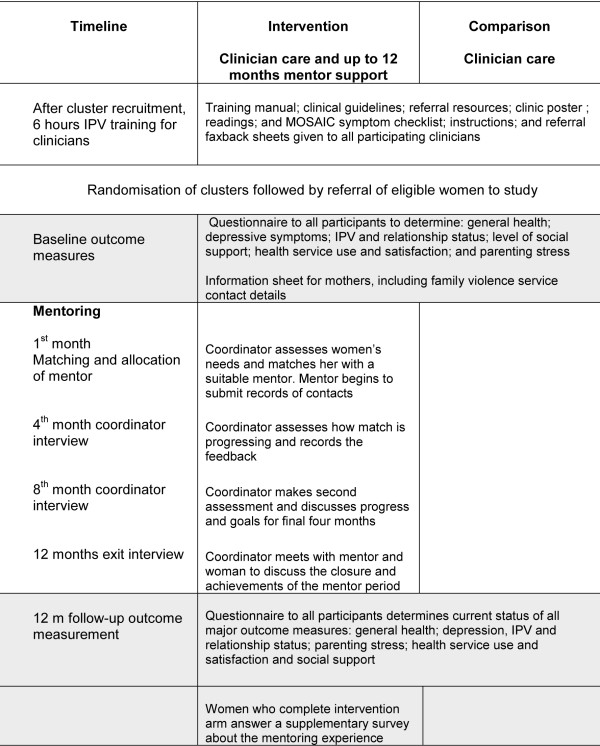
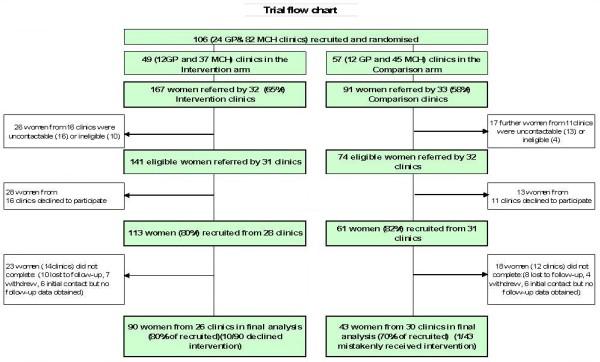
BACKGROUND: Effective interventions to increase safety and wellbeing of mothers experiencing intimate partner violence (IPV) are scarce. As much attention is focussed on professional intervention, this study aimed to determine the effectiveness of non-professional mentor support in reducing IPV and depression among pregnant and recent mothers experiencing, or at risk of IPV. METHODS: MOSAIC was a cluster randomised trial in 106 primary care (maternal and child health nurse and general practitioner) clinics in Melbourne, Australia. 63/106 clinics referred 215 eligible culturally and linguistically diverse women between January 2006 and December 2007. 167 in the intervention (I) arm, and 91 in the comparison (C) arm. 174 (80.9%) were recruited. 133 (76.4%) women (90 I and 43 C) completed follow-up at 12 months. INTERVENTION: 12 months of weekly home visiting from trained and supervised local mothers, (English & Vietnamese speaking) offering non-professional befriending, advocacy, parenting support and referrals. MAIN OUTCOME MEASURES: Primary outcomes; IPV (Composite Abuse Scale CAS) and depression (Edinburgh Postnatal Depression Scale EPDS); secondary measures included wellbeing (SF-36), parenting stress (PSI-SF) and social support (MOS-SF) at baseline and follow-up. ANALYSIS: Intention-to-treat using multivariable logistic regression and propensity scoring. RESULTS: There was evidence of a true difference in mean abuse scores at follow-up in the intervention compared with the comparison arm (15.9 vs 21.8, AdjDiff -8.67, CI -16.2 to -1.15). There was weak evidence for other outcomes, but a trend was evident favouring the intervention: proportions of women with CAS scores ≥ 7, 51/88 (58.4%) vs 27/42 (64.3%) AdjOR 0.47, CI 0.21 to 1.05); depression (EPDS score ≥ 13) (19/85, 22% (I) vs 14/43, 33% (C); AdjOR 0.42, CI 0.17 to 1.06); physical wellbeing mean scores (PCS-SF36: AdjDiff 2.79; CI -0.40 to 5.99); mental wellbeing mean scores (MCS-SF36: AdjDiff 2.26; CI -1.48 to 6.00). There was no observed effect on parenting stress. 82% of women mentored would recommend mentors to friends in similar situations. CONCLUSION: Non-professional mentor mother support appears promising for improving safety and enhancing physical and mental wellbeing among mothers experiencing intimate partner violence referred from primary care. TRIAL REGISTRATION: ACTRN12607000010493http://www.anzctr.org.au.
Overview
The claims and statistics of this paper haven’t been checked yet.
Run the check — free, no account needed. It reads the open-access text and checks the sources it cites.
Integrity signals
Registry
Cites
Statistics
Figures
Verification
Claims the paper makes
The claims and statistics of this paper haven’t been checked yet.
Run the check — free, no account needed. It reads the open-access text and checks the sources it cites.
Claims other papers make about this one
Each is checked against this paper’s own text: does it say what the citing paper says it does?
The source backs part of the claim, not all of it — or backs it for a different population, condition or comparison.
In the citing paper
“The studies showed good to moderate evidence of the positive impact of these interventions on mental health outcomes and also access to social support for the IPV survivors included in the study, and in a few studies, a reduction in partner aggression or experience of IPV (IPV scores) [15–23].”
From A systematic review of intimate partner violence interventions focused on improving social support and/ mental health outcomes of survivors (2020) · cites this paper as [19]
Experimental — accuracy not yet measured
Self-check
Percentages, sums and reported differences re-computed from the paper’s own numbers.
The self-check needs the paper’s full text.
Citations
Cites
Multiple Imputation for Nonresponse in Surveys
Rubin, D. B. (1987) · Wiley Series in Probability and Statistics · doi:10.1002/9780470316696 · Cited by 20,701
The world report on violence and health
Krug, E. G., Mercy, J. A., Dahlberg, L. L., & Zwi, A. B. (2002) · The Lancet · doi:10.1016/s0140-6736(02)11133-0 · Cited by 9,110 · cited 2×
“Intimate partner violence (IPV) is a prevalent and pressing public health issue, especially among women with young children in socio-economically deprived communities [1].”
The cochrane database of systematic reviews
Geddes, J. R. (1996) · Journal of Psychosomatic Research · doi:10.1016/s0022-3999(96)90063-x · Cited by 5,988
Cochrane Database of Systematic Reviews
(2008) · Springer eBooks · doi:10.1007/978-1-4020-5614-7_436 · Cited by 4,552
Assessing social support: The Social Support Questionnaire.
Sarason, I. G., Levine, H. M., Basham, R. B., & Sarason, B. R. (1983) · Journal of Personality and Social Psychology · doi:10.1037//0022-3514.44.1.127 · Cited by 3,067
Overview of the SF-36 Health Survey and the International Quality of Life Assessment (IQOLA) Project
Ware, J. E., & Gandek, B. (1998) · Journal of Clinical Epidemiology · doi:10.1016/s0895-4356(98)00081-x · Cited by 2,716
World Report on Violence and Health.
Hoffman, J. S. (2003) · Injury Prevention · doi:10.1136/ip.9.1.93 · Cited by 1,746
Olds, D. L. (1997) · JAMA · doi:10.1001/jama.1997.03550080047038 · Cited by 1,372
El informe mundial sobre la violencia y la salud.
Krug, E. G., Mercy, J. A., Dahlberg, L. L., & Zwi, A. B. (2002) · Biomédica · doi:10.7705/biomedica.v22isupp2.1182 · Cited by 1,058
The Validation of the Edinburgh Post-natal Depression Scale on a Community Sample
Murray, L., & Carothers, A. D. (1990) · The British Journal of Psychiatry · doi:10.1192/bjp.157.2.288 · Cited by 881
Research works printed but not linked: 6
- Warshaw C, Taft A, McCosker-Howard H: Educating health professionals: changing attitudes and overcoming barriers, in Intimate partner abuse and health professionals: new approaches to domestic violence. Edited by: Roberts G, Hegarty K, Feder G. 2006, Elsevier: London, 61-78.
- Kerr C, Taft A, Small R: MOSAIC Project Manual: setting up a mentor project for mothers experiencing intimate partner/family violence. 2009, Mother and Child Health Research, La Trobe University: Melbourne, Australia, 72-
- Abidin RR: Parenting Stress Index: Professional Manual. 1995, Odessa, Florida: PAR, Inc, Third
- Stata, Stata Statistical Software: Release 10. 2007, College Station, Texas, USA: StataCorp LP
- Davey M-A, T O, Oats JJN, Riley M: Births in Victoria 2005 and 2006. 2007, Victorian Perinatal Data Collection Unit: Melbourne
- Australian Bureau of Statistics: 2006 Census Community Profile Series: Victoria (electronic), in Community Profile Series. 2007, Commonwealth of Australia: Canberra
Cited by
Sorted by citations
Items 101–140 of 140
Ali, P. A., Allmark, P., Booth, A., McGarry, J., Woods, H. B., & Seedat, F. (2021) · Journal of Criminal Psychology · doi:10.1108/jcp-03-2021-0007 · Cited by 6
The Anatomy of a Community Health Center System-Level Intervention for Intimate Partner Violence
Rhodes, K. V., Grisso, J. A., Rodgers, M. A., Gohel, M. M., Witherspoon, M., Davis, M. B., Dempsey, S. H., & Crits-Christoph, P. F. (2013) · Journal of Urban Health · doi:10.1007/s11524-013-9816-9 · Cited by 6
Macdonald, K., Brinkman, S. A., Jarvie, W., Machuca-Sierra, M., McDonall, K., Messaoud‐Galusi, S., Tapueluelu, S., & Vu, B. T. (2017) · World Bank, Washington, DC eBooks · doi:10.1596/1813-9450-7944 · Cited by 7
Rhodes, S. D., Tanner, A. E., Mann‐Jackson, L., Alonzo, J., Hall, M. A., Bertoni, A. G., McCoy, T. P., Aguilar-Palma, S. K., Garcia, M., Miranda, D. E., et al. (2022) · BMJ Open · doi:10.1136/bmjopen-2022-066585 · Cited by 5
Sapkota, D., Baird, K. M., Saito, A., & Anderson, D. J. (2017) · Systematic Reviews · doi:10.1186/s13643-017-0657-6 · Cited by 8
Interventions to reduce Domestic Abuse in Pregnancy:a Qualitative Systematic Review
Leneghan, S., Gillen, P. A., & Sinclair, M. (2012) · Cited by 5
Semin, J. N., Skrundevskiy, A., Smith, L. M., & Rajaram, S. S. (2019) · Violence Against Women · doi:10.1177/1077801219890420 · Cited by 7
Domestic and family violence and parenting: mixed methods insights into impact and support needs
Hooker, L., Kaspiew, R., & Taft, A. (2016) · Cited by 5
Self-citationScott, S. E., Jenkins, G., Mickievicz, E., Saladino, J., Rick, A.-M., Levenson, R. R., Chang, J. C., Randell, K. A., Duplessis, V., Miller, E. P., et al. (2023) · Journal of Women s Health · doi:10.1089/jwh.2023.0347 · Cited by 4
Hailemariam, M., Zlotnick, C., Taft, A., & Johnson, J. E. (2022) · PLoS ONE · doi:10.1371/journal.pone.0267679 · Cited by 4
Self-citationWild, K. J., Gomes, L., Fernandes, A. D. C., de Araujo, G., McDonald, S., & Taft, A. (2020) · Social Science & Medicine · doi:10.1016/j.socscimed.2020.113191 · Cited by 4
Self-citationWhat can psychiatrists do to better support victims of family violence?
O’Connor, M., Cox, J., & Castle, D. J. (2014) · Australasian Psychiatry · doi:10.1177/1039856214563848 · Cited by 4
Acceptability and feasibility of trauma- and violence-informed care for intimate partner violence
Tiyyagura, G. K., Leventhal, J. M., Schaeffer, P., Gawel, M., Crawley, D., Frechette, A., Reames, S. E., Carlson, C., Sullivan, T. P., & Asnes, A. G. (2024) · Child Abuse & Neglect · doi:10.1016/j.chiabu.2024.107068 · Cited by 3
“Getting my Independence Back”: Economic solvency program ideas from residents of a women’s shelter
Gilroy, H., Nava, A., & Ellis, P. (2019) · Public Health Nursing · doi:10.1111/phn.12586 · Cited by 4
Domestic Violence and Perinatal Mental Health
Keynejad, R. C., Wilson, C. A., & Howard, L. M. (2022) · Springer eBooks · doi:10.1007/978-3-030-91832-3_28 · Cited by 3
Preventing Domestic Violence in Alberta: A Cost Savings PerspectivePreprint
Wells, L., Emery, J. C. H., & Boodt, C. (2012) · SSRN Electronic Journal · doi:10.2139/ssrn.2088960 · Cited by 3
Home visiting for postpartum depression
Yu, M., Washburn, M., Bayhi, J. L., Xu, W., Carr, L. C., & Sampson, M. (2025) · Cochrane Database of Systematic Reviews · doi:10.1002/14651858.cd015984 · Cited by 2
Allen‐Leap, M., Taft, A., Young, F., Hooker, L., & Hegarty, K. L. (2025) · Australian Journal of Primary Health · doi:10.1071/py24210 · Cited by 2
Self-citationCochrane, M., Szilassy, E., Coope, C., Emsley, E., Johnson, M., Feder, G. S., & Barbosa, E. C. (2024) · BMJ Open · doi:10.1136/bmjopen-2022-071300 · Cited by 2
Vroegtijdige herkenning partnergeweld
van Rosmalen-Nooijens, K. A. W. L., & Wong, S. L. F. (2014) · TvPO · doi:10.1007/s12503-014-0076-2 · Cited by 2
Intimate partner violence and breastfeeding practices: a systematic review of observational studies
Mezzavilla, R. D. S., Ferreira, M. D. F., Curioni, C. C., Lindsay, A. C., & Hasselmann, M. H. (2018) · Jornal de Pediatria (Versão em Português) · doi:10.1016/j.jpedp.2017.09.027 · Cited by 2
Women's Experiences of the Intervention for Health Enhancement After Leaving (iHEAL)
Colquhoun, R. A. (2013) · Scholarship@Western (Western University) · Cited by 1
Vroegtijdige herkenning partnergeweld
van Rosmalen-Nooijens, K. A. W. L., & Wong, S. H. L. F. (2011) · TvPO · doi:10.1007/s12503-011-0083-5 · Cited by 1
Perpetration and Victimization of Intimate Partner Aggression Among Rural Mothers
Schwab‐Reese, L. M., Harland, K. K., Smithart, K., & Ramirez, M. R. (2015) · Violence and Gender · doi:10.1089/vio.2014.0039 · Cited by 1
Rivas, C. A. (2012) · OpenGrey (Institut de l'Information Scientifique et Technique) · Cited by 1
Gender-Based Violence in Women and Mental Disorders
van Rosmalen-Nooijens, K. A. W. L., Wong, S. H. L. F., & Lagro-Janssen, A. L. M. (2011) · JAMA · doi:10.1001/jama.2011.1580 · Cited by 1
Social Support in a Pregnant and Postnatal Population
Hetherington, E. (2019) · doi:10.11575/prism/36399 · Cited by 1
Gear, C., Koziol‐McLain, J., & Eppel, E. (2020) · doi:10.26686/wgtn.12325820.v1 · Cited by 1
Atención a situaciones de violencia en atención primaria
Alonso, M. D. C. F., & Velázquez, S. H. (2014) · Dialnet (Universidad de la Rioja)
A Program Model Describing a Community-Based Mother and Infant Health Program
Guo, Y., Rousseau, J., Bender, M., Lee, J., Pimentel, P. S., Bojorquez, Y., Silva, M., & Olshansky, E. F. (2019) · Research and theory for nursing practice · doi:10.1891/1541-6577.33.1.39
Brook, J., Seal, J., & Jenkins, A. (2015) · Journal of Health Visiting · doi:10.12968/johv.2015.3.3.170
Interventions To Reduce Sexual Violence In Pregnant Mothers: Systemic Review
Solehati, T., Nadya, J., Kusuma, R., Aulia, F. O., Ryzka, S., Annisa Fitri, E., Cynthia, N., Kosasih, C. E., Hermayanti, Y., & Mediani, H. (2020) · International Conference on Advance and Scientific Innovation (ICASI) · doi:10.4108/eai.20-6-2020.2300572
Gear, C., Koziol‐McLain, J., & Eppel, E. (2020) · doi:10.26686/wgtn.12325820.v2
Gear, C., Koziol‐McLain, J., & Eppel, E. (2020) · doi:10.26686/wgtn.12325820
Mahapatro, M., Roy, S., Nayar, P., Jadhav, A. S., Panchkaran, S., Srivastava, D., & Prasad, S. (2025) · Frontiers in Public Health · doi:10.3389/fpubh.2025.1541169 · Cited by 1
Taft, A., Young, F., Hegarty, K. L., Yelland, J. S., Mazza, D., Boyle, D. I., Norman, R., Garcia‐Moreno, C., Nguyen, C. D., Li, X., et al. (2026) · BMC Medicine · doi:10.1186/s12916-026-04802-2
Self-citationTracey, D., Nash, S., & Burns, E. (2026) · Health & Social Care in the Community · doi:10.1155/hsc/4521372
Family-Based Interventions for Parents Affected by Trauma
Goodrum, N. M., Huynh, T., & Butler, L. V. (2026) · Psychiatric Clinics of North America · doi:10.1016/j.psc.2026.06.002
Sharda, A., Satyen, L., & Toumbourou, J. W. (2026) · Journal of Family Violence · doi:10.1007/s10896-026-01154-6
Metadata
- Authors
- Taft, A. J., Small, R., Hegarty, K. L., Watson, L. F., Gold, L., & Lumley, J. A.
- Affiliations
- La Trobe University (AU)
- The University of Melbourne (AU)
- Deakin University (AU)
- Corresponding author
- Taft, Angela J
- Venue
- BMC Public Health
- Published
- 2011-03-23
- Volume
- 11
- Issue
- 1
- Pages
- 178-178
- ISSN
- 1471-2458 (ISSN-L)
- PMC
- PMC3074545
- OpenAlex
- W2098860901
- Cited by
- 140
- References
- 39
- Citations by year
- 2026: 4 · 2025: 4 · 2024: 4 · 2023: 4 · 2022: 6 · 2021: 6 · 2020: 10 · 2019: 10 · 2018: 7 · 2017: 11 · 2016: 14 · 2015: 14 · 2014: 21 · 2013: 12 · 2012: 9
- FWCI
- 15.23
- Type
- journal article
- Language
- en
- Open access
- gold
- doi.org
- Licence
- Locations
- BMC Public Health (publishedVersion, cc-by)
- Europe PMC (PubMed Central) (publishedVersion, cc-by)
- PubMed Central (publishedVersion, cc-by)
- PubMed (publishedVersion)
- Minerva Access (University of Melbourne) (submittedVersion, cc-by)
- DOAJ (DOAJ: Directory of Open Access Journals) (submittedVersion)
- Funders
- State Government of Victoria
- Medical Research Council
- National Health and Medical Research Council
- Topics
- Social Sciences › Health › Intimate Partner and Family Violence
- Health Sciences › Medicine › Public Health, Environmental and Occupational Health › Maternal Mental Health During Pregnancy and Postpartum
- Health Sciences › Medicine › Epidemiology › Substance Abuse Treatment and Outcomes
- Keywords
- intimate partner violence, maternal depression, peer mentoring, home visiting, pregnant women, postpartum women, culturally and linguistically diverse women, primary care, maternal and child nursing, parental stress, social support, well-being, Composite Abuse Scale, Edinburgh Postnatal Depression Scale, mosaics, intervention effectiveness
- MeSH terms
- Adult, Australia, Depression, Female, Follow-Up Studies, Humans, Maternal Health Services, Mentors, Mothers, Pregnancy, Primary Health Care, Social Support, Spouse Abuse, Cluster Analysis, Outcome Assessment, Health Care, Pregnant People, Lost to Follow-Up
About these checks
Registry, retraction, Cites and statistics results are computed, not judged, with one exception: a printed reference that no index lists is read once by a model before it counts as a citation error. Claims are extracted by a model and kept only when their quote appears verbatim in the text; each cited source is then checked, with a model’s help, for whether it says what the claim relies on. Those verdicts can be wrong — read the claim’s quote and the cited source before relying on one.
Statistics and arithmetic are recomputed, not judged.
Confidence bands are shown only for fields calibrated on our annotated test set. None is calibrated yet, so no band is shown.
What counts as a claim ›How we measure confidence ›How we check this ›
Are you an author, or do you see a problem with this page? Request a review
