

The DOI matches its Crossref record; 65 of the 66 references it cites were found in a registry or an index.
The Sydney playground project: popping the bubblewrap – unleashing the power of play: a cluster randomized controlled trial of a primary school playground-based intervention aiming to increase children’s physical activity and social skills
Open accessAbstract
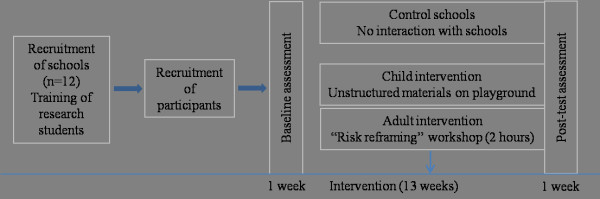
BACKGROUND: In the Westernised world, numerous children are overweight and have problems with bullying and mental health. One of the underlying causes for all three is postulated to be a decrease in outdoor free play. The aim of the Sydney Playground Project is to demonstrate the effectiveness of two simple interventions aimed to increase children's physical activity and social skills. METHODS/DESIGN: This study protocol describes the design of a 3-year cluster randomised controlled trial (CRCT), in which schools are the clusters. The study consists of a 13-week intervention and 1 week each of pre-and post-testing. We are recruiting 12 schools (6 control; 6 intervention), with 18 randomly chosen participants aged 5 to 7 years in each school. The two intervention strategies are: (1) Child-based intervention: Unstructured materials with no obvious play value introduced to the playground; and (2) Adult-based intervention: Risk reframing sessions held with parents and teachers with the aim of exploring the benefits of allowing children to engage in activities with uncertain outcomes. The primary outcome of the study, physical activity as measured by accelerometer counts, is assessed at baseline and post-intervention. Additional assessments include social skills and interactions, self-concept, after school time use and anthropometric data. Qualitative data (i.e., transcriptions of audio recordings from the risk reframing sessions and of interviews with selected teacher and parent volunteers) are analysed to understand their perceptions of risk in play. The control schools have recess as usual. In addition to outcome evaluation, regular process evaluation sessions are held to monitor fidelity to the treatment. DISCUSSION: These simple interventions, which could be adopted in every primary school, have the potential of initiating a self-sustaining cycle of prevention for childhood obesity, bullying and mental ill health. TRIAL REGISTRATION: Australian and New Zealand Clinical Trials Registration Number ACTRN12611000089932.
Overview
The claims and statistics of this paper haven’t been checked yet.
Run the check — free, no account needed. It reads the open-access text and checks the sources it cites.
Integrity signals
Registry
Cites
Statistics
Figures
Verification
Claims the paper makes
The claims and statistics of this paper haven’t been checked yet.
Run the check — free, no account needed. It reads the open-access text and checks the sources it cites.
Claims other papers make about this one
Each is checked against this paper’s own text: does it say what the citing paper says it does?
The source backs part of the claim, not all of it — or backs it for a different population, condition or comparison.
In the citing paper
“The results have shown that recess can be a healthy outlet for children”
From The LiiNK Project®: Effects of Multiple Recesses and Character Curriculum on Classroom Behaviors and Listening Skills in Grades K–2 Children (2018) · cites this paper as Bundy et al., 2011
Experimental — accuracy not yet measuredThe cited source says what the claim attributes to it.
In the citing paper
“it can increase physical activity on the playground”
From The LiiNK Project®: Effects of Multiple Recesses and Character Curriculum on Classroom Behaviors and Listening Skills in Grades K–2 Children (2018) · cites this paper as Bundy et al., 2011
Self-check
Percentages, sums and reported differences re-computed from the paper’s own numbers.
The self-check needs the paper’s full text.
Citations
Cites
On Happiness and Human Potentials: A Review of Research on Hedonic and Eudaimonic Well-Being
Ryan, R. M., & Deci, E. L. (2001) · Annual Review of Psychology · doi:10.1146/annurev.psych.52.1.141 · Cited by 11,567
The Disease Burden Associated With Overweight and Obesity
Must, A. (1999) · JAMA · doi:10.1001/jama.282.16.1523 · Cited by 4,827
Physical Activity, All-Cause Mortality, and Longevity of College Alumni
Paffenbarger, R. S., Hyde, R., Wing, A. L., & Hsieh, C.-C. (1986) · New England Journal of Medicine · doi:10.1056/nejm198603063141003 · Cited by 2,742
Calibration of two objective measures of physical activity for children
Evenson, K. R., Catellier, D. J., Gill, K., Ondrak, K. S., & McMurray, R. G. (2008) · Journal of Sports Sciences · doi:10.1080/02640410802334196 · Cited by 2,677
Spear, B. A., Winick, M., Phillips, C., & Wilfley, D. E. (1975) · Cited by 2,495
Studer, M., Asher, S. R., & Coie, J. D. (1991) · Contemporary Sociology A Journal of Reviews · doi:10.2307/2071877 · Cited by 2,267
Education and Treatment of Children
Hickman, J. A., & Wheatley, J. K. (2008) · Wiley eBooks · doi:10.1002/9780470373699.speced0741 · Cited by 1,938
Early life risk factors for obesity in childhood: cohort study
Reilly, J. J., Armstrong, J., Dorosty, A. R., Emmett, P. M., Ness, A., Rogers, I., Steer, C., & Sherriff, A. (2005) · BMJ · doi:10.1136/bmj.38470.670903.e0 · Cited by 1,675
‘Discovering’ chronic illness: Using grounded theory
Charmaz, K. (1990) · Social Science & Medicine · doi:10.1016/0277-9536(90)90256-r · Cited by 1,648
Andersen, L. B., Harro, M., Sardinha, L. B., Froberg, K., Ekelund, U., Brage, S., & Anderssen, S. A. (2006) · The Lancet · doi:10.1016/s0140-6736(06)69075-2 · Cited by 1,518
Research works printed but not linked: 8
- Ball DJ: Play and risk - In search of new ground. 2010, Fremantle
- Battles J: School ban running over lawsuit fears. The Sunday Times. 2004
- O'Hagan R: No playing in the playground? So what's it actually for?. MailOnline. 2010
- Walsh P: Fixed equipment: a time for change. Australian Journal of Early Childhood. 1993, 18: 23-29.
- Stratton M, Conn L, Liaw C, Conolly L: Sport and Related Recreational Physical Activity - The Social Correlates of Participation and Non-Participation. 2005
- Bundy AC, Luckett T, Naughton GA, Tranter PJ, Wyver SR, Ragen J, Singleton E, Spies G: Playful Interaction: Occupational Therapy for All Children on the School Playground. The American Journal of Occupational Therapy. 2008, 62: 522- · DOI
- Armitage M: Play pods in schools: an independent evaluation. 2010
- Gresham FM, Elliott SN: Manual for The Social Skills Ratings System. 1990, Circle Pines, MN
Cited by
Sorted by citations
Items 101–105 of 105
Everyday Learning Looks Like This: Classroom Ethnographies in Three Global Cities
Lee, I., Leung, W. M. V., Lim, K. M., Soo, L. M. J., Karthikeyan, N., Bartholomaeus, C., & Yelland, N. (2023) · Global childhoods in the Asia-Pacific · doi:10.1007/978-981-99-0486-0_5
Banstola, R. S., Poudel, U. K., Aryal, K. P., Banstola, I., Bhandari, S., & Înoue, S. (2025) · medRxiv · doi:10.1101/2025.10.19.25338329
Physical Activity Applied to Learning and Psycho-social Variables in Young People
(2025) · Frontiers research topics · doi:10.3389/978-2-8325-7140-8
Schüller, I., & Mess, F. (2026) · Current Psychology · doi:10.1007/s12144-026-09875-z
Metadata
- Authors
- Bundy, A. C., Naughton, G., Tranter, P., Wyver, S., Baur, L., Schiller, W., Bauman, A., Engelen, L., Ragen, J., Luckett, T., Niehues, A., Stewart, G., Jessup, G., & Brentnall, J.
- Affiliations
- The University of Sydney (AU)
- Australian Catholic University (AU)
- UNSW Canberra (AU)
- Macquarie University (AU)
- University of South Australia (AU)
- Corresponding author
- Bundy, Anita C
- ORCID
- Venue
- BMC Public Health
- Published
- 2011-09-01
- Volume
- 11
- Issue
- 1
- Pages
- 680-680
- ISSN
- 1471-2458 (ISSN-L)
- PMC
- PMC3188492
- OpenAlex
- W2161869905
- Cited by
- 105
- References
- 66
- Citations by year
- 2026: 2 · 2025: 6 · 2024: 5 · 2023: 7 · 2022: 6 · 2021: 5 · 2020: 10 · 2019: 6 · 2018: 15 · 2017: 15 · 2016: 3 · 2015: 12 · 2014: 4 · 2013: 5 · 2012: 4
- FWCI
- 2.84
- Type
- journal article
- Language
- en
- Open access
- gold
- doi.org
- Licence
- Locations
- BMC Public Health (publishedVersion, cc-by)
- Europe PMC (PubMed Central) (publishedVersion, cc-by)
- PubMed Central (publishedVersion, cc-by)
- PubMed (publishedVersion)
- Research Bank (Australian Catholic University) (submittedVersion)
- Research Online (University of Wollongong) (submittedVersion)
- Adelaide Research & Scholarship (AR&S) (University of Adelaide) (submittedVersion, cc-by)
- DOAJ (DOAJ: Directory of Open Access Journals) (submittedVersion)
- Figshare (submittedVersion, cc-by)
- UTS ePRESS (University of Technology Sydney) (submittedVersion)
- OPUS - Open Publications of UTS Scholars (University of Technology Sydney) (submittedVersion)
- Funders
- Medical Research Council
- Australian Research Council (DP0877590)
- National Health and Medical Research Council (570808)
- National Medical Research Council
- Topics
- Health Sciences › Medicine › Public Health, Environmental and Occupational Health › Physical Activity and Health
- Health Sciences › Medicine › Public Health, Environmental and Occupational Health › Obesity, Physical Activity, Diet
- Social Sciences › Education › Child Development and Education
- Keywords
- free play, children's physical activity, social skills, childhood obesity prevention, bullying prevention, child mental health, elementary school students, self-concept
- MeSH terms
- Child, Child, Preschool, Female, Health Promotion, Humans, Male, Mental Health, New South Wales, Play and Playthings, Schools, Socialization, Exercise, Cluster Analysis, Overweight, Bullying
About these checks
Registry, retraction, Cites and statistics results are computed, not judged, with one exception: a printed reference that no index lists is read once by a model before it counts as a citation error. Claims are extracted by a model and kept only when their quote appears verbatim in the text; each cited source is then checked, with a model’s help, for whether it says what the claim relies on. Those verdicts can be wrong — read the claim’s quote and the cited source before relying on one.
Statistics and arithmetic are recomputed, not judged.
Confidence bands are shown only for fields calibrated on our annotated test set. None is calibrated yet, so no band is shown.
What counts as a claim ›How we measure confidence ›How we check this ›
Are you an author, or do you see a problem with this page? Request a review
