

Ideal and actual involvement of community pharmacists in health promotion and prevention: a cross-sectional study in Quebec, Canada
Open accessThe DOI matches its Crossref record; 28 of the 28 references it cites were found in a registry or an index.
Abstract
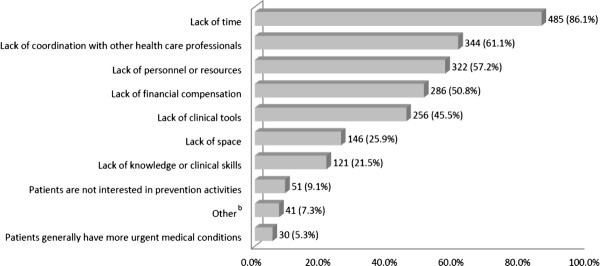
Background: An increased interest is observed in broadening community pharmacists' role in public health. To date, little information has been gathered in Canada on community pharmacists' perceptions of their role in health promotion and prevention; however, such data are essential to the development of public-health programs in community pharmacy. A cross-sectional study was therefore conducted to explore the perceptions of community pharmacists in urban and semi-urban areas regarding their ideal and actual levels of involvement in providing health-promotion and prevention services and the barriers to such involvement. Methods: Using a five-step modified Dillman's tailored design method, a questionnaire with 28 multiple-choice or open-ended questions (11 pages plus a cover letter) was mailed to a random sample of 1,250 pharmacists out of 1,887 community pharmacists practicing in Montreal (Quebec, Canada) and surrounding areas. It included questions on pharmacists' ideal level of involvement in providing health-promotion and preventive services; which services were actually offered in their pharmacy, the employees involved, the frequency, and duration of the services; the barriers to the provision of these services in community pharmacy; their opinion regarding the most appropriate health professionals to provide them; and the characteristics of pharmacists, pharmacies and their clientele. Results: In all, 571 out of 1,234 (46.3%) eligible community pharmacists completed and returned the questionnaire. Most believed they should be very involved in health promotion and prevention, particularly in smoking cessation (84.3%); screening for hypertension (81.8%), diabetes (76.0%) and dyslipidemia (56.9%); and sexual health (61.7% to 89.1%); however, fewer respondents reported actually being very involved in providing such services (5.7% [lifestyle, including smoking cessation], 44.5%, 34.8%, 6.5% and 19.3%, respectively). The main barriers to the provision of these services in current practice were lack of: time (86.1%), coordination with other health care professionals (61.1%), staff or resources (57.2%), financial compensation (50.8%), and clinical tools (45.5%). Conclusions: Although community pharmacists think they should play a significant role in health promotion and prevention, they recognize a wide gap between their ideal and actual levels of involvement. The efficient integration of primary-care pharmacists and pharmacies into public health cannot be envisioned without addressing important organizational barriers.
Overview
The claims and statistics of this paper haven’t been checked yet.
Free: it reads the open-access text and checks the first 5 claims that cite a source we can check. Create a free account to check every claim.
Integrity signals
Registry
Cites
Statistics
Figures
Verification
Claims the paper makes
The claims and statistics of this paper haven’t been checked yet.
Free: it reads the open-access text and checks the first 5 claims that cite a source we can check. Create a free account to check every claim.
Self-check
Percentages, sums and reported differences re-computed from the paper’s own numbers.
The self-check needs the paper’s full text.
Citations
Cites
Mail and internet surveys : the tailored design method
Dillman, D. A. (2007) · Cited by 9,587
Mail and Internet Surveys: The Tailored Design Method
CHISNALL, P. M. (2007) · Journal of Advertising Research · doi:10.2501/s0021849907070237 · Cited by 3,435
Public health in community pharmacy: A systematic review of pharmacist and consumer views
Eades, C. E., Ferguson, J. S., & O'Carroll, R. E. (2011) · BMC Public Health · doi:10.1186/1471-2458-11-582 · Cited by 471
Effect of outpatient pharmacists' non-dispensing roles on patient outcomes and prescribing patterns
Nkansah, N., Mostovetsky, O., Yu, C., Chheng, T., Beney, J., Bond, C. M., & Bero, L. (2010) · Cochrane Database of Systematic Reviews · doi:10.1002/14651858.cd000336.pub2 · Cited by 343 · cited 1×
“A recent Cochrane review confirmed the importance of the pharmacist’s role in therapeutic management and patient counseling [17].”
BackgroundPractice Change in Community Pharmacy: Quantification of Facilitators
Roberts, A. S., Benrimoj, S. I., Chen, T. F., Williams, K. A., & Aslani, P. (2008) · Annals of Pharmacotherapy · doi:10.1345/aph.1k617 · Cited by 195 · cited 1×
“Two studies have identified facilitators of practice change in community pharmacy [27,28].”
BackgroundAnderson, C., Blenkinsopp, A., & Armstrong, M. (2004) · Health Expectations · doi:10.1111/j.1369-7625.2004.00274.x · Cited by 169 · cited 1×
“Evidently, pharmacists and the population at large would welcome greater involvement of community pharmacies in health-promotion and preventive services [21,22].”
BackgroundUnderstanding practice change in community pharmacy: A qualitative study in Australia
Roberts, A. S., Benrimoj, S. I., Chen, T. F., Williams, K. A., Hopp, T. R., & Aslani, P. (2005) · Research in Social and Administrative Pharmacy · doi:10.1016/j.sapharm.2005.09.003 · Cited by 167 · cited 1×
“Two studies have identified facilitators of practice change in community pharmacy [27,28].”
BackgroundA randomized controlled trial of a smoking cessation intervention based in community pharmacies
Maguire, T. A., McElnay, J. C., & Drummond, A. (2001) · Addiction · doi:10.1046/j.1360-0443.2001.96232516.x · Cited by 137 · cited 3×
“Studies from many countries have demonstrated the benefits of pharmacy services on a wide range of important public-health issues [5]: notably in smoking cessation [6,7], diabetes [8,9], hypertension [9,10], dyslipidemia [9], contraception [11], osteoporosis [12-14], and immunization [15,16].”
BackgroundRandomized Trial Assessing the Effectiveness of a Pharmacist-Delivered Program for Smoking Cessation
Dent, L. A., Harris, K. J., & Noonan, C. W. (2009) · Annals of Pharmacotherapy · doi:10.1345/aph.1l556 · Cited by 135 · cited 2×
“Studies from many countries have demonstrated the benefits of pharmacy services on a wide range of important public-health issues [5]: notably in smoking cessation [6,7], diabetes [8,9], hypertension [9,10], dyslipidemia [9], contraception [11], osteoporosis [12-14], and immunization [15,16].”
BackgroundO’Loughlin, J. L., Masson, P., Déry, V., & Fagnan, D. (1999) · Preventive Medicine · doi:10.1006/pmed.1998.0436 · Cited by 113 · cited 5×
“A 1996 cross-sectional mail survey of community pharmacists practicing in the province of Quebec found that, although only few pharmacists reported routinely performing prevention activities, over 90% believed that integrating prevention into their practices was important [1].”
BackgroundInfluential
Cited by
Ibrahim, M. I. M., Palaian, S., Al‐Sulaiti, F. K., & Elshami, S. S. (2016) · Pharmacy Practice · doi:10.18549/pharmpract.2016.04.800 · Cited by 71
“Number of medicines (Median, IQR) 1 (1-2) 1 (1-2) 0.”
Medication use problems among older adults at a primary care: A narrative of literature review
Christopher, C. M., Bhuvan, K. C., Shrestha, S., Blebil, A. Q., Alex, D., Ibrahim, M. I. M., & Ismail, N. (2022) · Aging Medicine · doi:10.1002/agm2.12203 · Cited by 65
Athiyah, U., Setiawan, C. D., Nugraheni, G., Zairina, E., Utami, W., & Hermansyah, A. (2019) · Pharmacy Practice · doi:10.18549/pharmpract.2019.3.1518 · Cited by 66
Morton, K., Pattison, H. M., Langley, C., & Powell, R. (2014) · Research in Social and Administrative Pharmacy · doi:10.1016/j.sapharm.2014.04.006 · Cited by 48
Erku, D., & Mersha, A. G. (2017) · PLoS ONE · doi:10.1371/journal.pone.0180943 · Cited by 48
Metadata
- Authors
- Laliberté, M.-C., Perreault, S., Damestoy, N., & Lalonde, L.
- Affiliations
- Université de Montréal (CA)
- Centre Integre de Sante et de Services Sociaux de Laval (CA)
- Corresponding author
- Lalonde, Lyne
- Venue
- BMC Public Health
- Published
- 2012-03-15
- Volume
- 12
- Issue
- 1
- Pages
- 192-192
- ISSN
- 1471-2458 (ISSN-L)
- PMC
- PMC3342160
- OpenAlex
- W2063001045
- Cited by
- 155
- References
- 28
- Citations by year
- 2026: 7 · 2025: 3 · 2024: 11 · 2023: 17 · 2022: 16 · 2021: 11 · 2020: 12 · 2019: 11 · 2018: 14 · 2017: 16 · 2016: 11 · 2015: 11 · 2014: 6 · 2013: 7 · 2012: 2
- FWCI
- 9.40
- Type
- journal article
- Language
- en
- Open access
- gold
- doi.org
- Licence
- Locations
- BMC Public Health (publishedVersion, cc-by)
- PubMed Central (publishedVersion, cc-by)
- PubMed (publishedVersion)
- DOAJ (DOAJ: Directory of Open Access Journals) (submittedVersion, cc-by-sa)
- Funders
- Osteoporosis Canada
- Canadian Institutes of Health Research
- Topics
- Health Sciences › Health Professions › Pharmacy › Pharmacy and Medical Practices
- Health Sciences › Medicine › Geriatrics and Gerontology › Pharmaceutical Practices and Patient Outcomes
- Health Sciences › Medicine › Public Health, Environmental and Occupational Health › Health Promotion and Cardiovascular Prevention
- Keywords
- community pharmacists, health promotion, disease prevention, pharmacist perceptions, smoking cessation, hypertension screening, diabetes screening, dyslipidemia screening, sexual health, barriers to service delivery, primary care pharmacy, interprofessional coordination, Quebec, Montreal, clinical tools
- MeSH terms
- Workforce, Adolescent, Adult, Aged, Community Pharmacy Services, Cross-Sectional Studies, Female, Health Promotion, Humans, Health Knowledge, Attitudes, Practice, Male, Middle Aged, Partnership Practice, Pharmacists, Preventive Health Services, Private Practice, Professional Competence, Quebec, Surveys and Questionnaires, Socioeconomic Factors, Suburban Population, Urban Population
About these checks
Registry, retraction, Cites and statistics results are computed, not judged, with one exception: a printed reference that no index lists is read once by a model before it counts as a citation error. Claims are extracted by a model and kept only when their quote appears verbatim in the text; each cited source is then checked, with a model’s help, for whether it says what the claim relies on. Those verdicts can be wrong — read the claim’s quote and the cited source before relying on one.
Statistics and arithmetic are recomputed, not judged.
Confidence bands are shown only for fields calibrated on our annotated test set. None is calibrated yet, so no band is shown.
What counts as a claim ›How we measure confidence ›How we check this ›
Are you an author, or do you see a problem with this page? Request a review
How to cite
Cite CoChat for the checks on this page, and the paper for its own findings.
- This page
- CoChat. (2026). Citation check: Ideal and actual involvement of community pharmacists in health promotion and prevention: a cross-sectional study in Quebec, Canada. https://app.cochat.ai/papers/10.1186/1471-2458-12-192
- The paper
- Laliberté, M.-C., Perreault, S., Damestoy, N., & Lalonde, L. (2012). Ideal and actual involvement of community pharmacists in health promotion and prevention: a cross-sectional study in Quebec, Canada. BMC Public Health. https://doi.org/10.1186/1471-2458-12-192
Data sources
Bibliographic data: Semantic Scholar, OpenAlex, Crossref.
Contains information from the Semantic Scholar Academic Graph Datasets, made available under the ODC Attribution License (ODC-BY 1.0).
Semantic Scholar’s data is described in: Kinney, R., et al. (2023). The Semantic Scholar Open Data Platform. arXiv:2301.10140.
