

The DOI matches its Crossref record; 61 of the 62 references it cites were found in a registry or an index.
Football Fans in Training: the development and optimization of an intervention delivered through professional sports clubs to help men lose weight, become more active and adopt healthier eating habits
Open accessAbstract
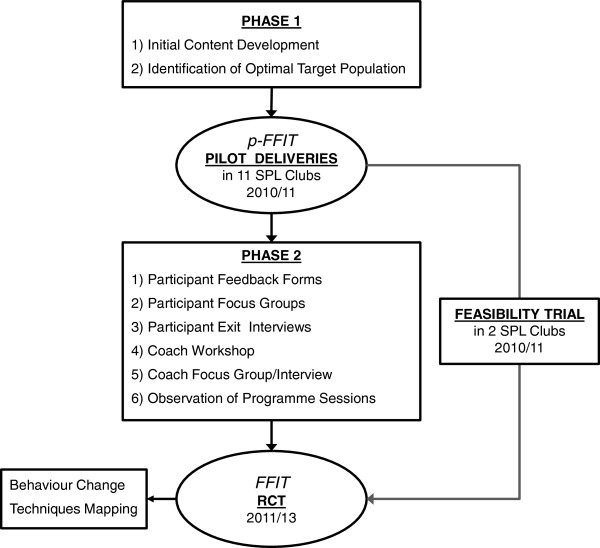
BACKGROUND: The prevalence of obesity in men is rising, but they are less likely than women to engage in existing weight management programmes. The potential of professional sports club settings to engage men in health promotion activities is being increasingly recognised. This paper describes the development and optimization of the Football Fans in Training (FFIT) programme, which aims to help overweight men (many of them football supporters) lose weight through becoming more active and adopting healthier eating habits. METHODS: The MRC Framework for the design and evaluation of complex interventions was used to guide programme development in two phases. In Phase 1, a multidisciplinary working group developed the pilot programme (p-FFIT) and used a scoping review to summarize previous research and identify the target population. Phase 2 involved a process evaluation of p-FFIT in 11 Scottish Premier League (SPL) clubs. Participant and coach feedback, focus group discussions and interviews explored the utility/acceptability of programme components and suggestions for changes. Programme session observations identified examples of good practice and problems/issues with delivery. Together, these findings informed redevelopment of the optimized programme (FFIT), whose components were mapped onto specific behaviour change techniques using an evidence-based taxonomy. RESULTS: p-FFIT comprised 12, weekly, gender-sensitised, group-based weight management classroom and 'pitch-side' physical activity sessions. These in-stadia sessions were complemented by an incremental, pedometer-based walking programme. p-FFIT was targeted at men aged 35-65 years with body mass index ≥ 27 kg/m(2). Phase 2 demonstrated that participants in p-FFIT were enthusiastic about both the classroom and physical activity components, and valued the camaraderie and peer-support offered by the programme. Coaches appreciated the simplicity of the key healthy eating and physical activity messages. Suggestions for improvements that were incorporated into the optimized FFIT programme included: more varied in-stadia physical activity with football-related components; post-programme weight management support (emails and a reunion session); and additional training for coaches in SMART goal setting and the pedometer-based walking programme. CONCLUSIONS: The Football Fans in Training programme is highly acceptable to participants and SPL coaches, and is appropriate for evaluation in a randomised controlled trial.
Overview
The claims and statistics of this paper haven’t been checked yet.
Run the check — free, no account needed. It reads the open-access text and checks the sources it cites.
Integrity signals
Registry
Cites
Statistics
Figures
Verification
Claims the paper makes
The claims and statistics of this paper haven’t been checked yet.
Run the check — free, no account needed. It reads the open-access text and checks the sources it cites.
Claims other papers make about this one
Each is checked against this paper’s own text: does it say what the citing paper says it does?
The cited source says what the claim attributes to it.
In the citing paper
“In particular, 17 of the 27 studies included in this review used the MRC 2000 framework, the updated 2008 version or a combination of the two [24–40].”
From Optimisation of complex health interventions prior to a randomised controlled trial: a scoping review of strategies used (2016) · cites this paper as [27]
In the citing paper
“Fourteen studies explored the acceptability and/or feasibility of the intervention to different stakeholders, including providers, recipients or policy makers and service commissioners [27, 29–32, 34, 36, 37, 39, 40, 42, 43, 47, 48].”
From Optimisation of complex health interventions prior to a randomised controlled trial: a scoping review of strategies used (2016) · cites this paper as [27]
In the citing paper
“The interventions reported across the review varied widely and included a few targeting behavioural change at the individual patient level, such as weight reduction [27] and smoking cessation programs [10, 44, 49], or at the level of healthcare professionals, such as interventions targeting general practitioners to reduce inappropriate prescribing behaviours [26, 45, 46, 48].”
From Optimisation of complex health interventions prior to a randomised controlled trial: a scoping review of strategies used (2016) · cites this paper as [27]
In the citing paper
“The majority of studies (n = 16) subsequently refined the intervention to then test the optimised version of the intervention within pilot studies or full-scale RCTs [24–32, 34, 38–40, 43, 47, 48].”
From Optimisation of complex health interventions prior to a randomised controlled trial: a scoping review of strategies used (2016) · cites this paper as [27]
In the citing paper
“Several studies used mixed methods, combining qualitative strategies to explore stakeholders’ perspectives and quantitative analysis to estimate the intervention effect [24, 27, 28, 33, 35–37, 40, 42].”
From Optimisation of complex health interventions prior to a randomised controlled trial: a scoping review of strategies used (2016) · cites this paper as [27]
In the citing paper
“However, other studies suggested that the process of identifying stakeholders and the potential lack of representativeness of the stakeholders involved were a limitation for optimisation studies [27, 37].”
From Optimisation of complex health interventions prior to a randomised controlled trial: a scoping review of strategies used (2016) · cites this paper as [27]
Self-check
Percentages, sums and reported differences re-computed from the paper’s own numbers.
The self-check needs the paper’s full text.
Citations
Cites
Scoping studies: towards a methodological framework
Arksey, H., & O'Malley, L. (2005) · International Journal of Social Research Methodology · doi:10.1080/1364557032000119616 · Cited by 36,742
Developing and evaluating complex interventions: the new Medical Research Council guidance
Craig, P., Dieppe, P., Macintyre, S., Michie, S., Nazareth, I., & Petticrew, M. (2008) · BMJ · doi:10.1136/bmj.a1655 · Cited by 10,995
Social cognitive theory of self-regulation
Bandura, A. (1991) · Organizational Behavior and Human Decision Processes · doi:10.1016/0749-5978(91)90022-l · Cited by 6,875
Renehan, A. G., Tyson, M., Egger, M., Heller, R. F., & Zwahlen, M. (2008) · The Lancet · doi:10.1016/s0140-6736(08)60269-x · Cited by 5,219
The Adult Learner: The Definitive Classic in Adult Education and Human Resource Development
Knowles, M. S., Holton, E. F., Robinson, P. A., & Caraccioli, C. (2005) · Civil War Book Review · Cited by 2,860
Carver, C. S., & Scheier, M. F. (1982) · Psychological Bulletin · doi:10.1037//0033-2909.92.1.111 · Cited by 2,650
(2004) · Choice Reviews Online · doi:10.5860/choice.42-2286 · Cited by 2,569
Effective techniques in healthy eating and physical activity interventions: A meta-regression.
Michie, S., Abraham, C., Whittington, C., McAteer, J., & Gupta, S. (2009) · Health Psychology · doi:10.1037/a0016136 · Cited by 2,229
Revision of the Physical Activity Readiness Questionnaire (PAR-Q).
Thomas, S. G., Reading, J., & Shephard, R. J. (1992) · PubMed · Cited by 1,952
Gender differences in food choice: The contribution of health beliefs and dieting
Wardle, J., Haase, A. M., Steptoe, A., Nillapun, M., Jonwutiwes, K., & Bellisie, F. (2004) · Annals of Behavioral Medicine · doi:10.1207/s15324796abm2702_5 · Cited by 1,358
Research works printed but not linked: 9
- Government Office for Science: Foresight tackling obesities: future choices - project report 2nd edition. 2007, London: Department of Innovation Universities and Skills
- Cancer Research UK: Obesity and diet. 2005, Cancer Research UK, http://info.cancerresearchuk.org/publicpolicy/ourpolicypositions/prevention/obesity/index.htm ,
- Government S: Scottish Health Survey 2010. 2011, Scottish Government: Edinburgh
- Daniel K: Brilliantly tackled. Community Pract. 2000, 73: 708-709.
- Witty K, White A: Tackling men’s health: implementation of a male health service in a rugby stadium setting. Community Pract. 2011, 84: 29-32.
- Scottish Premier League: SPL Trust. 2011, Scottish Premier League, http://www.scotprem.com/content/default.asp?page=home_Social%20Responsibility ,
- Cancer Research UK: UK, Weight Concern. Ten Top Tips: weight loss tips based on scientific evidence. 2010, Cancer Research UK, http://info.cancerresearchuk.org/healthyliving/obesityandweight/tentoptips/ ,
- Scottish Government: Active Nation: a Games legacy for Scotland. 2012, Scottish Government, http://www.ouractivenation.co.uk ,
- Abraham C: WIDER Recommendations to Improve Reporting of the Content of Behaviour Change Interventions. Abraham et al. 2009, http://interventiondesign.co.uk/wp-content/uploads/2009/02/wider-recommendations.pdf ,
Cited by
Sorted by citations
Items 101–154 of 154
Wyke, S., Gray, C. M., Anderson, A. S., Brady, A. J. B., Bunn, C., Donnan, P. T., Fenwick, E. A. L., Grieve, E., Lieshman, J., Miller, E., et al. (2014) · Cited by 6
Self-citationLangford, R. M., Brockman, R., Banks, J., Jago, R., Gillison, F., Coulman, K. D., Moore, T. H., & Nobles, J. (2024) · BMC Public Health · doi:10.1186/s12889-024-18031-w · Cited by 6
Embodied masculinities and bodywork within two British prison gyms
Maycock, M. W. (2022) · NORMA · doi:10.1080/18902138.2022.2037970 · Cited by 6
van Nassau, F., Huis, A. M. P., van de Glind, I., Andersen, E., Bunn, C., Gray, C. M., Hunt, K., Jelsma, J. G. M., van Mechelen, W., Morgan, H. M., et al. (2023) · Translational Behavioral Medicine · doi:10.1093/tbm/ibac100 · Cited by 6
Self-citationMaximising and evaluating the uptake, use and impact of golf and health studies
Murray, A. D., Kelly, P., Morton, S., Glover, D., Duncan, J., Hawkes, R. A., Grant, L., & Mutrie, N. (2019) · British Journal of Sports Medicine · doi:10.1136/bjsports-2019-100994 · Cited by 6
Self-citationGarnham-Lee, K. P., Trigwell, J., McGee, C. E., Knowles, Z. R., & Foweather, L. (2016) · Journal of Child & Adolescent Substance Abuse · doi:10.1080/1067828x.2016.1175982 · Cited by 6
Healthy and unhealthy eating after a behaviour change intervention in primary care
Samdal, G. B., Furset, O. J., Nysæther, M. B., Abildsnes, E., Mildestvedt, T., & Meland, E. (2022) · Primary Health Care Research & Development · doi:10.1017/s1463423622000147 · Cited by 5
Petrella, R. J., Gill, D. P., Kfrerer, M., Riggin, B., Majoni, M., Blunt, W. M., Bliss, B., Silva, N. C. B. S., Aspinall, P., Adekoya, P., et al. (2023) · Contemporary Clinical Trials · doi:10.1016/j.cct.2023.107178 · Cited by 5
Røynesdal, Ø. B., Roberts, G. C., Pereira, H. V., Jelsma, J. G. M., Wyke, S., Andersen, E., Gray, C. M., Hunt, K., Silva, M. N., van Nassau, F., et al. (2024) · Psychology of sport and exercise · doi:10.1016/j.psychsport.2024.102742 · Cited by 7
Self-citationFlipping the on switch: Men who became regularly physically active during middle age
Chatfield, S., & Hallam, J. S. (2015) · International Journal of Sport and Exercise Psychology · doi:10.1080/1612197x.2015.1036097 · Cited by 5
Murray, A. D., Hawkes, R. A., Kelly, P., Grant, L., & Mutrie, N. (2019) · BMJ Open Sport & Exercise Medicine · doi:10.1136/bmjsem-2018-000503 · Cited by 5
Self-citationDonnachie, C., Hunt, K., Mutrie, N., Gill, J. M. R., & Kelly, P. (2020) · Journal for the Measurement of Physical Behaviour · doi:10.1123/jmpb.2019-0018 · Cited by 6
Self-citationPetrella, A. R., Sabiston, C. M., O’Rourke, R. H., Mina, D. S., Hamilton, R. J., & Matthew, A. (2022) · Cancers · doi:10.3390/cancers14112800 · Cited by 5
Budden, T., Dimmock, J. A., Rosenberg, M., Beauchamp, M. R., Fitzpatrick, I., & Jackson, B. (2022) · Journal of Sport and Exercise Psychology · doi:10.1123/jsep.2021-0165 · Cited by 5
Scott, S., Parkinson, K. N., Kaner, E., Robalino, S., Stead, M., Power, C., Fitzgerald, N., Wrieden, W. L., & Adamson, A. (2017) · Systematic Reviews · doi:10.1186/s13643-017-0434-6 · Cited by 5
Men’s Experiences with the Hockey Fans in Training Weight Loss and Healthy Lifestyle Program
Muise, S., Gill, D. P., Cruz, A. D., Riggin, B., Pulford, R. W., Sibbald, S. L., & Petrella, R. J. (2016) · International Journal of Medical Students · doi:10.5195/ijms.2016.158 · Cited by 5
Older Mens’ Experiences with and Preferences for Physical Activity
Windt, S., Sims‐Gould, J., Mackey, D. C., & McKay, H. A. (2023) · Canadian Journal on Aging / La Revue canadienne du vieillissement · doi:10.1017/s0714980823000211 · Cited by 8
Maycock, M. W., MacLean, A., Gray, C. M., & Hunt, K. (2020) · Springer eBooks · doi:10.1007/978-3-030-46401-1_13 · Cited by 4
Self-citationOri, E. M., Berry, T. R., McCormack, G. R., Brett, K. R., Lambros, G. A., & Ghali, W. A. (2020) · Frontiers in Public Health · doi:10.3389/fpubh.2020.553434 · Cited by 4
Barriers and Enablers to Weight Management Programmes for Working Men: A Qualitative Study
Broughton, M., Lymn, J., & Redsell, S. A. (2023) · Health & Social Care in the Community · doi:10.1155/2023/7854774 · Cited by 3
Brooke, J., Allsop, F., Richards, L., & Ojo, O. (2025) · Journal of correctional health care · doi:10.1089/jchc.24.08.0062 · Cited by 2
Delivering social and public health programmes through community arms of professional football clubs
Maclean, J., MacLean, A., Gray, C. M., Chambers, S., Donnachie, C., Jago, R., & Hunt, K. (2025) · Health Promotion International · doi:10.1093/heapro/daaf106 · Cited by 3
Self-citationPietsch, B., Hanewinkel, R., & Morgenstern, M. (2022) · Clinical Obesity · doi:10.1111/cob.12540 · Cited by 3
Hunt, K., Wyke, S., Gray, C. M., Bunn, C., & Singh, B. (2015) · Springer eBooks · doi:10.1007/978-1-4614-5996-5_20 · Cited by 3
Self-citationBartram, A., Crabb, S., Hanson‐Easey, S., & Eliott, J. (2018) · Qualitative Health Research · doi:10.1177/1049732318809945 · Cited by 3
Onset of Weight Gain and Health Concerns for Men: Findings from the TAP Programme
Cortnage, M., & Pringle, A. (2022) · International Journal of Environmental Research and Public Health · doi:10.3390/ijerph19010579 · Cited by 3
Promoting Men’s Health in a Community
Johnson, S., Bodenstein, K., van Vuuren, E. C. J., & Nel, R. (2022) · International Journal of Men s Social and Community Health · doi:10.22374/ijmsch.v5i3.91 · Cited by 1
Der Einfluss von Geschlecht auf Gesundheit, Krankheit und Prävention
Oertelt‐Prigione, S. (2023) · Schriften zu Gesundheit und Gesellschaft - Studies on Health and Society · doi:10.1007/978-3-662-65586-3_7 · Cited by 2
Leijon, M. E., Åsberg, K., Karlsson, N. E., Skagerström, J., Dannapfel, P., & Arvidsson, D. (2019) · Health · doi:10.4236/health.2019.1110110 · Cited by 2
Skagerström, J., Hjertstedt, M., Dannapfel, P., Müssener, U., & Leijon, M. E. (2021) · Frontiers in Sports and Active Living · doi:10.3389/fspor.2021.616427 · Cited by 2
Encouraging physical activity: what works
Baber, M., Leach, S., Musuwo, N., Pham, H., & Rollins, K. B. (2021) · Perspectives in Public Health · doi:10.1177/1757913920974067 · Cited by 2
Haider, S., Lamprecht, T., Dick, D., & Lackinger, C. (2016) · Wiener Medizinische Wochenschrift · doi:10.1007/s10354-016-0438-1 · Cited by 1
Weber, C., Golding, S., Ratcliffe, E., Yarker, J., Lewis, R., & Munir, F. (2020) · Zürcher Hochschule für Angewandte Wissenschaften digital collection (Zurich University of Applied Sciences) · doi:10.21256/zhaw-21030 · Cited by 1
Mete, R., Georgousopoulou, E. N., Mellor, D. D., Khoo, J. J. C., Cheong, M., Leeds, A., Allan, K., Avery, A., Hart, K., Muir, A., et al. (2017) · Wiley eBooks · doi:10.1002/9781118857991.ch4 · Cited by 2
Petrella, A. R. (2020) · TSpace (University of Toronto) · Cited by 1
Walking football initiation and maintenance in older adults: a mixed-methods investigation
Cholerton, R. (2021) · Sheffield Hallam University · doi:10.7190/shu-thesis-00390 · Cited by 1
Copeland, L. (2015) · ORCA Online Research @Cardiff (Cardiff University)
Baker, C. M., Elizabeth, L., Crone, D., Tutton, A., & Aitken, P. (2016) · doi:10.1002/9781394259625.ch23
Scott, R. S. (2017) · Scholarship@Western (Western University)
Blake, H., Burton, E., Chatfield, L., Dixon, D. L., Harcourt, D. M., Herron, D., Hewitt, R. M., Lawes-Wickwar, S., Matvienko‐Sikar, K., Morrisey, E., et al. (2020) · Health Psychology Update · doi:10.53841/bpshpu.2020.29.3.41
Pietsch, B., Manske, M., Hanewinkel, R., Kaduszkiewicz, H., & Morgenstern, M. (2024) · Clinical Obesity · doi:10.1111/cob.12696
An Exploration of Health Inequalities in a Tier 3 Specialist Weight Management ServicePreprint
Sorrell, C., Brough, G., & Savidge, C. (2024) · Research Square · doi:10.21203/rs.3.rs-4992197/v1
Duamor, C. T., Wyke, S., Hampson, K., Cleaveland, S., Mpolya, E. A., Kreppel, K. S., Lugelo, A., Changalucha, J. J., Lushasi, K. S., Czupryna, A., et al. (2025) · SSRN Electronic Journal · doi:10.2139/ssrn.5384595
Self-citationKfrerer, M., Majoni, M., Gill, D. P., Riggin, B., Blunt, W. M., Ashe, M. C., & Petrella, R. J. (2025) · Translational Behavioral Medicine · doi:10.1093/tbm/ibaf075
MacLean, A., Maycock, M., Hunt, K., Mailer, C., Mason, K., & Gray, C. M. (2022) · Figshare · doi:10.6084/m9.figshare.19613858
Self-citationBunn, C., Palmer, V., Chng, N. R., Andersen, E., Gray, C. M., Hunt, K., Jelsma, J. G. M., Morgan, H., der Sanden, M. N.-V., Pereira, H. V., et al. (2024) · Figshare · doi:10.6084/m9.figshare.26576117
Self-citationLangford, R. M., Brockman, R., Banks, J., Jago, R., Gillison, F. B., Coulman, K., Moore, T. H., & Nobles, J. (2024) · Figshare · doi:10.6084/m9.figshare.25397485
Langford, R. M., Brockman, R., Banks, J., Jago, R., Gillison, F. B., Coulman, K., Moore, T. H., & Nobles, J. (2024) · Figshare · doi:10.6084/m9.figshare.25397728
Involving community members in designing behavioural weight management programmes: a scoping review
Moore, T. H., Brockman, R., Perry, R., Nobles, J., Dawson, S., Gillison, F., Savović, J., Jago, R., & Langford, R. M. (2026) · BMC Public Health · doi:10.1186/s12889-026-26210-0
Brazier, J., Murphy, J., Foster, C. E., & Townsend, N. P. (2026) · Sport Education and Society · doi:10.1080/13573322.2026.2621818
Lee, A. S. Y., Rudner, B. A., Rhodes, R. E., & Harper, N. J. (2026) · Healthcare · doi:10.3390/healthcare14070937
McDermott, C., McGrath, A., Finnegan, L., Egan, T., King, E., Sheppard, R., Richardson, N., Harrison, M., Krustrup, P., Daly, S., et al. (2026) · Frontiers in Health Services · doi:10.3389/frhs.2026.1835183
Metadata
- Authors
- Gray, C. M., Hunt, K., Mutrie, N., Anderson, A. S., Leishman, J., Dalgarno, L., & Wyke, S.
- Affiliations
- University of Glasgow (GB)
- MRC/CSO Social and Public Health Sciences Unit (GB)
- University of Edinburgh (GB)
- University of Dundee (GB)
- NHS Forth Valley (GB)
- Corresponding author
- Gray, Cindy M
- Venue
- BMC Public Health
- Published
- 2013-03-16
- Volume
- 13
- Issue
- 1
- Pages
- 232-232
- ISSN
- 1471-2458 (ISSN-L)
- PMC
- PMC3621078
- OpenAlex
- W2134253157
- Cited by
- 154
- References
- 60
- Citations by year
- 2026: 4 · 2025: 5 · 2024: 9 · 2023: 10 · 2022: 13 · 2021: 8 · 2020: 18 · 2019: 14 · 2018: 18 · 2017: 20 · 2016: 11 · 2015: 10 · 2014: 11 · 2013: 3
- FWCI
- 8.10
- Type
- journal article
- Language
- en
- Open access
- gold
- doi.org
- Licence
- Locations
- BMC Public Health (publishedVersion, cc-by)
- Europe PMC (PubMed Central) (publishedVersion, cc-by)
- PubMed Central (publishedVersion, cc-by)
- PubMed (publishedVersion)
- ENLIGHTEN (Jurnal Bimbingan dan Konseling Islam) (acceptedVersion)
- Edinburgh Research Explorer (University of Edinburgh) (submittedVersion, cc-by)
- Radboud Repository (Radboud University) (submittedVersion)
- Radboud Repository (Radboud University) (submittedVersion, other-oa)
- Funders
- National Institute for Health and Care Research (09/3010/06)
- University of Stirling
- Medical Research Council (5TK50)
- Topics
- Health Sciences › Medicine › Public Health, Environmental and Occupational Health › Physical Activity and Health
- Health Sciences › Medicine › Public Health, Environmental and Occupational Health › Obesity, Physical Activity, Diet
- Health Sciences › Medicine › Public Health, Environmental and Occupational Health › Obesity and Health Practices
- Keywords
- football fans, weight loss, physical activity, healthy eating, professional football clubs, complex intervention development, behaviour change techniques, peer support, coach education, SMART goal setting, overweight men
- MeSH terms
- Adult, Aged, Feeding Behavior, Football, Health Promotion, Humans, Male, Middle Aged, Motor Activity, Public Facilities, Program Evaluation, Program Development, Overweight, Weight Reduction Programs
About these checks
Registry, retraction, Cites and statistics results are computed, not judged, with one exception: a printed reference that no index lists is read once by a model before it counts as a citation error. Claims are extracted by a model and kept only when their quote appears verbatim in the text; each cited source is then checked, with a model’s help, for whether it says what the claim relies on. Those verdicts can be wrong — read the claim’s quote and the cited source before relying on one.
Statistics and arithmetic are recomputed, not judged.
Confidence bands are shown only for fields calibrated on our annotated test set. None is calibrated yet, so no band is shown.
What counts as a claim ›How we measure confidence ›How we check this ›
Are you an author, or do you see a problem with this page? Request a review
